The Ultimate Guide to Choosing a Foot Traffic Counter
What if a busy entrance is telling you less than you think? A Foot traffic counter can show how many people enter or pass through a space, but that number alone won’t tell you whether visitors make a purchase, how long they stay, or when more staff are needed. To get useful answers, match the measurement to the decision you need to make.
This guide explains what visitor counts can and can’t measure, how footfall differs from conversion and occupancy, and which site factors to assess before choosing a counter. You’ll learn how to plan for counting technology and analytics, then use traffic patterns to inform staffing, store operations, and venue planning. The aim isn’t to collect data for its own sake. It’s to measure movement in a way that gives your team evidence to act on.
Key Takeaways
- A Foot traffic counter records movement through a defined area. Other business data is needed to assess performance.
- Start with the decision you need to make, then map entrances and visitor flows to see where separate measurements are useful.
- Check that the counting setup and reporting frequency suit your site conditions and the questions you want to answer.
- Use a repeatable cycle: identify a traffic pattern, form a hypothesis, adjust an operation, and review the counts again.
What Does a Foot Traffic Counter Measure?
A Foot traffic counter records people entering or moving through a monitored area. The boundary matters: it might be a shop entrance, a building access point, or a zone inside a venue. As the People counter overview explains, these systems can use different technologies to detect passage. The resulting figure describes movement across the configured boundary, not everything a business might want to know about its visitors.
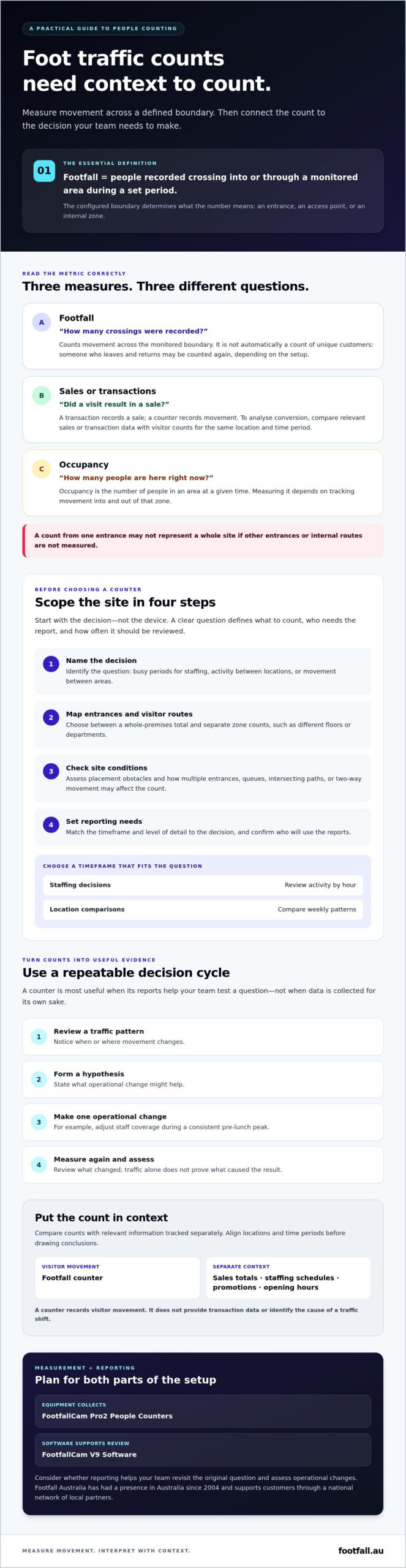
Footfall is the number of people recorded crossing a defined boundary into or through a monitored area during a set period. It isn’t automatically a count of unique customers. Someone who leaves and returns may be counted again, depending on the setup. A visitor count also doesn’t show whether someone bought something or how many people are inside at a particular moment.
Footfall counts versus sales and occupancy metrics
A transaction records a sale; a footfall count records movement. To analyse conversion, compare relevant sales or transaction data with visitor counts for the same location and time period. The counter doesn’t supply sales figures, and comparing mismatched periods can lead to misleading conclusions.
Occupancy is different: it refers to how many people are in an area at a given time. Measuring it depends on tracking movement into and out of that zone. A counter at one entrance won’t necessarily represent a whole site if other entrances or internal routes aren’t measured.
Define the counting direction and monitored zones before interpreting a report. Counting entries at a shop doorway, for example, answers a different question from measuring movement between departments. The count’s meaning depends on the setup, so confirm what is included before using it to guide decisions.
How to Scope a Foot Traffic Counter for Your Site
Start with the decision, not the device. Do you need to identify busy periods for staffing, compare visitor activity between locations, or understand movement between areas? A clear question helps define what to count, who needs the report, and how often they need to review it.
Start with the business question, not the device
Map every entrance and the visitor routes through the site. Decide whether you need a total for the whole premises or separate counts for zones, such as different floors or departments. Consider how people move through each point. Multiple entrances, queues, intersecting paths, and movement in both directions can all affect what a count represents. Then assess the physical setting and identify obstacles or conditions that could affect where a counter can be placed.
Define the decision, map entrances and visitor flows, assess site conditions, then set reporting needs. Choose a timeframe that matches the decision. Reviewing activity by hour may help with staffing, while comparing weekly patterns may help you assess differences between locations. Confirm who will use the reports and what level of detail will help them act. The people counting technology guide explores different system approaches in more depth.
For broader questions about demand, footfall is one signal, not a complete account of customer behaviour. Harvard Business School research on instability in a firm’s customer base provides context for why changes in traffic should be considered alongside other relevant business information. A counter alone can’t identify the cause of a shift.
Once you’ve defined what you need to measure, review how people counting hardware and analytics software could support your reporting needs.
Turn Foot Traffic Counter Data into Better Decisions
A Foot traffic counter becomes useful when its reports help you test a question. Use a repeatable cycle: review a pattern, form a hypothesis, make one operational change, then measure again. For example, if counts show a consistent peak before lunch, you might adjust staff coverage during that period and compare the patterns afterwards. Treat the result as evidence to assess, not proof that traffic alone caused a change.
Put counts in context by comparing them with relevant information you track separately, such as sales totals, staffing schedules, promotions, or opening hours. A counter records visitor movement; it doesn’t provide transaction data. Align time periods and locations before drawing conclusions, and consider other factors that could explain a shift. The footfall data analysis guide explores ways to interpret patterns and develop actionable insights.
Choose a solution that connects measurement with reporting
Plan for both the equipment that collects counts and the software used to review them. Footfall Australia supplies FootfallCam Pro2 People Counters and FootfallCam V9 Software as part of its people counting and analytics offering. Consider whether the reporting will help your team revisit the question behind the measurement and assess the effect of operational changes.
Footfall Australia has had a presence in Australia since 2004 and supports customers through a national network of local partners. Once you’ve defined your site requirements and reporting needs, you can review Footfall Australia’s people counting solutions.
Make Your Next Counting Decision Evidence Led
A useful Foot traffic counter starts with a clear operational question. Define the boundary you need to measure, account for entrances and visitor flows, and decide what reports will help your team act. Counts become more meaningful when you compare them with relevant business information, test changes, and review the pattern again.
The right solution connects people counting hardware with analytics software, so movement data can be collected and interpreted in context. Footfall Australia has been present in Australia since 2004 and supports customers through a national network of local partners.
With your site requirements in hand, explore Footfall Australia’s people counting solutions to discuss a suitable approach for measuring and reviewing visitor movement.
Frequently Asked Questions
What is a foot traffic counter?
A Foot traffic counter is a system that records people entering or moving through a configured area, such as a building entrance or a zone within a venue. The count represents movement across the monitored boundary during a selected period. It doesn’t identify unique customers or record sales, so treat it as a measure of visitor activity rather than a complete picture of business performance.
How does a foot traffic counter work?
A foot traffic counter observes movement through a defined area and records detected passages according to its configuration. The technology and setup determine what the count represents, including whether it records entries, exits, or movement through a particular zone. For meaningful reporting, clarify the monitored boundary and counting direction, especially if people can pass through more than once or use multiple routes.
Can a foot traffic counter measure conversion rate?
No. A counter provides visitor counts, not transaction data, so it can’t calculate conversion rate by itself. To analyse conversion, compare the visitor count with suitable sales or transaction data for the same location and timeframe. For example, matching daily visitor numbers with daily transactions can help you assess the proportion of visits associated with a transaction, while recognising that the figures don’t identify individual customers.
What should I consider before installing a foot traffic counter?
Begin with the business decision the count should support, then map entrances and zones to determine what needs separate measurement. Assess site conditions and visitor flow, and decide what reporting detail and timeframe will be useful. Identify who will interpret the results and how they’ll act on them. Before proceeding, confirm installation and implementation requirements with the supplier for your specific site.