
Upgrade Old Beam Counter Systems: From Infrared Blips to AI Intelligence (2026)
If your footfall data consistently fails to match your actual sales figures, you aren’t alone. Infrared beam sensors still accounted for 36.10% of the market in 2025, yet these legacy systems often struggle with accuracy rates as low as 60%. You’ve likely noticed the limitations firsthand when your counter treats a family of four as four separate visitors or fails to distinguish your staff from your customers. It’s frustrating to base critical business decisions on data that feels like guesswork rather than hard evidence.
The decision to upgrade old beam counter system technology is the first step toward reclaiming your store’s narrative with 99% data accuracy. This guide explains why legacy infrared technology is quietly draining your operational efficiency and how transitioning to AI-powered sensors provides the precision required for true conversion rate calculations. We will explore the technical shift from simple infrared blips to sophisticated spatial analytics and the seamless path offered by the FootfallCam Legacy Swap Out Plan. By the end, you’ll understand how to replace outdated hardware with the Pro2’s intelligence to gain the strategic advantage your business deserves.
Key Takeaways
- Identify the technical flaws of “break-the-beam” sensors, including the occlusion errors that lead to significant data underreporting in high-traffic environments.
- Discover how to upgrade old beam counter system technology to achieve 99% accuracy and implement essential features like automated staff exclusion.
- Evaluate the strategic advantage of spatial analytics, moving beyond raw visitor counts to measure dwell times, heatmaps, and true conversion rates.
- Learn about the FootfallCam Legacy Swap Out Plan, which ensures historical data continuity while transitioning from legacy Irisys or ShopperTrak hardware with zero disruption.
The Limitations of Infrared Beam Counters in Modern Retail
Horizontal infrared sensors operate on a “break-the-beam” principle. When an object passes between the transmitter and receiver, the circuit is interrupted and a count is recorded. While this was standard people counting technology for decades, it’s fundamentally ill-suited for the complex movement patterns of modern retail environments. Humans don’t walk in perfectly spaced, single-file lines. We walk in groups, push strollers, and linger in doorways. Because these sensors are blind to the nature of the object breaking the beam, they struggle to produce a reliable dataset.
Occlusion is the primary technical failure of infrared beam technology, occurring when two or more people walk through an entrance side-by-side and cause the system to record only one visitor. This single flaw can lead to an undercount of 20% to 40% in high-traffic scenarios. Beyond occlusion, these systems often lack bidirectional capabilities. They cannot distinguish between an entry and an exit; they simply count every interruption. This forces management to divide the total by two, a method that assumes a perfect 1:1 ratio that rarely exists in reality.
Environmental factors also compromise data integrity. “Ghosting” occurs when sudden changes in ambient light, such as direct sunlight hitting the sensor or shadows from a passing vehicle, trigger a false count. When you choose to upgrade old beam counter system hardware, you’re moving away from these physical limitations toward a system that actually recognizes the visitor. Modern AI-driven sensors don’t just count interruptions; they identify human shapes and movement vectors with precision.
Why 60% Accuracy is Costing You Money
Operating with low-fidelity data creates a domino effect across your entire business strategy. If your sensors report 60% accuracy, your staffing schedules are likely based on false peaks or missed surges. This leads to overstaffing during quiet periods and poor customer service during unrecorded busy hours. Additionally, your marketing ROI becomes impossible to calculate. If a campaign brings in a family of four but your beam counter only records one person, your conversion rate looks significantly lower than it actually is. Relying on these numbers means you’re making expensive decisions based on a distorted reality.
The Hidden Maintenance Burden of Legacy Hardware
Legacy systems demand constant physical attention. Sensors often drift out of alignment due to door vibrations or accidental bumps, leading to days of missing data before anyone notices. Since these devices lack remote health monitoring, you only discover a fault when you download the weekly report and find a gap. The labor hours spent on battery replacements and manual data consolidation across multiple sites represent a significant hidden cost. When you upgrade old beam counter system units to modern AI sensors, these manual tasks are replaced by automated, cloud-based reporting and real-time system alerts.
Why Upgrading Your People Counter is a Strategic Necessity
Transitioning from basic infrared sensors to AI intelligence shifts your perspective from raw numbers to actionable visitor narratives. While legacy systems provide a flat total of interruptions, modern sensors decode the human behavior behind those figures. You aren’t just seeing how many times a beam was broken; you’re seeing how many genuine sales opportunities entered your space. This clarity allows you to stop guessing and start managing with precision.
Staff exclusion represents one of the most immediate benefits when you upgrade old beam counter system hardware. In a typical retail environment, employee movements can inflate footfall data by 10% to 15%, especially in stores with frequent stock replenishment or front-of-house service. AI-powered sensors, such as the FootfallCam Pro2, use sophisticated algorithms to distinguish between staff and customers. This ensures your conversion metrics aren’t diluted by your own team’s activity, providing a clean dataset that reflects true market demand.
Group counting further refines this accuracy by identifying “buying units.” A family of four entering a store represents a single purchasing decision, yet an old beam counter would record four separate visitors. AI intelligence recognizes these clusters, allowing you to align your footfall data with the reality of consumer behavior. By integrating this high-fidelity data with your existing transaction records through FootfallCam V9 software, you can view your real-time conversion rates with total confidence. If you want to see how these insights look in practice, you can explore our live analytics dashboard.
Unlocking True Conversion Rates
The formula for retail success is simple: Sales Transactions divided by (Total Footfall minus Staff Counts). Without filtering out employees and identifying groups, your conversion rate is artificially suppressed. Precise data helps you identify underperforming store hours where high traffic isn’t translating into sales, often signaling a need for better staff training or improved floor layouts. Implementing a comprehensive retail footfall analysis Australia wide ensures that every marketing dollar is measured against actual visitor increases rather than skewed legacy statistics.
Optimising National Operations
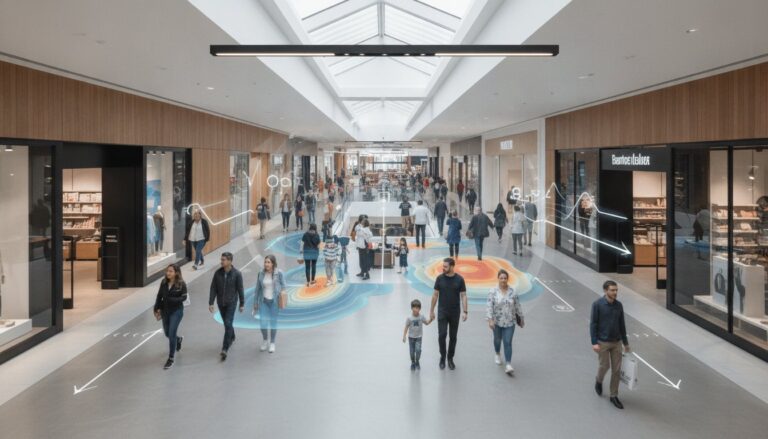
For businesses managing multiple sites, upgrading to a unified AI platform standardises performance metrics across all Australian locations. You can benchmark “Power Hours” across different regions to ensure your highest-performing staff are on the floor when traffic peaks. Spatial analytics also reveal how visitors move through your store, highlighting “dead zones” where product placement might be failing. This level of detail transforms your people counter from a simple utility into a central pillar of your operational strategy. When you upgrade old beam counter system units, you gain the technological eyes needed to see exactly where your business is growing and where it needs adjustment.
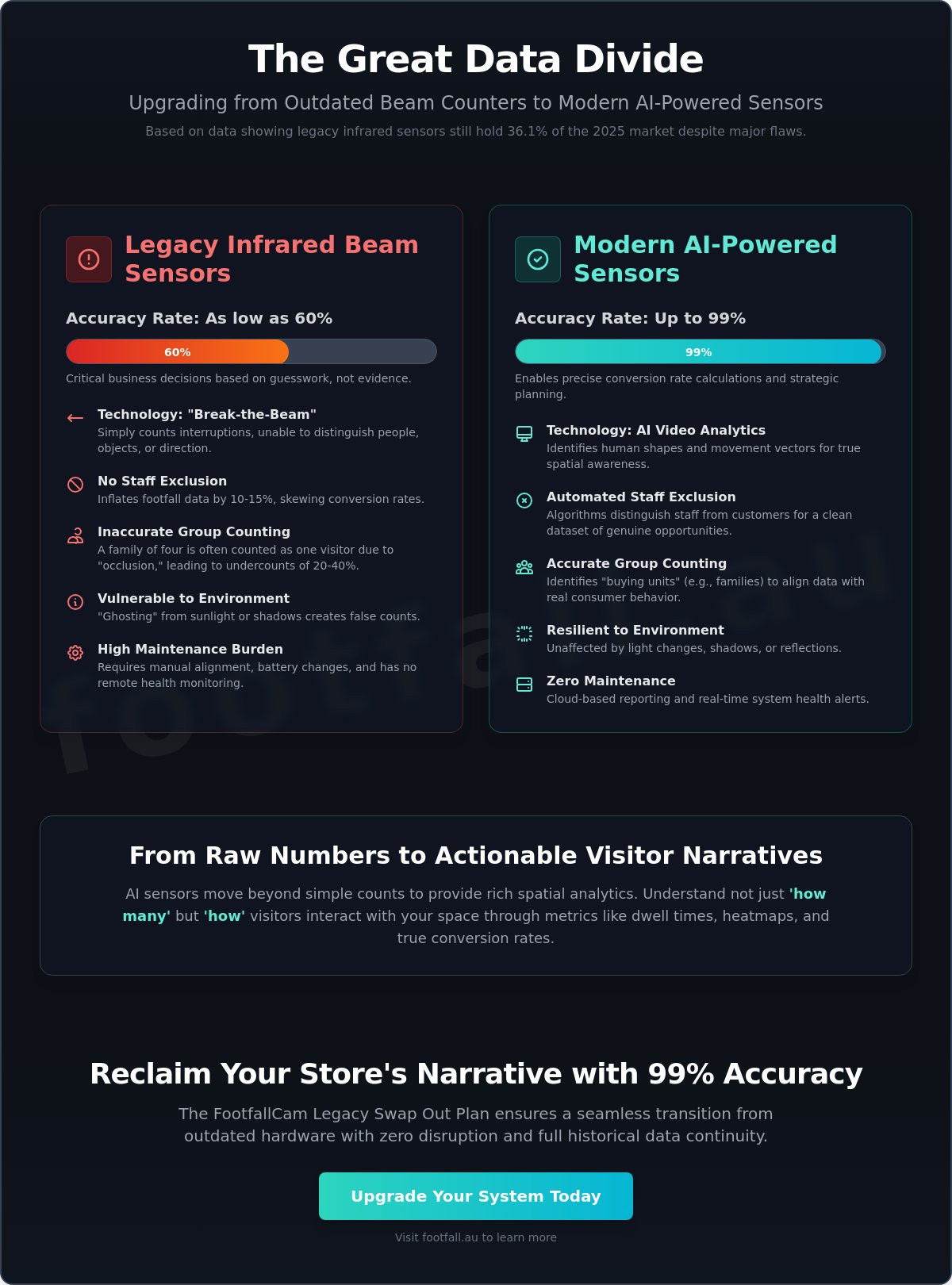
Beam vs. AI Video Counters: A Direct Performance Comparison
Legacy beam counters are limited by their binary nature. They record an event, but they don’t provide context. When you upgrade old beam counter system infrastructure to AI video analytics, you unlock a layer of data granularity that was previously impossible. Instead of a single total count, you receive detailed spatial analytics, including dwell time in specific zones and visual heatmaps of customer flow. This allows you to identify which displays are actually capturing attention rather than just which doors are being opened. Decisions to upgrade old beam counter system units are often driven by this need for deeper insight into the visitor journey.
Connectivity marks another major divide between these technologies. Standalone beam systems usually require manual data retrieval or basic local logging. Modern AI platforms are cloud-integrated by design, feeding real-time data directly into the FootfallCam V9 software. This centralized approach enables remote monitoring and automated reporting across your entire store network. Additionally, the “Set and Forget” nature of ceiling-mounted sensors ensures long-term reliability. Unlike side-mounted beams that are easily bumped or blocked by merchandise, ceiling-mounted AI sensors remain out of reach and maintain a clear, unobstructed view of the floor.
Technical Breakdown: 3D Stereoscopic Vision
The FootfallCam Pro2 utilizes dual lenses to mimic human binocular vision, allowing the device to perceive depth with extreme precision. This depth perception is critical for distinguishing between humans and inanimate objects like shopping trolleys or strollers. The AI can also differentiate between children and adults based on height thresholds, providing a more nuanced view of your customer demographics. By mapping movement in a three-dimensional space, 3D vision eliminates the double counting errors caused by shadows or floor reflections that often plague standard 2D sensors.
Privacy and Data Security in 2026
As privacy regulations tighten, the way data is captured has become as important as the data itself. Modern AI counters are designed with “Privacy by Design” principles, meaning they don’t record or store actual video footage. Instead, the sensor converts movement into anonymous coordinate data immediately. This approach ensures full compliance with the Australian Privacy Act, making it a safe choice for retail environments. Because the device uses edge-processing, all analytical calculations happen on the hardware itself rather than in the cloud. This localized processing adds an extra layer of security, as sensitive visual information never leaves the device; only the resulting statistical data is transmitted.
The Upgrade Path: How to Transition with Zero Disruption
Transitioning from a legacy “break-the-beam” model to an AI-driven environment is less about a total overhaul and more about strategic integration. When you prepare to upgrade old beam counter system hardware, the first step involves a detailed audit of your physical entry points and existing power availability. Unlike side-mounted infrared sensors that sit at waist height, AI sensors require a top-down view from the ceiling. This shift in perspective ensures a clear line of sight, but it also means checking for available network points or Power over Ethernet (PoE) connectivity near your entrances.
Once the physical audit is complete, the FootfallCam V9 software acts as the central intelligence hub. This platform allows you to manage data from various sources in one unified dashboard. A critical part of the migration process is running a “shadow period.” By operating your legacy beam counters alongside the new AI sensors for 14 days, you can directly compare the datasets. This period typically reveals the exact moments where the old system failed, such as during group entries or staff shift changes, providing the evidence needed to calibrate your new baseline of 99% accuracy. To start this process today, you can book a technical consultation with our specialists.
Option A: The FootfallCam Pro2 Hardware Swap
For high-traffic entrances where precision is non-negotiable, a dedicated hardware swap to the FootfallCam Pro2 is the preferred route. These sensors are designed specifically for the rigors of retail and public space monitoring, offering the highest level of detail in spatial analytics. Installation is streamlined through PoE, which carries both power and data over a single cable, resulting in a clean, professional setup without the need for additional electrical work. This dedicated approach ensures that your entry points are equipped with the latest people counting technology, capable of handling complex human movement patterns with ease.
Option B: Leveraging Existing CCTV with Centroid
Many businesses don’t realize they can gain AI intelligence without replacing every camera on-site. The FootfallCam Centroid is a powerful processing unit that connects to your existing IP CCTV network. It applies AI algorithms to the video streams you already have, turning standard security cameras into sophisticated people counting sensors. This is often the most cost-effective path for large-scale national rollouts, as it minimizes hardware costs and installation time. You maintain 99% accuracy across your entire network by utilizing your current infrastructure, effectively transforming your security system into a strategic business intelligence tool.
The Footfall Australia Legacy Swap Out Plan
The Footfall Australia Legacy Swap Out Plan is a specialized framework designed for retailers ready to move beyond the technical limitations of Irisys or ShopperTrak hardware. Many businesses remain tethered to these legacy systems because they fear losing years of historical traffic data. Our migration process addresses this directly by ensuring data continuity within the FootfallCam V9 software environment. We import your existing records so your year-on-year comparisons remain intact while your current accuracy jumps from an unreliable 60-80% to a verified 99%.
Executing an upgrade old beam counter system project across a national network requires more than just shipping hardware. We utilize a dedicated national partner network of certified installers who understand the nuances of Australian retail architecture. These teams handle the physical decommissioning of old sensors and the precise positioning of new AI units. Our specialists manage the technical handshake between the new hardware and your local network, ensuring that data begins flowing into your dashboard immediately after the swap. Accessing our people counter support ecosystem means you aren’t just buying a sensor; you’re securing a long-term strategy for data integrity and operational ROI.
A Tailored Approach for Australian Businesses
Global solutions often overlook the specific physical challenges of the Australian market. Storefronts in Sydney, Melbourne, or Brisbane often feature unique lighting conditions and varied ceiling heights that can interfere with generic sensor calibrations. Our consultants conduct personalized assessments to match specific hardware to your store’s environment. This local expertise, backed by decades of retail analytics experience, provides the quiet confidence that your investment is optimized for your specific footprint rather than a generic global template. We ensure that every sensor is calibrated for the specific floor reflectivity and pedestrian flow patterns of your location.
Next Steps for Your Upgrade
Beginning your transition starts with a comprehensive site audit of your national network. This audit identifies which legacy units are most prone to error and where infrastructure, such as cabling or network points, can be reused to minimize costs. With infrared beam sensors still holding a 36.10% market share in 2025, the move to AI is a significant competitive differentiator. Unlike many competitors who lock you into restrictive monthly fees, we offer a perpetual license model that gives you full ownership of your data and hardware. This transparent approach aligns with our commitment to providing evidence-based tools for modern business management. Contact Footfall Australia to discuss your Legacy Swap Out Plan today.
Transitioning to Data-Driven Precision
Relying on infrared blips in a landscape of complex consumer behavior is a strategic risk. The shift from 60% accuracy to 99% precision isn’t just about better hardware; it’s about gaining the ability to exclude staff and recognize buying groups. These insights transform raw traffic numbers into a clear narrative of the visitor journey. When you decide to upgrade old beam counter system units, you’re choosing to eliminate the guesswork that plagues legacy infrared technology.
Footfall Australia offers over 20 years of local expertise to ensure your migration is seamless. We provide a national support and installation network that handles the technical heavy lifting while maintaining your historical data continuity. Your business deserves decisions backed by hard evidence rather than estimates. Take the first step toward 99% accuracy and true conversion tracking today. Upgrade your legacy system with the Footfall Australia Swap Out Plan. Accurate data is the foundation of growth, and we’re ready to help you build it.
Frequently Asked Questions
Can I keep my old data when I upgrade from a beam counter?
Yes, you can maintain your historical records. When you upgrade old beam counter system hardware, the FootfallCam V9 software facilitates the importation of legacy data from Irisys or ShopperTrak. This ensures your long-term performance benchmarks remain intact. Our technical team handles the migration to ensure a seamless transition from your old database to our unified cloud platform.
How much more accurate is an AI counter compared to my old infrared system?
AI-powered video analytics offer a significant leap in precision. While infrared beam counters typically fluctuate between 60% and 80% accuracy due to sunlight and group walking, AI sensors deliver 97% to 99% accuracy. This level of precision is essential for calculating reliable conversion rates and making evidence-based staffing decisions that legacy hardware simply cannot support.
Is the installation of an AI people counter disruptive to my customers?
Installation is non-intrusive and usually completed within a few hours. Because sensors are ceiling-mounted and utilize Power over Ethernet (PoE), there’s no need for bulky side-mounted equipment or complex electrical work. Most Australian businesses schedule the swap during off-peak hours to ensure zero customer impact. Our national partner network manages the entire physical setup for you.
Do I need to replace my existing CCTV cameras to get AI footfall data?
No, you don’t necessarily need to replace your current hardware. The FootfallCam Centroid can process video streams from your existing IP CCTV network to provide high-accuracy AI analytics. This is a cost-effective path for large-scale rollouts. It turns your standard security cameras into sophisticated tools for measuring dwell time and spatial analytics without a total hardware overhaul.
What is the typical ROI period for upgrading a legacy counting system in Australia?
Return on investment is typically driven by optimized staffing and improved marketing effectiveness. By identifying your true “Power Hours” and removing the 10-15% error rate caused by staff movements, you can align resources with actual visitor demand. Most retailers find that the gains in operational efficiency and conversion clarity justify the upgrade costs within the first year of deployment.
Does the new system require an active internet connection to count people?
The sensor counts people locally on the device using edge processing. An internet connection is only required to transmit the final statistical data to the cloud for reporting. If your network fails, the device stores the data internally and automatically syncs it once the connection is restored. Your data integrity remains safe even during temporary outages.
Can the system distinguish between a customer and a security guard?
Yes, modern AI algorithms are designed specifically for staff exclusion. By analyzing height thresholds, movement vectors, and dwell patterns, the system filters out security guards and retail staff from your visitor totals. This ensures your conversion data isn’t diluted by internal operations, providing a clean dataset that reflects the behavior of genuine potential buyers.