Visitor Counting Solutions for Museums: The 2026 Guide to Data-Driven Curation
How do you prove the ROI of a new exhibit when your visitor data is based on guesswork? For many Australian museum curators, justifying funding applications and optimising gallery flow with outdated manual counters is a constant challenge. The shift towards advanced visitor counting solutions for museums is no longer a future concept but a present-day necessity for strategic management, yet navigating the options-from installation in heritage-listed buildings to ensuring visitor privacy-can be complex.
This definitive 2026 guide provides the clarity you need. We will explore how precise, automated analytics can transform your operational strategy, enabling you to justify funding with irrefutable data, optimise exhibit layouts with detailed engagement heatmaps, and enhance the overall patron experience. It’s time to replace ambiguity with actionable intelligence and unlock the full potential of your institution through data-driven curation.
Key Takeaways
- Move beyond simple headcounts to leverage visitor analytics for securing funding and validating curatorial strategies.
- Discover how to measure true exhibit engagement by analysing visitor dwell time and movement patterns, not just entry numbers.
- Learn how modern visitor counting solutions for museums provide the actionable data needed to optimise exhibit layouts and enhance the patron journey.
- Understand the specialised technology required for accurate data collection in unique cultural spaces, including Australian heritage-listed buildings.
The Strategic Importance of Visitor Counting for Museums in 2026
In the evolving landscape of Australia’s cultural sector, 2026 marks a pivotal year for ‘data-driven curation.’ The era of relying on simple door counts is over. Modern museum analytics now demand a far deeper understanding of visitor behaviour, moving beyond raw numbers to capture crucial engagement metrics like dwell time, visitor flow, and exhibit popularity. The transition from manual clickers to automated, AI-powered patron tracking, enabled by precise people counting technology, is redefining how institutions measure success. High-quality visitor counting solutions for museums provide the intelligence needed to enhance both operational efficiency and the overall visitor experience, turning abstract data into actionable strategy.
Securing Australian Arts Funding with Verified Data
Accurate footfall data is a critical component of financial sustainability. When applying for grants from bodies like the Australia Council for the Arts, verifiable reports on visitor numbers provide the concrete evidence of community reach that decision-makers require. This data-driven approach builds confidence with both public funding bodies and private donors, demonstrating a museum’s cultural impact with quantifiable metrics and proving your institution is a worthy investment for the community.
Moving from Door Counts to Visitor Journey Mapping
A simple entry count only tells you how many people entered; it reveals nothing about their experience. The real strategic advantage lies in understanding the visitor journey. Mapping how patrons move between galleries, how long they dwell at specific exhibits, and which paths they prefer unlocks powerful insights. This spatial intelligence allows you to identify and revitalise underutilised ‘dead zones,’ ensuring every square metre of your valuable floor space contributes to a compelling and engaging visitor narrative.
How Modern Visitor Counting Technology Works in Cultural Spaces
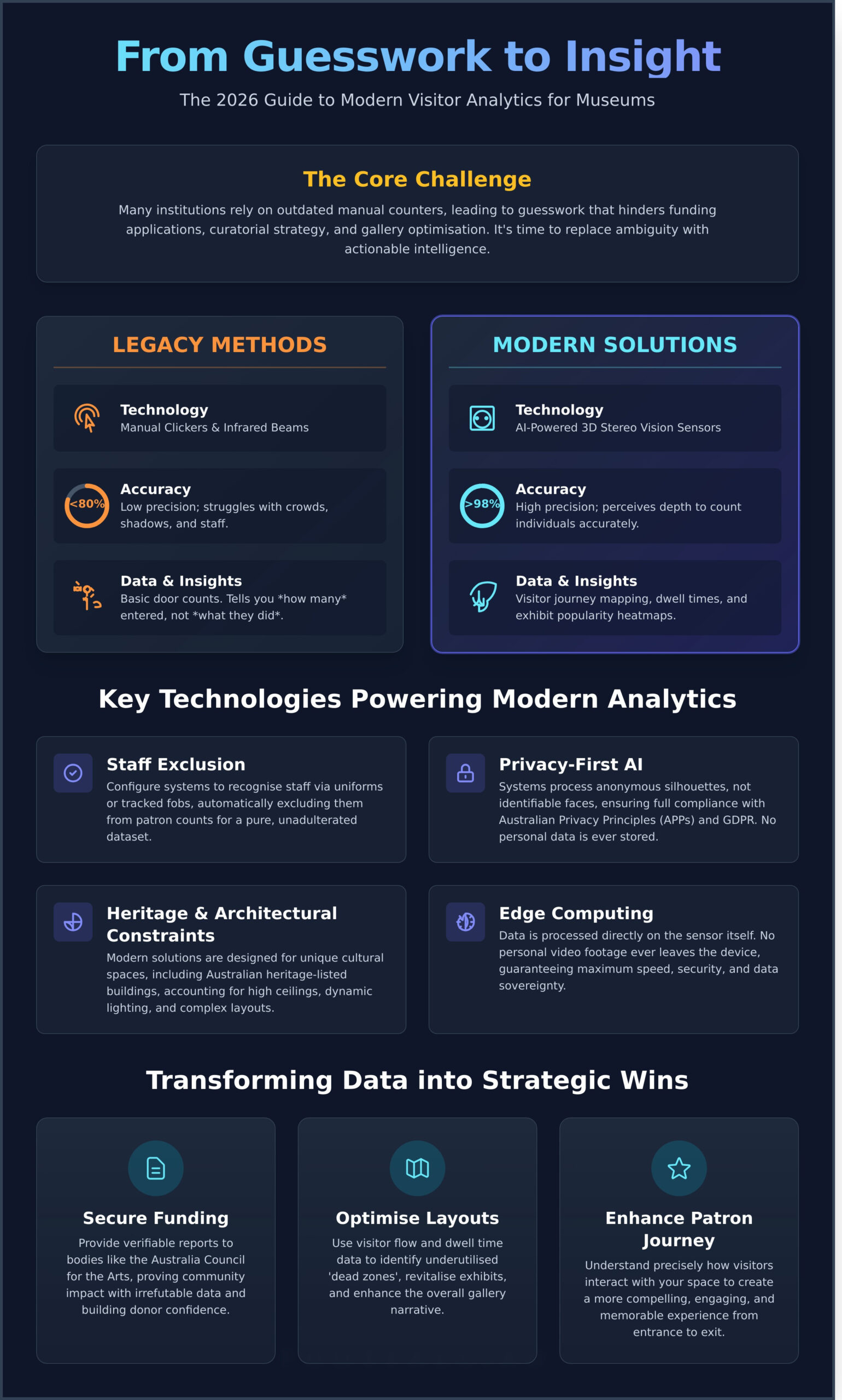
Understanding visitor flow is no longer a matter of guesswork; it’s a strategic imperative for optimising operations and securing funding. While manual clickers and simple infrared beams were once the standard, today’s leading visitor counting solutions for museums leverage sophisticated technology designed for the unique architectural and operational challenges of cultural institutions. The evolution from basic gate counts to precise spatial analytics provides the actionable intelligence needed to transform the visitor experience, a goal reinforced by findings in reports like the Annual Survey of Museum-Goers. This modern approach accounts for high ceilings, dynamic lighting, and complex group behaviours to deliver data you can trust.
Stereo Vision vs. Legacy Sensors
The core difference between legacy and modern systems lies in precision. Older technologies like infrared beams or thermal sensors often struggle with accuracy, falling below 80% and failing to distinguish between people entering together. In contrast, 3D stereo vision sensors deliver over 98% accuracy by using two lenses to perceive depth, just like human eyes. This technology effectively overcomes common issues in busy museum foyers:
- Shadowing: Where one person is obscured by another in a crowd, stereo vision can still accurately distinguish and count each individual.
- Staff Exclusion: Advanced systems can be configured to recognise staff uniforms or tracked fobs, automatically excluding them from patron counts for a pure, unadulterated dataset.
Privacy-First AI and Data Sovereignty
Modern visitor analytics deliver rich insights without compromising personal privacy. High-quality data does not require facial recognition. Instead, these systems employ a privacy-by-design framework. Privacy-First AI is a system that processes silhouettes rather than identifiable faces, converting human shapes into anonymous data points the moment they are captured. This ensures full compliance with the Australian Privacy Principles (APPs) and international standards like GDPR.
Furthermore, the use of edge computing is critical. Data is processed directly on the sensor itself rather than being sent to a central server. This local processing guarantees maximum speed and data security, as no personal video footage ever leaves the device. The result is an ethical, secure, and powerful solution for understanding visitor behaviour.
Interior Analytics: Measuring Exhibit Engagement and Dwell Time
Effective visitor counting solutions for museums provide intelligence far beyond the front door. By deploying sophisticated spatial analytics, you can move from simply counting heads to decoding the entire visitor journey. This data reveals which exhibits are truly capturing attention and which are being overlooked, providing the actionable insights needed for transforming the museum experience. Using heatmaps to visualise these patterns, you can instantly highlight popular zones and identify potential bottlenecks that disrupt visitor flow and diminish engagement.
This granular understanding allows you to correlate exhibit popularity with specific events, such as marketing campaigns or school holiday periods, proving ROI and informing future programming with hard evidence.
Calculating Dwell Time and Attraction Rates
To truly measure engagement, we must look at two key metrics:
- Attraction Rate: This is the percentage of total visitors who enter a specific gallery or interact with a designated exhibit. It tells you what initially draws a crowd.
- Dwell Time: This measures how long visitors stay in that area. It’s the crucial metric that separates a passing glance from genuine engagement, helping curators decide which pieces deserve more prominence or better interpretive materials.
Sudden drop-offs in a high-traffic path can also signal operational issues, such as poor signage or an unintuitive layout, allowing for immediate, data-backed improvements.
Optimising Exhibit Layout for Maximum Impact
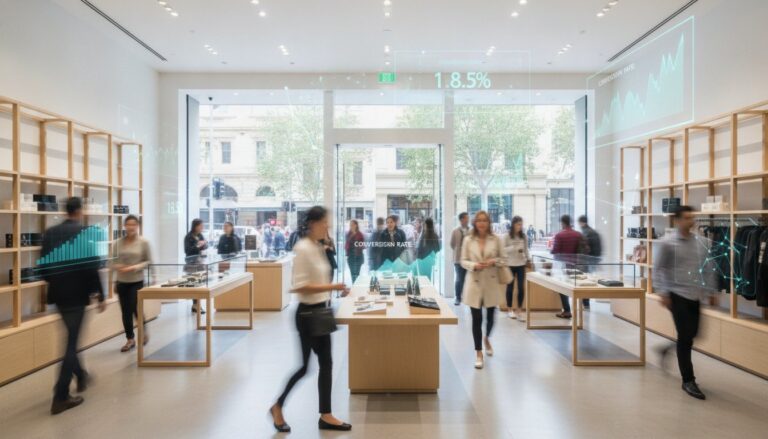
With precise interior analytics, you can replace guesswork with strategy. By A/B testing different exhibit placements, you can measure which configuration drives more traffic and longer dwell times. This data-driven approach ensures your most valuable assets receive the attention they deserve. Furthermore, optimising visitor flow is essential for maximising secondary revenue. Strategically guiding visitors towards gift shops and cafes can significantly impact your institution’s financial health. For example, a prominent Sydney gallery leveraged flow data to reposition a key exhibit, creating a natural pathway to its gift shop. This evidence-based change resulted in a 15% increase in shop footfall, directly boosting revenue.
Implementation: Heritage Constraints and Operational Integration
Deploying advanced technology within a museum requires more than just technical expertise; it demands a strategic approach that respects the institution’s unique character and operational needs. For many Australian museums, particularly those housed in heritage-listed buildings, the implementation of visitor counting solutions presents a distinct set of challenges. The goal is to achieve seamless integration without compromising structural integrity or daily workflows.
Non-Invasive Installation for Historic Sites
Preserving the fabric of a historic building is paramount. Modern visitor counting solutions for museums are designed for minimal physical impact. We utilise wireless sensors and custom-designed mounting brackets that attach to existing fixtures, eliminating the need for drilling into original stonework or timber. Power-over-Ethernet (PoE) technology further reduces invasive cabling, using a single cable for both data and power. By collaborating with specialist Australian installers who are well-versed in local heritage building codes, we ensure every installation is compliant, discreet, and reversible.
Data-Driven Staffing and Facility Management
Once installed, the system’s value is realised through its integration into daily operations. Footfall data provides the actionable intelligence needed to transform facility management from a reactive to a proactive model. This allows you to:
- Optimise Staffing Levels: Predict peak hours with precision to schedule the right number of docents, guides, and security personnel, enhancing the visitor experience and improving security coverage.
- Streamline Maintenance: Link cleaning schedules to actual usage patterns in high-traffic zones and washrooms, ensuring higher standards of hygiene and more efficient use of resources.
- Reduce Energy Costs: Integrate real-time occupancy data with your building management system to automate HVAC and lighting adjustments, lowering utility expenses without impacting visitor comfort.
The final steps involve integrating this footfall data with your existing Museum Management Systems (MMS) and Point of Sale (POS) terminals to create a unified view of your operations. Paired with comprehensive staff training on our intuitive analytics dashboards, your team gains the confidence to make informed, evidence-based decisions every day. A structured maintenance schedule ensures this flow of critical data remains uninterrupted, safeguarding your investment and operational intelligence 24/7. Discover how our tailored implementation process can work for your institution.
Why Footfall Australia is the Trusted Partner for Museums
Choosing the right partner for visitor counting solutions for museums is a critical decision that impacts everything from funding applications to visitor experience design. For over 20 years, Footfall Australia has been the trusted authority in people counting, developing a deep understanding of the unique operational challenges and reporting requirements of Australian cultural and public institutions. We deliver not just technology, but a strategic framework for turning visitor data into actionable intelligence.
The FootfallCam Pro2: Engineered for Museums
Our industry-leading hardware, the FootfallCam Pro2, is specifically engineered to perform with precision in the distinct architectural environments of museums. Its advanced 3D stereo vision technology seamlessly handles high ceilings, ornate archways, and wide, grand entrances, ensuring an accuracy rate of 98% or higher. This hardware is powered by our intuitive V9 Software, which presents complex data in clear, customisable dashboards designed for non-technical staff. For institutions with existing security infrastructure, our FootfallCam Centroid technology can integrate with your CCTV systems, transforming them into intelligent people counters.
Local Expertise and National Support
Working with a local Australian partner means you get more than just a product; you get a team that understands the local market and compliance landscape. With dedicated support teams in Brisbane, Sydney, Melbourne, and beyond, we provide prompt, on-the-ground assistance. Our Premium Support Plan offers proactive system monitoring and regular accuracy audits, guaranteeing the data integrity your stakeholders and funding bodies demand. This commitment to reliability ensures your system delivers continuous value, empowering your team to make evidence-based decisions with confidence.
Unlock the full potential of your visitor data. Contact Footfall Australia for a tailored museum visitor analysis audit and discover how precise footfall intelligence can secure your institution’s future.
From Footprints to Foresight: The Future of Museum Curation
As we look towards 2026, the strategic imperative for museums is clear: data is the new cornerstone of curation and operational excellence. The focus has shifted from simple headcounts to a deep understanding of the entire visitor journey-measuring exhibit engagement, dwell time, and traffic flow to make truly informed decisions. This intelligence is no longer a luxury but a fundamental tool for securing funding and enhancing visitor experiences.
The right visitor counting solutions for museums transform these insights into actionable strategy. Since 2004, Footfall Australia has partnered with Australian institutions to implement this technology with precision and care, offering a 98%+ accuracy guarantee and local support in all major cities. We understand the unique challenges of cultural spaces, from heritage constraints to complex layouts.
Ready to decode the story your visitors are telling? Book a Consultation with Footfall Australia’s Museum Specialists and take the first step towards a data-driven future for your institution.
Frequently Asked Questions
Are visitor counters accurate in museums with very high ceilings?
Yes, modern visitor counters maintain exceptional accuracy even in spaces with high or vaulted ceilings. We utilize advanced 3D sensors, such as Time-of-Flight (ToF) technology, which are specifically designed to perform reliably at mounting heights of up to 10 metres or more. Unlike basic infrared beams, these systems map the environment in three dimensions, ensuring that visitor height and distance from the sensor do not compromise the precision of the count, making them ideal for grand halls and atriums.
How do people counters distinguish between adults, children, and groups?
Our intelligent sensors use advanced algorithms and height detection to differentiate between adults and children with high precision. This allows for more granular demographic insights, such as family group composition. The system can also identify groups moving together by tracking multiple individuals as a single cohesive unit. This data provides actionable insights into how different visitor types engage with your exhibits, enabling you to tailor experiences and programming more effectively.
Can we install sensors in heritage-listed buildings without damaging the interior?
Absolutely. We understand the critical importance of preserving architectural integrity in heritage-listed venues. Our installation process is designed for minimal impact, utilising discreet, wireless sensors that can be mounted with non-damaging adhesives or custom brackets. This approach avoids drilling into or altering sensitive materials like ornate plasterwork, stone, or timber. We work closely with your facilities team to ensure a seamless and respectful installation that meets all heritage conservation requirements.
Do visitor counting systems store identifiable images of our patrons?
No, our systems are engineered with privacy as a core principle. The sensors do not capture or store any personally identifiable information (PII) or facial images. Instead, they convert human movement into anonymous data points, represented as thermal signatures or 3D shapes. This ensures full compliance with the Australian Privacy Act while providing precise footfall analytics. Your patrons’ anonymity is protected at every stage of the data collection and analysis process.
How much does a professional visitor counting solution cost for a small gallery?
For a small gallery, a professional visitor counting solution typically starts from around A$1,500 to A$3,000 for a single entrance. This initial investment generally includes the sensor hardware, essential software access for reporting, and initial setup support. More comprehensive visitor counting solutions for museums, covering multiple zones or offering deeper analytics, will have a different cost structure. We provide tailored quotes based on your specific layout and data requirements to ensure optimal value.
Can footfall data be integrated with our existing ticketing or POS system?
Yes, seamless integration is a core feature of our platform. Using a flexible API (Application Programming Interface), we can connect footfall data directly with your existing ticketing, POS, or CRM systems. This integration creates a holistic view of your operations, allowing you to correlate visitor numbers with ticket sales, donation values, and retail spend. It transforms separate data streams into powerful, actionable intelligence for optimising revenue and operational efficiency.
What is the difference between a standard people counter and a museum engagement sensor?
A standard people counter primarily measures the volume of visitors entering and exiting a space. In contrast, museum engagement sensors provide deeper spatial analytics about the visitor journey *within* the building. These advanced systems track metrics like dwell time at specific exhibits, popular pathways, and bottleneck areas. This intelligence moves beyond simple headcounts to reveal how patrons actually interact with your collection, enabling evidence-based curation and layout improvements.
How can visitor data help us get more government grants?
Government grants and funding bodies increasingly require evidence-based reporting to justify support. Accurate visitor data provides the hard evidence of your community engagement and cultural impact. You can present quantifiable metrics on total attendance, peak visit times, and demographic reach to build a compelling case. This data-driven approach demonstrates responsible management and proves your institution’s value to the community, significantly strengthening your grant applications and accountability reports.