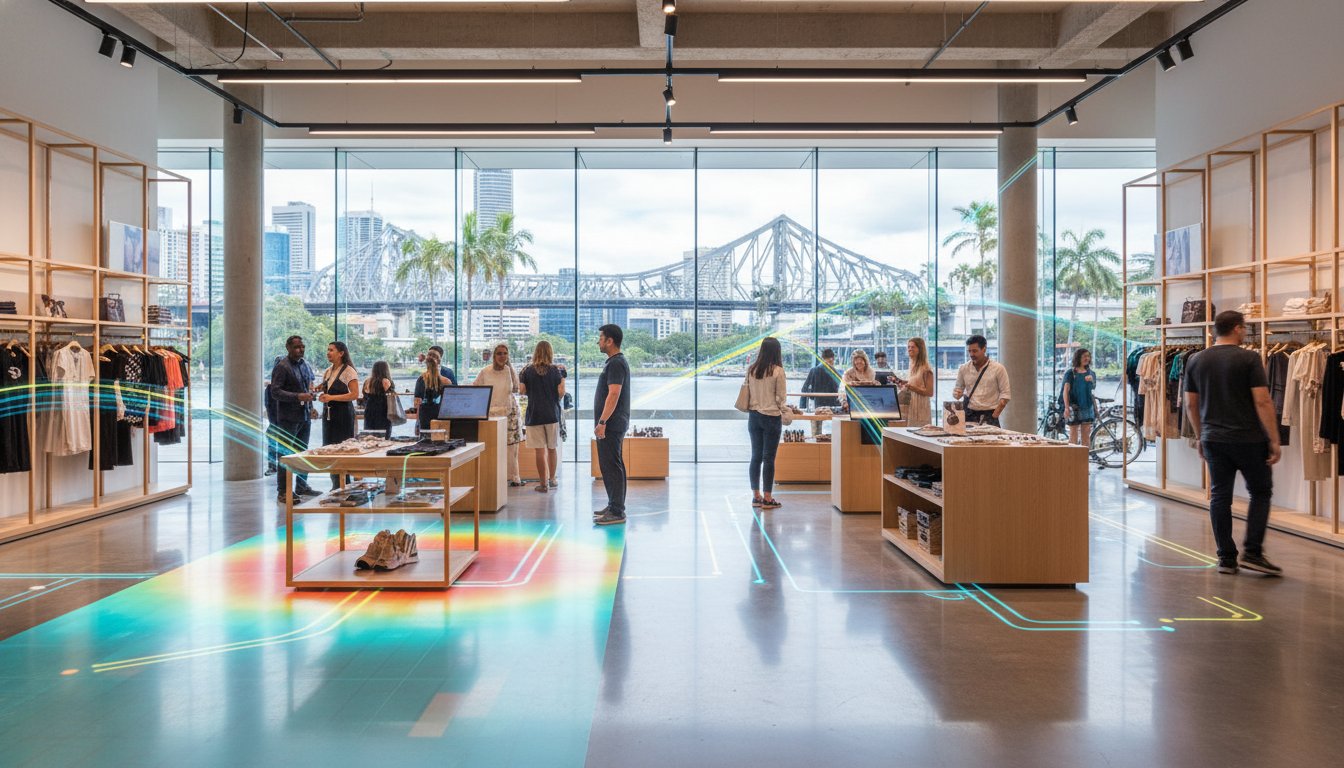
Store Layout Optimisation: The Data-Driven Guide for Australian Retailers (2026)
In a market where every square metre of retail space in Sydney and Melbourne commands a premium, relying on instinct to design your floor plan is a high-stakes gamble. Those underperforming ‘dead zones’ and the nagging uncertainty over whether a recent reshuffle actually improved sales are silent drains on profitability. For too long, measuring the true ROI of physical changes has been more art than science. This guide provides the science.
We will demonstrate how to implement data-driven store layout optimisation to transform your static floor plan into a dynamic, high-conversion sales engine. Prepare to move beyond guesswork. You will learn to use advanced footfall analytics and AI-driven spatial design to understand the complete visitor journey, strategically allocate staff based on real-time traffic flow, and gain measurable proof that every change you make is delivering a positive return. It’s time to make your space work as hard as you do.
Key Takeaways
- Discover how modern store layout optimisation moves beyond simple aesthetics, using AI-driven spatial intelligence to directly influence customer behaviour and sales.
- Learn to interpret AI-powered footfall data to map customer journeys, revealing high-value zones and critical friction points that are invisible to the naked eye.
- Access a 5-step framework for establishing a data baseline and systematically improving your store’s flow for measurable gains in engagement and revenue.
- Uncover why traditional “best practice” layouts can fail in the Australian market and how to use real-world data to validate design choices for maximum ROI.
What is Store Layout Optimisation in the Age of AI?
Store layout optimisation is the strategic arrangement of fixtures, products, and pathways within a physical retail space to guide customer flow and maximise sales. Historically guided by established retail design principles, this practice is undergoing a profound shift. By 2026, the industry is moving decisively from aesthetic-led design to performance-based spatial analytics. For Australian retailers, particularly those battling soaring operational costs in prime CBD locations, this evolution is not a luxury-it is a financial imperative. The core objective remains simple: to engineer a seamless and profitable “Path to Purchase” for every person who walks through the door.
The Psychology of the Australian Shopper
Understanding customer behaviour begins the moment they enter. The first few metres, known as the “Decompression Zone,” is where shoppers transition from the outside world. Here, they rarely notice intricate displays. A common retail theory suggests a right-turn bias, but in Australia, where we drive on the left, this instinct can be reversed. This initial turn directs them to the “Power Wall,” the first major wall they see, which creates the store’s first impression and sets the tone for their entire visit.
Why “Gut Feel” is Costing Your Retail Business
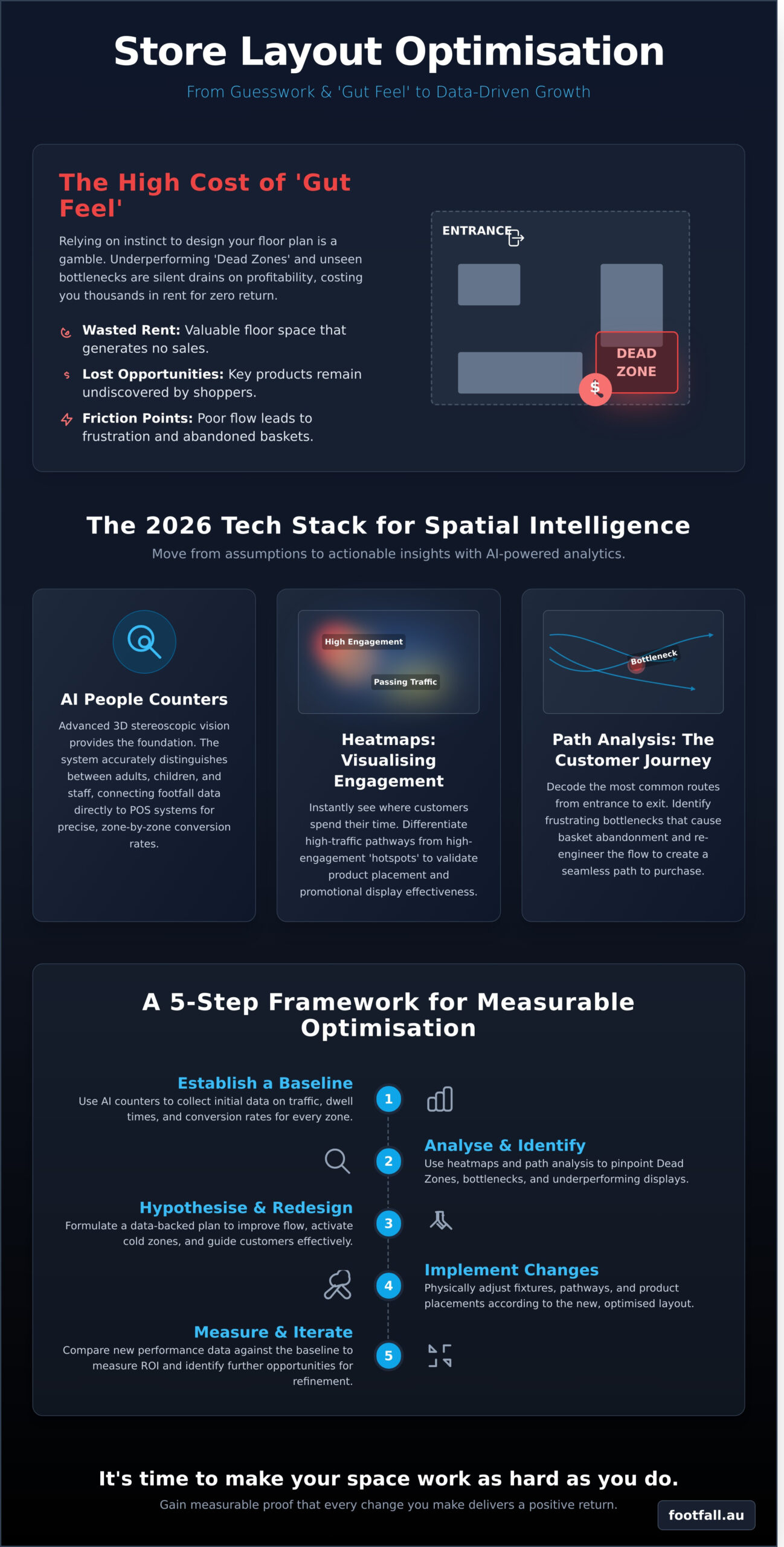
Relying on anecdotal evidence from floor staff is a high-risk strategy. What feels like a popular corner may, in reality, be a bottleneck, while other areas become “Dead Zones”-valuable floor space that drains thousands in rent per year without delivering any return on investment. These unvisited areas are invisible to traditional sales reports but glaringly obvious with modern footfall analytics. Without objective data, you are essentially paying a premium for underperforming assets.
By 2026, store layout optimisation is the data-driven process of engineering a physical space to guide customer behaviour, eliminate friction, and maximise revenue per square metre.
The 2026 Tech Stack: Using AI People Counters for Spatial Intelligence
Effective store layout optimisation requires moving beyond intuition and embracing empirical evidence. The foundation of this data-driven approach is spatial intelligence-a precise understanding of how people interact with your physical environment. This is achieved not with guesswork, but with technology designed to act as the objective ‘eyes’ of your store.
Modern solutions like the FootfallCam Pro2 transcend simple people counting. Powered by AI and advanced 3D stereoscopic vision, these devices analyse the complete visitor journey. The system can accurately distinguish between adults, children, and staff members, ensuring your analytics reflect genuine customer behaviour. By integrating this footfall data directly with your Point of Sale (POS) system, you can connect traffic to transactions, calculating precise conversion rates for every zone and display in your store. This transforms raw movement data into a clear narrative of shopper engagement and commercial performance.
Heatmaps: Visualising Customer Hotspots
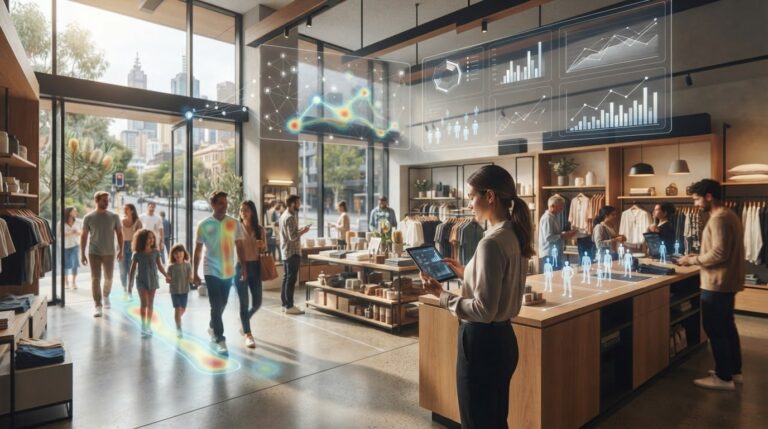
Heatmaps provide an immediate visual summary of customer activity, highlighting high-traffic zones in red and colder areas in blue. This allows you to identify which displays command the most attention. Crucially, by analysing dwell time, you can differentiate between high-volume “passing traffic” and truly “engaged shoppers.” If a promotional display has high traffic but low dwell time, it signals that the offer isn’t compelling enough to make customers pause, providing an actionable insight for immediate adjustment.
Path Analysis and Flow Monitoring
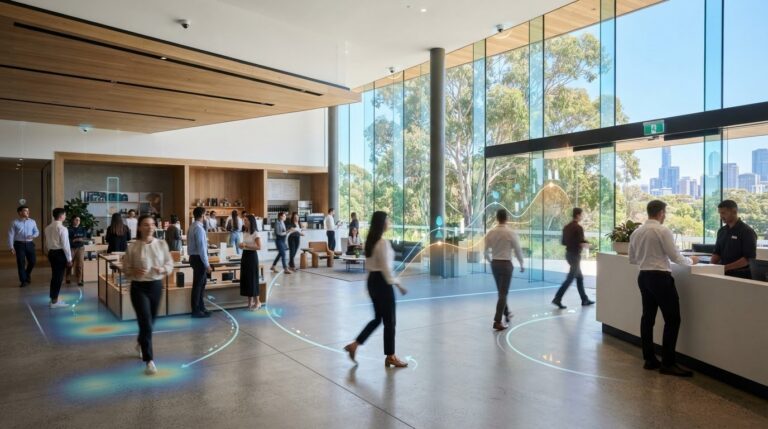
Path analysis decodes the most common routes customers take from entrance to exit, revealing the natural flow of your store. This analysis is critical for identifying performance gaps and physical “bottlenecks”-congested areas that can lead to shopper frustration and basket abandonment. Understanding these intricate customer behavior patterns allows for strategic store layout optimisation. The precision required for this granular flow monitoring is powered by dedicated hardware, detailed on the FootfallCam Pro2 product page, which captures the data needed to streamline the customer journey.
Traditional Layouts vs. Data-Driven Realities
For decades, retail design has relied on established principles-the grid for efficiency, the loop for exposure, and the free-flow for experience. While these models provide a solid foundation, they are based on assumptions about shopper behaviour. True store layout optimisation begins when we replace those assumptions with precise, empirical data, revealing the hidden flaws in even the most “perfect” floor plans.
The core challenge is balancing two competing priorities: shopper comfort and product density. Overcrowded aisles can deter browsing, yet underutilised space directly impacts revenue per square metre. Data analytics provides the objective evidence needed to find the optimal equilibrium. Furthermore, an intelligent layout directly influences operational excellence. When pathways are clear and logical, staff can restock shelves, manage inventory, and assist customers with greater speed and efficiency, enhancing the service experience from every angle.
Grid vs. Loop vs. Free-Flow: Which Wins?
There is no single “best” layout; there is only the best layout for your specific goals, validated by data.
- Grid Layout: Ideal for grocery or hardware stores where speed is paramount. To prevent it from feeling sterile, heatmaps can identify under-trafficked aisles, allowing you to place high-demand products or promotional displays strategically to distribute footfall evenly.
- Loop Layout: Maximises product exposure by guiding customers along a set path. Path-tracking sensors are crucial here, revealing exactly where shoppers deviate from the loop. This insight allows you to address engagement drop-off points with more compelling merchandising.
- Free-Flow Layout: Creates a sophisticated, boutique feel but carries the highest risk of creating customer confusion and unseen “dead zones.” Success here is entirely dependent on understanding the organic, and often unpredictable, visitor journey.
Identifying and Reviving Dead Zones
A dead zone is any part of your store that fails to generate value. Our FootfallCam V9 software flags any area with less than 5% visitor engagement, providing an immediate, actionable insight. Powered by AI, our people counting technology identifies underperforming floor space with 98% accuracy, removing all guesswork from your analysis. This practical application of technology aligns with extensive academic research, which has developed a comprehensive data-driven optimization methodology for store layouts to maximise floor space profitability. Once identified, reviving these zones is a matter of strategic intervention:
- Strategic Lighting: Use spotlights or ambient lighting to draw the eye and make the area feel more inviting.
- Compelling Signage: Implement clear wayfinding or promotional signs that give customers a reason to visit.
- “Destination” Items: Place a high-interest product, an interactive display, or a clearance section to create a powerful traffic driver.
The 5-Step Framework for Layout Optimisation
Effective store layout optimisation is not a matter of intuition; it is a science built on actionable data. By moving beyond guesswork, retailers can systematically enhance the customer journey and drive measurable growth. This proven 5-step framework provides a clear, repeatable process for turning spatial analytics into tangible commercial outcomes.
- Establish a Baseline: Begin by collecting a minimum of 30 days of raw footfall data. This period provides a statistically significant baseline, capturing daily traffic patterns, dwell times, and zone engagement before any changes are made.
- Identify the Critical Friction Point: Analyse your heatmaps and customer flow data to pinpoint the single greatest obstacle in your current layout. This could be a congested entrance, an underperforming product category, or a dead zone with minimal engagement.
- Implement a Single, Measurable Change: Introduce one specific modification to address the friction point. This could involve repositioning a high-demand display, widening an aisle, or altering the path to checkout. Isolating the change is crucial for accurate A/B testing.
- Monitor Staff-to-Customer Ratios: During the test period, use real-time data to track staffing levels against customer traffic. Ensure your team is deployed effectively to support the new flow, as staff presence directly impacts engagement and conversion.
- Review and Scale Success: After the test period, compare conversion rate deltas and key engagement metrics against your baseline. If the change produced a positive result, implement it permanently and move on to the next friction point.
A/B Testing Your Floor Plan
The foundation of successful layout testing is isolating variables. By changing only one display or aisle at a time, you can attribute any shift in customer behaviour directly to that modification. The FootfallCam V9 Software allows you to seamlessly compare “before and after” metrics, providing clear evidence of what works. This is particularly vital for seasonal adjustments; a winter layout that drives sales in Melbourne’s variable climate may not perform as well in Perth’s consistent warmth.
Aligning Staffing with Traffic Flow
Your layout data is also a powerful tool for workforce optimisation. Heatmaps reveal high-engagement zones where staff presence is most critical, enabling you to align rosters with actual customer behaviour. This proactive approach helps reduce lost sales during peak hours when traffic might otherwise exceed staff capacity. Our local support teams in Brisbane, Sydney, and Adelaide are available to help you integrate this intelligence into your daily operations. Learn more about data-driven strategies at footfall.au.
Maximising ROI with Footfall Australia Solutions
Choosing the right technology partner is as critical as the data itself. For Australian retail chains, Footfall Australia provides a distinct advantage through localised expertise and a focus on long-term, sustainable value. We understand that effective store layout optimisation is an ongoing strategy, not a one-time fix. That’s why we developed the Legacy Swap Out Plan, a seamless pathway for businesses to upgrade outdated people counting systems to meet 2026 analytics standards.
Our commitment extends across the nation, with professional installation and support services available in all major cities, from Perth to Brisbane. Unlike subscription models that lock you into recurring fees, we offer perpetual software licenses. This ensures you retain full ownership of your valuable historical data, providing a tangible asset that grows with your business and delivers a superior long-term return on investment.
Comprehensive Support and Maintenance
We tailor our support to your operational needs. Our Basic plan offers robust assistance for standard requirements, while the Premium plan provides priority service for multi-store retailers who depend on maximum uptime. With expert teams based in Sydney and Melbourne, we guarantee rapid, on-the-ground troubleshooting and maintenance, minimising disruption and keeping your analytics engine running smoothly. Ready to refine your customer journey? Request a layout audit from Footfall Australia today.
Future-Proofing Your Retail Space
The future of retail management lies in AI-driven predictive analytics, which transforms historical data into forward-looking strategy. Our systems are built to evolve, preparing your business for this next wave of innovation. For a cost-effective upgrade, our FootfallCam Centroid solution can leverage your existing CCTV cameras to generate sophisticated layout data. Since 2004, Footfall Australia has been the authoritative partner in empowering businesses with the intelligence needed to master their physical environments.
The Future of Your Floorplan is Data-Driven
The era of designing retail spaces based on intuition is over. As we’ve explored, the future of Australian retail in 2026 and beyond is defined by spatial intelligence, where every customer pathway and dwell zone provides actionable data. This shift from guesswork to evidence is the core of modern store layout optimisation, empowering you to create environments that are not just visually appealing, but strategically engineered for conversion and customer satisfaction.
Partnering with an expert is the most effective way to translate this data into growth. Since 2004, Footfall Australia has equipped local retailers with the tools to master their physical spaces. Leveraging proprietary AI hardware with 98%+ accuracy and backed by local support teams in all major Australian capitals, we provide the clarity you need to make confident, profitable decisions.
Optimise your store layout with Footfall Australia’s data-driven solutions. The path to a more intelligent and profitable retail environment is clearer than ever. It’s time to build it.
Frequently Asked Questions
How does store layout optimisation affect sales conversion rates?
Effective store layout optimisation directly impacts sales by shaping the customer journey. A data-driven layout guides shoppers towards high-margin products, eliminates navigational friction, and increases dwell time in key zones. By analysing foot traffic patterns to identify and resolve bottlenecks or dead zones, you create a seamless path to purchase. This strategic approach transforms casual browsing into confirmed sales, measurably lifting your conversion rates by aligning your space with actual customer behaviour.
Can I use my existing CCTV cameras for store layout analysis?
While technically possible, using standard CCTV for spatial analytics is not recommended for achieving precision. Security cameras are designed for surveillance, not for the high-accuracy counting and anonymous tracking required for business intelligence. Dedicated AI people counters provide superior accuracy (often over 98%) and are purpose-built to generate actionable data on traffic flow, heatmaps, and dwell times without compromising performance or raising privacy concerns, delivering far more reliable insights for decision-making.
What is the most efficient store layout for a small retail shop?
The most efficient layout is not one-size-fits-all; it depends entirely on your product and target customer behaviour. A grid layout maximises product exposure in a small grocery, while a loop layout creates a curated journey in a boutique. The key is to move beyond templates and use data to inform your decision. True efficiency is achieved through continuous store layout optimisation, using foot traffic analytics to understand how customers interact with your specific space and refining it accordingly.
How long does it take to see results from a layout change?
You can observe immediate changes in customer flow and movement patterns on your analytics dashboard within the first day of a layout modification. However, to measure the true impact on key metrics like dwell time and sales conversion, we recommend collecting data for at least two to four weeks. This period allows you to establish a new baseline and account for daily or weekly fluctuations, ensuring your conclusions are based on statistically significant evidence rather than short-term anomalies.
Is customer privacy protected when using AI people counters for heatmapping?
Yes, customer privacy is paramount and fully protected. Our AI-powered sensors are engineered to be privacy-by-design. They do not record video or capture any personally identifiable information (PII). The technology anonymously analyses movement, converting human shapes into data points to generate heatmaps and path analytics. This ensures complete compliance with Australian privacy laws, allowing you to gather critical business intelligence without ever compromising the trust of your customers.
What is the “Decompression Zone” and why is it important for Australian stores?
The Decompression Zone is the initial 1.5 to 4.5 metres just inside your storefront. It’s a critical transitional space where shoppers adjust from the outside world to your store’s environment. For Australian retailers, understanding this zone is vital because customers here are often not yet ready to engage with products or promotions. Placing key signage or high-value items past this threshold ensures your message is received by shoppers who are oriented and receptive, improving the effectiveness of your merchandising.
How much does a professional people counting system cost in Australia?
The investment in a professional people counting system is scalable to your needs. In Australia, the hardware for a high-accuracy AI sensor typically starts around A$500 per unit. This is complemented by a monthly software subscription for the analytics platform, which can range from A$50 to A$150 per sensor, depending on the features required. This model provides an affordable entry point for single stores and scales efficiently for multi-location enterprises seeking comprehensive spatial intelligence.
Do I need different layouts for different store locations like Sydney vs. Perth?
Yes, localising your layout is a strategic advantage. Customer demographics, shopping behaviours, and even pace can vary significantly between a bustling Sydney CBD location and a relaxed Perth suburban centre. A one-size-fits-all approach ignores these nuances. By deploying spatial analytics at each site, you can gather location-specific data on visitor journeys. This empowers you to tailor each layout to optimise flow and engagement based on the unique patterns of the local customer base.