
Choosing a People Counter Supplier in Australia: A 2026 Strategic Guide
If your current footfall data is only 85% accurate, you aren’t just missing 15% of your visitors; you’re making staffing decisions based on a fiction that costs thousands in lost efficiency every year. You likely recognize that a simple number on a screen isn’t enough to drive growth in the complex Australian retail and public space environment of 2026. Data is only valuable if it leads to a specific, positive change in your operations, yet many organizations still struggle with inaccurate sensors and isolated data silos that don’t communicate with their broader business intelligence.
This strategic guide will show you how to master the process of choosing a people counter supplier in Australia by focusing on the three pillars of modern footfall strategy: precision hardware, seamless data integration, and the security of local support. You’ll learn how to evaluate suppliers based on their ability to deliver 98% accuracy while ensuring their systems, such as the FootfallCam Pro2, integrate perfectly with your existing tools. We’ll explore how to move beyond high maintenance costs toward a scalable solution that treats physical movement as a sequence of human actions to be understood, interpreted, and optimized for long-term ROI.
Key Takeaways
- Identify why a strategic data partner is more valuable than a simple hardware vendor for long-term operational success.
- Leverage 3D AI vision technology to ensure 98%+ accuracy by distinguishing between human movement and non-human objects like trolleys or prams.
- Transform raw footfall metrics into actionable strategy using automated reporting tools and intuitive dashboards designed for executives and store managers.
- Prioritize local technical support when choosing a people counter supplier in Australia to ensure rapid troubleshooting and maintain system viability.
- Plan a successful national rollout by utilizing professional site surveys to determine optimal sensor placement for maximum data utility.
The Strategic Importance of Your People Counter Supplier Choice
The hardware sensor is often the focus of procurement, yet the sensor is merely a collector of raw signals. When choosing a people counter supplier in Australia, the real value lies in the infrastructure that converts those signals into actionable intelligence. A hardware vendor sells you a device and walks away. A strategic data partner, however, assumes responsibility for the entire data lifecycle, from initial site calibration to ongoing accuracy audits. This distinction determines whether your footfall metrics become a catalyst for growth or a source of internal confusion.
Supplier reliability directly impacts your ability to make evidence-based business decisions. If your data is inconsistent, your confidence in staffing levels and marketing ROI will inevitably erode. Evaluating the Total Cost of Ownership (TCO) over a five-year period reveals the hidden risks of low-cost hardware. Initial savings on entry-level sensors frequently vanish when faced with high maintenance fees, frequent recalibrations, or the eventual need for a Legacy Swap Out Plan. Reliable suppliers provide systems like the FootfallCam Pro2, designed for longevity and consistent performance without constant technical intervention.
Data Integrity: The Foundation of Footfall Analytics
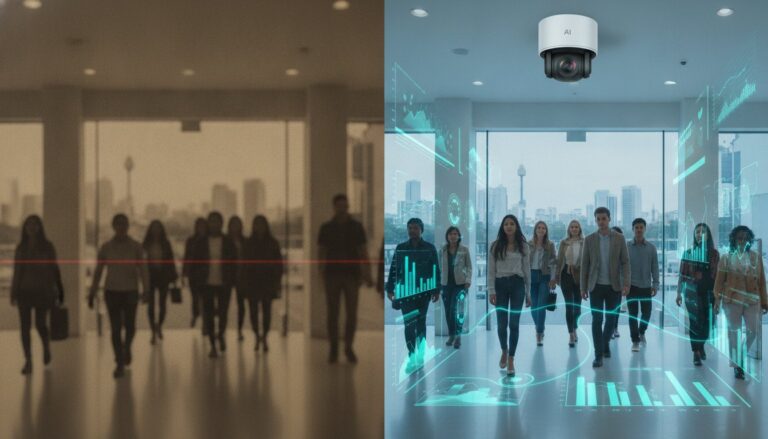
Accuracy isn’t just a percentage; it’s the difference between a profitable staffing roster and a wasted wage budget. While People counting technologies have evolved significantly, legacy thermal systems often achieve only 85% accuracy. In a high-traffic environment, a 15% error rate leads to “ghost counts” where shadows, reflections, or shopping carts are tallied as customers. These inaccuracies result in poor leasing negotiations and skewed conversion rates. Professional suppliers mitigate these risks by using 3D stereo-vision sensors and performing regular remote data audits to verify that every count reflects a genuine human action.
Scalability for National Australian Operations
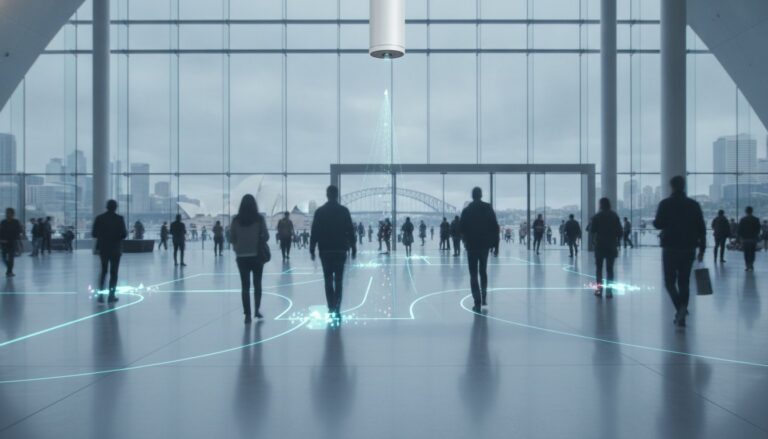
National brands operating across diverse regions, from New South Wales to Western Australia, require more than just local installers. They need a centralized management system that aggregates data from every location into a single source of truth. Choosing a people counter supplier in Australia with the capacity for national rollouts ensures that hardware performance remains uniform across your entire network. Implementing a unified people counting strategy through software like FootfallCam V9 allows for seamless benchmarking between flagship stores and regional outlets. This centralized approach eliminates the data silos that occur when fragmented local systems fail to communicate, providing a clear narrative of movement across your entire physical footprint.
Evaluating Hardware: AI Accuracy and Environmental Adaptability
Selecting the right hardware is a technical decision with profound operational consequences. When you’re choosing a people counter supplier in Australia, the primary differentiator is the sensor’s ability to interpret complex human environments rather than just detecting motion. 3D AI vision has emerged as the gold standard for 2026, particularly in high-traffic Australian retail settings. Unlike legacy 2D cameras, 3D systems use depth perception to distinguish between a customer and their shopping trolley, or a parent and a pram. This level of granularity ensures that your conversion rates are based on actual potential buyers, not just the volume of objects passing through the door.
Environmental adaptability is equally critical. Australian storefronts often contend with intense natural light, deep shadows, and reflective surfaces that confuse lower-tier sensors. Advanced AI models are trained to filter out these environmental anomalies, maintaining data integrity even in challenging lighting conditions. This technical resilience is paired with a strict commitment to privacy. Modern hardware employs “privacy by design” principles, processing all data at the edge. This means the system identifies human movement patterns without ever capturing or storing Personally Identifiable Information (PII), ensuring full compliance with the Australian Privacy Act 1988 and its 2024 amendments. If you’re ready to see these standards in action, you can view our full hardware range for more details.
The FootfallCam Pro2 Advantage
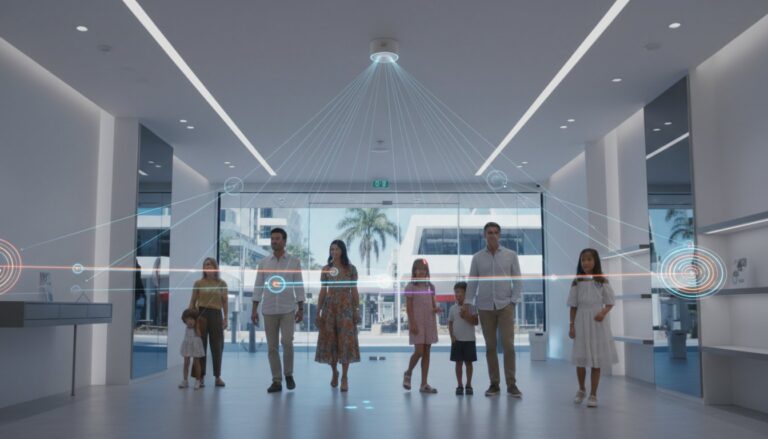
The FootfallCam Pro2 represents the peak of this technological evolution, offering a verified 98% accuracy rate. Its binocular vision mimics human eyes, creating a real-time 3D depth map of the entrance area. This allows the device to track multiple individuals simultaneously, even if they’re walking side-by-side or in close proximity. For facility managers, the hardware is designed for efficiency; Power over Ethernet (PoE) support simplifies installation in large-scale facilities by combining power and data into a single cable. This streamlined setup reduces installation time and minimizes the physical footprint of the system.
Handling High-Density Traffic
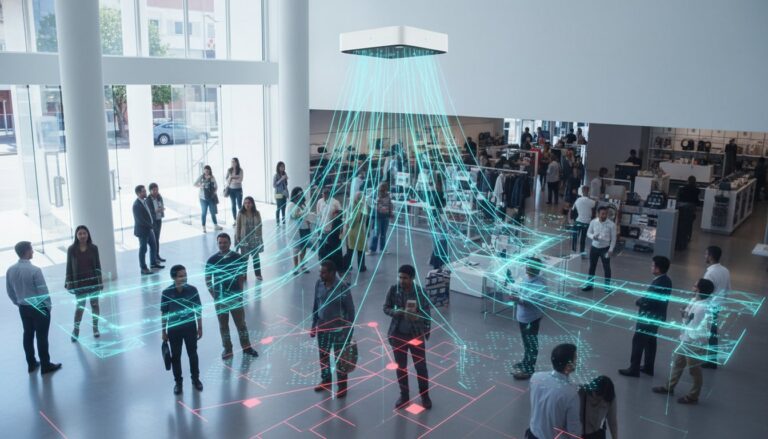
In crowded shopping centres or major public events, traditional infrared beam sensors fail because they can’t distinguish between one person and a group. AI-driven path tracking solves this by assigning a unique ID to every visitor as they enter the frame, following their journey to understand dwell times and flow patterns. This technology doesn’t just count; it observes the narrative of movement. AI-driven filtering reduces false positives by 35% compared to legacy sensors by intelligently ignoring non-human movement like swinging doors or shifting shadows. This precision ensures that the data reaching your dashboard is clean, reliable, and ready for strategic analysis.
Software and Insights: Transforming Raw Data into Strategy
A sensor without a sophisticated dashboard is an incomplete investment. When you’re choosing a people counter supplier in Australia, the analytics layer is what separates a simple counting tool from a comprehensive business strategy. Raw footfall numbers lack utility unless they’re contextualized within your specific operational goals. High-performing organizations use these metrics to move beyond intuition, relying instead on empirical evidence to dictate store layouts, marketing spend, and labor allocation. The true value of a strategic partner lies in their ability to provide a reporting ecosystem that is both technically deep and intuitively accessible.
Automated reporting is essential for maintaining a consistent flow of information between store managers and executive teams. Instead of manually pulling data, stakeholders should receive scheduled insights that highlight significant behavioral shifts. This becomes even more powerful when you integrate footfall data with your Point-of-Sale (POS) systems. By merging these datasets, you can calculate precise sales conversion rates, revealing whether a drop in revenue is due to lower traffic or a failure to convert the visitors already in the building. This level of transparency allows for targeted interventions rather than broad, expensive changes.
Benchmarking performance across a national portfolio is another critical function of advanced software. It’s not enough to know how a single location is performing; you must understand why a flagship store in Sydney might have a higher return rate than a regional outlet in Perth. Choosing a people counter supplier in Australia that offers robust benchmarking tools allows you to identify high-performing locations and replicate their success across your entire network. This comparative analysis turns individual data points into a cohesive narrative of movement and growth.
The FootfallCam V9 Analytics Dashboard
The FootfallCam V9 Software provides a centralized hub for real-time occupancy monitoring, which is vital for maintaining safety standards and regulatory compliance. Beyond simple counting, the dashboard tracks customizable KPIs such as average visit duration and peak hour trends. Detailed footfall data analysis helps management identify underperforming stores by highlighting discrepancies between traffic volume and staff availability. This allows for rapid recalibration of resources to capture missed opportunities during high-density periods.
API Integration and Data Export
Modern business intelligence requires interconnected systems. Open APIs are a necessity for organizations that want to feed footfall metrics directly into their existing ERP or BI tools, such as PowerBI or Tableau. Automating this data flow eliminates the risk of manual reporting errors and ensures that every department is working from a single source of truth. By making data accessible and exportable, you empower every stakeholder to make decisions that are backed by the same high-quality technical foundation, ensuring consistency across your entire organizational structure.

Local Support and Long-Term System Viability
Technical reliability is a prerequisite for any data-driven organization, yet physical hardware inevitably requires maintenance. Choosing a people counter supplier in Australia means prioritizing a partner who understands the local geographical and operational landscape. When a sensor fails, the resulting data gap skews monthly performance metrics and invalidates staffing schedules. Relying on international support desks often leads to delays caused by time zone discrepancies and shipping hurdles. A local partner provides the infrastructure necessary to keep your systems operational 24/7, ensuring your narrative of movement remains uninterrupted.
Support structures are typically divided into Basic and Premium tiers to suit different organizational needs. A Basic Support Plan provides essential troubleshooting and software updates. In contrast, a Premium Support Plan shifts the focus from reactive repairs to proactive monitoring. Proactive maintenance involves automated health checks that identify connectivity issues or accuracy drifts before they impact your dashboard. For mission-critical environments like major shopping hubs or transit stations, this continuous oversight is vital for maintaining the high-quality technical foundation required for complex decision-making.
The Importance of a Local Partner Network
Onsite support is indispensable for physical hardware adjustments that remote teams cannot perform. Footfall Australia utilizes a national network of technicians to provide consistent service across every state and territory. This local presence facilitates rapid response times and ensures that replacement stock is always available within the country. By reducing downtime through local expertise, you protect the long-term ROI of your investment and maintain a reliable stream of intelligence for your stakeholders. It’s a strategic advantage that ensures your data remains both accurate and actionable over the system’s entire lifecycle.
Upgrading Your Infrastructure
Many Australian businesses still rely on outdated infrared beams or thermal sensors that lack the precision of modern AI. These legacy systems often fail to meet the 98% accuracy threshold required for 2026 analytics. Modernisation is necessary when your current hardware can no longer distinguish between human actions and environmental noise. Our Legacy Swap Out Plan is designed to simplify this transition, reducing the technical barriers to adopting 3D vision technology. This ensures your people counting systems Australia remain future-proof and compliant with evolving privacy standards. If you’re ready to modernize your data collection, contact our local support team today to discuss an upgrade path that fits your national footprint.
Implementation Strategy: Planning Your National Rollout
Success in data-driven management depends as much on the execution as it does on the initial procurement. When you’re finalising the process of choosing a people counter supplier in Australia, you must evaluate their capacity to manage a large-scale deployment across diverse physical environments. A national rollout requires a structured roadmap that accounts for regional variations in infrastructure and store design. Whether you opt for a phased approach or a rapid implementation, the goal remains the same: achieving a seamless transition to high-precision analytics without disrupting your daily operations.
A phased rollout is often the preferred strategy for national brands. This allows your team to pilot the system in select flagship locations, refining data integration and reporting protocols before a wider release. It provides a valuable feedback loop where store managers can offer input on the utility of the FootfallCam V9 Software in a real-world setting. Conversely, a simultaneous rollout ensures that every location starts from the same high-quality technical foundation at once, which is beneficial for brands undergoing a complete digital transformation. Both methods require a partner that values accuracy and efficiency above all else.
Site Survey and Environmental Assessment
Professional site surveys are the only way to guarantee that your hardware performs to its theoretical limits. Technicians must analyse ceiling heights, entrance widths, and ambient lighting conditions to identify potential obstructions that could interfere with the 3D depth map. Choosing between wired Power over Ethernet (PoE) and Wi-Fi solutions depends largely on your existing infrastructure constraints and the need for long-term stability. AI sensors must be installed at an optimal mounting height between 2.1 and 4.5 metres to maintain the depth perception required for 98% accuracy. This precision ensures that the narrative of movement captured at the door is a true reflection of visitor behaviour.
Driving ROI Through Operational Change
The true return on investment becomes visible when footfall data begins to drive operational change. Within the first 12 months, organisations should see a measurable reduction in labour costs by aligning staff rosters with peak visitor hours identified by the system. Marketing teams can use attraction rates to evaluate the success of window displays and promotional events, ensuring that every campaign is backed by empirical evidence rather than guesswork. Training your staff to interpret these metrics empowers them to take ownership of store performance, turning raw data into a sequence of positive human actions. For organisations seeking a tailored implementation roadmap, you can contact Footfall Australia for a customised people counter support consultation.
Securing Your Operational Future with Precision Data
The transition from basic footfall counting to sophisticated behavioral analysis requires a foundation of accuracy and local expertise. Choosing a people counter supplier in Australia is a decision that defines the long-term integrity of your business metrics. By prioritizing 3D AI hardware, seamless software integration, and a proactive support ecosystem, you ensure that every data point leads to a measurable operational improvement. This strategic approach turns physical presence into a sequence of human actions that can be interpreted and optimized for growth.
Leveraging over 20 years of experience in the Australian market, Footfall Australia provides Red Dot Award-winning FootfallCam hardware backed by a national partner network for onsite support. Our commitment to data-driven logic ensures your organization remains prepared for shifting consumer trends with empirical evidence. Request a tailored people counting solution for your Australian business today to start transforming your physical environment into an optimized, high-performance space. You’re ready to move beyond intuition and lead with clarity.
Frequently Asked Questions
How do I choose the right people counting supplier in Australia?
You choose the right supplier by evaluating their hardware accuracy, data integration capabilities, and the availability of a local support network. When choosing a people counter supplier in Australia, prioritize partners who offer 3D AI vision technology and have a proven track record within the local retail and public sectors. This ensures your system remains scalable and provides a reliable return on investment through empirical, actionable insights rather than intuition.
What is the most accurate people counting technology available in 2026?
3D AI stereo vision is currently the most accurate technology available, achieving precision rates of 98% or higher. Unlike legacy thermal or infrared systems, 3D sensors use binocular vision to create depth maps, allowing them to distinguish between humans and objects like trolleys or prams. This technology maintains high performance even in high-density traffic and challenging lighting conditions typical of large Australian shopping centres and transport hubs.
Can I upgrade my existing people counting hardware without replacing the whole system?
You can modernize your infrastructure without a total system overhaul by utilizing a Legacy Swap Out Plan. This approach allows organizations to replace outdated infrared or thermal sensors with advanced AI hardware while maintaining existing data connections where possible. It’s a cost-effective method to improve data integrity and ensure your system is compatible with modern analytics software like FootfallCam V9 for deeper behavioral insights.
How much does a professional people counting system cost in Australia?
The cost of a professional system varies based on the number of entrances, the complexity of the environment, and the required level of data analysis. Instead of focusing solely on the initial hardware price, you should evaluate the Total Cost of Ownership (TCO) over a five-year period. This includes installation, software licensing, and support plans, which collectively determine the long-term value and reliability of your footfall data.
Do people counters comply with Australian privacy laws?
Modern people counters are designed to comply with the Australian Privacy Act 1988 and the 2024 amendments. Systems like the FootfallCam Pro2 use “privacy by design” principles, processing data at the edge to track movement patterns without capturing Personally Identifiable Information (PII). This ensures your organization gains valuable behavioral insights while remaining fully compliant with national data protection regulations and maintaining public trust.
What is the difference between a people counter and a CCTV camera?
A people counter is a specialized sensor designed for mathematical accuracy and anonymized data collection, whereas a CCTV camera is built for visual surveillance and security. People counters use AI to interpret human movement as numerical data points rather than recording video footage. This distinction is vital for maintaining visitor privacy and providing the high-level metrics needed for operational strategy rather than just security monitoring.
How does footfall data integrate with my current POS system?
Footfall data integrates with Point-of-Sale (POS) systems through open APIs that allow different datasets to communicate seamlessly. By combining traffic numbers with transaction data, you can calculate precise sales conversion rates and identify peak performance periods. This integration is typically managed through centralized software like FootfallCam V9, which aggregates diverse metrics into a single, intuitive reporting dashboard for streamlined executive analysis.
Why is local Australian support important for people counting systems?
Local Australian support is critical for minimizing system downtime and ensuring rapid troubleshooting for physical hardware issues. Choosing a people counter supplier in Australia with a national partner network provides access to onsite technicians and local stock availability. This eliminates the delays associated with international time zones and shipping, ensuring your data stream remains consistent and reliable for daily operational decision-making.