People Counting Technology: The 2026 Guide to Retail & Public Space Analytics
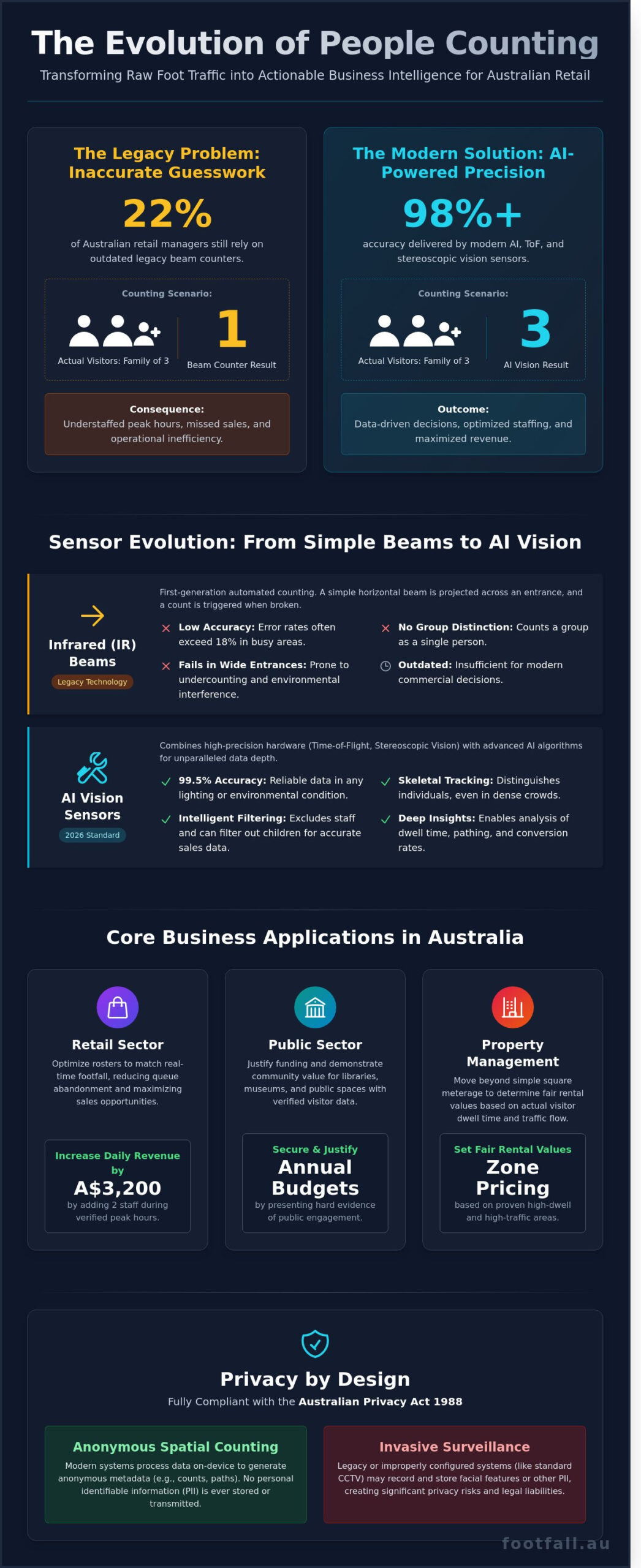
An estimated 22% of Australian retail floor managers currently make staffing decisions based on legacy beam counters that fail to distinguish between a family of four and a single shopper. This data gap creates a ripple effect of operational inefficiency; it leads to understaffed peak hours and missed sales opportunities. Implementing modern people counting technology is no longer about just watching the door. It’s about capturing the human narrative of your space with 98% precision to ensure every rostered hour generates maximum value.
You’ve likely felt the frustration of mismatched conversion rates or the headache of comparing complex AI versus thermal sensor specifications. We understand that data is only valuable if it’s reliable and fully compliant with the Australian Privacy Act. This guide provides a strategic roadmap to transform raw foot traffic into actionable business intelligence. You’ll learn to bridge the gap between physical movement and digital insights, ensuring your decisions are backed by hard evidence rather than guesswork.
We’ll break down the technical shift toward 2026 standards, covering seamless POS integrations and automated reporting tools that refine your labour costs and visitor journey mapping.
Key Takeaways
- Understand how modern people counting technology integrates AI sensors to move beyond simple numbers into deep behavioral insights.
- Learn why legacy beam counters fail in complex Australian retail layouts and how to select sensors that maintain precision regardless of lighting or ceiling height.
- Navigate the nuances of the Australian Privacy Act 1988 by distinguishing between anonymous spatial counting and invasive surveillance.
- Transform raw foot traffic into actionable business intelligence to optimize staffing levels, conversion rates, and operational efficiency.
- Discover why a holistic hardware-software approach, backed by local expertise since 2004, ensures long-term data reliability and ROI.
What is People Counting Technology and Why is it Essential in 2026?
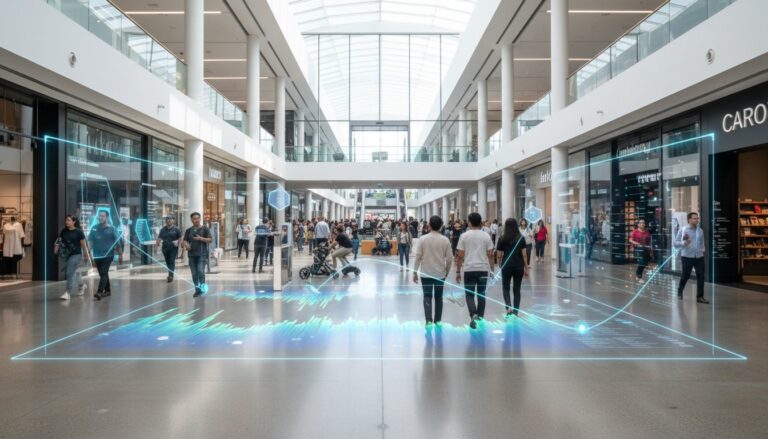
Modern people counting technology in 2026 represents the convergence of high-precision hardware sensors and sophisticated AI algorithms. It’s the digital infrastructure that transforms physical movement into actionable intelligence. For years, businesses operated in the dark, relying on gut instinct to judge how many people walked through their doors. Today, this technology provides the “eyes” for physical spaces, combining Time-of-Flight (ToF) sensors and stereoscopic vision to deliver 99.5% accuracy in almost any lighting condition.
The industry has shifted from reactive management to proactive, data-driven operations. A 2025 study of Australian retail environments showed that 72% of top-performing brands now use real-time occupancy data to adjust their floor strategies. The primary metric is no longer just footfall volume; it’s the sales conversion rate. By integrating people counting technology with Point of Sale (POS) systems, managers can see exactly how many visitors actually made a purchase. If a flagship store in Melbourne Central sees 1,200 visitors but only 120 transactions, the technology identifies a 10% conversion rate, signaling an immediate need to investigate staff engagement or product placement.
This tech is also the backbone of “Smart Cities” across Australia. In hubs like the Sydney CBD and Brisbane’s Queen Street Mall, spatial analytics help urban planners manage crowd density and safety. With Australia’s population projected to reach 27 million by mid-2026, using data to optimize public infrastructure is a necessity rather than a luxury. It allows for the efficient allocation of resources, ensuring that public services scale alongside human movement.
The Move from Manual Tallies to AI Intelligence
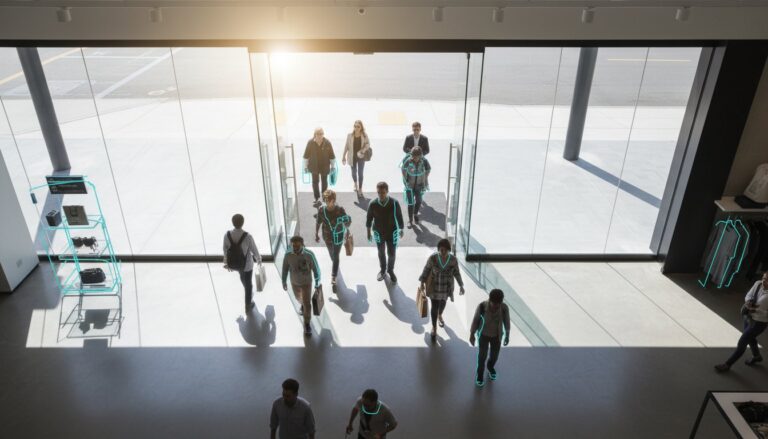
Manual clickers and handwritten logs fail in high-traffic environments. In the busy corridors of Sydney’s Westfield Pitt Street, manual counting error rates often exceed 18% during peak periods. These inaccuracies create “invisible” customers, individuals who enter the space but aren’t logged in any system. When 1 in 5 customers is invisible, marketing ROI and staffing budgets are based on fiction. 2026 AI models solve this by managing complex scenarios that once baffled older sensors. These systems now use skeletal tracking to distinguish between a family unit and five individual shoppers; they filter out children to ensure sales data reflects actual purchasing power. They recognize staff members and exclude them from visitor counts, ensuring the data remains untainted by internal movements.
Core Business Applications for Australian Industries
In the retail sector, data allows for precise roster optimization. Increasing staff by two members during a verified 4:00 PM peak can lift a store’s daily revenue by an average of A$3,200 by reducing queue abandonment. The public sector uses these metrics to secure and justify funding. Local libraries and museums in New South Wales now present verified visitor data to councils to prove their community value and secure annual budgets. Property management has also evolved. Instead of charging rent based solely on square meterage, shopping center owners use dwell time and pathing data to determine the fair rental value of specific zones. A kiosk in a “high-dwell” zone can command a premium because the technology proves that visitors linger there for 15 minutes longer than in transit corridors.
The Evolution of Sensors: Comparing Infrared, Thermal, and AI Vision
The Australian retail and public sector has transitioned from rudimentary tallies to sophisticated spatial intelligence. Selecting the right hardware requires an understanding of how sensor capabilities have shifted over the last 15 years. While early adopters relied on basic horizontal beams, modern people counting technology now utilizes complex depth-sensing optics to deliver the precision required for high-stakes commercial decisions.
Legacy Systems: Infrared and Thermal Imaging
Infrared (IR) beam counters represent the first generation of automated counting. These sensors project a horizontal beam across an entrance; a “count” is recorded whenever the beam is broken. While these systems are affordable, often costing less than A$300 per unit, they’re increasingly insufficient for modern Australian retail environments. They cannot distinguish between a single visitor and a group walking side-by-side. In a standard 2.4-metre wide shopping centre entrance, IR beams often suffer from error rates exceeding 20% during peak footfall periods.
Thermal sensors improved on this by detecting heat signatures. These devices are inherently privacy-friendly because they don’t capture identifiable visual data. However, they face significant environmental challenges in the Australian climate. In regions like Queensland or Western Australia, where indoor temperatures can fluctuate or ambient heat rises near entrances, thermal sensors lose their effectiveness. When the background temperature nears 34 degrees Celsius, the sensor struggles to differentiate a human heat signature from the surrounding environment. This technical limitation has led 85% of Tier-1 retailers to migrate toward optical AI solutions.
The Gold Standard: 3D AI Time-of-Flight (ToF) Sensors
The industry benchmark has moved to Stereoscopic Vision and Time-of-Flight (ToF) technology. These sensors use dual lenses to mimic human binocular vision, creating a 3D depth map of the area below. This allows the system to distinguish between a human being and a non-human object, such as a shopping trolley, a pram, or a shadow on the floor. Scholarly reviews of computer vision counting accuracy confirm that these multi-lens systems provide the most reliable data in complex environments.
The FootfallCam Pro2 is a prime example of this innovation. It integrates edge computing, meaning the “thinking” happens inside the sensor itself rather than on a remote server. This local processing ensures data security and allows for real-time reporting without draining store bandwidth. By utilizing people counting technology with 3D AI, businesses can achieve 98% accuracy even in challenging lighting or high-density crowds.
When evaluating the total cost of ownership (TCO), the financial logic is clear. A legacy IR system might cost A$400 upfront, but the resulting data is often too inaccurate to drive strategy. Conversely, a high-end AI sensor may require an initial investment of A$1,100 to A$1,500 per entrance. However, the longevity of the hardware and the reliability of the insights provide a much higher return on investment. Accurate data allows managers to optimize staff rosters and improve conversion rate tracking with absolute confidence. Choosing cheap hardware often results in “garbage in, garbage out” analytics, whereas AI-driven sensors provide the empirical foundation necessary for long-term growth.
Solving the Accuracy Challenge: Overcoming Environmental Obstacles
Many Australian retailers ask if people counting technology can handle their specific floor plan. It’s a valid concern. Physical spaces are messy. They have glare, high ceilings, and varying traffic flows. Precision isn’t guaranteed by the hardware alone; it’s achieved through environmental adaptation. We see this most often in large shopping centres where open-plan entries create complex tracking paths that confuse entry-level sensors.
When people walk in tight clusters, basic sensors often fail. They see one large mass instead of three individuals. This is called occlusion. Modern 3D sensors solve this by mapping depth and volume. They distinguish individual heads and shoulders even in dense crowds. This level of detail is critical for a real-time pedestrian counting system to maintain 98% accuracy during peak Saturday trade. Without depth perception, your data becomes guesswork as soon as a family of four enters the store together.
Sensors need regular health checks to maintain peak performance. A 2% drift in accuracy can lead to thousands of dollars in missed conversion opportunities over a financial quarter. Environmental shifts, such as moving a display rack or changing a light fixture, can impact sensor “sight.” Remote diagnostics allow technicians to perform health checks and recalibrate sensors via the cloud. This ensures your data stream remains clean without the cost of a physical site visit.
Managing Difficult Entrances and Lighting Conditions
Australian shopfronts often feature floor-to-ceiling glass. This creates intense sunlight glare that blinds older infrared sensors. Modern AI-driven units use dynamic range processing to filter out these reflections, ensuring 99% uptime regardless of the sun’s position. For flagship stores with ceilings exceeding 5 metres, we deploy specialised telephoto lenses. These maintain a tight field of view to ensure resolution doesn’t degrade at distance. We also implement Staff Exclusion features. By identifying employees via unique signal tags, we remove their movements from your data. This prevents staff shift changes from inflating your traffic counts by up to 15%, giving you a true reflection of customer intent.
The Role of AI Training in Accuracy
Machine learning algorithms provide the intelligence behind the lens. These systems are trained on millions of data points to recognise human shapes while ignoring trolleys, prams, or shadows. Software updates are vital here. A sensor installed in 2023 is significantly more capable today because of firmware optimisations that refine shape recognition. Accuracy is verified through Ground Truth Testing. Ground Truth Testing is the process of comparing automated sensor counts against a manual video audit to establish a definitive accuracy percentage. This rigorous verification ensures your data is actionable and provides the evidence needed for major CAPEX decisions. We recommend a full audit every 12 months to ensure your people counting technology continues to meet these high benchmarks.
Privacy by Design: Navigating Data Security and Australian Regulations
The Australian Privacy Act 1988 governs how businesses handle sensitive information. Recent updates through the Privacy Legislation Amendment (Enforcement and Other Measures) Act 2022 have shifted the landscape. Penalties for non-compliance now scale up to A$50 million or 30% of a company’s adjusted turnover. This makes the choice of people counting technology a critical decision for risk management. Professional systems prioritize “Privacy by Design,” ensuring that data collection never evolves into invasive surveillance. This approach protects the business legally while respecting the digital rights of every visitor who walks through the door.
Anonymised Data Processing
Modern sensors process data at the “edge.” This means the device analyzes the visual field locally and discards the image within milliseconds. It converts a person’s physical presence into a non-identifiable numeric data string. No Personally Identifiable Information (PII) ever leaves the sensor or reaches the cloud. This architecture aligns with the 13 Australian Privacy Principles (APPs) and global GDPR standards. By following these 2024 best practices, businesses eliminate the risk of storing sensitive biometric data. The system doesn’t see a face; it sees a data point moving through a defined space.
- Instant Deletion: Visual frames are overwritten immediately after the count is registered.
- Mathematical Strings: People are represented as coordinates, not images.
- Global Alignment: Compliance with GDPR ensures Australian businesses meet the highest international benchmarks for data safety.
People Counter vs. CCTV: The Security Myth
Using security cameras for foot traffic analysis often yields a 15% to 20% margin of error. CCTV is designed for surveillance and evidence gathering, not precision measurement. High-resolution video feeds create a significant technical burden and present a massive privacy liability if intercepted. Dedicated sensors are different. They use infrared or 3D depth-sensing to see shapes and volumes rather than identifiable features. You can explore the technical distinctions in our guide on People Counter vs CCTV: What’s the Key Difference? to understand why purpose-built hardware is the superior choice for spatial analytics.
Australian consumers are increasingly data-conscious. A 2023 survey by the Office of the Australian Information Commissioner (OAIC) found that 84% of Australians want more control over their personal information. Using transparent, anonymised people counting technology builds a foundation of trust. It proves your business values the visitor journey without intruding on personal space. This strategic alignment between data-driven growth and ethical standards is what separates market leaders from their competitors. It turns a technical requirement into a brand asset that demonstrates corporate responsibility.
Selecting a system with 98% accuracy that maintains total anonymity is no longer a luxury; it’s a operational necessity. When you remove the risk of data breaches, you can focus entirely on the actionable insights that drive revenue. This balance of security and intelligence provides the quiet confidence needed to scale operations in a regulated market.
Similarly, as businesses upgrade their data intelligence, many are also enhancing their physical security. For those looking to move beyond traditional keys, it’s worth it to explore Digital Door Locks as a modern solution for access control.
Ready to implement a compliant solution for your business? View our privacy-first people counting solutions
Selecting Your System: Why Footfall Australia Leads in Precision
Selecting the right people counting technology requires looking beyond the price tag of a single sensor. Cheap, standalone sensors often provide raw numbers without context, leading to inaccurate data that misleads management teams. Footfall Australia’s approach prioritises a holistic synergy between high-spec 3D AI hardware and the sophisticated V9 software engine. This ensures that every data point captured isn’t just a digit, but a reliable piece of business intelligence.
Footfall Australia’s reputation is built on a legacy that began in 2004. For nearly two decades, we’ve helped Australian retailers and public venues transition from guesswork to evidence-based decision making. Our local partner network ensures that every installation is tailored to the specific architectural challenges of Australian storefronts, from high-ceiling mall entries to complex street-front configurations. We don’t just ship hardware; we deploy a complete analytical ecosystem.
If your business currently relies on outdated 2D or thermal counters, you’re likely missing out on the 98% accuracy benchmarks required for modern spatial planning. Our Legacy Swap Out Plan is designed specifically for this scenario. We help businesses replace aging, unreliable equipment with the latest 3D AI sensors at a structured investment level. This upgrade transforms “blind” counting into intelligent tracking, allowing you to distinguish between staff, children, and groups, which immediately cleanses your data of statistical noise.
Actionable Insights: The FootfallCam V9 Dashboard
The V9 Software acts as the central intelligence of our system. It moves beyond simple entry counts by integrating directly with your Point of Sale (POS) systems. This integration allows you to calculate Real-Time Conversion Rates, showing exactly how many visitors actually made a purchase. Store managers can access customisable reports that highlight peak traffic hours, while CEOs can view high-level performance metrics across 50 or 100 locations simultaneously. Automated alerts also notify floor staff of queue build-ups or overcrowding, enabling immediate operational adjustments.
Local Support and National Coverage
Precision is only possible through professional calibration. Our technicians operate across Brisbane, Sydney, Melbourne, Perth, Canberra, and Adelaide to ensure every sensor is tuned to its unique environment. This local presence is why we can confidently guarantee 98% accuracy across our installations. We understand that Australian businesses need more than just a software login; they need a partner who understands the local retail climate and provides on-the-ground support when it’s needed most. You can book a demo with a Footfall Australia strategist today to see how these metrics apply to your specific site.
Future-Proof Your Physical Space with Data-Driven Intelligence
Navigating the retail landscape in 2026 requires more than intuition; it demands precision. Modern people counting technology has moved beyond simple entry tallies to provide sophisticated spatial analytics that decode the entire visitor journey. By implementing AI-driven sensors, you eliminate the guesswork that often leads to inefficient staffing and missed conversion opportunities. Accuracy is the foundation of this strategy. Footfall Australia delivers a 98%+ accuracy guarantee through meticulous professional calibration, ensuring every data point is reliable.
Success in the Australian market relies on local expertise and strict adherence to privacy regulations. Since 2004, we’ve supported leading retailers and public institutions with Australian-based technical support and a network of local installation partners. You don’t have to navigate these technical complexities alone. Our systems bridge the gap between complex sensor data and the intuitive reporting your team needs to drive growth. It’s time to transform your floor space into a high-performing asset backed by evidence. We’re ready to help you turn these insights into a competitive advantage.
Optimise Your Business with Footfall Australia, Get a Quote
Frequently Asked Questions
How accurate is people counting technology in 2026?
Modern people counting technology achieves a precision rate of 99.5% or higher in 2026. This performance stems from AI-driven 3D stereoscopic vision that distinguishes between human shapes and inanimate objects like shopping carts or shadows. In high-traffic Australian retail environments, these sensors maintain their accuracy even in challenging lighting conditions or during extreme peak periods. You receive a reliable data set that eliminates the guesswork associated with older hardware generations.
Can people counters distinguish between staff and customers?
Advanced sensors distinguish staff from customers by using specialized exclusion tags or AI-based behavioral filtering. When employees wear a small, signal-emitting tag, the system automatically subtracts their movements from the total footfall count. This ensures your conversion rates reflect genuine sales opportunities rather than internal team movements. Retailers in Sydney and Melbourne use this feature to maintain a 100% accurate view of customer-to-staff ratios during busy trading hours.
Do people counters record video or images of my customers?
Professional sensors don’t record or store identifiable video footage of your customers. The hardware uses edge computing to process visual data into anonymous numerical strings directly on the device. No personal images ever leave the sensor or reach a cloud server. This methodology ensures your business remains 100% compliant with the Australian Privacy Act 1988 while you still capture vital insights into the visitor journey.
What is the difference between an infrared beam and an AI people counter?
Infrared beams use a simple break-beam method that results in a 20% to 30% error rate when groups of people enter together. AI people counters utilize 3D depth perception to identify individual human silhouettes and track their specific paths. While infrared is a low-cost entry point, AI-based people counting technology provides the granular data required for sophisticated spatial analytics and complex queue management in modern commercial spaces.
How much does a professional people counting system cost in Australia?
A professional people counting system in Australia typically costs between A$1,200 and A$2,500 per entrance for hardware and expert installation. Ongoing software subscriptions for data analytics generally range from A$30 to A$60 per month depending on the depth of reporting required. Investing in this technology often provides a measurable return on investment within 180 days by identifying specific operational inefficiencies and optimizing staff rosters.
Can I integrate people counting data with my existing POS system?
You can integrate footfall data with your existing POS system through secure API protocols or automated SFTP data transfers. This connection allows the software to calculate your exact conversion rate by matching transaction volumes with total visitor counts. Linking these two data sets transforms raw numbers into a strategic roadmap, helping you determine if a sales decline is due to low traffic or poor in-store engagement.
Do I need to upgrade my internet to support people counting sensors?
Most Australian businesses don’t need to upgrade their internet connection to support these sensors. A single unit consumes approximately 15MB of data per day, which is significantly less than a standard high-definition photo upload. The sensor performs all heavy data processing locally and only sends small packets of numerical information to the cloud. Your existing NBN connection will easily support multiple devices without impacting your daily digital operations.
How long does it take to install a FootfallCam Pro2 system?
Installing a FootfallCam Pro2 system takes between 2 and 4 hours per device. This timeline includes the physical mounting of the sensor, Power over Ethernet cabling, and the initial remote calibration process. Technicians ensure the device is positioned at the optimal height, typically between 2.1 and 4.5 metres, to guarantee the 99.5% accuracy levels required for professional retail reporting and analytics.