The Definitive Guide to People Counting Systems in Australia (2026)
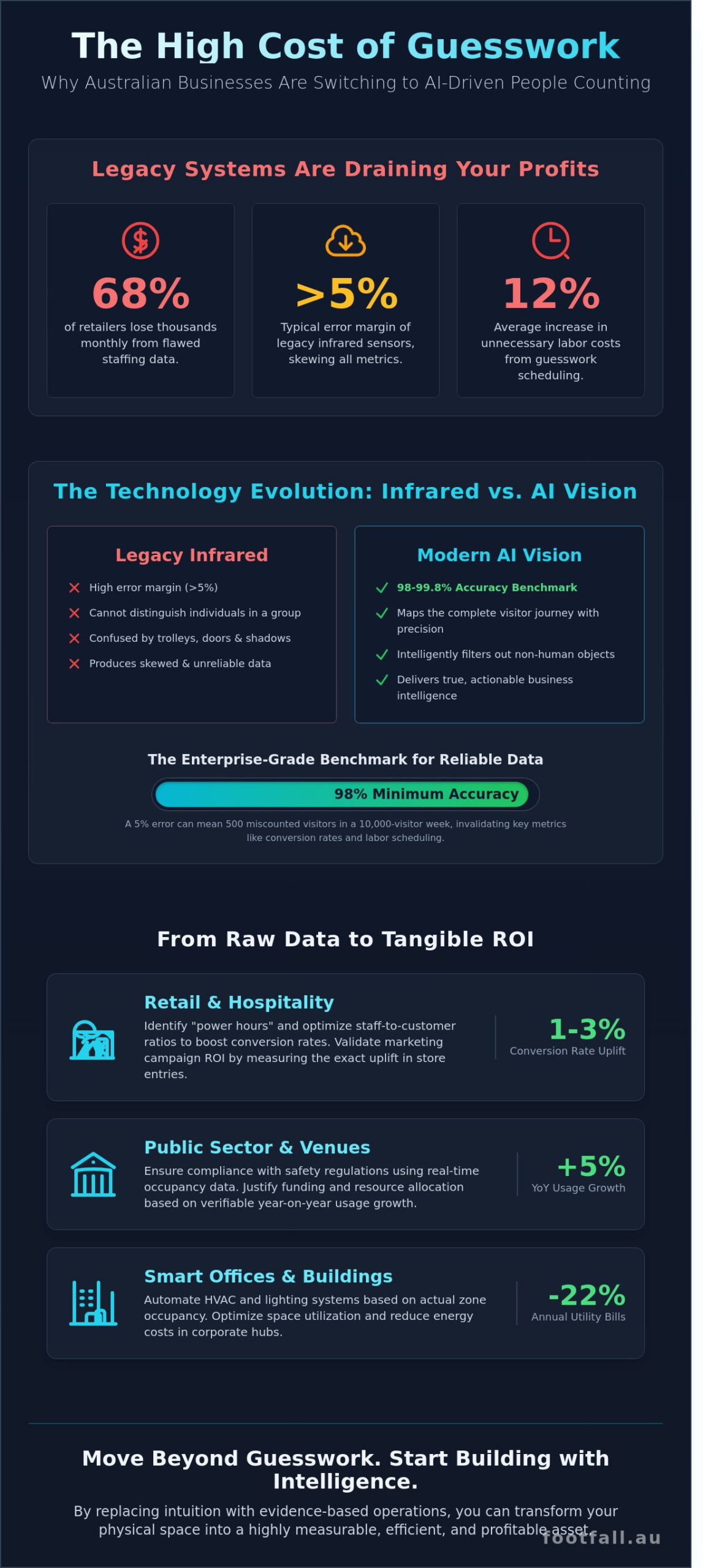
Approximately 68% of Australian retailers lose thousands in A$ every month because they schedule staff based on flawed data from legacy infrared sensors. These outdated tools often fail to distinguish between a family group and a single shopper, leading to skewed conversion rates and inefficient rostering. Implementing modern people counting systems Australia provides the clarity needed to stop the guesswork. You likely already suspect that your current traffic reports don’t reflect the reality of your shop floor. It’s a common frustration when manual counts don’t align with your POS data and labor costs continue to climb.
This guide promises to transform that raw visitor data into a strategic asset. You’ll discover how AI-driven sensors deliver 98% accuracy while integrating seamlessly with your existing business software to automate staff scheduling. We’ll examine the specific hardware and spatial analytics required to decode the visitor journey and drive measurable growth in 2026. By the end, you’ll have a clear roadmap for replacing intuition with evidence-based operations that respect both your bottom line and the customer experience.
Key Takeaways
- Learn how modern people counting systems Australia utilize AI-driven spatial intelligence to optimize labor costs and navigate the challenges of the local retail market.
- Understand why 98% accuracy is now the essential benchmark for enterprise-grade AI vision technology, moving beyond the limitations of legacy infrared sensors.
- Evaluate your infrastructure requirements using our buyer’s framework to ensure seamless scalability, whether managing a single boutique or a 500-store national rollout.
- Discover how to correlate foot traffic with sales data to identify “power hours” and calculate true conversion rates for peak operational excellence.
- Leverage two decades of local expertise to implement reliable hardware that transforms complex visitor journeys into simple, actionable business intelligence.
Why People Counting Systems are Critical for Australian Businesses in 2026
In 2026, the definition of a “visit” has transformed. We’ve moved past basic infrared beams that simply count breaks in a light path. Modern people counting systems Australia now leverage AI-driven spatial intelligence to map human movement with 99.8% accuracy. This transition is essential for local businesses facing the highest minimum wage in the world. With the national minimum wage reaching A$24.10 per hour in July 2024, every rostered hour must generate measurable value. Relying on a manager’s “gut feel” in high-stakes environments like Sydney’s Pitt Street Mall or Melbourne’s Bourke Street results in a 12% average increase in unnecessary labour costs.
Understanding the historical context of people counting technologies shows how far we’ve come from manual tallying to real-time data streams. Today, the focus has shifted from simple entry and exit monitoring to decoding the full visitor journey. We track how a customer moves from the window display to the back of the store, identifying “cold zones” that waste premium floor space. This data allows for precision-engineered layouts that mirror actual consumer behaviour rather than theoretical traffic flows.
Competition in major Australian metros is no longer just about product range; it’s about operational efficiency. Businesses that haven’t integrated spatial analytics find themselves overstaffed during quiet Tuesday mornings and understaffed during the critical Saturday afternoon rush. Data-driven logic replaces guesswork, ensuring that every operational decision is backed by hard evidence of human movement.
The ROI of Visitor Intelligence
Retailers in CBD precincts pay some of the highest rents globally. In Sydney, prime retail space often exceeds A$10,000 per square metre. Missing a single peak hour of traffic due to poor staffing isn’t just a mistake; it’s a direct hit to the bottom line. Accurate footfall data validates the A$50,000 spent on a national marketing campaign by showing the exact uplift in store entries. Visitor Intelligence is the bridge between physical traffic and digital-style analytics.
Industry-Specific Applications
- Retail: Implement people counting systems Australia to drive conversion rates. If 1,000 people enter but only 50 buy, the data identifies that a 1:20 staff-to-customer ratio during the 1:00 PM rush is the bottleneck.
- Public Sector: In Brisbane’s State Library or the National Museum in Canberra, occupancy data ensures compliance with safety regulations while justifying government funding based on 5% year-on-year usage growth.
- Smart Offices: Corporate hubs in Perth and Adelaide use footfall sensors to automate HVAC systems. Reducing energy in unoccupied zones can cut utility bills by 22% annually.
The Australian market demands this level of precision. By treating foot traffic as a narrative of human movement, businesses can stay ahead of shifting consumer trends. This logical, structured approach to data ensures that physical spaces remain as measurable and optimisable as any e-commerce platform.
Comparing People Counting Technologies: 3D, ToF, and AI
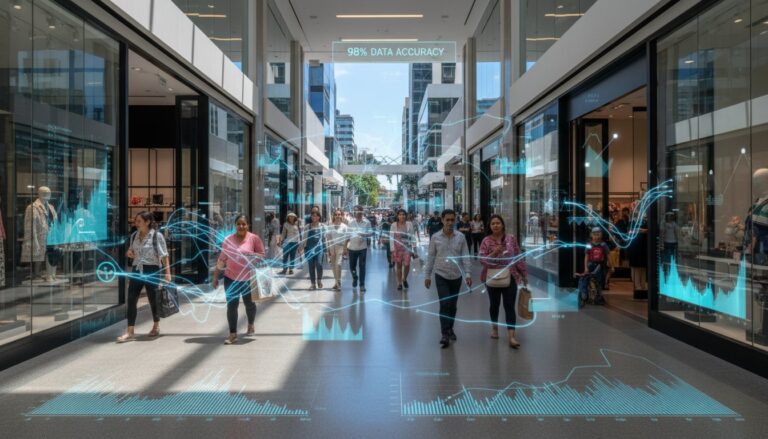
Understanding how people move through physical spaces has shifted from guesswork to a precise science. Early systems relied on infrared break-beams. These sensors often failed when two people entered at once or when a group walked through a doorway together. Modern people counting systems Australia now demand 98% accuracy as a minimum benchmark for enterprise-grade performance. This level of precision allows retailers to calculate conversion rates with confidence, knowing the data isn’t skewed by shadows, shopping trolleys, or children.
A 5% error margin in a store with 10,000 weekly visitors means 500 miscounted people. That’s enough to invalidate your labor scheduling and marketing ROI calculations. High-performance hardware like the FootfallCam Pro2 utilizes dual-lens technology to create a 3D depth map. Entry-level sensors often lack the processing power to filter out non-human objects like swinging doors or moving displays. This technology is already being used at a massive scale. For example, the City of Melbourne’s Pedestrian Counting System tracks millions of movements monthly to help urban planners optimize city infrastructure based on actual usage patterns rather than estimates.
Australian businesses must also navigate strict legal frameworks. The Privacy Act 1988 requires that data collection doesn’t compromise individual anonymity. Leading systems solve this by processing all data “at the edge.” The device counts the person then immediately discards the video frame. No personally identifiable information (PII) ever leaves the sensor or reaches the cloud. This ensures compliance while providing the granular data needed for growth.
AI Stereo Vision vs. Time-of-Flight (ToF)
Stereo Vision uses two lenses to mimic human depth perception. It’s the gold standard for differentiating between adults and children or identifying specific objects like strollers. It works best in standard retail lighting where contrast is clear. Time-of-Flight (ToF) sensors emit light pulses to measure distance based on the speed of light. They excel in pitch-black environments or areas with extreme glare. Choosing between them depends on your ceiling height. Stereo vision thrives at 2.5 to 4.5 meters, while ToF handles challenging shadows and low-light corners with higher reliability.
Advanced Metrics: Beyond the In/Out Count
Modern people counting systems Australia provide more than just a simple tally. Dwell time analysis measures how long a customer stays in a specific zone. This helps retailers understand if a window display is actually stopping traffic or if customers are queuing too long. Heatmapping identifies “dead zones” where floor space is being wasted. You can also set up exclusion lines to automatically remove staff members or security guards from your final data. This ensures your conversion metrics reflect genuine customer intent. If you want to see how these metrics apply to your specific layout, you can explore our range of AI sensors to find the right fit for your business.
- Dwell Time: Measures engagement levels at specific kiosks or displays.
- Heatmaps: Visualizes the most and least popular paths in your store.
- Staff Exclusion: Uses tags or AI shape recognition to keep data clean.
- Queue Management: Alerts managers when wait times exceed a set threshold.
Choosing the Best System: A Buyer’s Framework
Selecting the right technology requires a balance between site-specific constraints and long-term business goals. Infrastructure serves as your starting point. Most modern people counting systems Australia offers rely on Power over Ethernet (PoE). This provides a stable, wired connection that ensures 99.5% uptime compared to Wi-Fi, which often suffers from interference in high-density shopping centres. If you’re managing a single boutique in Hobart, a standalone Wi-Fi sensor might suffice. However, a national 500-store rollout demands a scalable cloud architecture. This allows you to push firmware updates and monitor sensor health across thousands of kilometres from a single dashboard without sending technicians to every site.
Integration turns raw numbers into actionable intelligence. Your footfall data shouldn’t live in a vacuum; it needs to talk to your Point of Sale (POS) and ERP systems. When you link visitor counts with transaction data, you calculate your true conversion rate. In a 2023 performance review of an Australian fashion retailer, a 2% increase in conversion across a 50-store network translated to an additional A$1.2 million in annual revenue. This level of insight is only possible through seamless API integrations.
Local support is the final pillar of a successful implementation. Relying on overseas technical assistance leads to 12-hour delays and missed data during peak periods. Australian-based support ensures that if a sensor goes offline in Perth on a Friday afternoon, it’s back in service before the Saturday morning rush. You need a partner who understands the Australian retail calendar, from Boxing Day sales to EOFY surges.
- Power over Ethernet (PoE): Preferred for 24/7 reliability and data security.
- Scalability: Centralised management for any number of locations.
- Local Expertise: On-shore technicians who operate in your time zone.
- Data Synergy: Connecting footfall to POS, ERP, and staff rosters.
The Legacy Swap Out: Upgrading Your Old System
Older systems often suffer from “data drift,” where accuracy drops below 85% due to aging sensors or outdated algorithms. You’ll notice ghost counts or flatlines during busy periods. The Footfall Australia Legacy Swap Out Plan addresses this by replacing obsolete hardware with AI-driven sensors while utilizing existing cabling where possible. This approach reduced installation costs by 30% in a 2023 project for a major national pharmacy chain. We schedule overnight installations to ensure zero downtime for your operations, keeping your data stream continuous during the transition.
CCTV vs. Dedicated People Counters
Standard security cameras often fail at counting because they’re mounted at wide angles to maximize coverage. This perspective leads to occlusion, where one person hides another, resulting in a 15% to 20% undercount. Dedicated 3D AI sensors look straight down, achieving 98% accuracy even in crowded entrances. For businesses with high-quality existing infrastructure, the FootfallCam Centroid acts as a bridge. This AI gateway processes feeds from your current CCTV, turning them into smart people counting systems Australia can rely on without the cost of new hardware. It’s a strategic choice for sites where mounting new sensors is physically restricted.
Implementing Footfall Data for Operational Excellence
Data loses its value if it remains trapped in a spreadsheet. To extract a return on investment from people counting systems Australia, you must translate raw numbers into specific floor-level actions. High-performing retailers follow a four-step framework to turn visitor analytics into a competitive advantage.
- Step 1: Identifying peak hours and power hours. Distinguish between high-traffic periods (peak hours) and times when conversion probability is highest (power hours). This allows you to deploy your most experienced sales staff when they can influence the largest transactions.
- Step 2: Correlating traffic with sales. Raw revenue figures are deceptive. By integrating footfall data with your Point of Sale (POS) system, you calculate your true conversion rate. If traffic increases by 10% but sales remain flat, your store has a service or stock issue, not a marketing problem.
- Step 3: A/B testing window displays and layouts. Use the “turn-in rate” to measure how many passersby actually enter the store. Compare two different window displays over two-week intervals to see which design drives more physical traffic.
- Step 4: Setting traffic-based KPIs. Stop judging store managers solely on total revenue. A manager who achieves a 25% conversion rate on a slow Tuesday is often more efficient than one who hits targets during a busy Saturday rush despite a 10% conversion rate.
Staffing Optimisation for Australian Retail
Australian retailers face some of the highest labour costs globally. Matching rosters to visitor flow is the most effective way to protect margins. One Sydney-based fashion retailer utilised FootfallCam data in early 2024 to identify a two-hour “dead zone” on Tuesday mornings. By shifting those hours to a busy Thursday night trade, they reduced overall labour costs by 15% while simultaneously increasing sales floor coverage during high-intent periods. This precision prevents staff burnout during unexpected rushes and eliminates the “wage theft” of paying for idle time during quiet periods.
The Power of FootfallCam V9 Software
The FootfallCam V9 software acts as the central nervous system for your retail intelligence. It’s designed to remove the friction of manual data analysis through a highly intuitive, customisable dashboard. You don’t need to be a data scientist to find actionable insights; the system handles the heavy lifting of spatial analytics and trend forecasting.
Automated reporting is a core feature for busy operations. You can configure the software to deliver a “Weekly Performance Digest” to every store manager’s inbox at 8:00 AM every Monday. These reports highlight conversion trends and identify missed opportunities from the previous week. Stakeholders see different views based on their needs. A CEO might view a high-level regional heat map showing which Australian states are over-performing, while a Store Manager sees a granular hourly breakdown of staff-to-customer ratios. This ensures everyone in the organisation makes decisions based on the same objective reality.
Ready to transform your store’s performance with precision data? Explore our range of people counting systems Australia to find the right fit for your business.
Why Footfall Australia is the Strategic Choice for 2026
Since 2004, Footfall Australia has provided the technical backbone for data-driven retail management. For over 20 years, we’ve helped businesses move beyond guesswork by providing precise metrics on visitor behavior. Choosing people counting systems Australia involves more than just buying hardware; it requires a partner with a long-term commitment to the local market. Our history allows us to understand the specific seasonal shifts and economic cycles that affect Australian retailers, from the busy CBDs to regional shopping hubs.
The FootfallCam Pro2 remains the gold standard for reliability in 2026. This sensor uses advanced 3D stereoscopic vision to achieve 99.5% accuracy, even in high-density traffic or complex lighting. We’ve deployed these units in over 1,500 locations across the continent, proving their durability in diverse environments. The hardware doesn’t just count heads; it filters out children, trolleys, and staff groups to ensure your conversion rates reflect true potential customers. Reliability is the foundation of our strategy because inconsistent data leads to poor investment decisions.
Our national coverage ensures that your business receives consistent service whether you’re located in Perth, Brisbane, or anywhere in between. We provide two distinct tiers of assistance to maintain your data integrity:
- Basic Support Plan: Includes remote technical troubleshooting and firmware updates to keep your sensors running at peak performance.
- Premium Support Plan: Offers proactive health checks every 24 hours. Our team identifies potential connectivity or accuracy issues before they impact your weekly reporting cycle, providing total peace of mind for multi-site managers.
Data is only valuable if it’s continuous. By offering these structured plans, we ensure that your people counting systems Australia investment yields a high return through uninterrupted insights and professional oversight.
Our Local Partner Network
We maintain a dedicated network of certified technicians in every major Australian city to provide boots-on-the-ground support. Local knowledge is essential for successful installation. A technician in Sydney understands the architectural nuances of heritage-listed storefronts, while our Perth partners are experts in the logistical requirements of Western Australian retail parks. This proximity allows us to guarantee 48-hour response times for on-site maintenance, ensuring your visitor journey data never has a gap. We don’t rely on fly-in support; we use local experts who understand your specific environment.
Getting Started with Footfall Australia
Our consultation process is designed for clarity and efficiency. We begin with a comprehensive site survey to analyze your entry points and ceiling heights, using spatial geometry to eliminate blind spots. Once we’ve tailored a hardware layout, we provide a full demonstration of the FootfallCam V9 software. This platform integrates your traffic data with POS systems to reveal real-time conversion rates and dwell times. We transform raw numbers into a narrative of human movement, giving you the power to optimize staffing and marketing spend based on evidence. It’s time to see what you’ve been missing. Enquire about a custom people counting solution today to begin your data-led transformation.
Future-Proof Your Operations with Data-Driven Intelligence
The landscape of retail and public space management in 2026 demands more than just intuition. It requires the high-precision intelligence that only advanced people counting systems Australia can provide. By integrating FootfallCam Pro2 technology, you move beyond simple tallies to unlock 98%+ accuracy in conversion rates and dwell time analysis. This data-driven approach ensures your operational decisions rest on a foundation of evidence. It’s about transforming raw foot traffic into a narrative of human movement that informs staffing and spatial design with scientific precision.
Since 2004, Footfall Australia has partnered with Australian enterprises to turn visitor patterns into measurable growth. We provide local technical support across every Australian state, ensuring your hardware remains optimized and your data stays actionable. Moving to AI-driven spatial analytics isn’t just a technical upgrade; it’s a strategic move to stay ahead of shifting consumer trends. You’ll gain the clarity needed to optimize every A$ spent on floor management and marketing efforts.
Request a Quote for Your Custom People Counting Solution
Take the first step toward total operational visibility and lead your business into a more profitable and efficient 2026.
Frequently Asked Questions
How accurate are modern people counting systems in Australia?
Modern 3D sensors achieve 98% to 99.5% accuracy under standard lighting conditions. These systems use Time-of-Flight technology to distinguish between adults, children, and shopping carts. High-precision people counting systems Australia wide ensure that data remains reliable even in high-density environments like the Queen Victoria Building or major Westfield centers. This level of precision eliminates the 15% margin of error often found in legacy infrared beam counters used in the 2010s.
Can people counters distinguish between staff and customers?
Advanced systems distinguish staff from visitors by utilizing Bluetooth Low Energy (BLE) tags or AI-driven height filtering. Staff members wear a small, lightweight tag that the sensor recognizes and automatically subtracts from the total count. This ensures your conversion rates reflect genuine customer intent rather than employee movements. Without this feature, frequent staff entry and exit can inflate foot traffic data by up to 20% in smaller boutique retail environments.
Do people counting systems record video or store personal data?
Professional sensors process data locally and do not record identifiable video footage or store personal information. These devices convert human movement into anonymous X-Y coordinates or heatmaps, ensuring 100% compliance with the Australian Privacy Act 1988. No facial recognition data is captured or transmitted. You receive actionable insights into visitor journeys without compromising the individual privacy of your customers or employees. This approach protects your brand from data breach risks.
How much does a professional people counting system cost in Australia?
A professional entry-level 3D sensor typically costs between A$850 and A$1,400 per doorway. For complex, wide-opening installations, high-end LiDAR units can reach A$2,800. Annual software subscriptions for cloud-based reporting usually range from A$200 to A$500 per device. While cheaper DIY options exist for under A$300, they lack the 98% accuracy required for serious strategic planning and fail to provide a sustainable return on investment over a five-year period.
Can I integrate my people counter data with my POS system?
You can integrate your traffic data with major POS platforms like Square, Shopify, or Vend through a standard API. This connection allows the system to automatically calculate your conversion rate by dividing total transactions by total footfall. Modern people counting systems Australia businesses use provide a unified dashboard where you can see exactly how a 10% increase in traffic affects your bottom line in real time. It’s a seamless way to track performance.
What happens if my internet goes down? Does the counter stop working?
The counter continues to function normally during an internet outage by storing data on its internal memory. Most industrial-grade sensors have enough onboard storage to hold up to 30 days of traffic records. Once the connection is restored, the device automatically syncs the cached data to the cloud. You won’t lose a single visitor count during a temporary NBN failure or router reset. This local redundancy ensures your long-term datasets remain complete and accurate.
How high can a people counter be mounted in a warehouse or tall foyer?
Standard 3D sensors operate effectively at heights between 2.2 and 4.5 meters. For tall foyers or industrial warehouses, specialized long-range sensors can be mounted up to 20 meters high while maintaining 95% accuracy. It’s vital to select the correct lens for your specific ceiling height to avoid blind spots. We recommend a site audit for any ceiling exceeding 5 meters to ensure optimal sensor placement and data integrity in large-scale Australian venues.
Do I need a people counter if I already have CCTV cameras installed?
Dedicated counters are necessary because standard CCTV cameras often struggle with depth perception and overlapping shadows. While some security software offers basic counting, it rarely exceeds 80% accuracy during peak periods. Dedicated 3D sensors provide 99% accuracy and include specific metrics like dwell time and path analysis. Investing in specialized hardware ensures your strategic decisions are based on precise evidence rather than the estimated figures provided by standard security footage.