How to Identify Retail Peak Hours: A Data-Driven Guide for Australian Businesses
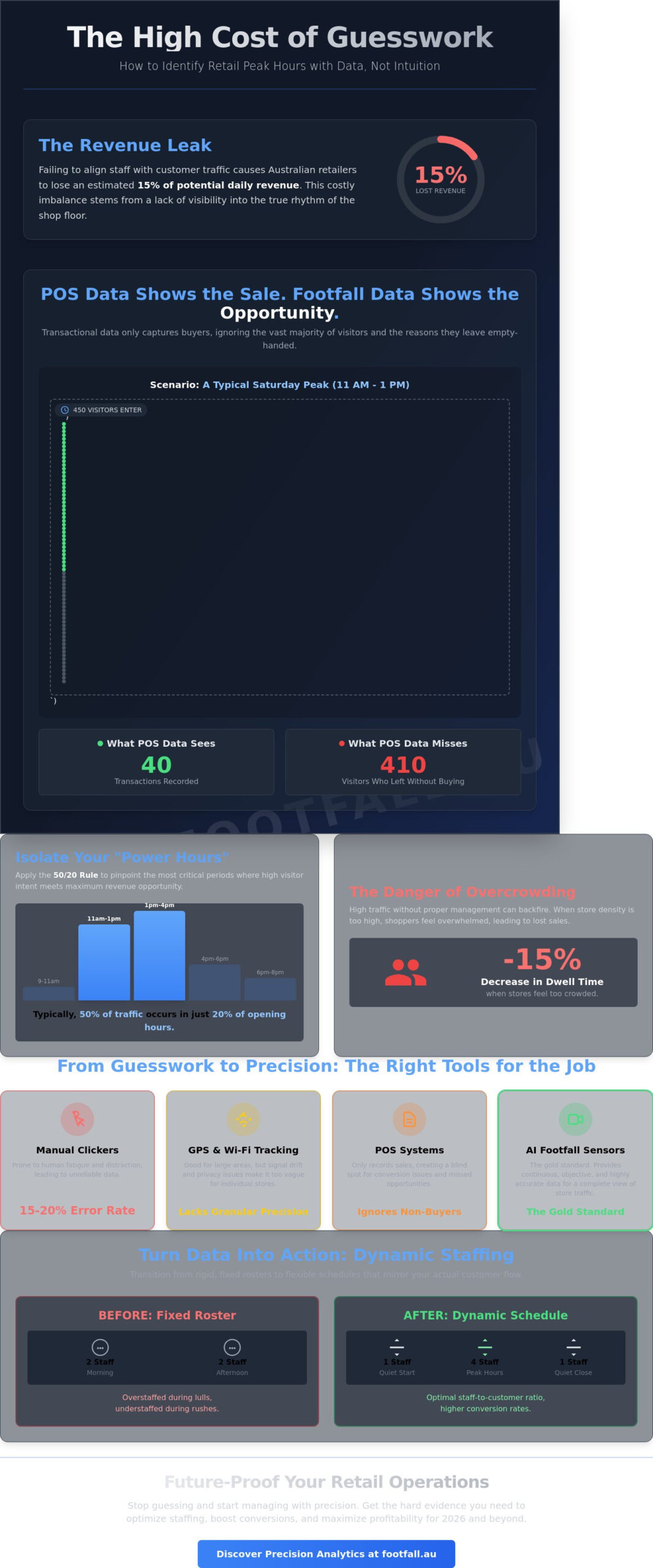
Recent industry data suggests that Australian retailers lose approximately 15% of their potential daily revenue when they fail to align staffing levels with actual customer demand. Most business owners recognize the frustration of paying high labor costs during a quiet Tuesday morning while watching sales slip away during an understaffed Saturday afternoon rush. It’s a costly imbalance that stems from a lack of visibility into the true rhythm of the shop floor.
This guide provides the precise methodology you need to identify retail peak hours with scientific accuracy, allowing you to move beyond intuition and toward evidence-based management. You’ll learn how to capitalize on your busiest periods to optimize staffing and maximize revenue through a series of actionable, data-driven steps. We’ll break down the framework for improving your staff-to-customer ratios and show you how to distinguish high-intent buyers from casual browsers to drive higher conversion rates across every shift.
Key Takeaways
- Understand the psychological link between peak periods and dwell time to better capture visitor potential during high-volume windows.
- Evaluate the limitations of POS data and learn how to identify retail peak hours using advanced footfall sensors for a complete view of store traffic.
- Apply the 50/20 Rule to isolate your “Power Hours,” where high visitor intent meets maximum revenue opportunity.
- Transition from fixed rosters to dynamic, traffic-aligned scheduling to optimize your staff-to-customer ratio and boost conversion rates.
- Discover how precision hardware and multi-site analytics software provide the hard evidence needed to future-proof your Australian retail operations for 2026.
The Science of Retail Peak Hours: Why Timing is Everything
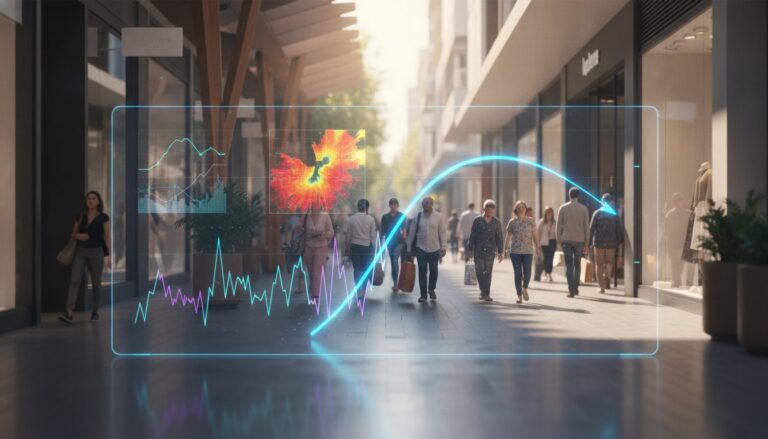
Retail success in 2026 hinges on precision. Retail peak hours represent more than just busy periods; they are high-velocity windows where visitor volume reaches its maximum potential. In Australia, the cost of staffing and energy continues to climb. The Fair Work Commission’s 3.75% increase to the national minimum wage in July 2024 set a trajectory that makes every rostered hour critical to the bottom line. To identify retail peak hours correctly, you must look beyond the crowded shop floor and analyze the data behind the movement.
High traffic significantly affects customer psychology and dwell time. Research indicates that when store density exceeds a specific threshold, shoppers often feel overwhelmed, leading to a 15% decrease in time spent browsing. If you don’t manage these peaks with precision, you risk driving customers away before they reach the checkout. Identifying “Dead Zones” is equally vital for operational health. Paying for a full floor team during a 2:00 PM slump wastes capital that could be reinvested into peak-hour service. Precision timing transforms these quiet periods from financial drains into strategic opportunities for inventory management or staff training.
Sales Peaks vs. Traffic Peaks: The Critical Distinction
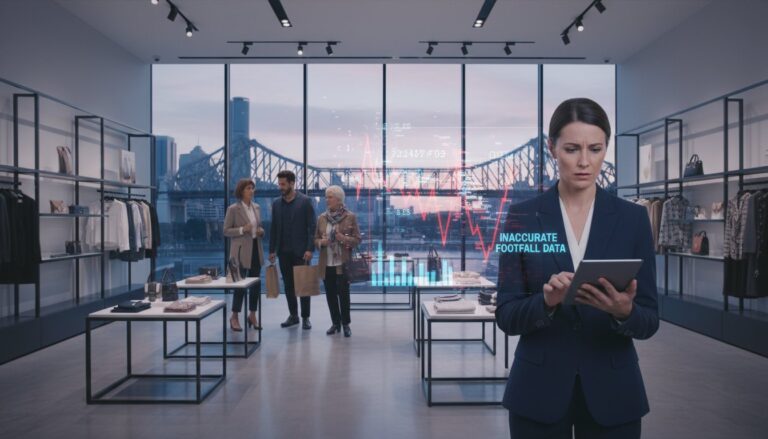
Your Point of Sale (POS) system provides a detailed record of what happened, but it ignores what didn’t happen. A store might see 450 visitors between 11:00 AM and 1:00 PM but only record 40 transactions. This gap reveals a significant missed opportunity window. Modern Retail intelligence tools bridge this gap by comparing door counts against transaction data in real time. If traffic is high while sales remain flat, you’ve identified a service bottleneck. Perhaps the queue was too long, or staff were occupied with stock instead of shoppers. Without traffic data, those potential customers remain invisible statistics.
Why ‘Gut Feeling’ Fails in Modern Retail Management
Relying on floor staff intuition is a gamble that modern retailers can’t afford. Staff often perceive “busyness” based on their own stress levels rather than actual visitor numbers. A chaotic hour with three difficult customers feels busier to a team member than a steady, profitable stream of thirty efficient shoppers. External factors like the shifting Australian weather patterns or localized events can disrupt traditional traffic flows.
Data allows you to move from reactive panic to proactive, evidence-based management. It ensures you aren’t overstaffed during a rainy Tuesday or under-resourced during an unseasonable heatwave. This transition is the only reliable way to identify retail peak hours with the accuracy required for modern profitability. By removing guesswork, you create a stable environment where both staff performance and customer satisfaction can thrive.
Methods to Identify Retail Peak Hours: POS vs. Footfall Sensors
Traditionally, retailers relied on Point of Sale (POS) systems to identify retail peak hours. This method assumes that sales volume mirrors store activity. It’s a flawed metric. POS data captures the conclusion of a customer journey, not the beginning or the middle. It ignores everyone who walked in, looked around, and left without spending a cent. Relying on legacy methods to identify retail peak hours often leaves managers blind to the 30% of visitors who walk out empty-handed during busy periods.
GPS and Wi-Fi tracking offer a broader perspective by monitoring signals from mobile devices. These technologies map consumer movement across entire shopping precincts. While useful for high-level urban planning, they lack the granular precision needed for individual storefronts. Signal drift and privacy restrictions often result in data that’s too vague for floor-level decision-making. Manual clickers remain in use for approximately 12% of independent Australian retail audits, yet they suffer from a 15% to 20% margin of error due to human fatigue and distraction. Automated systems eliminate this variability, providing a continuous, objective stream of data for long-term trend analysis.
The Limitations of Transactional Data
A high transaction count often masks a conversion crisis. If 500 people enter a store but only 100 make a purchase, your peak hour isn’t a success; it’s a missed opportunity. High foot traffic coupled with low sales typically indicates the “Queue Abandonment” factor. When shoppers see long lines or crowded aisles, they often choose to leave rather than wait. Sales data alone cannot calculate true store capacity because it ignores the customers who leave without making a purchase.
Leveraging AI-Driven People Counters for Precision
AI-powered sensors represent the gold standard for accuracy in modern retail. 3D stereoscopic sensors use dual lenses to perceive depth, which allows the system to distinguish between human shapes and inanimate objects. These systems effectively filter out non-shoppers like staff, delivery personnel, and children, resulting in a 98% accuracy rate. This precision ensures that management decisions are based on clean, actionable data.
- Real-time dashboards: Managers can monitor occupancy levels instantly to adjust floor coverage or open new registers.
- BI Integration: Connecting sensor data with existing business intelligence tools provides a 360-degree view of the visitor journey.
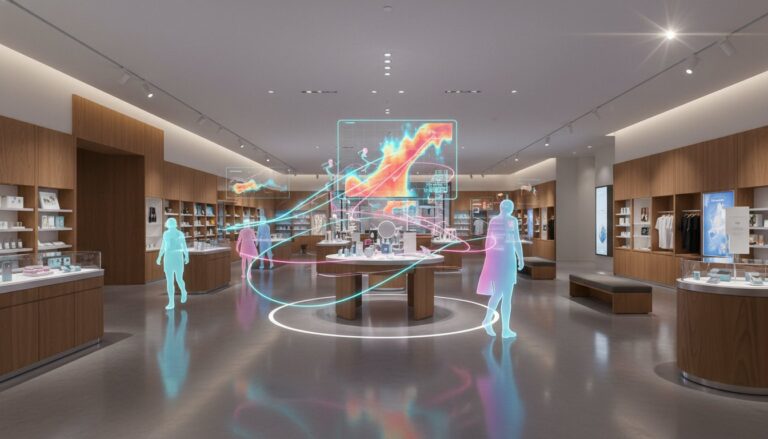
- Spatial Analytics: Understanding how people move through a space helps in optimizing product placement and aisle flow.
By moving toward automated sensing, you can optimise your staffing levels based on actual visitor patterns rather than historical sales receipts. This strategic shift turns raw numbers into a clear narrative of human behavior. It empowers you to manage your space with the quiet confidence that comes from evidence-based logic.
The 50/20 Rule and Beyond: Analysing Traffic Patterns
The 50/20 rule remains a fundamental principle in Australian retail management. It dictates that 50% of a store’s weekly revenue typically occurs within just 20% of its operating hours. Understanding this concentration allows you to move beyond general scheduling and start optimizing for profit. To identify retail peak hours with this level of precision, you must look past simple door counts and examine the relationship between volume and value.
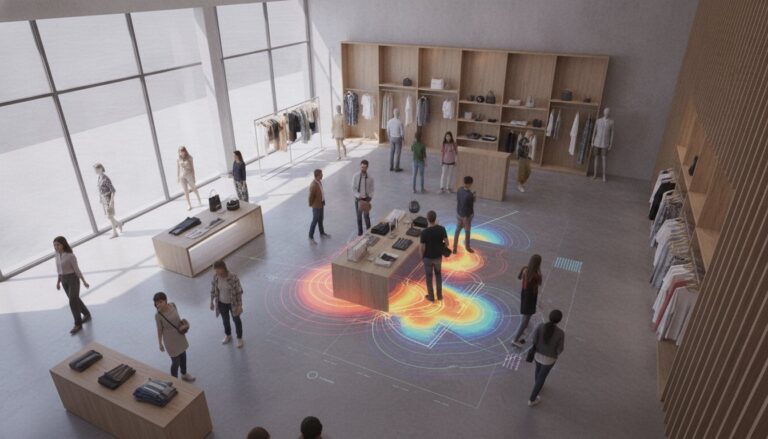
Identifying your Power Hours involves finding the specific windows where high traffic meets high purchase intent. These aren’t just the busiest times; they are the moments where your best staff can influence the highest number of transactions. When you use spatial analytics to track the visitor journey, you see exactly how these customers move. Data often shows that during peak times, 60% of visitors may bypass certain zones entirely due to crowding. Heat mapping identifies these bottlenecks, showing you where store layout friction is actively killing your conversion rate.
Calculating the Capture Rate During Peak Periods
Your capture rate is a vital health metric for any physical location. You calculate it using a simple formula: (Number of store entrants / Total passing foot traffic) x 100. During peak periods, this rate often declines. This happens because crowded aisles or visible queues act as psychological deterrents to passersby. In Australian specialty retail, a healthy capture rate typically sits between 8% and 15%. If your rate drops below 6% during busy windows, you’re losing potential customers to perceived friction before they even cross the threshold. Monitoring this ensures your storefront remains inviting even when the floor is at capacity.
Understanding the ‘Power Hour’ Phenomenon
Staff expertise has its highest ROI during Power Hours. These windows aren’t static, and relying on historical gut feel is a risk. Changing work-from-home patterns in major hubs like Sydney and Melbourne have shifted traditional peaks significantly. Friday lunchtimes in CBD locations might now see 20% more traffic than they did in 2019, while Saturday mornings might have softened. Leveraging footfall data analysis helps you predict these shifts with scientific accuracy. When you identify retail peak hours using real-time evidence, you can align your most experienced team members with the periods of highest opportunity. This strategic alignment turns a busy period into a high-conversion event rather than a chaotic scramble.
Turning Peak Hour Data into Actionable Staffing Strategies
Raw numbers only provide value when they influence your daily operations. The ability to identify retail peak hours with precision allows you to move away from fixed shifts toward traffic-aligned rosters. This shift ensures your highest-paid assets, your people, are exactly where they need to be the moment foot traffic climbs. It replaces the “gut feeling” of a store manager with a calculated blueprint for floor coverage.
Data-Driven Staffing: Matching Labour to Traffic
Traditional rosters often rely on historical sales, but sales don’t account for the customers who left because the queue was too long. By using footfall data, you can establish a precise staff-to-customer ratio. Aiming for a 1:10 or 1:15 ratio during peak windows maximizes conversion rates. It prevents the common 22% productivity loss seen during morning lulls and the service fatigue that occurs during understaffed lunch rushes. Managers can use live occupancy dashboards to move staff from inventory tasks to the shop floor the moment traffic spikes. This proactive approach reduces employee burnout and ensures no customer is left waiting.
- Eliminate overstaffing: Identify the specific 90-minute windows where staff levels can be reduced without impacting service.
- Dynamic positioning: Use real-time data to shift employees from back-of-house roles to the sales floor during sudden surges.
- Operational scheduling: Plan inventory replenishment and deep cleaning during verified “dead zones” where traffic consistently drops by 40% or more.
Strategic Marketing and Operational Efficiency
Data reveals more than just when to staff up; it shows when to push harder. If your 10:00 AM to 11:30 AM window shows a consistent 35% dip in visitors, that is your target for “Happy Hour” promotions or loyalty rewards. Measuring the success of these campaigns requires looking at footfall lift alongside sales lift. A campaign might increase sales by 10%, but if it increased footfall by 25%, your conversion strategy needs adjustment. Referencing retail footfall analysis Australia helps you understand if your traffic dips are unique to your brand or part of a broader precinct trend. You can also optimize opening hours. Many Australian retailers find that closing 60 minutes earlier on a Monday saves more in overheads than the marginal revenue generated during that quiet period.
Stop guessing and start growing with evidence-based management. View our data solutions to transform your visitor traffic into measurable profit.
Future-Proofing with FootfallCam: Precision Analytics for 2026
To accurately identify retail peak hours in 2026, Australian retailers require a sophisticated ecosystem that translates physical movement into strategic assets. Guesswork no longer suffices in a competitive landscape where labor costs and consumer expectations continue to climb. The FootfallCam Pro2 serves as the foundational technology for this shift, providing the granular data needed to optimize staffing and energy usage. By leveraging AI-driven insights, businesses can move beyond simple counting and begin to understand the narrative of their floor space.
The FootfallCam V9 Software elevates this data by allowing for multi-site peak hour comparison. This capability is vital for national chains that need to synchronize operations across different states. When you connect your people counter to your existing POS system, the software correlates foot traffic with sales transactions. This integration reveals the conversion rate during your busiest times, helping you determine if high traffic is actually driving revenue or if missed opportunities are occurring due to long queues.
Key Features of the FootfallCam Pro2
- AI-Based Object Counting: The Pro2 maintains 99.5% accuracy in challenging lighting conditions, such as high-glare glass shopfronts or dim boutique environments.
- Privacy-Compliant Technology: It processes all data at the edge, ensuring it doesn’t store personal identifiable information, which meets strict Australian privacy standards.
- Comprehensive Hardware: You can learn more about the hardware in our FootfallCam Pro2 buying guide.
Precision sensors allow managers to identify retail peak hours across multiple time zones and store formats. This clarity ensures that your most experienced staff members are on the floor when the highest density of visitors is present. It eliminates the inefficiency of overstaffing during quiet periods while protecting the customer experience during the rush.
The Advantage of Perpetual Licensing and Local Support
Investing in the right technology requires a focus on long-term ROI. FootfallCam offers a one-time hardware purchase with no hidden monthly fees, making it a smarter financial choice for 2026. Ongoing reliability is guaranteed through professional people counter support, which is essential for maintaining data integrity over several years. Footfall Australia’s national network provides the local expertise needed for large-scale rollouts, ensuring your system stays online and calibrated. This local presence means technical issues are resolved quickly, preventing gaps in your data stream that could lead to flawed business decisions.
Mastering Your Store’s Pulse for Long-Term Growth
Moving beyond guesswork is the first step toward operational excellence. You’ve seen how relying solely on transaction data misses the significant percentage of visitors who leave without a purchase. By using AI-powered sensors to identify retail peak hours, you gain a transparent view of the visitor journey. This allows you to apply the 50/20 rule effectively, ensuring your highest-performing staff are on the floor during the busiest 20% of the day to capture every conversion opportunity. Since 2004, Footfall Australia has helped local businesses replace intuition with evidence. Our technology delivers 99.5% accuracy, providing the precision needed to future-proof your strategy for 2026 and beyond. With a national support and maintenance network, you’re never left to interpret these complex spatial analytics alone. It’s time to transform your floor traffic into a measurable, actionable asset. We’re ready to help you unlock the full potential of your physical space.
Request a data-driven retail consultation from Footfall Australia and start making decisions backed by hard evidence today.
Frequently Asked Questions
How do I calculate retail peak hours for my specific store?
To identify retail peak hours, calculate the average visitor count for every hour of operation over a 30 day period. Look for consistent spikes where traffic exceeds your baseline by 25% or more. This quantitative approach removes guesswork and reveals specific windows, such as a Saturday 11:00 AM surge, where staffing must be optimized to capture every conversion opportunity.
Is POS data enough to identify when my shop is busiest?
POS data is insufficient because it only records successful transactions, ignoring the 30% to 50% of visitors who leave without a purchase. You need footfall sensors to measure the total opportunity within your space. Comparing total entries against completed sales reveals your true conversion rate, allowing you to see if you’re losing revenue during busy periods due to long queues.
What is the 50/20 rule in retail management?
The 50/20 rule dictates that you should deploy 50% of your weekly labor hours during the 20% of the week when traffic is highest. In a typical 60 hour trading week, this means concentrating your most experienced team members into the 12 busiest hours. This strategic alignment ensures that high volume periods have the necessary support to maintain a 1:15 staff to customer ratio.
How can I increase sales during my store’s peak hours?
Boost sales by increasing floor staff by 15% during peak windows to reduce wait times and improve service quality. High traffic periods are the ideal time to deploy “power hour” demonstrations or limited time offers. Data shows that a 5% increase in staff responsiveness during peak times can lift conversion rates by up to 12%, turning browsers into buyers through active engagement.
What is a good staff-to-customer ratio for an Australian retail shop?
An optimal staff to customer ratio for Australian specialty retail typically sits between 1:10 and 1:15. For service-oriented businesses like fitzpatrickoptometrists.com.au, maintaining this balance is crucial for ensuring patients receive timely care while the retail floor remains supported. If your ratio exceeds 1:20 during peak times, customer satisfaction scores often drop by 20% or more. Maintaining this balance requires precise scheduling based on historical footfall data, ensuring your team isn’t overwhelmed during the 12:00 PM to 2:00 PM lunch rush or Saturday afternoon peaks.
Do people counters work in stores with wide entrances or high ceilings?
Modern 3D LiDAR and AI powered sensors function accurately at heights up to 10 meters and can cover entrances wider than 12 meters. These systems use depth sensing technology to distinguish between adults, children, and inanimate objects like shopping trolleys. This precision ensures a 98% accuracy rate, even in complex architectural environments like large shopping centers or flagship stores with vaulted ceilings.
How often should I review my footfall traffic patterns?
Conduct a tactical review of your data every 7 days to adjust the following week’s roster. For broader strategic planning, perform a deep dive analysis every 90 days to account for seasonal shifts, such as the 30% traffic increase typically seen during the November pre-Christmas period. Regular monitoring allows you to identify retail peak hours as they shift throughout the year, protecting your bottom line.
Can I use people counting data to justify changing my trading hours?
Use footfall data to identify hours where visitor counts fall below a profitable threshold, such as the final hour of trade if it accounts for less than 2% of daily traffic. If sensors show consistent entry patterns 30 minutes before opening, you have the evidence needed to shift your operating window earlier. This data backed approach allows you to reallocate labor costs to more productive, high traffic periods.