
Problems with Inaccurate People Counters: The Strategic Cost of Bad Data
A 15% margin of error in your visitor data isn’t just a minor technical glitch; it’s a financial leak that could be costing your Australian retail operation thousands in misallocated wages every month. You likely know the frustration of watching a busy floor in Sydney or Melbourne only to find your digital reports show a dip in traffic. It’s unsettling when your conversion metrics don’t align with your POS sales trends, leaving you to question every strategic decision you make.
These problems with inaccurate people counters turn your high-level planning into a guessing game. We agree that data is only valuable if it leads to a specific, positive change in your operations. You’ll discover how unreliable footfall data sabotages your ROI and learn about the technical shift required to achieve 99.5% accuracy. This guide provides a framework to quantify the financial loss of bad data and a roadmap to upgrading your facility with AI-driven 3D sensors.
Key Takeaways
- Understand how a minor 10% discrepancy in footfall data can escalate into a 40% error in conversion forecasting, fundamentally undermining your retail strategy.
- Identify the technical limitations of legacy IR beams and 2D sensors to overcome common problems with inaccurate people counters that lead to unreliable KPIs.
- Quantify the “Staffing Leak” to prevent unnecessary A$ costs in over-scheduling and ensure store performance reviews are based on precise visitor behavior.
- Discover how 3D stereoscopic vision and AI-based filtering distinguish between actual customers and non-human objects to achieve 99.5% data accuracy.
- Learn the strategic path to restoring data integrity in Australian business environments through a low-friction legacy hardware swap-out plan.
The Data Integrity Gap: Why Inaccurate People Counters Are a Strategic Risk
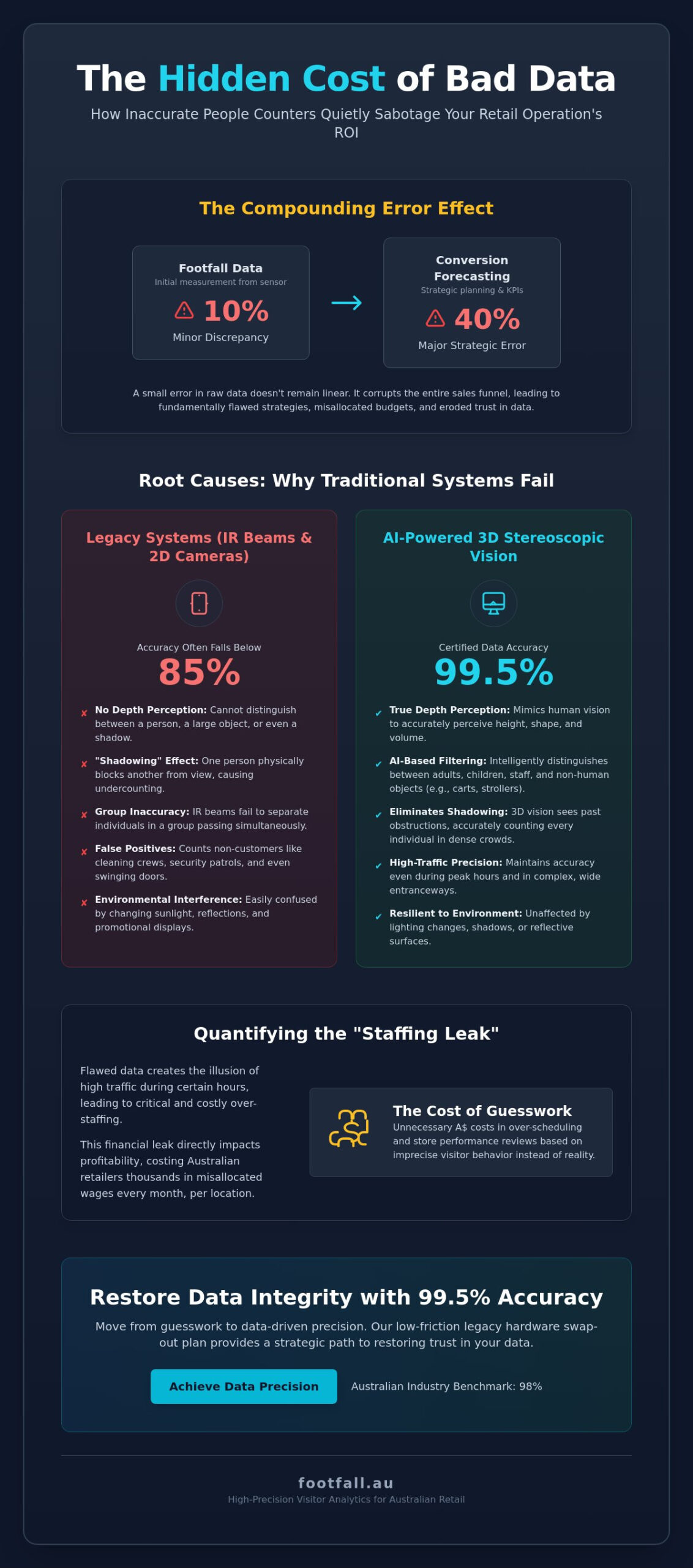
Data integrity in retail is the alignment between reported metrics and physical reality. When a sensor records 1,200 entries but only 1,000 represent unique potential customers, a Data Integrity Gap emerges. This discrepancy represents more than just a minor technical glitch; it is a fundamental strategic liability. One of the primary problems with inaccurate people counters is the compounding effect of error. A seemingly small 10% error rate in raw footfall data doesn’t remain linear. By the time that data reaches your conversion forecasting models, it often manifests as a 40% error in projected outcomes. This happens because skewed baseline figures misrepresent the entire sales funnel, leading to misallocated labor budgets and ineffective stock levels.
Reliance on flawed data forces experienced managers to revert to “gut feeling” to make operational decisions. This shift isn’t a failure of leadership but a direct failure of technology. When a dashboard suggests a peak period that clearly isn’t happening on the floor, stakeholder trust evaporates. Once a team loses faith in the numbers, the psychological cost is high. Data-driven culture dies, replaced by a cynical view of technical investments that hampers future innovation.
The Illusion of Insight
Possessing flawed data is significantly more dangerous than having no data at all. False data creates a veneer of certainty that leads to expensive mistakes. Many Traditional People Counting Systems struggle to filter out non-customer movement, such as security patrols, cleaning crews, or staff members entering and exiting during a shift. These false positives artificially inflate traffic while simultaneously suppressing your true conversion rate. The Cost of Inaccuracy is an invisible tax on retail operations.
National Standards for Data Precision
The Australian retail industry benchmark for actionable intelligence currently sits at 98% accuracy. Anything below this threshold introduces too much noise for high-stakes decision-making. Australian businesses operate in a tightening economic landscape where every A$1 spent on labor must be justified by footfall density. Precision isn’t just a technical metric; it’s a competitive necessity. To build a robust strategy for the coming years, stakeholders should consult the ultimate guide to people counting to understand how modern sensors bridge the gap between simple tallies and sophisticated spatial intelligence. High-precision data ensures that every operational adjustment is backed by hard evidence, providing a stable foundation for growth in a volatile market.
Root Causes: Why Traditional People Counting Systems Fail
Legacy systems often rely on technology that hasn’t evolved alongside modern retail environments. Many Australian retailers still use infrared (IR) beams or 2D mono-vision cameras, which create significant problems with inaccurate people counters when traffic volume increases. These sensors lack the spatial intelligence to process complex human movements, leading to data discrepancies that can exceed 20% in high-traffic scenarios. Relying on this flawed data forces business owners to make critical staffing and inventory decisions based on guesswork rather than evidence.
Limitations of 2D and Infrared Technology
Standard 2D cameras operate on flat imagery. They can’t distinguish between a human being and a life-sized floor decal or a high-contrast shadow. Without depth perception, these sensors often suffer from the “shadowing” effect, where one person physically blocks another from the camera’s view. IR beams are even more restricted. They’re generally ineffective for any entrance wider than a standard 920mm doorway, as they cannot separate individual bodies within a group passing through the beam simultaneously. This technical ceiling prevents the hardware from “seeing” the world in three dimensions, treating every dark shape as a unique visitor.
Environmental and Structural Obstacles
Physical store layouts frequently compromise older hardware performance. Motion-based sensors often struggle with swinging doors or stationary objects like promotional mannequins. If ceiling heights vary across different Australian locations, older fixed-lens sensors fail to maintain a consistent focal length. This results in “loitering” errors, where a customer standing near the entrance is counted multiple times. Environmental shifts like changing sunlight patterns or reflections from polished mall floors also trick older sensors. A cloud passing over a skylight can trigger a false count in a 2D system that relies solely on pixel changes to detect movement. These technical gaps transform simple foot traffic into a messy dataset that lacks actionable spatial intelligence.
Group dynamics present another significant hurdle. Basic counters fail to distinguish between a family of four and four individual shoppers. This distinction is vital for calculating true conversion rates and understanding purchasing intent. Maintaining these systems often leads to calibration fatigue. When sensors require manual adjustments every quarter to account for lighting shifts, and those adjustments are missed, accuracy levels typically decline by 10% annually. High-performance retail requires a more robust approach that eliminates these manual vulnerabilities and provides a foundation of data-driven logic.
Quantifying the Hidden Tax: The Cost of Bad Data on Business KPIs
Relying on flawed metrics creates a “hidden tax” that erodes profitability across every department. The problems with inaccurate people counters extend far beyond the IT department; they directly impact the bottom line of Australian businesses through misallocated resources and missed growth opportunities. When your primary data source is compromised, every subsequent calculation, from labour budgets to marketing ROI, becomes a guess rather than a strategy.
Operational Inefficiency and Labour Costs
Labour represents the largest controllable expense for most Australian retailers. Maintaining the correct staff-to-customer ratio is a delicate balance that requires precision. If a store manager in Sydney schedules three staff members when five are needed because of a 10% undercount, the cost isn’t just the missed wages. It’s the thousands of A$ in lost sales from frustrated customers who leave empty-handed. Conversely, over-scheduling based on ghost counts leads to a “staffing leak” where wages are paid for idle time, directly cutting into the store’s net margin.
A mere 5% inaccuracy in peak-hour data often results in a total breakdown of service standards during high-traffic periods like the EOFY sales or Saturday afternoon rushes. Executing a successful retail footfall analysis Australia depends entirely on the accuracy of the primary sensor, as even minor discrepancies ripple through the entire strategic plan. Without high-fidelity data, you can’t align inventory turnover with physical traffic, leading to stockouts of high-demand items or overstocking products that aren’t moving.
Marketing and Strategic Blind Spots
Marketing teams often rely on “cost per visitor” to justify national campaign spends. If your sensors are overcounting by 15%, your marketing ROI looks significantly better than it actually is, leading you to reinvest in ineffective channels. This data skew hides the true impact of seasonal trends and national holidays, making it impossible to distinguish between a successful promotion and a natural surge in organic traffic. The problems with inaccurate people counters also create a “Conversion Rate Fallacy.” When sensors fail to distinguish between staff, delivery drivers, and actual customers, store teams are often unfairly penalised for low conversion rates that don’t reflect their actual sales performance.
- Lease Negotiations: Using skewed data for long-term site selection or rent reviews can lock a business into a multi-year A$500,000 lease based on non-existent foot traffic.
- Performance Reviews: Inaccurate counts lead to unfair benchmarks, damaging staff morale and increasing turnover.
- Inventory Misalignment: Foot traffic data is critical for predicting stock turnover; bad data leads to A$10,000s in tied-up capital.
Precision is the only way to transform raw movement into actionable intelligence. By eliminating the noise of bad data, businesses move from reactive firefighting to proactive, evidence-based management.
The AI Shift: How 3D Stereoscopic Vision Solves Accuracy Problems
Legacy systems often fail because they perceive the world in two dimensions. Shadows, floor reflections, or even patterned carpets trigger false counts, which are primary contributors to the problems with inaccurate people counters. Modern 3D stereoscopic sensors solve this by mimicking human depth perception. These devices use dual lenses to create a real-time depth map, allowing the system to calculate the exact height, mass, and direction of every object passing through the entrance.
Stereoscopic Vision vs. Mono-Vision
Mono-vision sensors frequently struggle with occlusion. When two people walk shoulder-to-shoulder, a basic sensor often records them as a single visitor. 3D technology separates these individuals by identifying their unique spatial profiles. Leading people counting technology now relies on edge-computing AI. This allows the device to process complex visual data locally, ensuring 99.5% accuracy while maintaining strict data privacy standards across Australian retail environments.
Smart Filtering and Feature Detection
Precision requires the ability to distinguish a human visitor from a non-human object. AI-driven sensors use advanced object filtering to ignore prams, shopping trolleys, and delivery pallets that would otherwise inflate footfall numbers. To provide a truly clean data set, these systems incorporate several sophisticated features:
- Staff Exclusion: Using AI-based shape recognition or Wi-Fi signal filtering to remove employees from the total count, ensuring conversion rates aren’t diluted.
- U-Turn Detection: Automatically ignoring individuals who enter the detection zone but exit immediately without fully entering the premises.
- Environmental Adaptation: Advanced background subtraction allows the AI to ignore static changes, such as a new floor display or shifting sunlight in high-glare Australian shopfronts.
The transition from manual calibration to automated cloud-based validation represents a significant leap in reliability. Modern systems perform their own health checks by comparing sensor data against short video bursts. This ensures the hardware remains accurate over years of operation without the need for expensive on-site technician visits. It eliminates the “data drift” that often occurs when store layouts change or lighting conditions shift. If you want to eliminate guesswork and secure reliable data for your business, explore our AI-driven counting solutions today.
Restoring Data Integrity: The Footfall Australia Path to 99.5% Accuracy
Solving the problems with inaccurate people counters requires a transition from legacy hardware to sophisticated 3D stereoscopic vision. The FootfallCam Pro2 stands as the gold standard for Australian business environments. It utilizes dual-lens technology to perceive depth, ensuring that shadows, floor reflections, or children don’t distort your metrics. This level of precision transforms your data from a source of doubt into a foundation for strategic growth. When your sensors achieve 99.5% accuracy, you gain the confidence to make high-stakes decisions regarding staffing levels and lease negotiations.
Integrating the FootfallCam V9 software provides a unified, national view of your business operations. Whether you manage a single boutique in Melbourne or a retail chain spanning every state, the V9 platform centralizes your spatial analytics. It distills complex human behavior into actionable insights, allowing you to compare site performance through a single, intuitive interface. This software doesn’t just count heads; it decodes the visitor journey to reveal how people interact with your physical space.
The Legacy Swap Out Strategy
Upgrading your technology shouldn’t require a total site overhaul. Our Legacy Swap Out Plan offers a low-friction path to modernizing obsolete hardware. We follow a structured approach to ensure your transition is seamless:
- Infrastructure Audit: We evaluate your current 2D or infrared setup to identify salvageable components.
- Cabling Optimization: By leveraging existing Cat5 or Cat6 cabling, we minimize installation downtime and reduce labor costs.
- Rapid Deployment: Our technicians replace inaccurate sensors with Pro2 units, often completing the swap without interrupting trading hours.
Justifying this upgrade is straightforward through a projected ROI analysis. Businesses often find that correcting a 15% undercount reveals enough “hidden” conversion opportunities to pay for the new hardware within the first two quarters of operation. Precision is an investment that yields immediate dividends in operational efficiency.
Ongoing Support and Data Validation
Accuracy isn’t a “set and forget” metric. Environmental changes, such as new store layouts or shifts in seasonal lighting, can impact sensor performance over time. Our comprehensive people counter support ensures your system never drifts from peak performance. We treat data as a service, providing the technical oversight necessary to maintain long-term integrity.
Remote auditing is essential for national multi-site operations. Our team performs regular digital health checks to verify count consistency across your entire network without the need for expensive site visits. If a discrepancy is detected, we calibrate the sensors remotely to restore precision. This proactive stance prevents the problems with inaccurate people counters from resurfacing and undermining your business intelligence. Don’t let flawed metrics dictate your future strategy. Contact Footfall Australia for a data integrity audit and secure the evidence-based insights your business deserves.
Transform Your Foot Traffic into Strategic Intelligence
Operating on flawed data creates a ripple effect across your entire organization. From misallocated staff rosters to skewed conversion rates, the problems with inaccurate people counters represent a hidden tax on your profitability. High-performance retail requires precision; you can’t optimize what you can’t measure with absolute certainty. Footfall Australia has supported local businesses since 2004, providing the technical infrastructure needed to eliminate guesswork from your operations.
Our 3D AI sensors deliver a 99.5% accuracy guarantee, ensuring every visitor journey is captured with scientific precision. If your current hardware is failing to meet these standards, our Legacy Swap Out Plan makes upgrading to modern spatial analytics seamless and cost-effective. Stop letting bad data dictate your business strategy. Take control of your store’s performance by identifying the gaps in your current reporting. Audit your data accuracy with Footfall Australia today to start making decisions backed by hard evidence. Your path to optimized growth begins with numbers you can actually trust.
Frequently Asked Questions
Why is my people counter double-counting groups of people?
Double-counting often occurs because legacy 2D thermal or infrared sensors lack depth perception. These systems struggle to distinguish individual heat signatures when groups enter through a standard 1.8-metre wide Australian retail doorway. Upgrading to 3D stereoscopic sensors allows the system to map the X, Y, and Z axes, ensuring each person is identified as a single unit regardless of their proximity to others.
Can lighting conditions really affect the accuracy of my footfall data?
Lighting conditions significantly impact the performance of standard video-based counters. Variable sunlight in Australian storefronts or harsh LED reflections create shadows that 2D systems misinterpret as additional visitors. High-quality 3D sensors mitigate this by using Time-of-Flight technology, which remains accurate in 0 lux total darkness or high-contrast environments. This prevents the common problems with inaccurate people counters caused by environmental shifts.
What is the difference between 2D and 3D people counting sensors?
The primary difference lies in spatial awareness and depth perception. 2D sensors capture flat images and rely on pixel changes, which often leads to a 20% margin of error in crowded spaces. In contrast, 3D sensors use dual lenses or infrared pulses to create a three-dimensional map. This technology achieves 98% accuracy by distinguishing between humans, prams, and shopping trolleys based on height and volume.
How do I know if my current people counting system is inaccurate?
You can identify inaccuracy by performing a 15-minute manual audit during peak traffic periods. Compare your manual tally against the system’s digital report; a variance exceeding 5% indicates a hardware or calibration issue. Many Australian retailers discover problems with inaccurate people counters when their reported conversion rates fluctuate wildly despite steady transaction volumes at the point of sale.
Is it possible to exclude staff members from the visitor count?
Modern systems exclude staff by using wearable infrared tags or AI-driven height and path filtering. This ensures that employees entering and exiting the floor 10 to 15 times per shift don’t inflate your footfall totals. Removing these internal movements provides a clean data set, allowing for a precise calculation of true customer conversion rates and labour efficiency across your store network.
How much accuracy do I really need for retail analytics?
Retailers require a minimum accuracy threshold of 95% to make informed commercial decisions. If your data is only 80% accurate, a 5% increase in traffic might actually be a 15% decrease in reality. High-precision data allows Australian store managers to optimise staff rosters against 30-minute traffic intervals, ensuring labour costs align perfectly with actual visitor peaks rather than guesswork.
What happens to my data if the internet connection is lost?
Professional sensors include internal memory that stores data locally during network outages. Most enterprise-grade devices can hold up to 30 days of timestamped records on the device itself. Once the NBN or local Wi-Fi connection is restored, the sensor automatically synchronises the cached data with your cloud dashboard. This prevents gaps in your historical trends and maintains the integrity of your long-term spatial analytics.
How often should a people counting system be recalibrated?
You should recalibrate your system whenever you change the physical layout of your entrance or at least once every 12 months. Seasonal adjustments are also vital if you introduce large promotional displays near the sensor’s field of view. Regular health checks ensure the software continues to distinguish between human movement and static objects, maintaining the high level of precision needed for strategic planning.