Shop Traffic Counters: 2026 Retailer Selection Guide
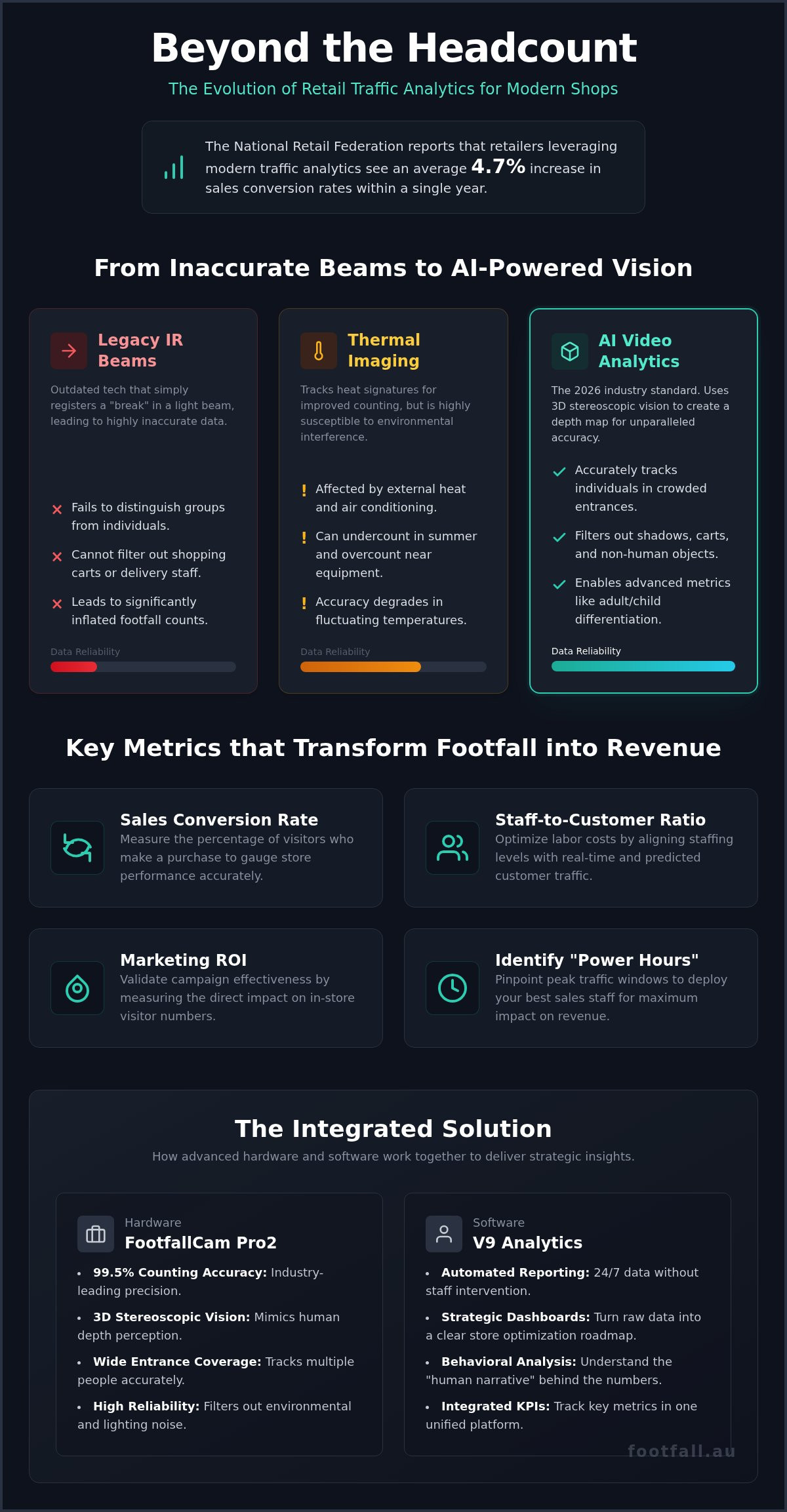
The National Retail Federation indicates that retailers leveraging traffic analytics saw an average 4.7% increase in sales conversion rates within a single year. Despite this potential, many Australian store owners still rely on outdated infrared beam counters that fail to distinguish between a group of shoppers and a single delivery person. Finding the right customer traffic counter for shops is no longer about simple tallying. It’s about capturing the human narrative behind every entry to drive actual growth.
You likely recognize the frustration of seeing a crowded floor but low sales, or paying for a full staff roster during a surprising mid-afternoon lull. This guide helps you move past intuition and toward empirical evidence by selecting a system that integrates AI video analytics with your broader retail strategy. We’ll explore how advanced hardware like the FootfallCam Pro2 and V9 software provide the automated reporting you need to optimize staff-to-customer ratios and measure marketing ROI. This selection guide provides the strategic clarity required to navigate the 2026 regulatory landscape while transforming raw visitor numbers into a clear roadmap for store optimization.
Key Takeaways
- Understand why modern retail requires a shift from basic head counting to AI-driven behavioral analysis to remain competitive.
- Evaluate the technical differences between legacy beam sensors and advanced AI video analytics to ensure you choose the most accurate customer traffic counter for shops.
- Learn to calculate and apply critical KPIs like sales conversion rates and staff-to-customer ratios to optimize your labor costs and floor performance.
- Identify the specific environmental and connectivity factors, such as ceiling height and PoE requirements, that dictate the success of your hardware installation.
- Discover how the FootfallCam Pro2 hardware and V9 software work together to provide automated, strategic insights that drive long-term revenue growth.
Why a Customer Traffic Counter for Shops is Essential in 2026
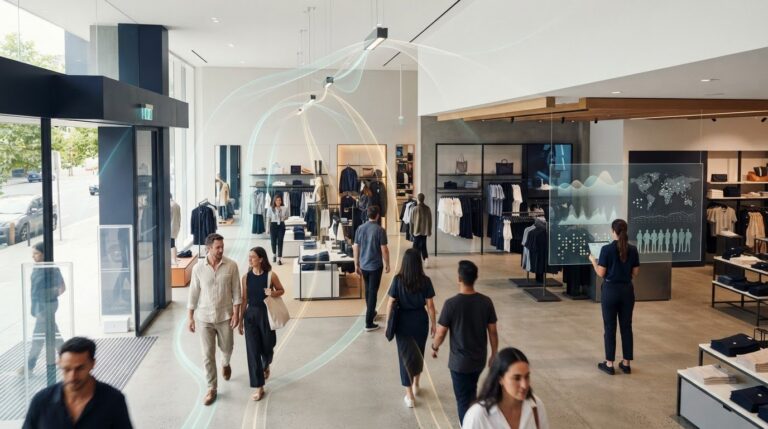
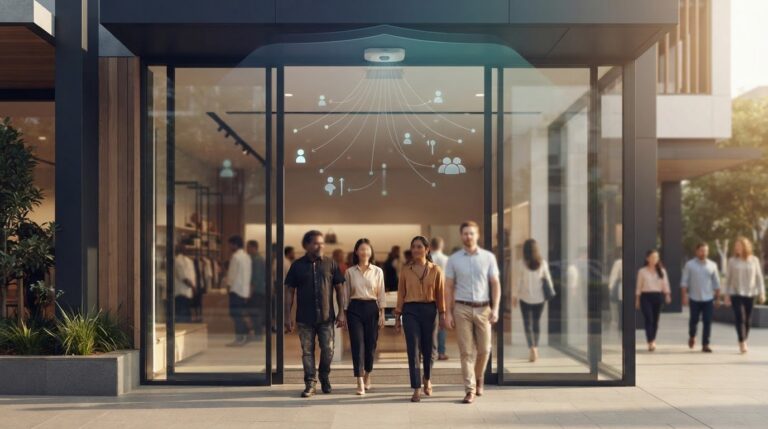
Strategic retail management in 2026 demands a transition from simple observation to precise, algorithmic measurement. A modern customer traffic counter for shops is no longer a passive device mounted above a door; it’s an AI-integrated sensor that interprets the complexities of human movement. In the Australian retail landscape, the focus has shifted from merely counting heads to deeply understanding behavior. This evolution allows retailers to distinguish between a group of browsing visitors and high-intent solo shoppers, providing a level of granularity that intuition simply cannot match.
Relying on “gut feel” for staffing frequently leads to inflated operational costs or, conversely, missed sales opportunities during unpredicted surges. Data-driven logic replaces these guesses with empirical evidence. When you can see exactly how many people enter your store following a specific social media campaign or a new window display, you can validate marketing spend with total confidence. This transparency ensures that every dollar invested in attracting visitors is measurable against the actual footfall it generates.
Moving Beyond Manual Door Counting
Manual tallies and staff-operated clickers are fundamentally flawed in high-volume environments. Human error, fatigue, and the natural distractions of a busy shop floor make manual data unreliable for serious strategic planning. Automated People counting technologies eliminate these inconsistencies by providing 24/7 data accuracy without requiring staff intervention. Automated footfall counting represents the absolute baseline for 2026 retail operations.
The ROI of Real-Time Traffic Data
Access to real-time traffic data transforms how you manage physical assets. By linking visitor patterns to facility management, you can optimize energy consumption, adjusting lighting and climate control based on actual occupancy levels. This agility extends to the shop floor itself, where managers can reassign tasks the moment a traffic peak begins to form. Identifying your “Power Hour” — those specific windows of time where traffic and conversion potential are at their highest — allows you to deploy your best sales talent exactly when they can have the most significant impact on the bottom line. This structured approach to movement ensures that your store remains both efficient and responsive to shifting behavioral trends. For retailers in Adelaide looking to further enhance their physical space, Travis the TV Bloke offers professional mounting services to ensure that in-store displays are perfectly integrated into this optimized environment.
Selecting a customer traffic counter for shops requires a clear understanding of the technical trade-offs between initial cost and long-term data utility. Legacy infrared (IR) beam counters represent a traditional entry point for basic footfall monitoring. These sensors rely on the physical breaking of a light beam, which means they can’t distinguish between a family group and a single shopper. This limitation often leads to significant data inflation, providing a skewed view of store performance that makes accurate conversion analysis nearly impossible.
Thermal imaging counters track heat signatures to offer improved accuracy over IR beams. While these sensors maintain a high level of privacy, they’re notably sensitive to environmental temperature fluctuations. In the Australian climate, where store entrances often face extreme external heat or intense air-conditioned drafts, thermal sensors can struggle to maintain a consistent baseline. This sensitivity often results in undercounting during peak summer months or overcounting near high-heat retail equipment.
AI video analytics, specifically 3D stereoscopic systems, have become the 2026 industry standard for high-stakes retail environments. These units use dual-lens technology to create a sophisticated depth map of the entrance. This allows the system to ignore shadows, shopping carts, and pets while providing advanced metrics like adult/child differentiation. Australian retailers are increasingly migrating toward AI to gain these deeper insights, ensuring that marketing efforts are measured against the correct demographic of potential buyers.
The Precision of 3D Stereoscopic Vision
Dual-lens technology mimics human depth perception to provide a three-dimensional view of the shop floor. This allows the customer traffic counter for shops to track individuals accurately even in crowded, wide entrances where people walk side-by-side. High-precision hardware like the FootfallCam Pro2 maintains up to 99.5% accuracy by filtering out environmental noise and complex lighting patterns. This level of reliability is essential when using footfall data to justify lease negotiations or major labor reallocations.
Privacy and Compliance in Data Collection
The 2026 updates to the Australian Privacy Act make data transparency and “privacy-by-design” mandatory for automated systems. Modern AI counters ensure compliance by processing all visual data locally on the edge device. No video is recorded, stored, or transmitted to the cloud. It’s vital to understand the People Counter vs. CCTV distinction; while CCTV is designed for surveillance and identification, AI counters are built for anonymous movement analysis. This approach protects your business from the significant civil penalties associated with privacy breaches while providing the strategic data you need.
If you’re currently using legacy hardware that provides inconsistent results, our Legacy Swap Out Plan offers a structured path to modernize your data infrastructure with the latest AI technology.
Key Metrics That Transform Footfall into Revenue
Data points only gain value when they trigger a specific, positive change in your operations. Moving beyond simple volume totals allows you to treat your shop floor as a laboratory for performance optimization. By utilizing a high-precision customer traffic counter for shops, you gain access to the behavioral metrics that separate high-performing retailers from those struggling with stagnant growth. These metrics provide the empirical evidence needed to move from reactive management to proactive strategy.
One of the most vital yet overlooked data points is the “Capture Rate,” which measures outside traffic against store entries. If thousands of potential customers pass your storefront but only a fraction enter, your window displays or external signage aren’t performing their primary function. Measuring this ratio provides an objective way to test marketing effectiveness before a customer even reaches the point of sale. Once inside, tracking dwell time and heat mapping helps identify “dead zones” where products are ignored and “hot spots” where engagement is highest, allowing for data-backed adjustments to store layout and product placement.
Calculating and Improving Sales Conversion
The Sales Conversion Rate remains the ultimate KPI for retail health. It’s calculated using a simple but powerful formula: (Total Transactions / Total Footfall) x 100. This metric acts as a diagnostic tool for your entire operation. A dip in sales conversion during high-traffic periods usually indicates a service or inventory problem rather than a marketing failure. For a deeper look at how to apply these insights to your specific location, consult our Retail Footfall Analysis in Australia guide. Understanding these patterns helps you determine if you need to drive more traffic or simply get better at serving the visitors you already have.
Staff Optimisation and Planning
Labor is often a retailer’s highest controllable expense. Using historical traffic data allows you to predict peak periods with high accuracy, ensuring you aren’t over-staffed during quiet Monday mornings or under-staffed during frantic Saturday afternoons. Aligning your staff-to-customer ratio ensures that every visitor has the opportunity to be assisted, directly protecting your margins from lost sales. A 5% improvement in staff alignment can significantly impact annual revenue by ensuring that high-intent shoppers aren’t abandoned during your store’s most critical “power hours.” This level of precision turns staffing from a fixed cost into a flexible, revenue-driving asset.
Selection Framework: Choosing the Right System for Your Shop
Selecting a customer traffic counter for shops requires a systematic evaluation of your physical space and operational goals. Start with environmental factors. Ceiling height determines the mounting position and the resulting field of view. A sensor placed too low may fail to capture the full width of an entrance; conversely, one mounted too high might lose the precision needed for adult/child differentiation. Lighting conditions, particularly in stores with large glass frontages, demand AI hardware that can adjust dynamically to high-contrast shadows. Connectivity is equally critical. While Wi-Fi offers flexibility for boutique setups, Power over Ethernet (PoE) remains the standard for national retail chains due to its superior stability and simplified maintenance.
Hardware Durability and Aesthetics
In a retail environment, visual merchandising is paramount. Your counting hardware should feature a discreet design that blends into the ceiling architecture rather than distracting the customer. Beyond aesthetics, long-term reliability is the primary driver of ROI for national rollouts. Choosing hardware that requires minimal manual intervention ensures data consistency across the entire network. For organizations still tethered to inaccurate legacy systems, our Legacy Swap Out Plan provides a clear, cost-effective pathway to upgrade to the latest AI standards without starting from scratch.
Data Integration and API Access
Raw numbers are only useful if they can be translated into action. The most effective systems in 2026 offer robust API access, allowing you to export footfall data directly into your existing POS or ERP software. This integration is what makes it possible to calculate conversion rates automatically. Whether you prefer cloud-based storage for accessibility or on-premise solutions for specific security protocols, the platform must offer intuitive reporting that prioritizes actionable insights over dense data tables. For a deeper dive into technical specifications, consult the Definitive Guide to People Counting Systems in Australia.
A truly professional framework accommodates growth. The system you choose for a single boutique should use the same underlying architecture as a 500-store national rollout. This ensures that as your business scales, your data remains comparable and your management remains centralized. If you’re ready to move beyond simple counting and begin strategic optimization, contact our specialist team to discuss a tailored hardware configuration for your specific environment.
Implementing Your Traffic Strategy with Footfall Australia
Transitioning from basic visitor counts to sophisticated retail intelligence requires a partner with a long-term track record in the Australian market. Footfall Australia has been operational since 2004, providing the technical infrastructure and strategic guidance necessary to turn footfall into revenue. Selecting a customer traffic counter for shops through our managed service ensures that you aren’t just buying hardware; you’re investing in a complete ecosystem of AI-driven sensors and powerful analytics software. The synergy between the FootfallCam Pro2 hardware and FootfallCam V9 Software creates a centralized “brain” for your operations, automating the interpretation of human movement across your entire store network.
National deployment demands a support structure that guarantees 99%+ uptime. Our national reach allows for consistent maintenance and specialized expertise, ensuring your data stream remains uninterrupted regardless of your location. The implementation process is structured and logical, moving from an initial consultation to a tailored hardware configuration that respects your store’s unique architectural constraints. This methodical approach leads to a strategic advantage where decisions are backed by empirical evidence rather than intuition.
The FootfallCam Pro2 Advantage
The FootfallCam Pro2 stands as the gold standard for accuracy in the 2026 retail landscape. Its built-in AI processing and stereoscopic 3D sensors allow it to maintain precision in complex environments where legacy systems often fail. The hardware’s plug-and-play nature is designed for rapid deployment, which is essential for retailers who need to modernize their data collection without disrupting daily operations. This efficiency allows you to begin capturing actionable insights almost immediately after installation. You can explore the specific technical capabilities and environmental requirements in our FootfallCam Pro2 Buying Guide.
Comprehensive Support and Legacy Upgrades
Maintaining data integrity requires ongoing commitment. We provide both Basic and Premium Support Plans to ensure your sensors stay calibrated and your V9 software remains updated with the latest analytical features. For retailers currently struggling with inaccurate data from outdated beam or thermal counters, our Legacy Swap Out Plan offers a cost-effective pathway to modernization. This plan is specifically designed to make the transition to high-precision AI affordable for established shops, removing the financial barriers to sophisticated retail analytics. If you’re ready to stop guessing and start measuring, contact Footfall Australia for a strategic consultation to begin your data-driven transformation.
Optimising Your Retail Strategy Through Data
The retail landscape in 2026 demands more than just observation; it requires a precise understanding of visitor movement to drive conversion. By selecting a high-precision customer traffic counter for shops, you move beyond simple tallies and gain access to the behavioral metrics that define store success. We’ve explored how AI video analytics outperform legacy sensors and why a structured selection framework is essential for maintaining data integrity across national rollouts.
Implementing these insights is the final step toward operational excellence. Utilizing FootfallCam Pro2 AI Hardware paired with V9 Data Analytics Software gives you the empirical evidence needed to optimize staffing and validate marketing spend. If you’re currently managing with outdated sensors, our Legacy Swap Out Plan provides a seamless path to modernization. This transition replaces intuition with accuracy, ensuring every decision you make is backed by reliable data.
Request a Quote for Your National Retail Footprint to begin transforming your footfall data into actionable revenue. With the right technology and a strategic partner, you can confidently navigate shifting behavioral trends and secure the long-term growth of your physical spaces.
Frequently Asked Questions
How accurate are modern customer traffic counters for shops?
Modern AI-driven systems provide up to 99.5% accuracy in most retail environments. The customer traffic counter for shops utilizes 3D stereoscopic vision to map depth, allowing it to ignore shadows, carts, and reflections that often trigger false counts in older technology. This precision ensures that the data you use for strategic planning is reliable and consistent.
Can a people counter distinguish between staff and customers?
Yes, advanced sensors can differentiate between personnel and shoppers. By using AI-based height filtering or specialized staff exclusion tags, the system removes employee movement from your analytics. This ensures your sales conversion rates remain untainted by operational activities, providing a true reflection of customer behavior.
Is a traffic counter the same as a security camera (CCTV)?
No, these technologies serve entirely different purposes. A people counter is an anonymous data sensor that processes movement locally without recording or storing identifiable images. CCTV is designed for surveillance and video storage, whereas traffic counters focus purely on the narrative of movement and numerical data extraction.
What is the best mounting height for a retail people counter?
The ideal mounting height typically falls between 2.1 and 4.5 meters. The exact placement depends on the entrance width and the specific lens configuration of the hardware. Proper installation ensures the sensor maintains a clear, top-down view to avoid occlusion, which is essential for maintaining accuracy during high-traffic periods.
Do I need to pay a monthly subscription for the analytics software?
Most high-end analytics platforms require a subscription to maintain cloud-based reporting and data integrity. Our FootfallCam V9 Software includes regular updates and automated insights as part of its managed service. This ensures your system stays compliant with shifting behavioral trends and technical standards while providing 24/7 access to your data.
How does a traffic counter help improve my store’s conversion rate?
A customer traffic counter for shops provides the essential data needed to calculate your sales conversion ratio. By comparing visitor numbers to transactions, you can determine if low sales are a result of poor marketing or ineffective floor service. This allows for targeted improvements in staff training, inventory management, or store layout based on empirical evidence.
Can the system count people in groups or families accurately?
Yes, 3D stereoscopic sensors accurately count individuals even when they walk in tight groups or family units. Unlike legacy beam counters that might record a family of four as a single break in the IR signal, AI systems distinguish separate physical forms. This prevents the data inflation or undercounting common in less sophisticated hardware.
Is the data collected by people counters compliant with Australian privacy laws?
Modern systems are designed to be fully compliant with the 2026 updates to the Australian Privacy Act. Data is anonymized at the point of collection, and no personally identifiable information is stored or transmitted. This privacy-by-design approach ensures your business meets its regulatory obligations while still gathering the strategic insights needed for growth.