
Footfall Data for Retail Management: 2026 Strategic Guide
If you could reduce your monthly A$ payroll costs by 15% without losing a single sale, would you still rely on gut feeling to schedule your staff? Most Australian retailers understand the frustration of a quiet floor overstaffed with expensive labour, or the missed opportunities of a busy peak period left unsupported. Using footfall data for retail management transforms these common operational challenges into a precise science of measurable growth.
Intuition isn’t enough to justify major shifts. We’ll show you how to turn visitor movement into actionable intelligence. By integrating high-accuracy tools like the FootfallCam Pro2 with intuitive V9 Software, you can finally align your rosters with actual traffic patterns. This article outlines the strategic roadmap for 2026, covering everything from sales conversion improvements to evidence-based store layout changes that drive efficiency.
Key Takeaways
- Shift from counting heads to interpreting human behavior as a strategic asset for organizational growth and objective decision making.
- Master the science of using footfall data for retail management to eliminate overstaffing and capture every sales opportunity during peak hours.
- Identify the specific metrics needed to measure the true ROI of marketing campaigns and store layout modifications through concrete visitor patterns.
- Evaluate the role of high-accuracy sensors like the FootfallCam Pro2 in building a scalable, future-proof operational framework for your retail environment.
Transforming Raw Traffic into Actionable Retail Intelligence
In the high-stakes Australian retail environment, viewing footfall as a simple headcount is an outdated approach. Modern management treats visitor movement as a sequence of human actions that reveal intent and preference. Using footfall data for retail management in 2026 requires moving beyond basic tallies toward a sophisticated understanding of how people interact with physical spaces.
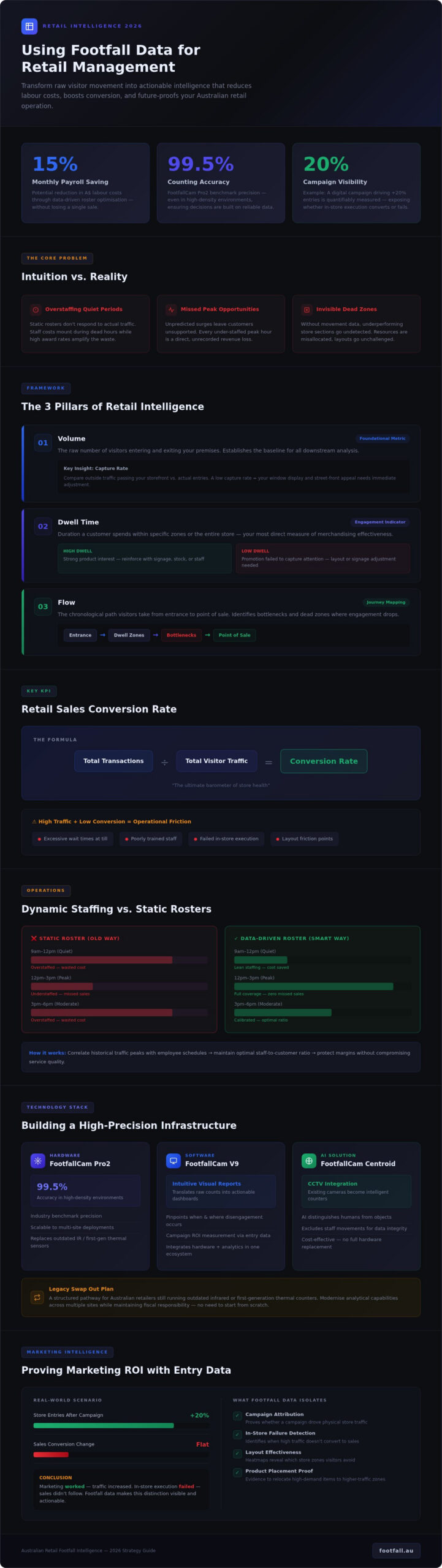
Relying on intuition often leads to costly errors in staffing and inventory. Using footfall data for retail management allows you to replace guesswork with logic. When decisions aren’t backed by empirical evidence, retailers risk misallocating resources during critical peak periods. True retail intelligence rests on three analytical pillars:
- Volume: The raw number of visitors entering and exiting your premises.
- Dwell Time: The duration a customer spends within specific zones or the entire store.
- Flow: The chronological path visitors take from the entrance to the point of sale.
Beyond the Door: Understanding the Narrative of Movement
Capturing the relationship between “outside traffic” and actual entries reveals your capture rate. This metric is the most honest appraisal of your window displays and street-front appeal. If thousands pass your storefront but few enter, your external marketing needs immediate adjustment.
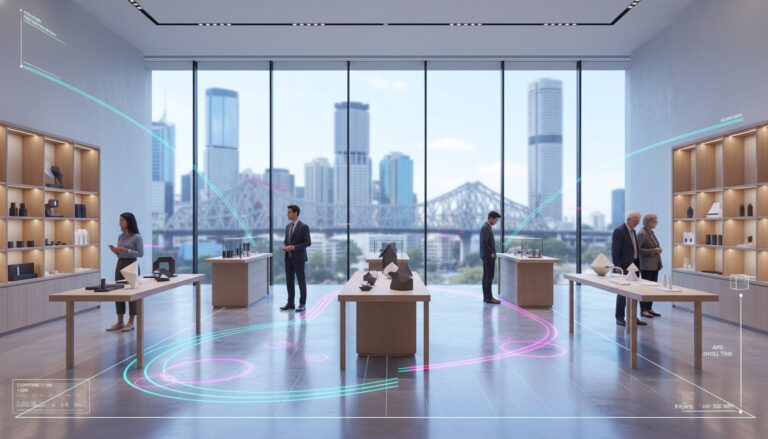
Once inside, tracking the customer journey identifies bottlenecks and “dead zones” where engagement drops. By establishing dwell zones, you can measure merchandising effectiveness with precision. High dwell time in a specific aisle suggests strong product interest, while rapid transit through a promotional area indicates a failure to capture attention. This narrative of movement empowers managers to make evidence-based layout changes that directly influence sales conversion.
Optimising Store Operations Through Data-Driven KPIs
Australian retail managers face significant pressure from rising labour costs and strict award rates. Relying on static rosters often leads to overstaffing during quiet periods or, worse, losing sales during unpredicted peaks. Using footfall data for retail management allows for the creation of dynamic staffing models. By correlating historical traffic peaks with employee schedules, you can maintain an optimal staff-to-customer ratio that protects both your margins and the customer experience.
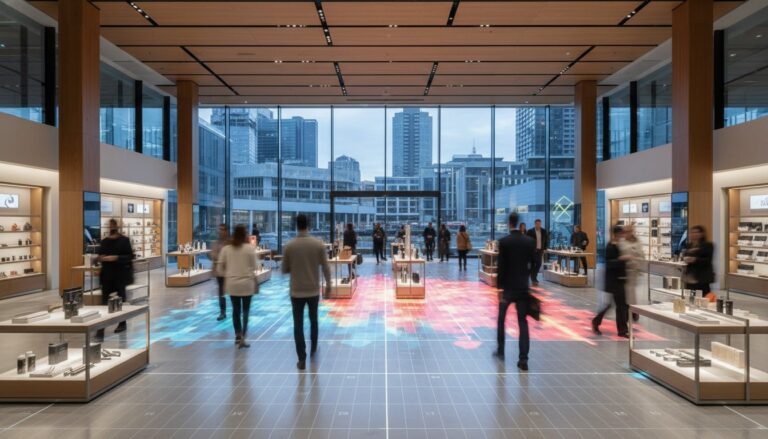
Beyond scheduling, empirical data serves as the foundation for justifying changes to store layouts and product placements. If heatmaps show that visitors consistently avoid a specific quadrant, you have the evidence needed to relocate high-demand items. This logic extends to marketing. If a digital campaign drives a 20% increase in entries but sales remain flat, the data proves the marketing worked, but the in-store execution failed.
When data indicates that in-store execution or layout needs to change, A1 Precision Solutions offers complete turnkey solutions for commercial buildings to help Australian retailers physically transform their spaces based on these insights.
Calculating and Improving the Retail Sales Conversion Rate
The retail sales conversion rate is the ultimate barometer of store health, defined as total transactions divided by total visitor traffic. A high-traffic environment with low conversion rates signals operational friction. This might stem from excessive wait times at the till or poorly trained staff. By using footfall data for retail management through FootfallCam V9 software, you gain the reporting depth needed to pinpoint these lost opportunities. It allows you to see exactly when and where potential customers are disengaging, turning a generic bad day into a specific, solvable management problem.
Implementing a High-Precision People Counting Infrastructure
Strategic retail decisions are only as reliable as the data that informs them. Achieving the necessary precision requires a robust hardware foundation. The FootfallCam Pro2 stands as the industry benchmark, delivering up to 99.5% accuracy even in high-density environments. This level of reliability ensures that using footfall data for retail management isn’t just a theoretical exercise but a practical tool for daily operations. When combined with the FootfallCam V9 Software, managers access an integrated ecosystem that translates raw counts into intuitive, visual reports.
Leveraging the FootfallCam Centroid for AI-Driven Insights
For large-scale environments, the FootfallCam Centroid offers a sophisticated alternative to individual sensor installation. It connects directly to existing CCTV networks, transforming standard security cameras into intelligent people counters. This approach is highly cost-effective, allowing retailers to extract more value from their current infrastructure investment without a full hardware replacement.
The Centroid uses advanced AI to distinguish between human figures and objects, and crucially, between staff and customers. By excluding staff movements from the final tally, it ensures data integrity. This distinction is vital for accurately calculating conversion rates and understanding true visitor intent. Implementing these high-precision systems ensures that using footfall data for retail management remains a competitive advantage rather than an operational burden.
Securing a Data-Driven Future for Australian Retail
Transitioning from simple observation to strategic implementation is the hallmark of a resilient retail operation. By moving beyond raw counts to understand dwell times and capture rates, you build a foundation of empirical evidence. Using footfall data for retail management isn’t just about efficiency; it’s about staying ahead of shifting consumer behaviours while protecting your bottom line against rising operational costs. When every visitor action is interpreted as a data point, your store layout and staffing rosters finally align with reality.
Achieving this level of precision requires a partner that understands the Australian market. Footfall Australia has been trusted by national retailers since 2004, providing the advanced AI-driven accuracy of the FootfallCam Pro2 alongside comprehensive local support and maintenance plans. You don’t have to rely on intuition when you can master the science of visitor movement. Optimise your retail management with Footfall Australia today and transform your physical space into a high-performance environment.
Frequently Asked Questions
How does footfall data differ from POS sales data?
POS data only records successful transactions, leaving you blind to the customers who walked out empty-handed. Footfall data captures every person who enters your store, regardless of whether they bought something. This distinction is vital for identifying the “missed opportunities” on your shop floor and understanding the true scale of your potential market.
Can I use my existing security cameras for retail footfall analysis?
Yes, you can integrate existing CCTV networks by using the FootfallCam Centroid. This AI-driven device connects to your current IP cameras, transforming them into high-accuracy people counters. It’s a cost-effective way to leverage your current infrastructure while gaining the sophisticated reporting capabilities of the V9 software without a total hardware overhaul.
What is a good sales conversion rate for Australian retail stores?
Conversion rates vary by sector, with luxury boutiques often seeing 10% while high-volume pharmacies might exceed 40%. The real value lies in benchmarking against your own historical performance. Using footfall data for retail management allows you to set realistic KPIs based on your specific traffic patterns rather than relying on broad industry averages.
How often should I review my footfall data for management decisions?
Daily reviews are best for managing immediate staffing rosters and identifying peak hour shifts. Weekly analysis helps you evaluate the success of marketing campaigns or window display changes. For long-term strategy, monthly reviews provide the empirical evidence needed to justify significant store layout modifications or permanent changes to your operational hours.
Is people counting technology compliant with Australian privacy laws?
Modern people counting systems are fully compliant with the Australian Privacy Act 1988. These devices use anonymised data processing, meaning they don’t record facial features or personally identifiable information. They track human shapes and movement patterns as silhouettes. This ensures you gain deep operational insights without compromising the privacy of your visitors or staff.
Does the system distinguish between staff and customers?
Advanced sensors like the FootfallCam Pro2 use AI-based filtering to distinguish between employees and shoppers. By excluding staff movements from the total count, your data remains untainted by internal operational activities. This precision is essential when using footfall data for retail management to ensure your conversion rates and visitor metrics reflect genuine customer intent.