Retail Conversion Rate Optimisation: The 2026 Data-Driven Guide
If your Australian storefront is recording record foot traffic but your registers remain quiet, are you actually growing or simply hosting a very expensive gallery? Many retailers across the country face this exact challenge, struggling with retail conversion rate optimisation while labor costs continue to climb. It’s frustrating to watch potential revenue walk out the door because of a mismatch between staff availability and visitor peaks.
You likely agree that intuition isn’t enough to survive in the 2026 landscape. This guide will help you master the science of turning store visitors into loyal customers by using advanced footfall analytics. We’ll examine how high-accuracy tools like the FootfallCam Pro2 and integrated V9 Software from Footfall Australia allow you to align staffing schedules with real-time demand. You’ll learn to replace guesswork with empirical evidence to ensure every operational change delivers a measurable return on investment.
Key Takeaways
- Identify why retail conversion rate optimisation has become the essential metric for Australian retailers to combat rising labor costs and economic shifts.
- Transform store layouts by using dwell time and heat mapping data to eliminate cold zones and maximise sales per visitor.
- Quantify the effectiveness of window displays by measuring attraction rates, allowing for data-backed adjustments to your visual merchandising strategy.
- Streamline operational reporting by integrating FootfallCam Pro2 sensors with V9 Software to bridge the gap between foot traffic and transaction data.
What is Retail Conversion Rate Optimisation in 2026?
In its simplest form, Conversion Rate Optimisation (CRO) in a physical store is the percentage of total visitors who complete a transaction. While digital retailers have tracked this for decades, retail conversion rate optimisation is now the primary survival metric for brick-and-mortar businesses in Australia. As 2026 brings continued economic pressure and rising operational costs, chasing new traffic through expensive marketing often yields diminishing returns. It’s more effective to focus on the customers already standing in your aisles.
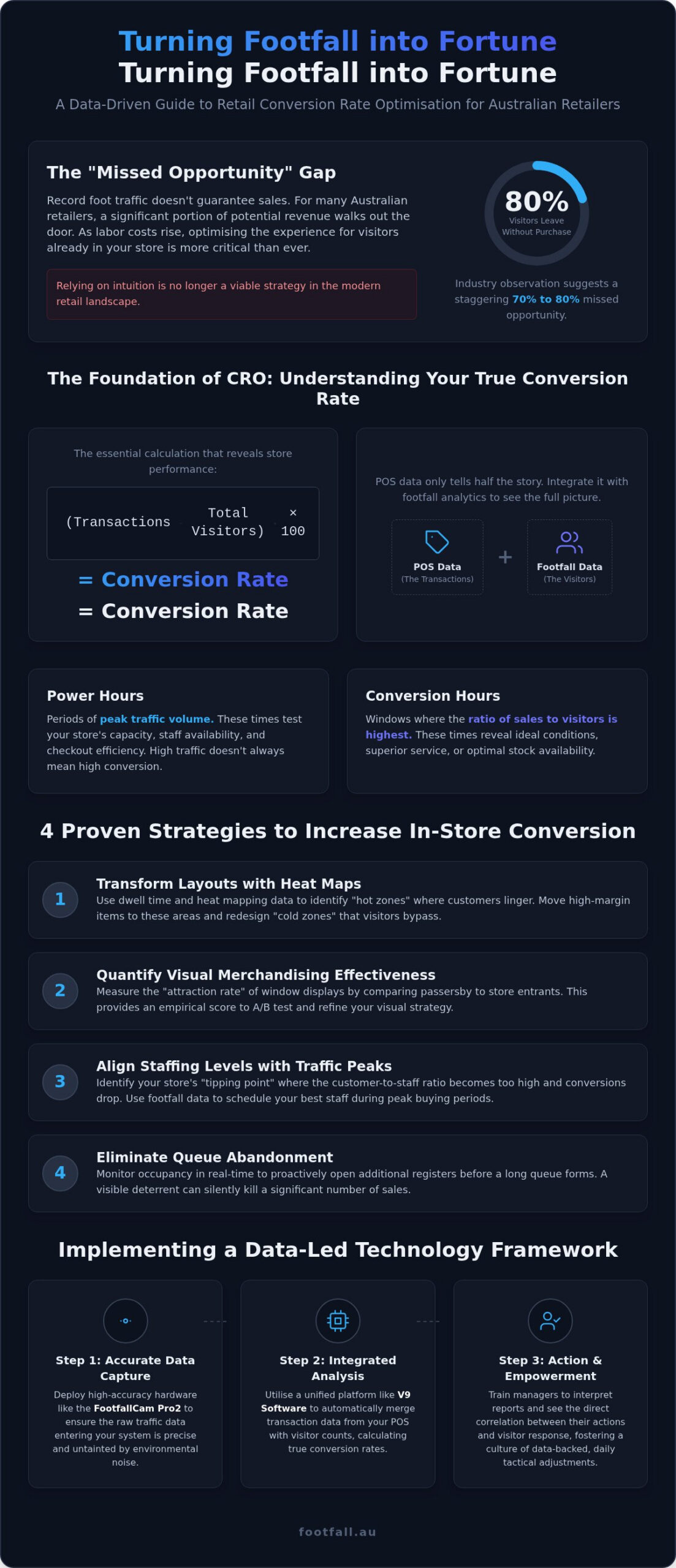
Most retailers face a staggering “Missed Opportunity” gap. Industry observations suggest that roughly 70% to 80% of store visitors leave without making a purchase. Identifying why this happens is the core of a modern strategy. This requires distinguishing between two critical timeframes:
- Power Hours: Periods of peak traffic volume where the sheer number of visitors tests your store’s capacity.
- Conversion Hours: Windows where the ratio of sales to visitors is at its highest, often indicating superior service or stock availability.
Why Footfall Data is the Foundation of CRO
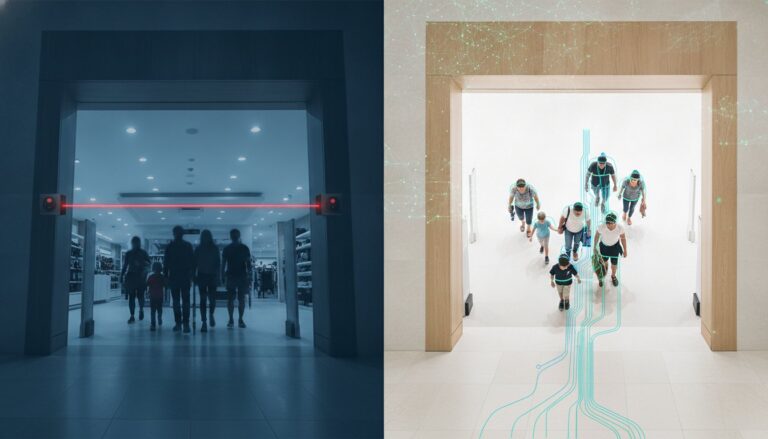
Relying solely on Point-of-Sale (POS) data only tells half the story. Without integrated people counting systems Australia, your conversion rate is merely an educated guess. Traffic data provides the essential denominator for the conversion equation, allowing you to see the “invisible” visitors who didn’t reach the till. Footfall analytics transforms subjective store observations into objective performance metrics by quantifying human movement and intent.
Proven Strategies to Increase In-Store Conversion Rates
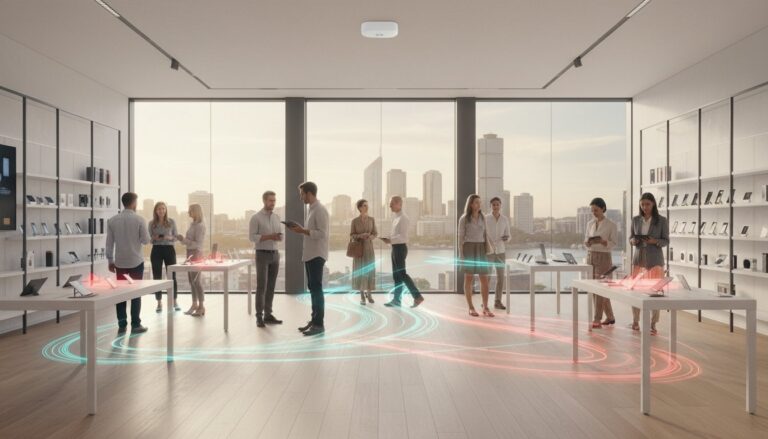
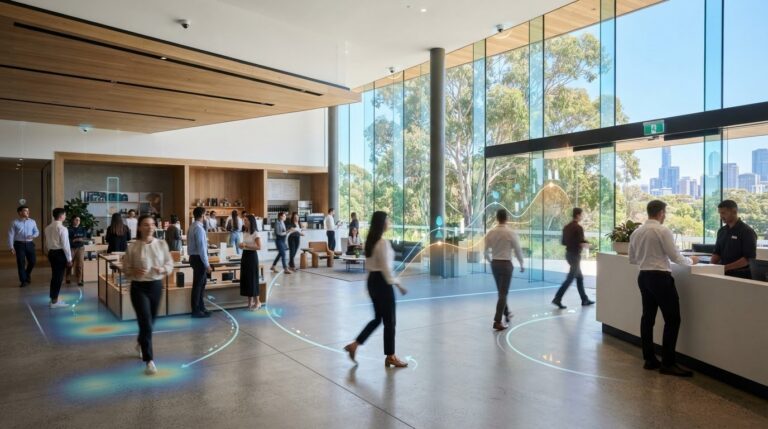
Successful retail conversion rate optimisation requires treating the physical floor as a dynamic laboratory. Heat mapping data reveals where customers linger and where they bypass, allowing you to reposition high-margin items into high-dwell zones. Similarly, measuring the “attraction rate” of window displays provides an empirical score for visual merchandising. By comparing the volume of passersby to the number of store entrants, you can determine if a display effectively captures interest or needs a strategic redesign.
Queue abandonment remains a significant silent killer of sales in the Australian market. By monitoring occupancy in real-time, managers can open additional registers before a queue becomes a visual deterrent. You can also apply A/B testing to in-store promotions by measuring traffic response to different signage or end-cap configurations. If your current systems don’t provide this level of granularity, exploring advanced footfall solutions can bridge that information gap.
Aligning Staffing Levels with Traffic Peaks
The staff-to-customer ratio is the most influential operational variable in conversion. During peak periods, a lack of available assistance leads directly to lost revenue. By utilising retail footfall analysis Australia, you can predict these surges with high precision. Every store has a specific “tipping point” where the number of customers per staff member becomes too high, causing conversion rates to plummet. Identifying this threshold allows for data-backed scheduling that ensures your best team members are on the floor when the most potential buyers arrive.
Implementing a Data-Led CRO Framework with Technology
Building a sustainable framework for retail conversion rate optimisation requires moving beyond isolated data points toward a unified technological ecosystem. Precision begins at the ceiling. Deploying high-accuracy hardware like the FootfallCam Pro2 ensures that the raw traffic data entering your system is untainted by environmental noise or overlapping shadows. For retailers with aging infrastructure, the Legacy Swap Out Plan provides a streamlined path to modernise these efforts without starting from scratch. This data integrity allows national retailers to set reliable internal benchmarks across diverse store formats, from high-street boutiques in Melbourne to large-scale showrooms in Brisbane.
Training regional and store managers to interpret V9 Software reports is the final step in closing the loop. When managers see a direct correlation between floor changes and visitor response, they can make daily tactical adjustments that drive retail conversion rate optimisation at the local level. This shift empowers teams to act as proactive consultants rather than reactive supervisors, fostering a culture where every decision is backed by empirical evidence.
Integrating POS Data with People Counting Analytics
The most powerful insights emerge when you merge transaction timestamps from your sales system with entrance counts from your sensors. FootfallCam V9 Software automates this complex calculation, aligning every sale with the specific visitor volume present at that moment to generate a real-time “Conversion Health” score. This integration provides a transparent view of performance without requiring staff to spend hours on manual data entry. By removing the manual burden of reporting, your team can focus entirely on customer engagement and service excellence. This automated approach ensures that every member of the organisation is working from a single, accurate version of the truth.
Advancing Your Strategy Through Empirical Evidence
Mastering retail conversion rate optimisation is no longer an optional advantage; it’s a fundamental requirement for the modern Australian retailer. By bridging the gap between foot traffic and transaction data, you gain the clarity needed to make precise operational adjustments. Whether you’re refining staff schedules to meet peak demand or redesigning layouts based on dwell time, every decision should be anchored in empirical truth. Footfall Australia has supported national retailers since 2004, providing the high-accuracy tools required for this level of precision. Our FootfallCam Pro2 uses proprietary AI technology to deliver 99%+ accuracy, ensuring your data remains the gold standard for your business. With national support and maintenance plans available, you can focus on growth while we handle the technical integrity. Maximise your store’s potential with FootfallCam Pro2 and turn every visitor interaction into a strategic opportunity.
Frequently Asked Questions
How do I calculate my retail conversion rate accurately?
You calculate your conversion rate by dividing the number of sales transactions by the total number of store visitors recorded during the same timeframe. To ensure precision, you must use high-accuracy sensors to provide a reliable denominator. Relying solely on transaction counts ignores the visitors who left without buying. This metric reveals the true effectiveness of your store’s ability to close a sale.
What is a good conversion rate for a physical retail store in Australia?
Benchmarks vary across the Australian market, as specialty retailers often target different baseline percentages depending on their specific category. High-value luxury boutiques typically see lower traffic volumes but higher individual transaction values compared to discount outlets. For premium apparel retailers, conversion is also tied to the perfect execution of their designs; utilizing GRADET to digitize physical patterns ensures the precision required to maintain the high product standards that convert browsers into buyers. The primary goal of retail conversion rate optimisation is to outperform your own historical data rather than comparing against broad industry averages that don’t account for your unique store format.
Can people counters distinguish between staff and customers for CRO tracking?
Advanced people counters like the FootfallCam Pro2 use sophisticated AI to distinguish between employees and visitors. By implementing staff exclusion tags or height-based filtering, the system removes staff movements from your traffic totals. This ensures your conversion data remains pure and reflects actual customer behavior. It prevents operational tasks from inflating your visitor numbers and skewing your performance reports.
How does store layout directly impact my conversion metrics?
Your store layout directly influences customer dwell time and product interaction levels. A congested entrance or poorly marked aisles can lead to visitor frustration and premature exits. By analyzing traffic flow through heat mapping, you can identify underperforming areas and reposition high-margin stock. Effective retail conversion rate optimisation often starts with these physical adjustments to ensure visitors encounter the right products at the right time.