People Counter vs. Beam Counter: A Strategic Comparison for 2026
A 5% margin of error in your footfall data isn’t just a minor technicality; it’s a structural flaw that can misguide your entire retail strategy. You likely rely on your current infrared sensors for daily reporting, yet you’ve noticed the numbers often fail to reflect the reality of group entries or high-traffic periods. It’s difficult to justify technology investments when your core metrics feel like guesswork rather than empirical evidence.
This strategic comparison of a modern people counter vs beam counter reveals the technical differences defining the 2026 landscape. You’ll learn how the accuracy gap impacts your ROI and why AI-driven systems like the FootfallCam Pro2 provide the data depth required to calculate true conversion rates. We’ll examine how to transition from legacy hardware to sophisticated analytics that optimise your operations with quiet, data-driven confidence.
Key Takeaways
- Understand the fundamental accuracy gap between horizontal infrared beams and overhead AI vision to eliminate data guesswork in high-traffic environments.
- Evaluate the people counter vs beam counter landscape by examining how sophisticated systems filter staff and recognise family groups to provide true conversion rates.
- Identify the long-term ROI of migrating from legacy hardware to modern sensors through strategic upgrade paths like the Legacy Swap Out Plan.
- Learn how to align your technical selection with specific site constraints to build a reliable, empirical data foundation for 2026 and beyond.
Technology and Accuracy: How Beams and AI Counters Differ
Horizontal infrared beams represent a legacy approach to data collection. These sensors detect presence by registering an interruption in a light beam. While simple, this binary logic often leads to significant data discrepancies that compromise your reporting accuracy.
The Mechanism of Measurement
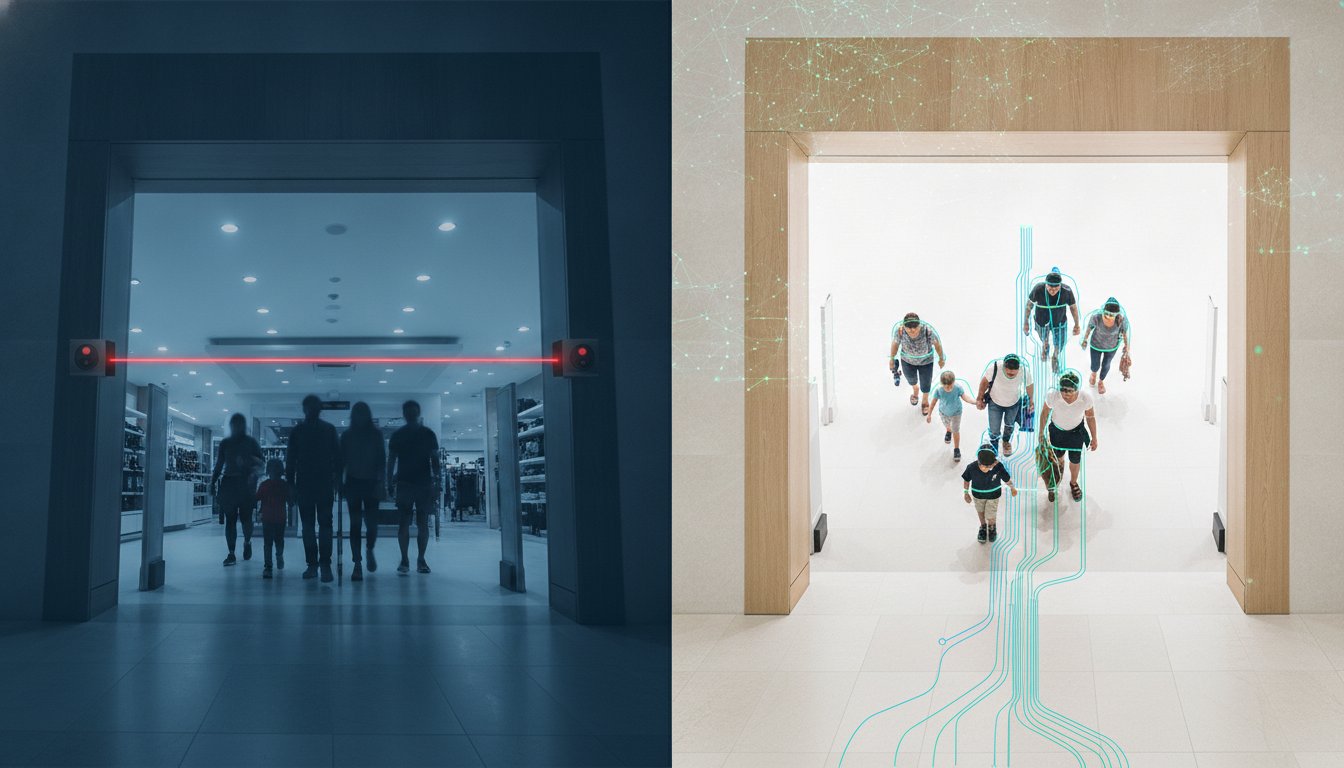
Beam counters rely on interrupt-and-count logic. This method fails to distinguish between a single shopper or a group walking side-by-side; it often double-counts swinging arms or misses small children entirely. In contrast, the FootfallCam Pro2 employs AI to track human shapes and movement paths. 3D stereoscopic vision is the gold standard for depth perception in counting because it uses dual-lens technology to accurately calculate the height and volume of every object in the doorway.
Environmental variables further complicate the people counter vs beam counter debate. Wide entrances allow multiple people to cross a single beam simultaneously, which leads to significant undercounting. Changes in sunlight or fast-moving pedestrians also trigger false positives in infrared systems. AI counters remain unaffected by these factors, easily distinguishing human shapes from shopping trolleys or prams while maintaining consistency across diverse site constraints.
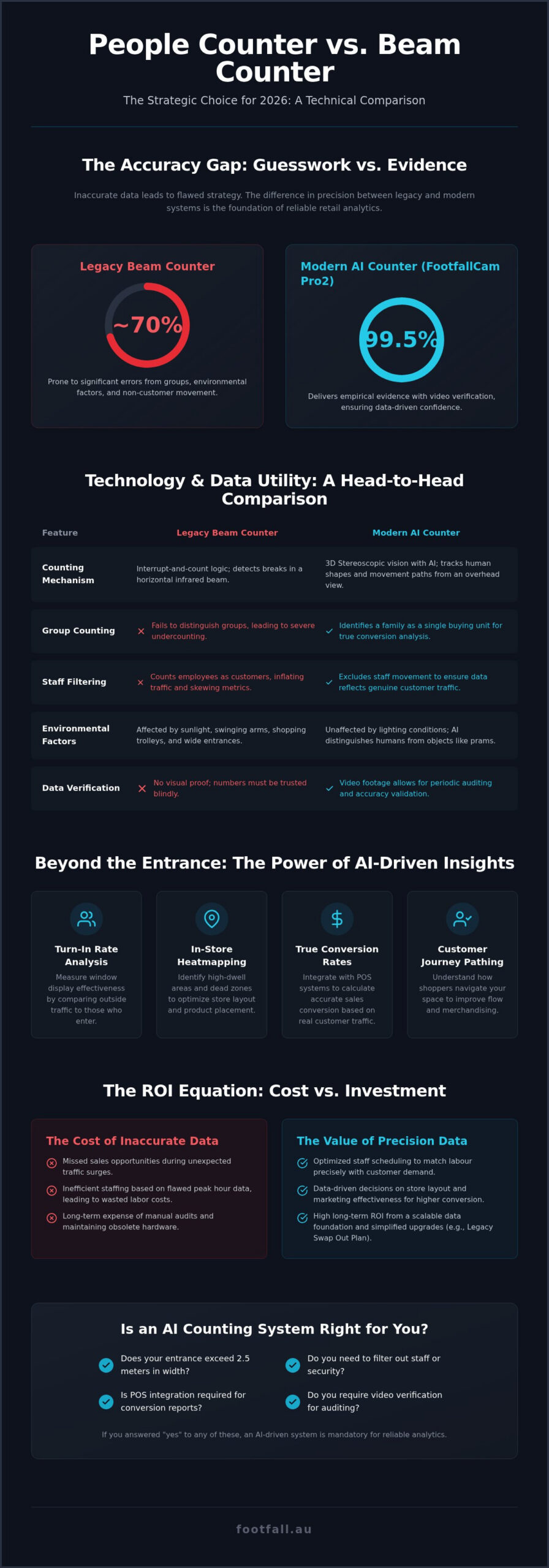
High-accuracy people counting technologies provide something beams cannot: video verification. Without visual evidence, you’re forced to trust numbers blindly. Modern AI systems allow for periodic auditing of recorded footage to verify that your data reflects actual human behaviour. This transparency allows managers to recognise exactly where discrepancies occur and ensures that 99.5% accuracy is a reality rather than an estimate.
Data Utility: Beyond Simple Foot Traffic Numbers
Horizontal infrared beams provide a raw tally, but they lack the intelligence to distinguish between different types of movement. When evaluating a people counter vs beam counter, the true value lies in the utility of the data produced. Beams can’t see human intent. They simply register a break in a signal, which means they physically cannot provide insights into dwell time or customer pathing.
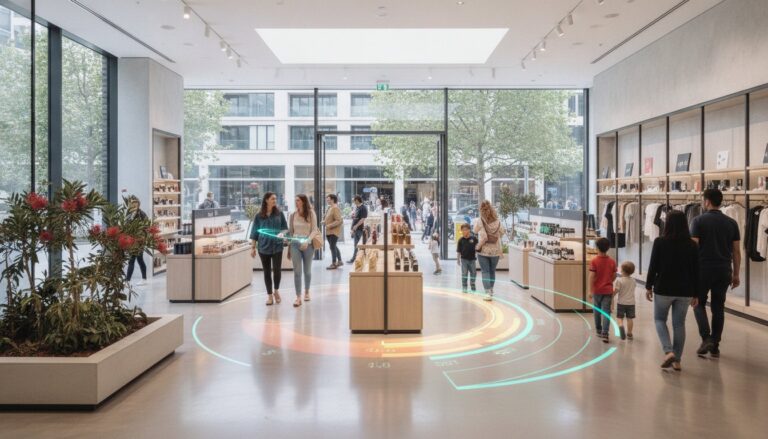
Staff exclusion is a critical differentiator. Every time an employee exits for a break, a beam counter logs a “customer” exit. This noise artificially inflates your traffic and ruins your conversion rate data. AI systems like the FootfallCam Pro2 filter out staff movement, ensuring metrics reflect actual buying intent. Similarly, group counting logic allows the system to recognise a family of four as a single buying unit rather than four individual shoppers, providing a more realistic foundation for sales analysis.
Integrating this refined data with POS systems via V9 Software transforms footfall into a strategic asset. This identifies exactly how many visitors converted, providing a transparent view of operational efficiency that beams cannot match.
Capturing the Full Customer Journey
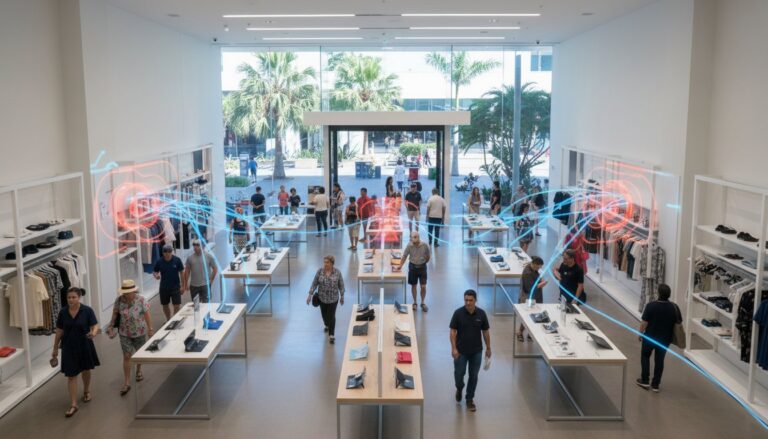
AI counters extend their vision beyond the entrance. By monitoring “outside traffic” and comparing it to the “turn-in rate,” you can objectively measure the effectiveness of window displays. High-tech sensors also enable heatmapping to identify dead zones and high-dwell areas, allowing for evidence-based store layout optimisation. To deepen your understanding of these metrics, consult our Footfall Data Analysis: A Strategic Guide. If you’re ready to move beyond basic tallies, you can explore our AI-driven hardware solutions to capture these behavioural insights.
ROI and Implementation: The Cost of Inaccurate Data
Low upfront costs often mask the long-term expense of manual auditing and missed opportunities. When evaluating a people counter vs beam counter, you must consider the financial impact of making staffing decisions based on 70% accurate data. AI systems like the FootfallCam Pro2 provide a 99.5% accuracy rate, allowing you to align labour hours precisely with peak traffic periods. This prevents overstaffing during quiet hours and minimises lost sales during unexpected surges.
Upgrading doesn’t require a total infrastructure overhaul. Our Legacy Swap Out Plan simplifies the transition from infrared to AI, allowing businesses to replace obsolete beams with high-fidelity sensors cost-effectively. This ensures your data foundation remains scalable as your facility expands, providing a much higher long-term ROI than maintaining legacy hardware that produces unreliable metrics.
Choosing the Right System for Your Facility
While a simple beam counter might suffice for basic occupancy limits in small, single-entry rooms, AI is mandatory for retail environments requiring conversion analytics. Use this checklist to determine your needs:
- Does your entrance exceed 2.5 metres in width?
- Do you need to filter out staff or security personnel?
- Is POS integration required for sales conversion reports?
- Do you require video verification to audit count accuracy?
Professional support and maintenance ensure your data integrity remains constant over time. When you choose a people counter vs beam counter for a complex environment, the depth of reporting becomes your greatest competitive advantage. For more detailed selection criteria, read The Definitive Guide to People Counting Systems in Australia.
Future-Proofing Your Facility Data
Evaluating a people counter vs beam counter reveals that the decision is ultimately between basic tracking and operational intelligence. While legacy beams served a purpose in simpler environments, they can’t support the complex analytics required for modern retail and public spaces. By adopting AI-driven vision, you gain the ability to filter staff, recognise group dynamics, and verify every count with visual evidence.
We provide a 99.5% accuracy guarantee with the FootfallCam Pro2, supported by our proprietary V9 Software and a dedicated local Australian partner network. Don’t settle for estimates when you can build your strategy on a foundation of empirical evidence. Request a tailored quote for the FootfallCam Pro2 today to begin optimising your facility with confidence. We look forward to helping you transform your physical space into a source of actionable insights.
Frequently Asked Questions
Are beam counters still effective for small retail stores?
Beam counters remain effective only for basic occupancy tallies in low-traffic environments with single-person entry points. They fail to provide the granular data required for modern retail, such as conversion rates or group counting logic. For stores aiming to optimise labour costs and understand customer behaviour, the accuracy gap makes them a liability rather than a strategic tool.
How does the FootfallCam Pro2 handle staff exclusion?
The FootfallCam Pro2 uses AI-driven shape recognition and movement pathing to distinguish between visitors and employees. By identifying specific behavioural patterns or using staff exclusion tags, the system filters out non-customer traffic. This ensures your conversion data remains pure and isn’t skewed by staff members entering or exiting the facility throughout the business day.
What is the typical accuracy difference between infrared and AI counters?
Infrared beam counters typically achieve 90% to 95% accuracy but often drop lower in high-traffic scenarios or with groups. In contrast, the FootfallCam Pro2 offers a 99.5% accuracy guarantee. This difference is critical when evaluating a people counter vs beam counter, as even a minor error rate leads to significant miscalculations in sales conversion and staffing requirements.
Can I upgrade my existing beam counter to an AI system easily?
Transitioning from legacy hardware is straightforward through our Legacy Swap Out Plan. This program allows businesses to replace outdated infrared sensors with modern AI hardware like the FootfallCam Pro2. Upgrading provides immediate access to V9 Software, enabling advanced analytics and deeper insights into customer movement without requiring a complex or disruptive infrastructure overhaul at your facility.