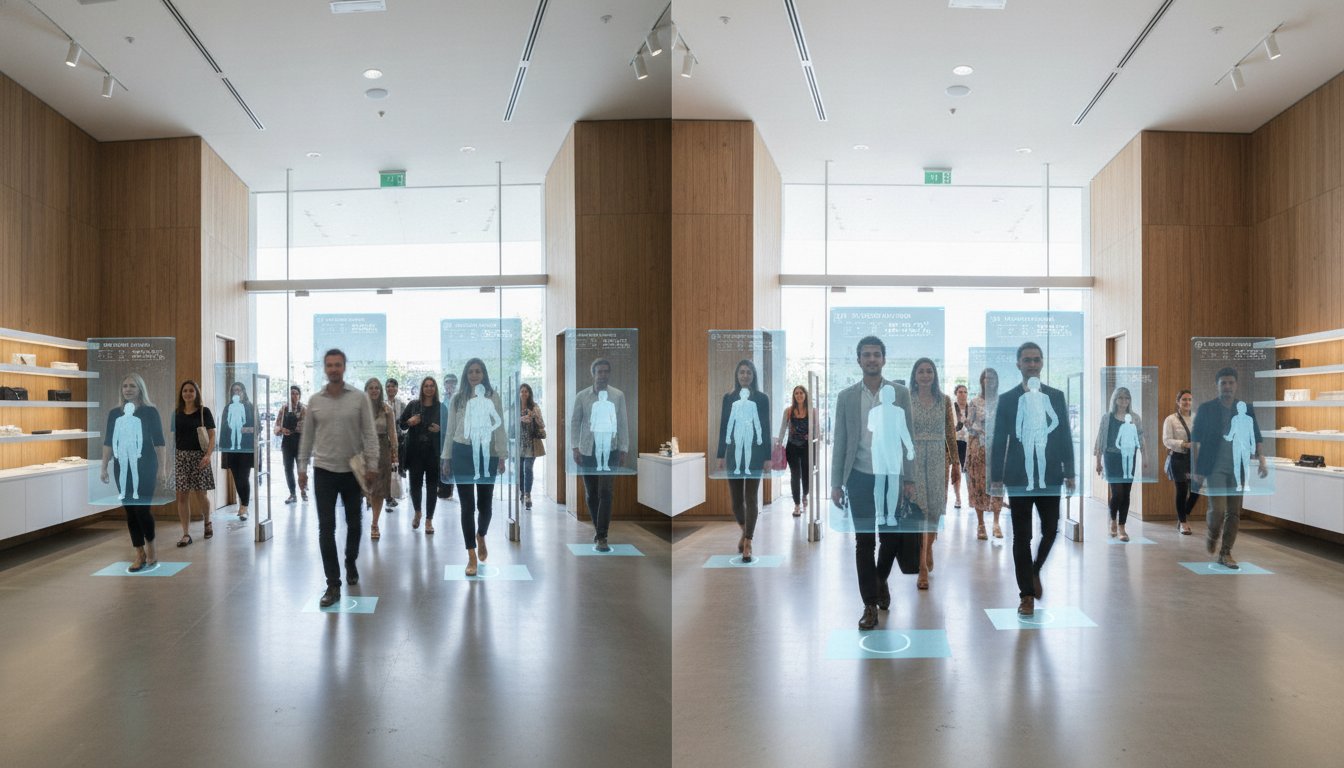
FootfallCam Pro2 vs Pro1: Which People Counter is Right for Your Business?
Would you invest in sensor hardware today if you knew it would be obsolete by 2027? You’re likely weighing the FootfallCam Pro2 vs Pro1 to determine if 3D stereoscopic vision justifies the shift from traditional IP or fisheye technology. It’s challenging to manage conflicting technical specs when your primary goal is simply reliable, actionable accuracy for your ROI calculations. You need to know that your data reflects real human behavior rather than digital noise.
This article clarifies the technical and operational distinctions between these two devices to ensure your analytics strategy rests on a future-proof foundation. We’ll examine the 99.5% accuracy benchmarks of the latest Pro2 (2025) model, deployment scenarios where the Pro1 still adds value, and how the Legacy Swap Out Plan provides a clear path for upgrading your existing infrastructure without disrupting your operations.
Key Takeaways
- Learn how 3D stereoscopic AI in the Pro2 provides a precision advantage over the wide-area fisheye technology used in Pro1 units.
- Discover why the latest Pro2 models achieve 99.5% accuracy, ensuring your ROI calculations are based on the most reliable data available.
- Evaluate the FootfallCam Pro2 vs Pro1 based on your specific infrastructure needs, including PoE requirements and entrance complexity.
- Find out how to unify your data streams using V9 Software or leverage the Legacy Swap Out Plan if it’s time to modernize your hardware.
Technical Evolution: Understanding 3D Pro2 vs. Fisheye Pro1 Technology
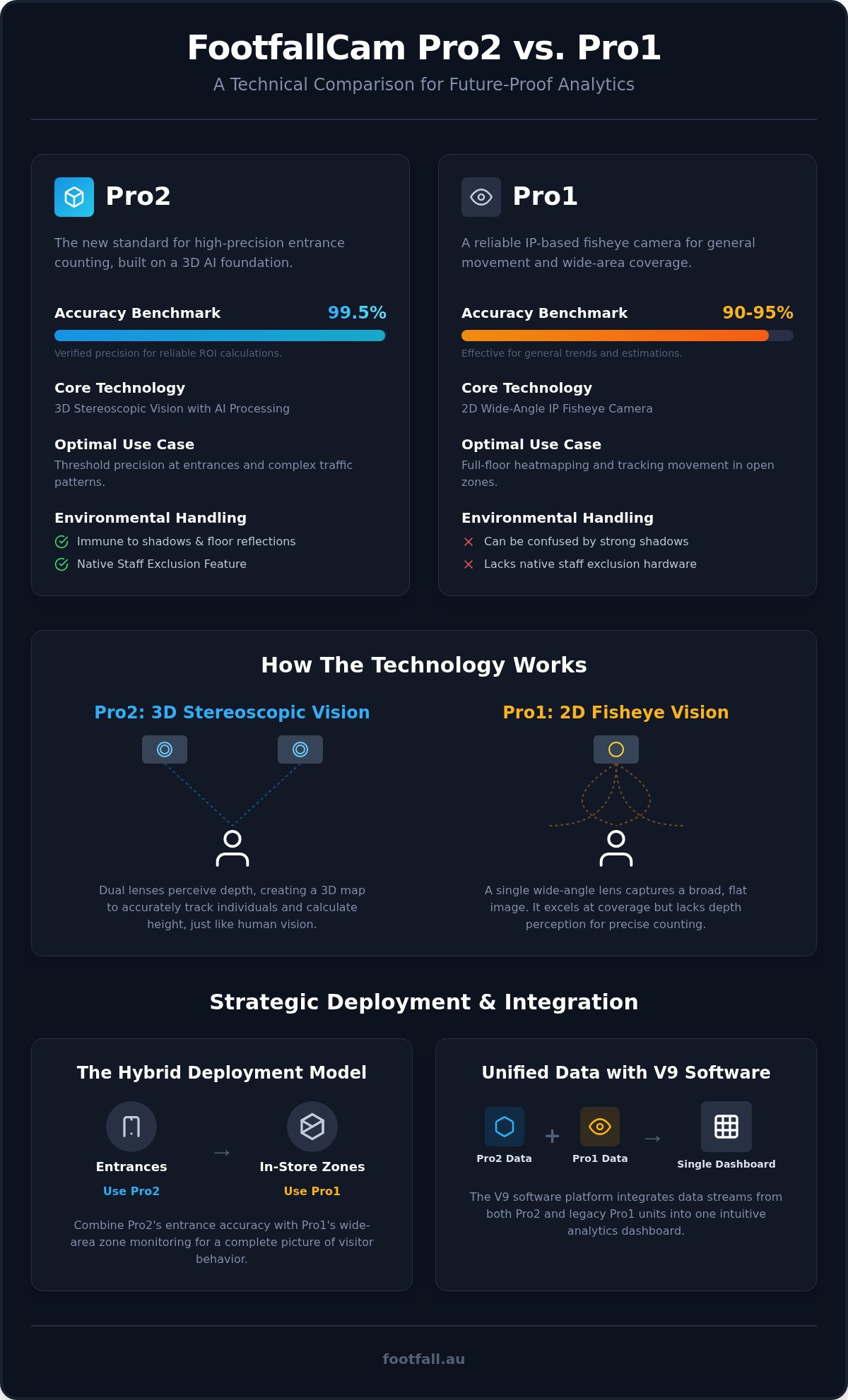
The transition from 2D imaging to 3D depth-sensing marks a pivotal shift in how we measure physical space. When evaluating the FootfallCam Pro2 vs Pro1, it’s essential to recognize their distinct engineering goals. The Pro2 is a 3D stereoscopic AI sensor built for high-precision entrance counting, whereas the Pro1 functions as an IP-based Fisheye camera designed for wide-area surveillance and general movement tracking.
Modern AI-integrated hardware actively reduces data noise by distinguishing human forms from environmental interference like floor reflections or moving shadows. This ensures that every count recorded is a verified human action rather than a technical error.
3D Stereoscopic Vision vs. Wide-Angle IP Technology
The Pro2 utilizes dual lenses to perceive depth, operating much like human sight to create a three-dimensional map of the entrance. This allows the device to accurately track individuals even in dense crowds or complex traffic patterns. In contrast, the Pro1’s wide-angle lens provides exceptional lateral coverage. When comparing the FootfallCam Pro2 vs Pro1, it’s clear the former excels at threshold precision while the latter is better suited for broad visibility.
Ceiling height significantly impacts sensor performance. While traditional people counting technology often struggled with high mountings or variable lighting, the industry has moved toward 3D sensors for entrance points. Modern people counting technology now prioritizes 3D depth-sensing to ensure data remains consistent across different architectural environments, from narrow doorways to expansive mall entrances.
Performance Benchmarks: Accuracy, Lighting, and Coverage
Accuracy serves as the primary differentiator when comparing the FootfallCam Pro2 vs Pro1. The Pro2 achieves a verified accuracy rate of 99.5% or higher, even during peak traffic periods. This precision is essential for high-stakes retail environments where every visitor counts toward conversion metrics. In contrast, the Pro1 typically delivers between 90% and 95% accuracy. While useful for general trend monitoring, it can struggle to maintain this level in dense crowds or complex queuing areas.
Environmental factors often compromise 2D sensors. The Pro2’s 3D lenses effectively ignore shadows and floor reflections that frequently confuse the Pro1’s IP-based system. Whether managing a sun-drenched storefront or a dim gallery, the Pro2 maintains data integrity. It also features native staff exclusion to filter out employee movements, a critical utility that the Pro1 lacks in its base hardware configuration. You can find more technical comparisons in the definitive guide to people counting systems in Australia.
Entrance Precision vs. Full-Floor Heatmapping
The Pro2 acts as the gold standard for threshold monitoring. When weighing the FootfallCam Pro2 vs Pro1 for specific site layouts, the Pro2’s precision ensures that sales conversion rates are calculated against real visitor numbers rather than estimates. However, the Pro1 still plays a vital role in spatial analytics. Its wide-angle lens captures human movement across large floor plates, making it an effective tool for identifying high-traffic zones or dwell times deeper within a facility.
A hybrid deployment often provides the most comprehensive data set. We recommend installing a Pro2 at every entrance for maximum precision and utilizing Pro1 units for secondary zone-based tracking. This balanced approach creates a complete narrative of movement while keeping your infrastructure investment optimized. If you need help mapping your floor plan, you can request a technical site assessment to determine the ideal sensor mix.
Strategic Implementation: Choosing the Right Model for Your Site
Deploying an effective analytics system requires a clear understanding of your site’s physical and digital infrastructure. Both the FootfallCam Pro2 and Pro1 utilize Power over Ethernet (PoE), which simplifies installation by combining power and data into a single cable. This standardized approach ensures that hardware can be mounted with minimal disruption to your existing ceiling layouts.
The FootfallCam V9 Software acts as the central intelligence hub for your operations. It unifies data streams from both legacy Pro1 units and newer Pro2 sensors into a single, intuitive dashboard. This integration allows Australian businesses to maintain a mixed hardware fleet while achieving a cohesive view of visitor behavior across all locations. When evaluating the FootfallCam Pro2 vs Pro1, it’s clear the software bridges the gap between different hardware generations.
A common concern is whether upgrading is necessary if existing Pro1 units are still functional. While the Pro1 remains a reliable tool for wide-area monitoring, the Pro2 offers enhanced edge processing and 99.5% accuracy. These features are essential for high-precision reporting as retail environments become more complex. Footfall Australia provides national support for both generations, ensuring your data remains accurate regardless of your current hardware mix.
The Legacy Swap Out Plan: Upgrading Your Infrastructure
Transitioning to modern hardware doesn’t require a total system overhaul. The Legacy Swap Out Plan enables a phased approach, allowing you to replace high-priority entrance sensors with Pro2 units while keeping Pro1 devices in secondary zones. This strategy maximizes your existing investment while improving data reliability where it matters most.
Upgrading provides access to advanced AI features and better integration with comprehensive people counter support plans. We recommend auditing your current fleet to identify high-traffic entrance points that would benefit from the Pro2’s 3D precision. This ensures your analytics strategy remains robust through 2026 and beyond.
Optimising Your Data Strategy for Long-Term Growth
Deciding on the FootfallCam Pro2 vs Pro1 depends on your specific analytical requirements. While the Pro1 provides broad spatial awareness, the Pro2’s 3D AI technology delivers the 99.5% counting accuracy essential for calculating precise sales conversion rates. With over 20 years of local industry expertise, Footfall Australia understands that data is only valuable when it’s reliable and actionable. Our national Australian support network ensures your hardware remains a strategic asset rather than just a technical installation. Whether you’re maintaining a legacy fleet or deploying new sensors, unifying your metrics through the V9 Software platform creates a transparent view of human movement. Upgrade your system with our Legacy Swap Out Plan today to ensure your business decisions are always backed by empirical evidence. You’re now equipped to build a smarter, more efficient physical environment.
Frequently Asked Questions
Can I use FootfallCam Pro2 and Pro1 on the same network?
Yes, you can integrate both devices within the same local network using standard Power over Ethernet (PoE) connectivity. When evaluating the FootfallCam Pro2 vs Pro1 for a multi-site rollout, the FootfallCam V9 Software aggregates data from all hardware generations. This allows you to view consolidated analytics on a single dashboard, even if your infrastructure uses a mix of legacy and modern sensors.
Does the Pro2 require a different software license than the Pro1?
No, both the Pro2 and Pro1 are fully compatible with the FootfallCam V9 Software platform. While the hardware capabilities differ, the reporting interface and data management tools remain consistent across your fleet. You don’t need a separate software ecosystem to manage different hardware generations. Licenses are typically managed on a per-device basis to ensure every sensor contributes to your overarching data strategy.
How much more accurate is the Pro2 in high-traffic retail environments?
The FootfallCam Pro2 vs Pro1 comparison shows a measurable jump in precision, with the Pro2 achieving 99.5% accuracy. In high-traffic retail settings, the Pro2’s 3D stereoscopic lenses excel at distinguishing individual visitors within dense groups. The Pro1 typically maintains 90% to 95% accuracy, which is reliable for monitoring general trends but may fluctuate under challenging lighting or extreme crowd density.
Is the FootfallCam Pro1 still supported for Australian businesses in 2026?
Yes, Footfall Australia continues to provide technical support and maintenance for the Pro1 series in 2026. While the industry is shifting toward 3D AI sensors, we recognize that many established sites still rely on legacy hardware. You can maintain your current units through our support plans or utilize the Legacy Swap Out Plan when you’re ready to modernize your entrance tracking.
What are the mounting height requirements for the FootfallCam Pro2?
The standard installation height for the FootfallCam Pro2 ranges from 2.1 metres to 4.5 metres for the base model. The latest 2025 iteration extends this functional range up to 6.0 metres, providing greater flexibility for sites with high ceilings or grand entrances. Maintaining these specific height parameters is essential for the 3D lenses to accurately perceive depth and deliver high-precision data.