Student Traffic Analysis: Data Guide for Schools
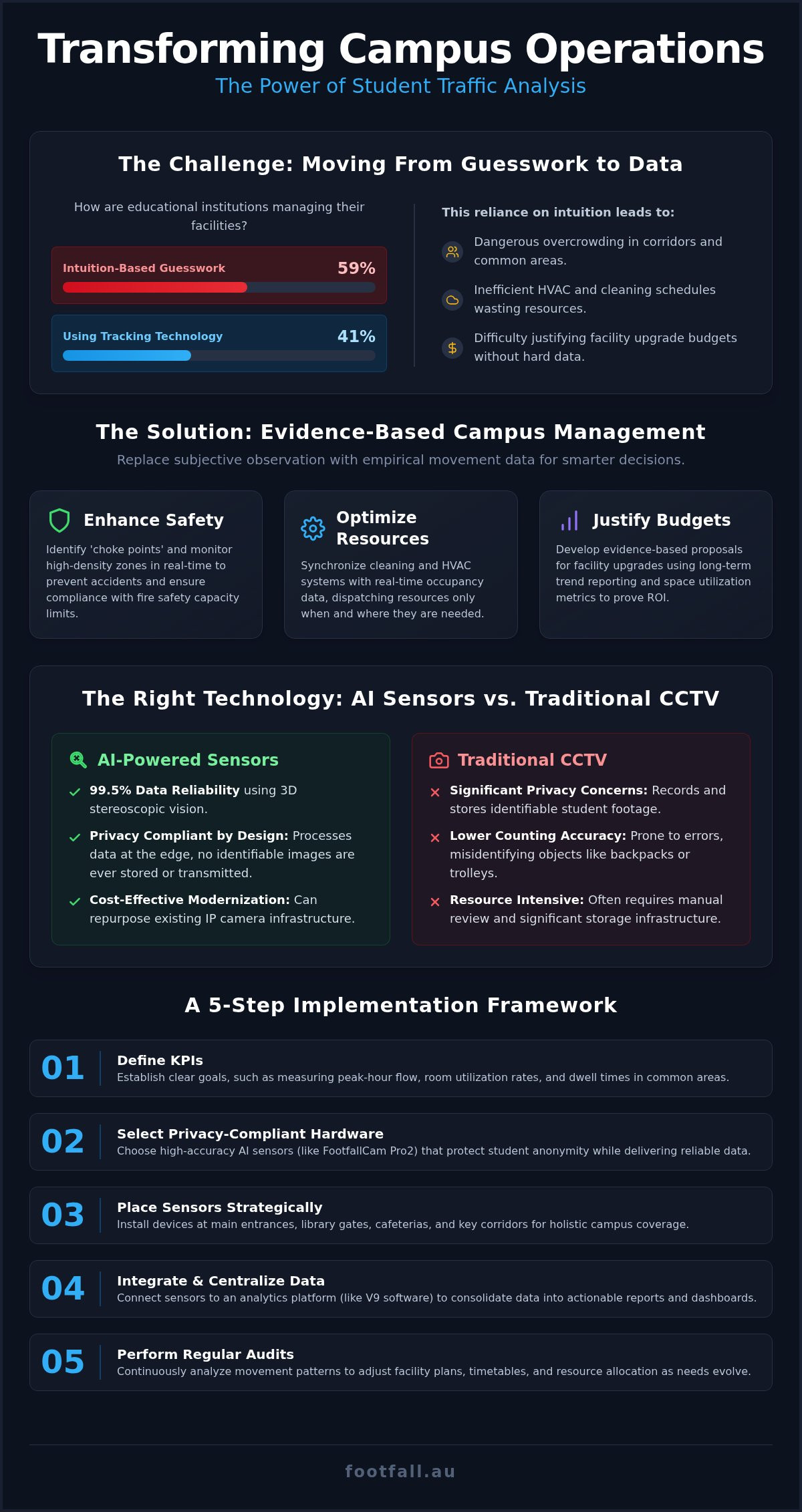
While 41% of educational leaders already utilize tracking technology to manage their environments, many institutions still rely on intuition to solve the daily chaos of overcrowded corridors. You likely know the frustration of lecture halls reaching capacity or maintenance schedules that miss the mark because they don’t account for actual usage. It’s often difficult to justify budget requests for facility upgrades without a formal student traffic analysis to replace subjective observations of foot traffic.
Discover how sophisticated student traffic analysis transforms campus safety, resource allocation, and operational efficiency through empirical movement data. We’ll explore how real-time occupancy insights and the FootfallCam Pro2 provide the evidence-based foundation you need for smarter facility planning and improved safety during peak periods. By shifting from guesswork to granular reporting, you can create a campus that responds intelligently to the students who move through it.
Key Takeaways
- Replace subjective observations with empirical movement data to gain a precise understanding of how students navigate your campus corridors and common areas.
- Learn to deploy a high-accuracy student traffic analysis system using privacy-compliant hardware that maintains student anonymity while delivering 99.5% data reliability.
- Streamline facility management by synchronising cleaning schedules and HVAC operations with real-time room occupancy and peak usage periods.
- Develop evidence-based proposals for facility upgrades using long-term trend reporting to justify budget allocations to school boards and stakeholders.
Why Student Traffic Analysis is Critical for Modern Education
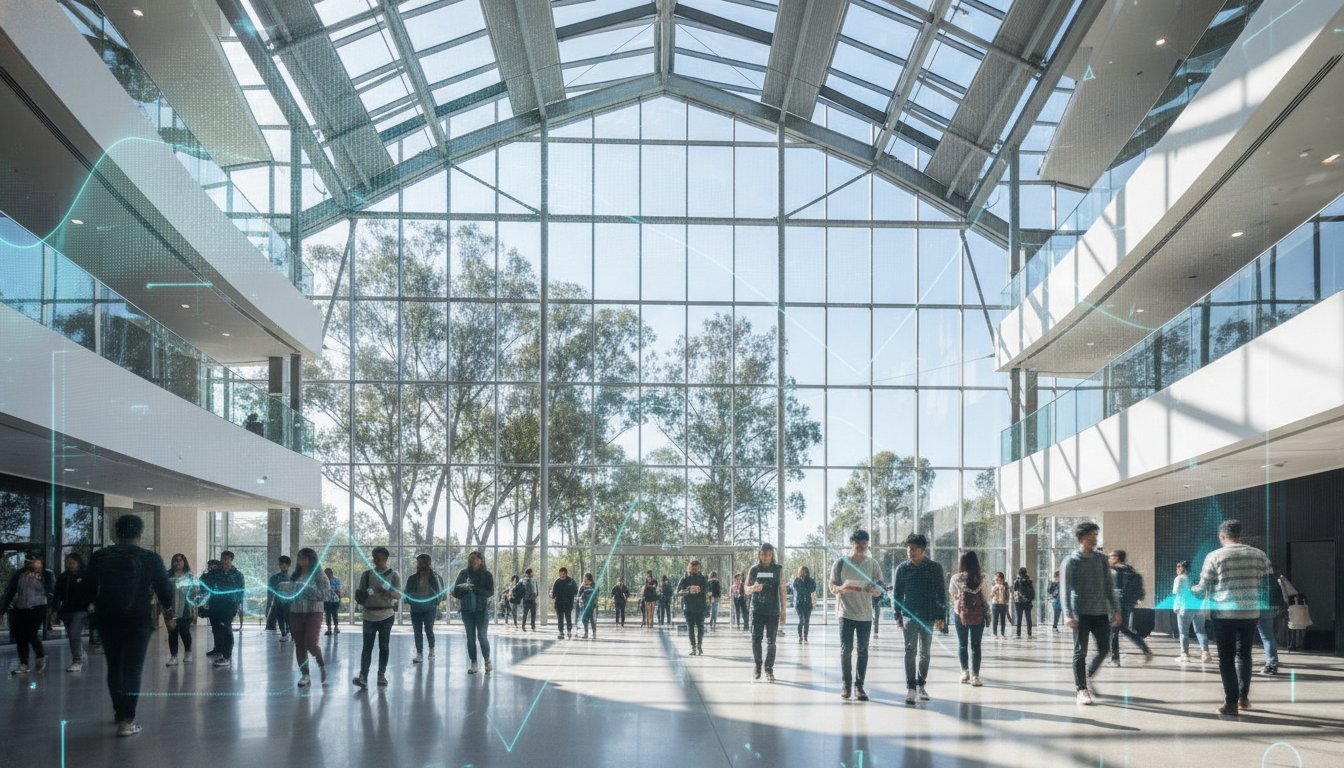
There is a documented correlation between movement data and student safety. High-density zones like libraries, student hubs, and cafeterias require precise monitoring to prevent dangerous overcrowding. By analyzing the narrative of movement, administrators can see how students actually use a space rather than how it was designed to be used. This objective data replaces the coldness of pure statistics with an empathetic understanding of student behavior, ensuring safety protocols remain effective during peak periods.
Addressing Campus Safety and Overcrowding Challenges
Identifying ‘choke points’ in corridors and stairwells is vital for preventing accidents during high-traffic period changes. Utilizing advanced people counting technology allows schools to observe these transitions in real-time. This capability ensures strict compliance with fire safety regulations and maximum capacity limits by providing instant occupancy alerts. By integrating sophisticated people counting technologies, such as AI-driven sensors, facility managers can maintain a secure environment while respecting student anonymity. These systems offer the transparency and reliability needed to justify safety-related capital works to stakeholders.
Implementing a Student Traffic Analysis System: A 5-Step Framework
Transitioning to a data-led campus requires a structured implementation strategy. First, define key performance indicators such as peak-hour flow and room utilization rates to ensure your student traffic analysis targets specific operational goals. Second, select privacy-compliant hardware like the FootfallCam Pro2, which maintains 99.5% accuracy while protecting student anonymity. Third, place sensors strategically at main entrances and library gates for holistic coverage. Fourth, integrate these devices with V9 software to centralize your data. Finally, perform regular audits to adjust your facility plans as student movement patterns evolve over the semester.
AI Sensors vs. Traditional CCTV for Education
Standard video surveillance often creates privacy concerns within educational settings. AI-driven sensors offer a superior alternative by processing data at the edge, meaning no identifiable images are ever stored or transmitted. For schools with existing infrastructure, the FootfallCam Centroid can repurpose current IP cameras for a sophisticated student traffic analysis, providing a cost-effective path to modernization. These sensors utilize 3D stereoscopic vision to distinguish students from backpacks or maintenance trolleys, ensuring your metrics remain precise. This level of technical accuracy allows administrators to trust their data when making high-stakes budget decisions. You can speak with our team to explore which sensor configuration best suits your campus architecture.
Optimising Campus Operations Through Footfall Intelligence
Integrating student traffic analysis into daily facility management unlocks immediate cost savings and operational precision. Automated building systems can now adjust HVAC levels based on real-time occupancy rather than rigid, inefficient timers. Similarly, cleaning crews can be dispatched to high-traffic zones only after specific footfall thresholds are met. This shift ensures institutional resources aren’t wasted on empty lecture halls or underutilised common areas. It’s a proactive approach that prioritises high-impact zones, directly improving the student experience by maintaining cleaner, more comfortable environments in service hubs and student union spaces.
Beyond maintenance, traffic data can also inform the selection of facility resources. For institutions looking to enhance their outdoor or common areas, Step4 provides specialized equipment that encourages active play and engagement, ensuring these spaces are both functional and developmental.
Institutions burdened by outdated hardware don’t need to start from scratch. The Legacy Swap Out Plan provides a clear path to modernising infrastructure without a total system overhaul. This allows schools to transition seamlessly to high-accuracy sensors while maintaining historical data continuity.
Measuring ROI in the Education Sector
Strategic facility planning requires more than just raw numbers. It requires context. By calculating the cost-per-student-hour for specific facilities, administrators can identify underutilised assets and repurpose them for higher-value activities. Data-driven reports derived from a comprehensive student traffic analysis provide the empirical evidence needed to secure faster board approval for expansions or new capital works. Adopting standardised people counting systems in Australia ensures your institution remains aligned with national benchmarks for space optimisation and safety. This long-term commitment to accuracy fosters a culture of transparency and strategic growth across the entire campus ecosystem.
Securing the Future of Campus Infrastructure
Transforming a modern campus into a responsive environment starts with understanding the narrative of human movement. By replacing observational guesses with a robust student traffic analysis, institutions can pinpoint exactly where operational resources are needed most. This empirical approach doesn’t just improve daily safety; it provides the transparent evidence required to secure board approval for future capital works. You can now move from intuition to insight with ease.
Deploying the FootfallCam Pro2 ensures your facility decisions are backed by 99.5% accuracy and privacy-compliant AI technology. Supported by local Australian maintenance plans, these systems empower you to manage space with quiet confidence. Optimise your campus with Footfall Australia’s data-driven solutions. and lead your institution toward a more efficient, evidence-based future. It’s time to let data guide your growth.
Frequently Asked Questions
Is student traffic analysis compliant with Australian privacy laws?
Yes, student traffic analysis is fully compliant with Australian privacy laws through the use of edge-processing AI technology. Our systems, such as the FootfallCam Pro2, don’t store or transmit identifiable facial images. This privacy-compliant approach ensures institutions remain aligned with GDPR and Australian Privacy Principles while gaining 99.5% accurate movement data without compromising the anonymity of students or staff members.
Can people counters distinguish between students, staff, and visitors?
Advanced people counters distinguish between individuals based on physical attributes like height and movement patterns. While they don’t identify specific roles like “visitor” or “staff” through facial recognition, they accurately filter out non-human objects like trolleys or backpacks. This level of precision ensures your student traffic analysis reflects actual human presence, providing a reliable foundation for calculating facility utilization rates and space requirements.
How does student footfall data help with campus energy efficiency?
Footfall data drives energy efficiency by enabling institutional facilities to transition from fixed schedules to demand-based climate control. By integrating V9 software with building management systems, schools can automate HVAC and lighting based on real-time room occupancy. This eliminates the significant cost of heating or cooling empty lecture halls, ensuring energy is only consumed where students are physically present and active.
What is the difference between occupancy monitoring and flow analysis in a school?
Occupancy monitoring focuses on the total number of people within a specific zone to manage safety and capacity limits. In contrast, flow analysis tracks the direction and volume of students moving through transit points like stairwells and corridors. Combining these metrics allows administrators to identify dangerous choke points and optimize the narrative of movement across the entire campus during peak period changes.