
Validating Marketing Spend with Traffic Data: 2026 Guide
Only 36% of marketers feel they can accurately measure their return on investment. If you’re managing a retail network across Australia, you likely recognise the frustration of seeing high click-through rates while store managers report quiet floors. It feels like throwing capital into a black box, especially when you’re tasked with validating marketing spend with traffic data to justify your budget. You know digital engagement should drive physical presence, yet the offline customer journey often remains opaque.
This guide bridges that gap by showing you how to transform footfall analytics into a strategic asset. You’ll learn a clear framework for measuring cost-per-visitor and discover how to optimise your marketing spend based on real-time store traffic spikes. We’ll examine how FootfallCam V9 Software helps align your digital ad spend with physical visits, ensuring every A$1 invested is backed by empirical evidence. You’ll gain the tools to move beyond intuition and lead with data-driven confidence.
Key Takeaways
- Understand why digital metrics alone create a “black hole” in retail attribution and how to capture the full offline customer journey.
- Establish a reliable methodology for validating marketing spend with traffic data by correlating specific campaign dates with precise footfall spikes.
- Implement the Cost-Per-Visit (CPV) framework to calculate the exact marketing investment required to drive a single customer into your store.
- Utilise automated reporting to identify high-performing channels, allowing you to reallocate budget toward the campaigns that generate the highest physical engagement.
The Attribution Gap: Why Traditional Metrics Fail Physical Retail
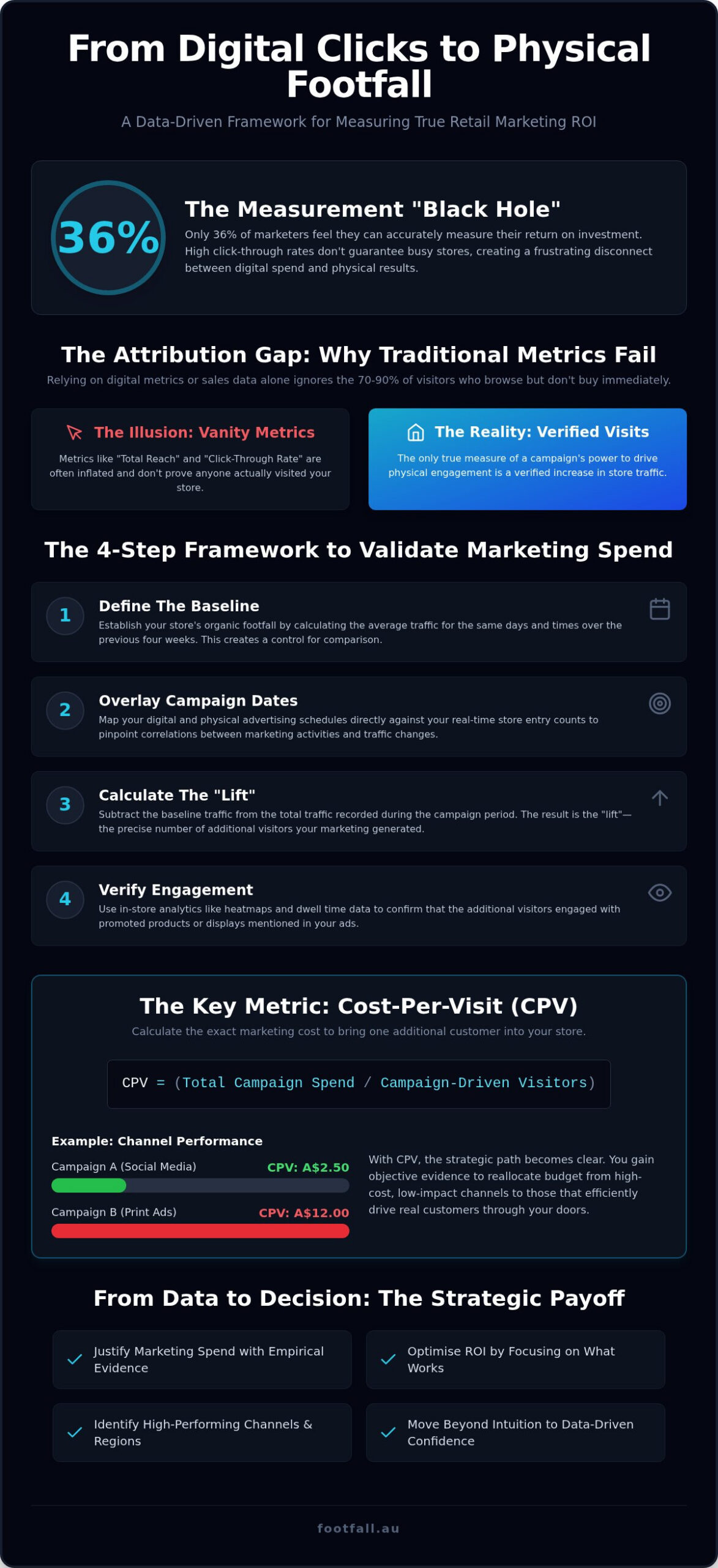
Traditional marketing attribution models often fail at the storefront. While digital dashboards track every impression and click, they frequently lose sight of the customer the moment they step off the screen. This creates a “black hole” where the effectiveness of expensive campaigns remains unverified. Relying solely on sales data is misleading, as it ignores the 70-90% of visitors who enter a store but leave without making a purchase. The Attribution Gap is the disconnect between marketing reach and physical store entry.
By validating marketing spend with traffic data, retailers can finally see the complete picture. Precise traffic data provides the missing link between a customer seeing an ad and physically entering the store. Without this layer of insight, marketing remains an expense based on intuition rather than a measurable investment. It’s difficult to justify a budget when you can’t prove that your digital efforts actually moved people through your doors.
Bridging the Gap Between Digital Clicks and Physical Footfall
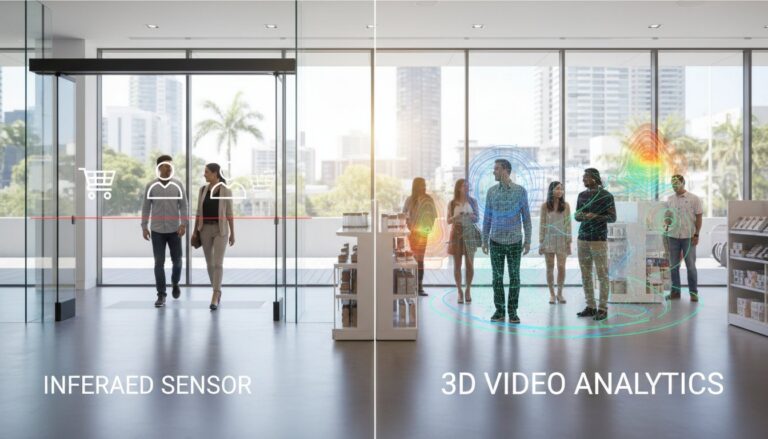
People counting systems Australia-wide are evolving to track the full customer journey with high precision. Strategic footfall data analysis allows managers to identify specific campaign-driven visits by comparing baseline traffic against promotional periods. Modern sensors like the FootfallCam Pro2 offer the accuracy required to distinguish between organic shoppers and those prompted by a specific marketing push. In a landscape where digital impressions are often inflated, “Total Reach” has become a vanity metric compared to “Verified Store Visits.” It doesn’t tell you if anyone actually showed up. This shift from estimated impact to empirical evidence ensures that every A$ spent on advertising is tied to a tangible physical action.
Measuring Campaign Impact with Precise Footfall Analytics
To accurately validate marketing spend with traffic data, you must first establish a baseline. Without understanding your organic footfall, it’s impossible to distinguish between a standard Saturday rush and a genuine campaign-driven spike. By establishing a control period, you can isolate the “lift” generated by specific promotional activities. This empirical approach replaces guesswork with certainty, allowing you to see exactly how many additional visitors entered your store due to your investment.
Isolating campaign traffic involves a structured process:
- Define the baseline: Calculate average traffic for the same days and times over the previous four weeks.
- Overlay campaign dates: Map your digital or physical ad schedule against real-time entry counts.
- Calculate the lift: Subtract your baseline from the total traffic recorded during the campaign.
- Verify engagement: Use heatmaps and dwell time data to confirm if these visitors engaged with the specific featured displays mentioned in your ads.
This method ensures that you aren’t crediting your marketing budget for traffic that would have arrived regardless of your efforts. It provides the objective evidence needed to prove channel effectiveness to stakeholders.
Using FootfallCam V9 to Isolate Marketing-Driven Traffic
The FootfallCam V9 Software simplifies this process through the automated Marketing Effectiveness Report. This tool allows marketing managers to see performance across different national locations, identifying which regions responded best to specific spend. To ensure accuracy, the system integrates external data points such as weather patterns and local holidays. If a sudden rainstorm coincides with your campaign, the V9 Software helps you adjust your validation to account for environmental factors. For those looking to refine their strategy, exploring advanced people counting solutions can provide the granular data needed for precise ROI calculations.
Optimising ROI: Turning Traffic Insights into Strategic Spend
Optimising ROI requires moving beyond surface-level traffic counts. By implementing the Cost-Per-Visit (CPV) metric, you can calculate the exact investment needed to drive a single additional visitor into your store. This is achieved by dividing your total marketing spend by the number of extra visitors generated above your established baseline. Validating marketing spend with traffic data in this way allows you to identify which channels offer the best value for money. If one campaign has a CPV of A$2.50 while another costs A$12.00 per visitor, the strategic path becomes clear. Leveraging retail footfall analysis Australia provides the objective evidence needed to justify increasing marketing budgets for high-performing locations.
Real-time insights enable agile budget management. If data shows a specific store is underperforming despite high digital spend, you can shift that capital in real-time to locations showing higher marketing-driven footfall. This ensures your resources aren’t wasted on dead zones. It’s about quality as much as quantity. Using conversion rate data helps identify if your marketing is bringing in the right kind of customers who actually intend to buy.
Integrating Footfall Data with Sales to Prove True Campaign Value
The synergy between people counting technology and sales data provides the ultimate validation tool. Calculating the “Return on Marketing Spend” involves looking at the uplift in both traffic and conversion rates simultaneously. If a campaign drives a massive footfall spike but conversion rates plummet, your messaging might be attracting the wrong demographic. Conversely, a high-conversion spike alongside increased traffic proves the campaign reached high-intent shoppers. Presenting these integrated findings to stakeholders transforms marketing from a perceived cost into a proven revenue driver. It provides a foundation of quiet confidence, allowing you to secure future investment through empirical evidence rather than intuition.
Transforming Marketing from an Expense to a Strategic Asset
Validating marketing spend with traffic data is no longer a luxury for Australian retailers; it’s a prerequisite for growth within competitive markets. By bridging the attribution gap and implementing precise metrics like Cost-Per-Visit, you move beyond the uncertainty of digital clicks to the clarity of physical store performance. This shift ensures every marketing dollar is accountable and every campaign is measured by its true impact on human movement.
Success in 2026 relies on the integration of hardware accuracy and intelligent reporting. The FootfallCam Pro2 provides industry-leading AI accuracy, while our national support network ensures your systems remain reliable. With seamless data integration for major POS systems, you can finally prove the direct link between digital reach and your bottom line.
Optimise your marketing spend with FootfallCam V9 Software today and lead your organisation with the confidence of empirical evidence.
Frequently Asked Questions
How do I distinguish between regular customers and those driven by a specific marketing campaign?
You distinguish marketing-driven visitors by establishing a baseline of organic traffic before your promotion begins. By comparing average entry counts from previous weeks against the traffic recorded during your campaign, you can isolate the specific “lift” in attendance. This empirical approach ensures you aren’t misattributing regular shoppers to your marketing budget, providing a clear method for validating marketing spend with traffic data.
Can people counting data help me validate my digital ad spend on platforms like Facebook or Google?
Yes, people counting systems bridge the gap between digital impressions and physical store visits. While Facebook and Google track clicks, they cannot confirm if a user actually entered your store. By overlaying your digital ad schedule with real-time footfall spikes recorded by the FootfallCam Pro2, you can verify if online engagement translated into physical presence, effectively closing the attribution loop for your digital spend.
What is the most important metric to track when validating marketing spend for a physical store?
The most critical metric is Cost-Per-Visit (CPV). This is calculated by dividing your total marketing spend by the number of additional visitors generated above your baseline. Tracking CPV allows you to compare different channels objectively to see how many A$ were required to drive each visit. When combined with conversion rate data, it reveals if your marketing successfully attracted high-intent customers.
Is it possible to automate marketing validation reports using FootfallCam software?
Automation is a core feature of the FootfallCam V9 Software through its dedicated Marketing Effectiveness Report. This tool automatically correlates your promotional dates with traffic fluctuations, removing the need for manual data entry. It streamlines the process of validating marketing spend with traffic data, delivering intuitive summaries that help managers quickly identify which campaigns yielded the highest return on investment across their national store network.