
A/B Testing Store Layouts: A Data-Driven Guide for Australian Retailers (2026)
Gut feeling is the most expensive way to run a retail store in 2026. You likely understand the frustration of approving a costly shopfitting project only to find it impossible to isolate the layout’s impact from seasonal trends or a new marketing campaign. It’s a common challenge for Australian retailers who want to move beyond intuition but feel limited by the lack of objective evidence for their merchandising decisions. Making changes without a clear baseline often leads to wasted capital and missed opportunities for growth.
This guide provides the data-driven clarity you need to transform your floor plan into a strategic asset. You’ll learn how to scientifically optimise your retail space through A/B testing store layouts, using precise foot traffic metrics to drive higher conversion and sales. Industry research indicates that an optimised layout can increase sales by up to 10% and improve conversion rates by 20%. We will outline a practical framework for testing layout changes using tools like the FootfallCam Analytic Manager V9, giving you the ability to justify every shopfitting investment with empirical proof of improved customer flow and engagement.
Key Takeaways
- Replace intuition with a structured framework that uses historical baselines to isolate the true impact of any layout change.
- Interpret human movement as a sequence of strategic actions by tracking critical metrics like zone footfall and specific engagement duration.
- Implement A/B testing store layouts using the FootfallCam Pro2 to achieve 99.5% data accuracy when comparing different merchandising strategies.
- Use the FootfallCam V9 software to automate reporting, allowing you to justify capital expenditure on shopfitting with clear evidence of increased conversion.
What is A/B Testing for Store Layouts?
Physical A/B testing is a controlled experiment where you compare two versions of a retail environment to determine which one better facilitates your commercial objectives. Unlike digital environments where traffic is split instantly by an algorithm, physical retail requires a structured methodology to isolate specific variables. You might change the orientation of your shelving, the height of a display, or the width of an aisle to observe how these adjustments influence human movement and purchasing intent. The core objective is to move beyond the “what” of sales figures and understand the “why” behind customer behavior.
In 2026, the Australian retail market demands this level of precision. With total retail spending reaching $38.63 billion in January 2026, consumers are more selective and value-conscious than ever. You can’t afford to rely on “gut feeling” for merchandising when labor accounts for approximately 40% of your operating costs. A/B testing store layouts provides the empirical evidence needed to justify every square metre of floor space, ensuring that shopfitting investments lead to a measurable return on investment rather than an expensive guess.
Retailers typically choose between two testing models. Split testing involves applying “Layout A” to one store and “Layout B” to a similar sister store within the same region. This is effective for large chains but can be skewed by local demographic differences. Alternatively, time-series testing uses a single location. You establish a firm baseline over a set period, implement your layout change, and then measure the variance in performance. This second method is often more reliable for isolating the impact of a specific change without the noise of varying store locations.
The Evolution of Retail Experimentation
Retail strategy has shifted from staff using manual clickers to sophisticated, automated sensors that capture the full narrative of movement. While sales figures tell you what happened at the register, they don’t explain where you lost the customer. Relying solely on transaction data is insufficient because it ignores the customers who entered a zone but left without engaging. Implementing retail footfall analysis Australia wide allows you to see the “invisible” path to purchase, identifying exactly where friction occurs before a shopper even reaches the checkout.
Variables You Can Test Today
Testing isn’t just about moving a shelf; it’s about optimizing the flow of human action. You can scientifically measure several critical variables:
- Entrance Displays: Test the effectiveness of your “decompression zone” to see if shoppers are engaging with your lead promotions or walking straight past them.
- Aisle Width: Determine if narrower aisles create a “butt-brush” effect that drives shoppers away, or if wider paths encourage longer browsing sessions.
- Product Placement: Compare high-impact power walls against modular island displays to see which configuration generates the highest dwell time in specific zones.
By treating your floor plan as a living lab, you transform your store from a static space into a high-performance environment that adapts to shifting behavioral trends.
Critical Metrics for Measuring Layout Success
Sales figures are lagging indicators. They confirm a result but offer no insight into the behavioral journey that preceded the transaction. To truly master A/B testing store layouts, you need to track leading indicators that reveal how customers interact with your physical space in real-time. By observing these metrics, you can identify precisely where a layout succeeds or fails before the final sales report is even generated. High-performing retailers don’t just look at the total revenue; they look at the narrative of movement that leads to that revenue.
Effective measurement requires a focus on five core metrics:
- Footfall Volume: This measures the total draw of a specific store zone, providing a baseline for how many people your new layout actually reaches.
- Dwell Time: This tracks how long customers spend engaging with a specific display or product category. High dwell time typically suggests interest, while extremely low dwell time indicates a lack of visual impact.
- Pathing Analysis: This identifies where customers “leak” out of the store or skip specific sections. It highlights structural barriers that might be preventing full store circulation.
- Capture Rate: This is the percentage of passers-by who enter a specific aisle or zone. It’s a direct measure of how effectively your signage and endcap displays attract attention.
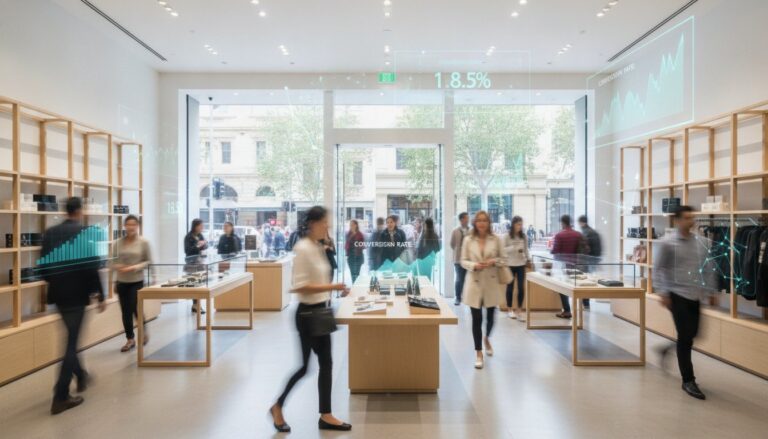
- Conversion Rate: While sales are the end goal, you must link movement data to POS transactions to see if your layout change actually converted browsers into buyers.
Strategic experts often look at design considerations for retail A/B tests to ensure they aren’t just moving furniture, but are actually influencing the customer’s decision-making process. This prevents the common mistake of optimizing for aesthetics while accidentally sacrificing functionality.
The Importance of Zone Engagement
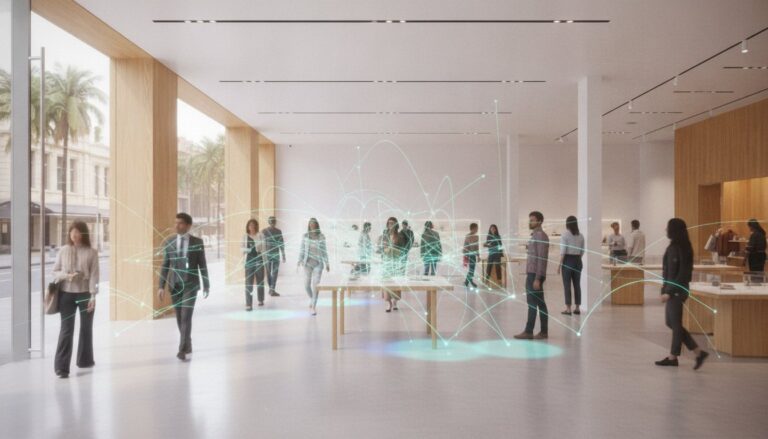
Visualizing customer density through heatmaps allows you to distinguish between “hot zones” and “cold zones.” If a layout change increases footfall but decreases sales, you might be creating a “bottleneck” where customers feel crowded. Zone engagement is the ratio of passers-by to active shoppers. A high ratio suggests that while people are moving through the area, they aren’t pausing to interact with the products, indicating a potential issue with product accessibility or shelf height.
Beyond the Cash Register
High dwell time isn’t always a positive sign. It could indicate that customers are confused by your pricing or can’t find the correct size. Using footfall data analysis helps you spot these missed opportunities by comparing engagement levels against final sales. If a display has a high average dwell time but a low conversion rate, the layout is attracting attention but failing to close the deal. Integrating these quantitative sensors with your own observations creates a complete picture of the customer experience. For those looking to upgrade their current monitoring, a modern people counting system provides the granular data necessary for these deep dives.

Traditional Merchandising vs. Data-Driven Testing
For decades, retail merchandising was treated as an art form directed by experience and intuition. While veterans often have a sharp eye for aesthetics, relying on “the way we’ve always done it” is increasingly dangerous in a shifting market. Total Australian retail spending hit $38.63 billion in January 2026, yet consumers are projected to make fewer in-store purchases than in previous years. This shift means every square metre must work harder to justify its existence. A/B testing store layouts transforms merchandising from a subjective debate into a objective science, ensuring that floor plans are designed for the customer’s actual behavior rather than a manager’s preference.
The cost of a failed layout change is immense. When you consider that labor accounts for 40% of operating costs, the hours spent moving stock and fixtures for an ineffective plan represent a significant drain on margins. Testing allows you to validate a hypothesis on a small scale before committing to a national rollout. For instance, research shows that moving specific products to checkout areas can boost sales by between 80% and 478%. Without testing, such a high-impact change remains a missed opportunity; with it, the change becomes a documented success story that can be scaled with confidence.
Data-driven testing removes the friction often found between corporate headquarters and local floor managers. When a layout change is proposed, internal bias often leads to departmental conflict. Strategic retailers use empirical evidence to resolve these disputes, letting the customers’ movement patterns act as the final word. This creates a culture of transparency and reliability where decisions are backed by evidence-based success rather than seniority.
Identifying the “Gut Feeling” Bias
Floor managers and executives often disagree on layout because they view the store through different lenses. An executive might prioritize brand aesthetic, while a manager focuses on ease of restocking. Using data as an objective referee eliminates this bias. When teams see that a rear endcap is generating a 416% increase in brand sales, the debate ends. This evidence-based approach builds psychological confidence across the entire organization, as staff know their efforts are aligned with proven customer engagement.
Agile Retail: Fast Failure and Faster Success
Physical retail is adopting the “fail fast” mentality once reserved for software development. By treating a single location as a pilot site, you can iterate on floor plans rapidly without risking your brand’s reputation across the entire network. Modern people counting technology facilitates this agility by providing immediate feedback on how a change affects zone dwell time and flow. This allows you to pivot away from unsuccessful configurations in days, rather than waiting for quarterly sales reports to reveal a decline.
Step-by-Step: How to Run a Layout A/B Test
Executing a successful experiment requires more than just moving shelves; it requires a rigorous adherence to scientific principles. To begin A/B testing store layouts, you must first define a clear, measurable hypothesis. A vague goal like “improving sales” is difficult to track and even harder to prove. Instead, focus on a specific behavioral shift, such as: “Moving the denim collection to the primary power wall will increase zone dwell time by 15%.” This level of clarity allows you to select the exact metrics needed for validation and prevents the misinterpretation of results.
Once your hypothesis is set, establish a firm baseline. Use at least four weeks of historical footfall data to account for weekly variance and standard shopping patterns. This period acts as your control group. When you transition to the test phase, isolate a single major variable. If you change the lighting, the aisle width, and the product placement simultaneously, you’ll be unable to identify which factor drove the result. Run the experiment for a duration that captures enough traffic to be statistically significant, typically matching the length of your baseline period to ensure a fair comparison.
Controlling for External Factors
Australian retailers must account for external noise that can corrupt data. A 5% year-on-year increase in retail spending, as seen in January 2026, can easily be mistaken for a successful layout change if you don’t normalise your figures against broader market trends. You must also factor in public holidays like Australia Day or Easter, local school terms, and shifting weather patterns that influence national foot traffic. By comparing your test store against a control store or regional averages, you ensure the observed lift is a direct result of your spatial strategy rather than an external spike in consumer activity.
Analysing the Results
Visual proof is often the most compelling way to justify shopfitting costs to stakeholders. Compare “before” and “after” heatmaps to see if the new layout successfully redirected flow into previously underutilised areas. Calculate the lift in zone-specific conversion rates by matching zone footfall against POS data to see if the movement translated into revenue. Statistical significance in a retail context is achieved when the observed change in customer behavior exceeds the standard deviation of your historical baseline by a margin that ensures the result is not due to random chance. If the data confirms your hypothesis, you can proceed with a wider rollout with total confidence. To start building your baseline today, explore our people counting solutions for precise data collection.
Optimising with FootfallCam Technology
Precision in measurement is the foundation of any successful experiment. To achieve the level of detail required for A/B testing store layouts, you need technology that goes beyond simple counting. The FootfallCam Pro2 provides 99.5% tracking accuracy, giving you the granular data necessary to detect even subtle shifts in customer behavior. When you are comparing two different floor plans, a margin of error in your data can lead to false conclusions. High-accuracy sensors ensure that every increase in dwell time or change in pathing is a true reflection of your layout’s performance.
Managing these tests manually is time-consuming and prone to human error. The FootfallCam V9 software automates the testing process by aggregating data into intuitive, real-time reports. You can generate heatmaps instantly to see immediate feedback on a new display or aisle configuration. This allows you to observe how shoppers navigate the space as it happens, rather than waiting weeks for a retrospective analysis. While the software integrates with existing sales data to provide a complete view of the customer journey, its primary value lies in its ability to turn movement into actionable strategy.
The Power of AI People Counters
Modern retail environments are complex, and standard sensors often struggle with “noise” that corrupts data. The FootfallCam Pro2 uses advanced AI to distinguish between staff and customers, ensuring your internal movements don’t skew the results of a layout test. It also filters out non-shopping entities, such as shopping trolleys and children, to maintain a pure dataset. The technical superiority of 3D stereoscopic vision allows these devices to maintain accuracy even in high-density areas where customers may be walking in close groups, providing a reliable foundation for your spatial experiments.
Strategic Implementation Nationwide
Scaling a successful layout test from a single pilot site to a national network requires a centralised approach to data. Footfall Australia provides the local expertise needed to deploy these systems across multiple locations simultaneously. By centralising your metrics within the V9 software, head office teams can review performance across different regions in a single dashboard. This transparency allows for rapid decision-making and ensures that successful layout changes are rolled out quickly across the country. You gain a partner that values accuracy and efficiency, helping you stay prepared for shifting behavioral trends with evidence-based success.
Transforming Retail Movement into Measurable Growth
Mastering the science of physical retail requires a fundamental shift from subjective observation to empirical validation. You’ve seen how isolating specific spatial variables and establishing firm historical baselines can remove the financial risk from significant capital investments. By prioritising leading indicators like zone dwell time and capture rates, you gain a transparent view of the human actions that precede every transaction. This level of insight is essential for maintaining a competitive edge as consumer habits evolve.
Implementing a structured framework for A/B testing store layouts ensures that your merchandising decisions are consistently backed by evidence rather than intuition. This methodology allows you to justify shopfitting costs with 99.5% counting accuracy while navigating the competitive complexities of the 2026 Australian retail market. It transforms your store from a static environment into a high-performance space that responds to data.
With over 20 years of experience in Australian retail analytics and a dedicated national support network for both hardware and software, we provide the technical foundation for your strategic growth. Request a Data-Driven Store Layout Consultation to begin optimising your environment with absolute precision. Your floor plan is your most valuable asset; it’s time to manage it with data-backed confidence.
Frequently Asked Questions
What is the most important metric when A/B testing a store layout?
The most critical metric is the zone-specific conversion rate, which links footfall in a particular area to final transaction data. While total sales provide a high-level view, understanding the ratio of shoppers who engaged with a display versus those who made a purchase reveals the layout’s true effectiveness. Tracking dwell time also serves as a vital leading indicator of customer interest before they reach the register.
How long should a retail A/B test run to be accurate?
A retail experiment should run for a minimum of four weeks to ensure statistical significance. This duration allows you to account for weekly variance and standard shopping cycles. Matching the test period to a four-week historical baseline ensures that you’re comparing like-for-like data, effectively isolating the impact of the layout change from random traffic fluctuations that occur throughout the month.
Can I A/B test a layout without expensive software?
You can perform basic testing using manual counts, but the risk of human error and high labor costs often outweighs the savings. Automated systems like the FootfallCam V9 software provide a more cost-effective solution by delivering 99.5% accuracy without manual intervention. Precise data is essential for A/B testing store layouts because even minor errors can lead to expensive, incorrect merchandising decisions.
What are common mistakes in physical store A/B testing?
The most frequent error is failing to isolate a single variable during the experiment. If you change lighting, signage, and shelf height simultaneously, it’s impossible to determine which factor caused the shift in behavior. Other mistakes include ignoring external factors like local weather or failing to establish a firm historical baseline before starting the test, which makes the results difficult to verify.
How do I account for seasonal sales during a layout experiment?
Account for seasonal trends by comparing your test store’s performance against a control store in the same region that hasn’t changed its layout. Alternatively, you can normalise your data by looking at year-on-year growth rates rather than raw sales numbers. This ensures that a seasonal spike in Australian retail spending isn’t incorrectly attributed to your new floor plan when it was actually a market-wide trend.
Is it better to test one store or two different stores?
Time-series testing in a single store is generally superior for isolating specific layout impacts. While testing two different stores is possible, demographic variations and differing staff performance can introduce noise into your data. By establishing a baseline in one location and then implementing the change, you ensure the only significant variable is the layout itself, leading to more reliable and actionable insights.
How does heatmapping help with store layout optimization?
Heatmapping provides a visual representation of customer density, identifying hot zones of high engagement and cold zones that shoppers ignore. This technology allows you to see exactly where customers pause and where they bypass products entirely. It’s an essential tool for A/B testing store layouts as it reveals the immediate behavioral reaction to spatial changes, allowing you to refine the flow in real-time.
What is the “butt-brush” effect and how do I test for it?
The butt-brush effect occurs when a shopper leaves a display because they are bumped by passing traffic in a narrow aisle. You can test for this by comparing dwell times in aisles of varying widths. If wider aisles result in significantly longer browsing sessions, your previous layout was likely causing physical discomfort that discouraged engagement, proving that space is as important as product placement.