
The Impact of Weather on Retail Footfall: A Data-Driven Analysis for 2026
Weather volatility puts approximately $1 trillion in annual global retail revenue at risk, yet over 3% of total retail sales are directly tied to these shifting patterns. Understanding the impact of weather on retail footfall is no longer about making retrospective excuses for a quiet afternoon; it’s about mastering predictive precision. You’ve likely experienced the operational strain of unpredictable staffing during a storm or the frustration of seeing marketing spend wasted on days when climate discourages physical shopping. It’s difficult to hold teams accountable or conduct accurate performance reviews when external factors skew your baseline metrics.
This analysis provides a clear framework to quantify meteorological effects and transform climate volatility into a strategic advantage. You’ll discover how to normalize conversion rates regardless of the forecast and implement evidence-based staffing models that adjust to real-time predictions. We’ll examine how high-fidelity analytics and the advanced AI capabilities of the FootfallCam Pro2 (2025) empower you to treat weather as a manageable data layer rather than an uncontrollable obstacle. The goal is to move beyond intuition and rely on empirical evidence to drive higher ROI across every localized campaign.
Key Takeaways
- Identify how specific retail environments, such as open-air high streets and enclosed malls, respond differently to meteorological shifts.
- Quantify the precise impact of weather on retail footfall by calculating a data-driven coefficient that replaces anecdotal evidence with empirical facts.
- Adopt weather-adjusted conversion rates as a primary KPI to ensure performance reviews remain focused on sales execution rather than external climate factors.
- Optimize labor costs and inventory through 72-hour predictive modeling, allowing for dynamic staffing that reflects upcoming weather patterns.
- Automate the integration of environmental variables into your reporting suite using FootfallCam Pro2 hardware and the V9 Software platform.
The Correlation Between Meteorological Patterns and Consumer Mobility
Weather is far more than a background condition for retail; it’s a primary catalyst for human action. To master the impact of weather on retail footfall, you must analyze the psychological shifts that dictate consumer mobility patterns. When environmental conditions shift, so does the nature of a shopper’s journey. Significant weather events often compress the shopping window, moving intent from casual discovery to urgent utility. This shift manifests differently across the Australian retail landscape. High-street precincts in major CBDs often witness a sharp decline during heavy rain as pedestrians prioritize shelter. Conversely, enclosed shopping centers frequently see a “shelter surge,” where foot traffic increases as consumers move their errands into climate-controlled environments.
We also identify a “Goldilocks” effect in consumer behavior. Paradoxically, exceptionally clear and mild days can be detrimental to specific retail formats. On these days, consumers often trade the shopping mall for outdoor leisure or travel, leading to a measurable dip in traffic for indoor precincts. Understanding this requires recognizing the lag time between a weather change and the resulting movement. A morning storm might suppress traffic for the entire day, even if the skies clear by noon, as consumers have already recalibrated their schedules. Data from January 2026 highlights this sensitivity; severe conditions contributed to a 0.2% slip in retail sales, with department store traffic falling by as much as 6.0% during peak volatility.
Sector-Specific Climate Sensitivity
Different retail categories respond with varying intensity to the impact of weather on retail footfall. Apparel retailers often see immediate spikes during sudden temperature drops as shoppers rush to purchase seasonal protection. Essential services and grocery sectors remain the most resilient; people still require food and medicine regardless of the forecast, though their arrival times may shift to avoid the heaviest precipitation. Luxury retail also demonstrates high resilience. High-intent shoppers seeking premium goods are less deterred by environmental factors, as their visits are typically planned and carry a higher psychological commitment.
The Role of Regional Climate Norms
Consumer behavior is deeply rooted in what’s considered “normal” for a specific region. Shoppers in tropical North Queensland maintain different rain-response habits than those in Melbourne or Sydney. The most significant disruptions occur during “unseasonal” events that break these established patterns. For instance, April 2026 was recorded as the driest April since 2008, which created an unexpected uplift in foot traffic for outdoor shopping destinations that usually prepare for autumn rain. These anomalies prove that historical averages are no longer sufficient for planning. Climate-resilient retail is a strategic operational model that utilizes real-time environmental data to proactively adjust staffing, inventory, and marketing to maintain profitability regardless of weather volatility.
Quantifying the ‘Weather Effect’ with Precision Analytics
Eliminate the guesswork associated with climate-driven traffic fluctuations. To truly understand the impact of weather on retail footfall, you must move beyond anecdotal observations and establish a data-driven baseline. Basic sensors or manual clickers fail to capture the nuance of movement during weather events, often missing the subtle shifts in demographic arrivals or unique visitor counts. Modern hardware like the FootfallCam Pro2 (2025) utilizes an Octa-Core processor and sensor fusion technology to maintain 99.5% accuracy, even in challenging environmental conditions. This level of precision allows you to isolate the “Weather Impact Coefficient,” a formula that compares actual traffic against expected traffic under neutral conditions to reveal the true cost of a storm.
Research from the Federal Reserve Bank of San Francisco highlights the necessity of precision analytics on weather to understand broader economic shocks. By leveraging historical data, you can build predictive models that forecast how upcoming weather patterns will likely influence your specific location. This transition from retrospective analysis to predictive modeling turns weather from a liability into a manageable operational variable. Retailers seeking to bridge this gap can explore the FootfallCam V9 Software for automated correlation reporting.
Data Integration: Syncing Footfall with Meteorological Feeds
Automating the overlay of meteorological feeds onto your traffic charts provides immediate context for performance dips. It’s not enough to look at national averages; micro-climates often dictate behavior at specific store locations. A coastal outlet may experience a traffic surge during a light breeze that would discourage shoppers at an inland high-street site. Integrating real-time data sync through specialized APIs ensures your operational pivots are based on the current conditions outside your door, not a generic regional forecast.
Visualising the Impact: Heatmaps and Traffic Flow
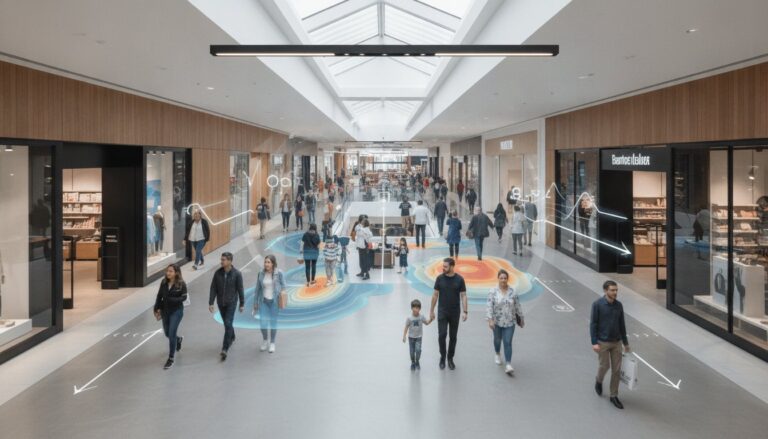
Weather doesn’t just change how many people enter; it changes how they move once inside. During rain events, shoppers often congregate near entrances, creating artificial “dead zones” in the rear of the store. Advanced people counting technology generates heatmaps that visualize these shifts in real-time. By identifying where dwell times increase during inclement weather, you can adjust zone-specific marketing and product placement to capitalize on where your audience is actually standing. This objective view of physical presence ensures your floor layout remains optimized for every climate scenario.

Normalising Conversion Rates: Evaluating True Performance
Low traffic shouldn’t always serve as an indictment of a store’s performance. The “weather excuse” is a common trap in retail management, where a rainy Tuesday is used to justify a dip in total sales volume. However, a scientific approach to impact of weather on retail footfall reveals that environmental traffic suppression often filters out casual browsers, leaving behind high-intent “storm shoppers.” These individuals have braved the elements specifically to make a purchase, meaning that while footfall is lower, the probability of sale per visitor is frequently higher. Failing to account for this shift leads to inaccurate performance reviews and missed opportunities to reward staff for high execution during difficult conditions.
To see through the fog of external variables, sophisticated retailers use retail footfall analysis Australia to separate service quality from climate volatility. By establishing a “Weather-Adjusted Conversion” KPI, you can evaluate store managers based on how well they converted the traffic that actually arrived, rather than penalizing them for the traffic that stayed home. This objective baseline ensures that operational excellence is recognized regardless of the forecast outside.
The Math of Normalisation
Normalising your data requires a systematic weighting of sales against environmental suppression. Start by establishing your baseline conversion rate under neutral weather conditions. Next, overlay your footfall data with specific weather severity tiers. You’ll likely notice that as footfall drops due to rain or extreme heat, your raw conversion rate naturally climbs. As weather severity increases, the casual browser disappears, leaving behind high-intent shoppers whose purchase probability is significantly higher than the average visitor. If your conversion rate doesn’t rise during a storm, it indicates that your team isn’t successfully capturing the high-intent traffic that did walk through the door. Using the FootfallCam V9 Software allows you to automate these calculations, providing a “normalised” view of performance that accounts for every millimetre of rainfall.
Staff Performance Reviews in Volatile Conditions
Protecting staff morale is essential during periods of extreme weather. Using data to prove performance excellence on low-traffic days prevents the frustration that comes from being judged on metrics beyond a team’s control. These “thin” days also serve as a perfect diagnostic tool for identifying training gaps. When a store is quiet, service inconsistencies become highly visible; if conversion remains stagnant despite a higher concentration of serious buyers, it signals a need for better closing techniques or product knowledge. Setting weather-contingent KPIs allows national retail teams to stay motivated. It shifts the focus from “why is the store empty” to “how well are we serving the people who are here.” This level of transparency builds trust and ensures your best talent stays engaged even when the forecast is bleak.
Strategic Operational Adjustments for Volatile Forecasts
Moving from retrospective analysis to proactive execution requires a shift in how you view the 72-hour forecast. Instead of accepting weather as an uncontrollable variable, treat it as a primary input for your operational logistics. This involves aligning every resource, from front-line staff to climate control systems, with the anticipated impact of weather on retail footfall. When data indicates a high probability of severe weather, you can preemptively adjust energy consumption by scaling back HVAC and lighting in zones predicted to have lower occupancy. These adjustments protect your margins even when physical attendance is suppressed by external conditions.
Inventory management also benefits from this predictive approach. Aligning stock levels with weather-driven demand surges ensures you don’t carry excess seasonal inventory during unseasonal climate shifts. If the forecast predicts a dry, warm spell in early spring, you can prioritize the display of outdoor categories over lingering winter stock. This responsiveness prevents lost sales and reduces the need for aggressive markdowns later in the season. To implement these changes effectively, you need a system that translates environmental data into clear directives for store teams. Explore the FootfallCam V9 Software for automated operational reporting.
Predictive Staffing Models
Labor is often the largest controllable expense in retail, yet it’s frequently mismanaged during weather events. You can reduce wage leakage by 15% by utilizing footfall data analysis integrated with real-time meteorological feeds. Instead of following a static roster, dynamic staffing allows you to scale down during predicted storms or scale up to meet the needs of high-conversion “storm shoppers.” This precision also supports staff safety; by identifying early indicators of extreme weather, you can manage call-ins and shift cancellations before they disrupt the floor. Ensuring you have the right number of experts available for high-intent visitors maximizes the value of every person who enters your space.
The Omni-channel Safety Net
Physical footfall drops don’t have to result in lost revenue if you utilize an omni-channel strategy. Use significant traffic dips as a trigger for localized digital “rainy day” promotions that encourage shoppers to browse your e-commerce platform from home. Syncing Click-and-Collect availability with weather-driven patterns also provides a bridge for consumers who still want their items but wish to minimize their time spent in transit. Maintaining a strong brand presence through targeted digital marketing when physical attendance is low ensures that your store remains the first choice when the weather clears. This approach transforms a quiet day at the high street into a surge in digital engagement, maintaining a steady revenue stream regardless of the barometer.
Integrating Weather Intelligence with FootfallCam Pro2
Mastering the impact of weather on retail footfall requires a hardware foundation capable of processing environmental variables in real-time. The FootfallCam Pro2 (2025) represents a significant leap in this capability, featuring an Octa-Core processor and 8 TOPs of AI processing power. These specifications allow the device to perform advanced on-device analytics, ensuring that environmental noise doesn’t compromise data integrity. By integrating these high-fidelity insights with the FootfallCam V9 Software, retailers can automate the correlation between meteorological patterns and visitor numbers. This creates a 360-degree view of the “Weather Effect” by allowing users to overlay their own external performance data with footfall metrics, providing a comprehensive understanding of how climate dictates commercial outcomes.
Positioning people counting systems Australia as a core risk-management tool is essential for navigating the volatility of 2026. Modern retail environments are too complex to manage through intuition alone. Utilizing sophisticated hardware ensures that every operational decision, from energy usage to marketing pivots, is backed by empirical evidence. This technological integration transforms weather from an unpredictable threat into a quantifiable variable that can be factored into long-term growth strategies.
AI-Powered Accuracy in All Conditions
Reliable data collection must persist regardless of the conditions outside. The Pro2 utilizes 3D Time-of-Flight (TOF) technology to maintain 99.5% accuracy during low-light or stormy periods that often baffle standard IP cameras. Its advanced AI filters out non-human movement, such as wind-blown debris or umbrellas, ensuring your dataset remains clean and actionable. For organizations still relying on older, weather-sensitive sensors, the Legacy Swap Out Plan offers a structured path to upgrade to modern standards without disrupting ongoing operations. This ensures that your baseline remains stable even when the environment is not.
Actionable Insights from the V9 Dashboard
The true value of information lies in its utility. The V9 Software dashboard empowers users to set automated alerts for weather-based traffic anomalies, providing immediate notification when conditions deviate from the forecast. These insights can be exported as “Weather Impact” reports, offering board-level clarity on how environmental factors influenced quarterly performance. This level of transparency replaces speculation with the specialized language of measurement and strategy. Discover how FootfallCam Pro2 can insulate your business from weather volatility.
Transforming Climate Volatility into Operational Precision
Managing physical environments requires a fundamental shift from intuition-based reactions to empirical certainty. By quantifying the impact of weather on retail footfall, you move beyond retrospective excuses and gain the ability to normalize performance metrics across your entire network. This data-driven approach ensures that labor, inventory, and marketing resources are allocated with maximum efficiency, regardless of the forecast. It’s about seeing the human behavior behind the statistics and preparing for it before the first raindrop falls.
Footfall Australia has been helping organizations navigate these complexities since 2004. Our solutions deliver 99.5% counting accuracy in all environmental conditions, ensuring your data remains reliable during storms or heatwaves. With seamless V9 software integration into national weather APIs, you gain a transparent view of consumer movement that stays stable even during unseasonal climate events. The future of retail belongs to those who view environmental variables as actionable data layers rather than uncontrollable risks. Request a Data Strategy Consultation with Footfall Australia to insulate your operations from volatility and turn every weather event into a strategic opportunity for growth.
Frequently Asked Questions
How much does rain actually reduce retail footfall on average?
Rainfall typically causes a sharper decline in high-street environments compared to enclosed malls. During severe winter weather in January 2026, department store sales fell by 6.0%, while total retail sales saw a 0.2% slip from the previous month. The specific reduction depends on your location’s format and regional climate norms. Open-air precincts often experience significant traffic suppression, whereas climate-controlled centers may see a “shelter effect” that maintains visitor levels.
Can people counters distinguish between shoppers and staff during bad weather?
Modern hardware like the FootfallCam Pro2 uses advanced AI to filter out staff movement from your visitor data. This is crucial for accurately measuring the impact of weather on retail footfall, as staff presence remains constant even when customer traffic drops. By excluding employees and security personnel, you ensure that your conversion rate calculations reflect genuine consumer intent rather than skewed internal activity.
Is it possible to integrate Bureau of Meteorology (BOM) data directly into footfall software?
Yes, the FootfallCam V9 Software allows for seamless API integration with national meteorological feeds, including the BOM. This automation overlays local weather conditions onto your traffic charts in real-time. It eliminates the need for manual data entry and allows store managers to generate instant correlation reports. These insights help stakeholders understand exactly how specific weather events influenced daily performance metrics.
How does temperature volatility affect high-street vs. shopping center traffic differently?
High-street locations are highly sensitive to temperature extremes, often seeing traffic dips during heatwaves or cold snaps as consumers avoid being outdoors. Enclosed shopping centers frequently act as thermal refuges, attracting visitors who seek a climate-controlled environment for their errands. This divergence means that a temperature spike might hurt a boutique on a main road while simultaneously driving a surge in an indoor mall.
What is the best way to adjust staff rosters based on a 5-day weather forecast?
Utilize the predictive modeling features in the V9 Software to compare upcoming forecasts against historical traffic patterns. By identifying how similar weather events impacted your store in the past, you can implement dynamic rostering. This approach helps reduce labor costs by 15% during predicted storms. It also ensures you have enough experts on the floor to serve high-intent “storm shoppers” who are more likely to convert.
Do people counters work accurately during low-light conditions caused by heavy storms?
The FootfallCam Pro2 uses 3D Time-of-Flight (TOF) technology to maintain 99.5% accuracy regardless of lighting conditions. Unlike standard Pro1 IP cameras that rely on visual clarity, TOF sensors use light pulses to create a depth map of the environment. This ensures that heavy cloud cover, storm-driven darkness, or glare from wet surfaces won’t compromise your data integrity or visitor counts.
Can weather data help in predicting online sales surges for brick-and-mortar brands?
Severe weather events that keep shoppers at home directly correlate with a rise in e-commerce activity. In January 2026, as winter conditions impacted physical traffic, nonstore retailers saw a 1.9% increase in sales. By monitoring weather-driven footfall drops in real-time, you can trigger localized digital promotions. This strategy captures the “at-home” audience and maintains your revenue stream when physical attendance is suppressed.
How do I explain a weather-related traffic drop to stakeholders using data?
Use the “Weather Impact Coefficient” to provide a quantifiable explanation for performance fluctuations. This metric, generated by the V9 Software, isolates the percentage of traffic lost specifically due to environmental factors. Presenting this alongside “Weather-Adjusted Conversion” rates proves that while traffic was lower, your team successfully converted the visitors who did arrive. This shifts the narrative from a general excuse to a data-driven operational analysis.