Top Features of a People Counting System: The 2026 Strategic Guide
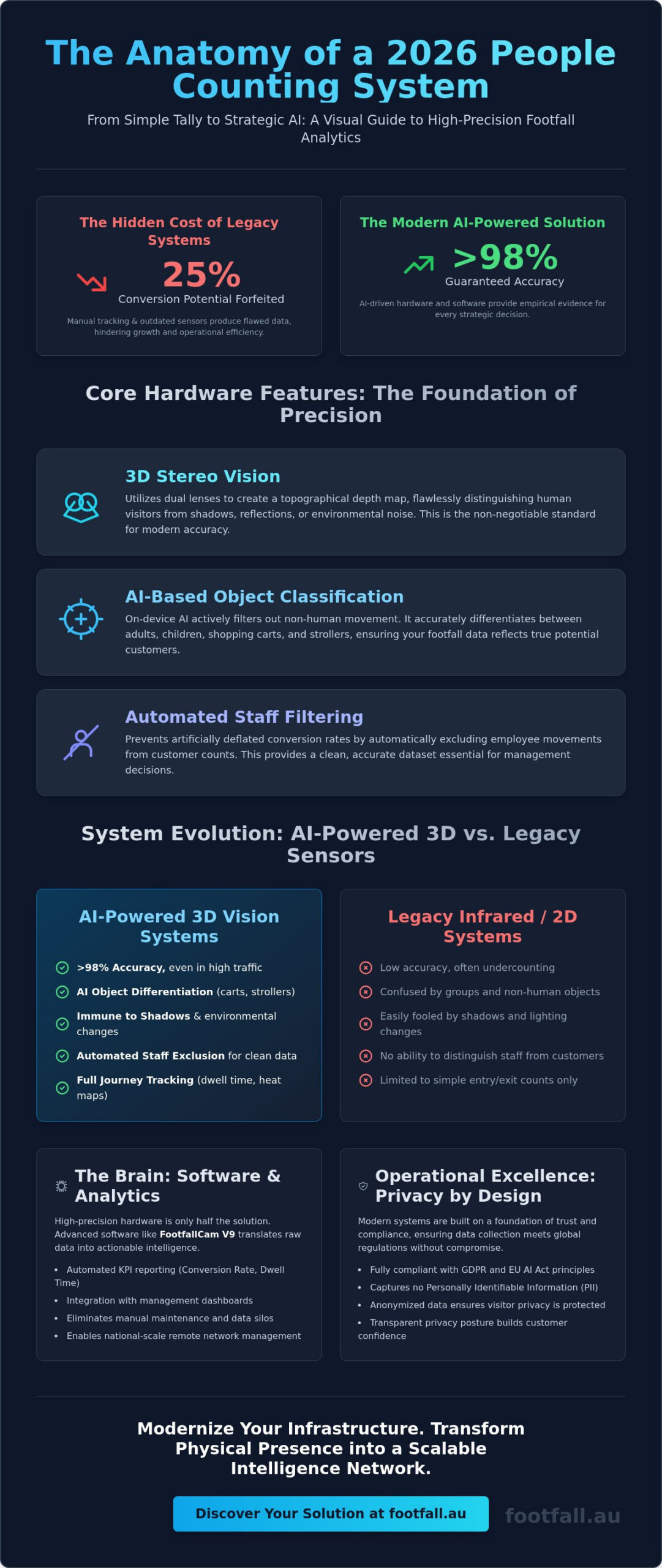
Retailers relying on manual tracking or legacy sensors often forfeit up to 25% of their conversion potential because their data foundation is fundamentally flawed. In 2026, identifying the top features of a people counting system is no longer about simple entry counts; it’s about deploying a strategic AI asset that translates human movement into empirical evidence. You likely understand that raw footfall data is only valuable if it’s accurate, yet legacy data silos and privacy compliance anxiety under the EU AI Act continue to hinder organizational growth.
This guide identifies the specific hardware and software capabilities required to achieve over 98% accuracy while maintaining a transparent privacy posture. We’ll explore how modern 3D sensors, such as the FootfallCam Pro2, work with FootfallCam V9 software to automate reporting and eliminate manual maintenance overhead. You’ll discover the essential requirements to transform physical presence into a scalable, national intelligence network that informs every strategic decision with quiet confidence.
Key Takeaways
- Understand the evolution of spatial monitoring from simple reactive tallies to predictive AI-IoT ecosystems that forecast behavioral trends.
- Learn why 3D stereo vision and AI-based object classification are essential hardware components for filtering non-human movement and maintaining high precision.
- Identify the top features of a people counting system that integrate directly with management dashboards to automate KPI reporting on metrics like dwell time and conversion rates.
- Discover how Privacy by Design principles ensure your data collection remains fully compliant with global regulations without capturing personally identifiable information.
- Evaluate the strategic benefits of a Legacy Swap Out Plan to cost-effectively modernize your existing infrastructure for national-scale remote management.
The Strategic Role of People Counting Systems in 2026
Modern people counting systems have evolved far beyond simple entry sensors. In 2026, a truly effective solution is an integrated AI-IoT ecosystem. This shift marks a transition from reactive counting, where managers look at yesterday’s numbers, to predictive behavioral analytics that forecast future demand. Organizations are rapidly moving away from manual tallying and legacy infrared beams. These older methods often suffer from inaccuracies caused by group entries or environmental shadows. Instead, the top features of a people counting system now center on high-precision data that ensures every metric is defensible.
Data utility is the cornerstone of this evolution. Information only carries value if it triggers specific operational changes. If a report doesn’t lead to optimized staffing levels or a refined marketing strategy, it remains a vanity metric. By focusing on utility, businesses can transform raw figures into a sequence of human actions that can be interpreted and acted upon. This ensures that organizational management is backed by empirical evidence rather than intuition or guesswork. It’s about moving from simply knowing how many people entered to understanding why they stayed or left.
Beyond the Doorway: Understanding Human Flow
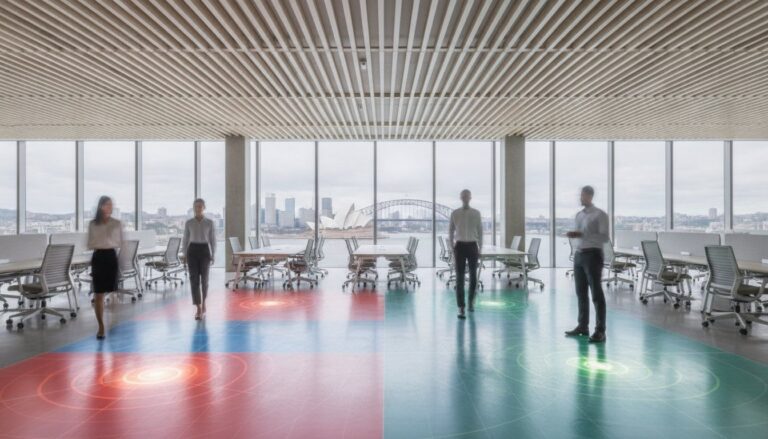
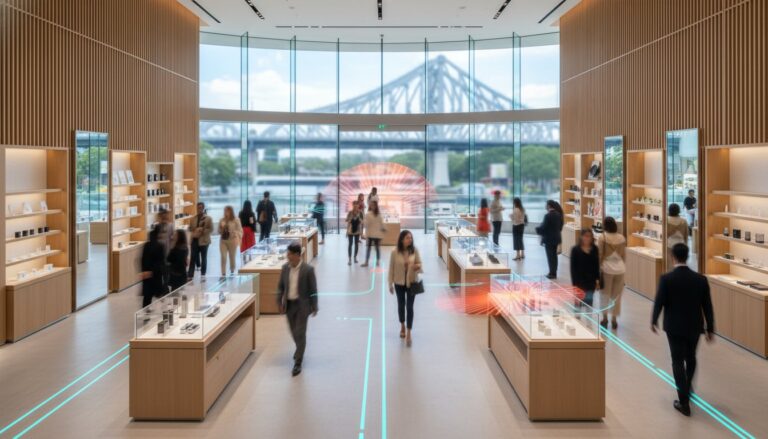
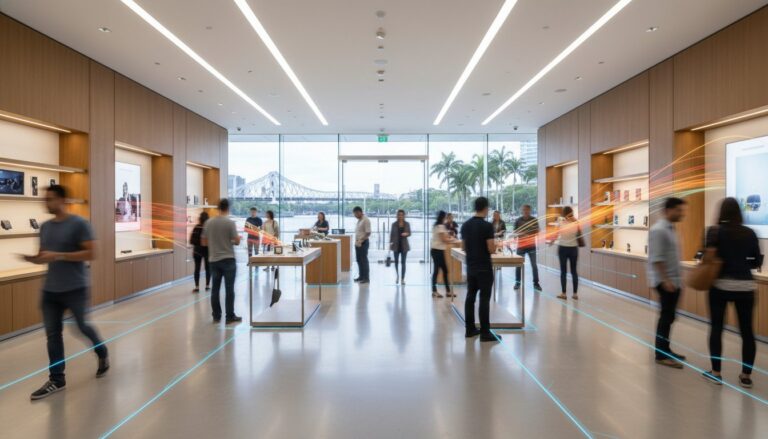
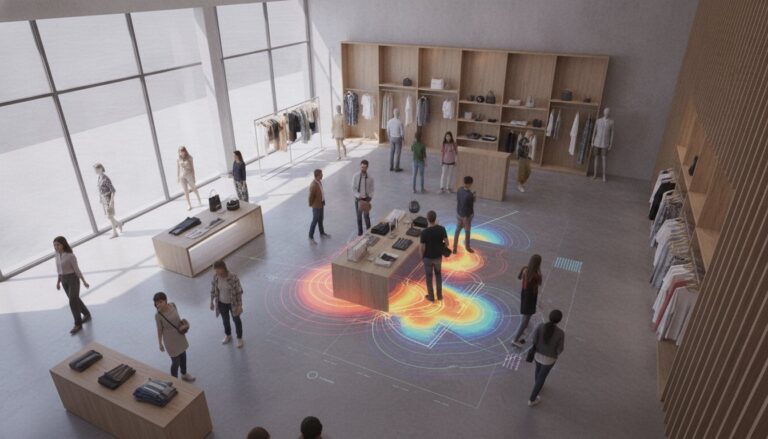
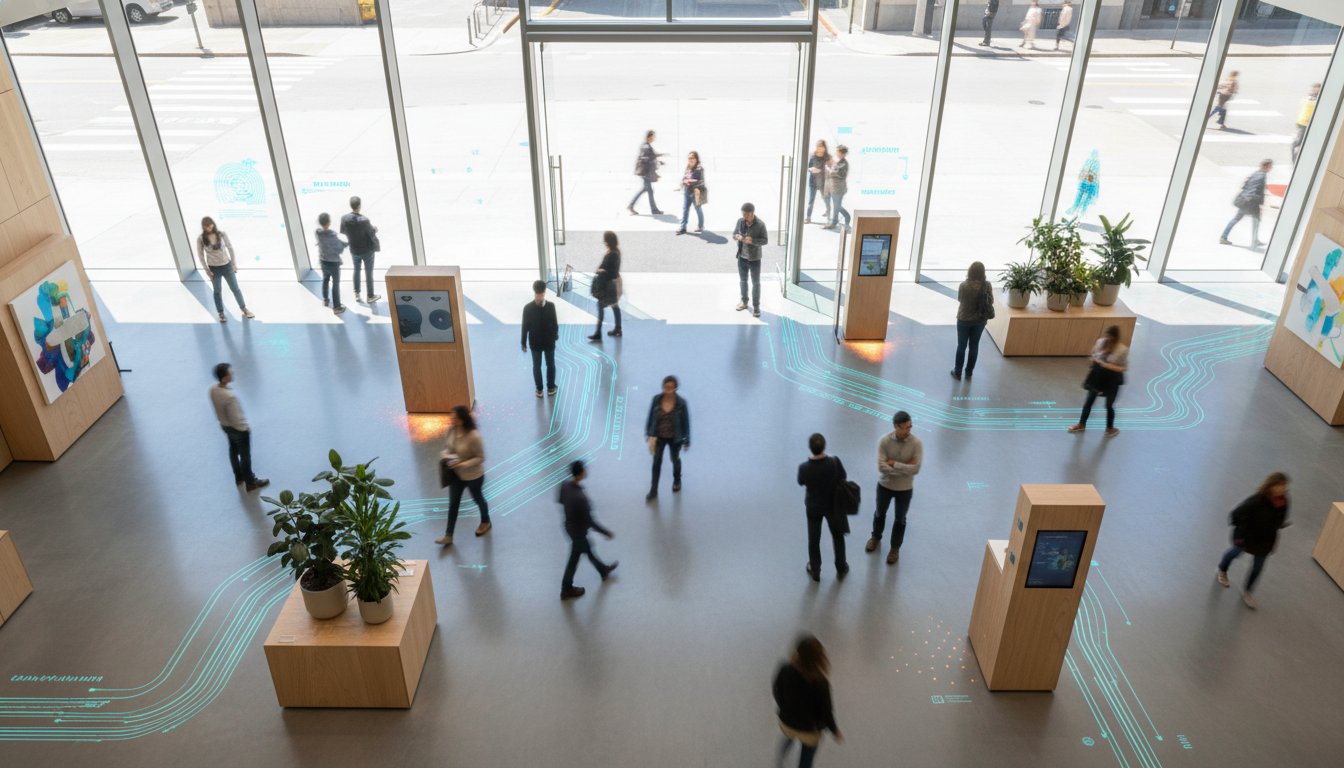
Capturing an entrance event is only the beginning of the narrative. Modern sensors like the FootfallCam Pro2 track the full journey of a visitor through a physical space. This involves monitoring dwell time in specific zones and generating heat maps to identify high-traffic corridors. Footfall analytics serves as the essential bridge between physical presence and digital metrics, allowing managers to apply the same level of scrutiny to a brick-and-mortar store as they would to an e-commerce website. Understanding how people move through a space reveals hidden friction points that hinder conversion. It’s about seeing the person behind the number and interpreting their intent through their movement patterns.
The Business Case for High-Feature Systems
Investing in a sophisticated system directly impacts the bottom line. By identifying the top features of a people counting system, stakeholders can link data to labor cost optimization and revenue maximization. For instance, aligning staff schedules with peak traffic periods prevents lost sales due to poor service levels. This alignment is a key component of the national shift toward Smart Buildings and Smart Retail environments, where every square meter is optimized for efficiency. High-accuracy systems provide the transparency needed to justify large-scale operational shifts. For those seeking a deeper dive into these strategies, our ultimate guide to people counting provides a broader context for driving growth through empirical evidence.
Core Hardware Features: Precision Through AI and 3D Vision
High-precision hardware is the bedrock of any reliable data strategy. When evaluating the top features of a people counting system, 3D Stereo Vision stands out as a non-negotiable requirement for modern environments. Unlike 2D cameras that struggle with depth, 3D sensors use dual lenses to create a topographical map of the area. This allows the system to distinguish between a human being and a shadow or a floor reflection. Sophisticated people counting system hardware now incorporates AI-based object classification to filter out non-human movement. It can accurately differentiate between adults, children, and objects like shopping carts or prams, ensuring that your footfall metrics reflect actual potential customers.
A critical feature often overlooked by legacy providers is automated staff filtering. In a professional retail setting, employees frequently cross the counting line during shifts. Without the ability to identify staff via AI facial recognition or uniform detection, your conversion rates will be artificially deflated. High-feature systems ensure these internal movements are excluded from the final tally, providing a clean dataset for management. This level of detail is why businesses are increasingly opting for the FootfallCam Pro2 to secure their data integrity.
3D Stereo Vision vs. Legacy Sensors
Comparing 3D depth sensing against 2D video or infrared beams reveals a stark difference in utility. Infrared beams often fail in high-traffic Australian retail environments where multiple people enter simultaneously. 2D video lacks the spatial awareness to handle complex lighting or crowded doorways. For any business serious about growth, accuracy under 95% is functionally useless for ROI calculations. Modern 3D sensors achieve over 98% accuracy, providing the empirical evidence needed to justify staffing and marketing spend. This precision is essential when stitching multiple sensors together to cover exceptionally wide openings seamlessly.
Edge Computing and AI Processing
Top-tier hardware utilizes Edge Computing to process all visual data directly on the device. This means no video streams are sent to the cloud, significantly enhancing privacy and reducing bandwidth requirements. The AI onboard continuously learns to ignore environmental noise, such as swinging doors or moving displays. By processing data at the source, the system remains fast and reliable even in locations with limited connectivity. If you’re looking to stabilize your data stream, choosing a precision-engineered sensor with onboard AI is the most effective way to future-proof your infrastructure.
The Brain: Advanced Software Analytics and Integration
The sophisticated hardware described previously remains a dormant asset without a robust software layer to interpret the data. In 2026, the software dashboard is where management realizes the true value of their investment. It transforms raw counts into strategic levers. Among the top features of a people counting system, the ability to integrate disparate data sources stands paramount. By connecting AI-powered people counting outputs with external Point-of-Sale (POS) data, businesses can calculate conversion rates with absolute precision. This integration allows you to see how weather patterns or marketing campaigns directly influence foot traffic and, ultimately, revenue.
Real-time occupancy monitoring has also become a non-negotiable requirement for national safety and compliance standards. Modern software doesn’t just count; it manages the environment. It provides live alerts when capacity limits are approached, ensuring a safe experience for visitors while shielding the organization from liability. This level of automated oversight replaces manual observation with empirical, real-time evidence. It’s about maintaining a steady, logical flow of information that empowers the user to make decisions with quiet confidence.
Automated Reporting and Custom Dashboards
Efficiency in organizational management relies on getting the right information to the right people without manual intervention. Automated reporting features allow regional and national managers to receive scheduled PDF reports directly in their inboxes. These reports distill complex datasets into clear, actionable KPIs. Customizable widgets within the dashboard enable different roles to view the metrics most relevant to them; this might mean dwell time for a visual merchandiser or total footfall for a store manager. For those looking to refine their interpretation of these metrics, our footfall data analysis guide provides a strategic framework for turning data into growth.
Predictive Analytics and Trend Forecasting
The transition from reactive to proactive management is fueled by predictive analytics. By analyzing historical traffic data, software like FootfallCam V9 identifies “Power Hours,” the specific windows where traffic is highest and conversion potential is at its peak. AI algorithms also play a critical role in identifying anomalies. For example, if foot traffic remains high but conversion rates drop suddenly, the system flags this discrepancy for immediate investigation. This benchmark for enterprise-level reporting ensures that you aren’t just observing the present but are actively preparing for future shifts in consumer behavior. It’s a forward-thinking approach that treats physical presence as a sequence of human actions that can be predicted and optimized.
Operational Excellence: Scalability, Privacy, and Support
Achieving high accuracy is only the first step toward a successful data strategy. For large organizations, the top features of a people counting system must include operational resilience and strict adherence to global privacy standards. A system that provides 98% accuracy becomes a liability if it creates data silos or violates regional regulations. By implementing a “Privacy by Design” framework, organizations observe human behavior without ever capturing Personally Identifiable Information (PII). This ensures that while you’re gathering empirical evidence to drive growth, you’re also protecting the anonymity of every individual who enters your space.
Scalability is the second pillar of operational excellence. National rollouts require a “Plug-and-Play” installation process that doesn’t demand specialized local expertise at every site. This allows for rapid deployment across hundreds of locations while maintaining a consistent data configuration. It’s about creating a stable, national intelligence network that functions as a single, cohesive unit rather than a collection of disconnected sensors. This structured approach leads to long-term reliability and lower total cost of ownership.
Privacy Compliance in the Australian Landscape
Compliance isn’t optional in a modern business environment. In 2026, businesses must navigate the complexities of the Australian Privacy Act alongside international standards like the GDPR. Modern systems replace traditional video recording with anonymous vector tracking. This technology identifies movement patterns and human shapes rather than faces or biometric data. It establishes a “Legitimacy of Interest” for the business, allowing for the collection of essential traffic data while remaining fully compliant. It’s a transparent approach that builds trust with both regulators and the public by focusing on movement narratives rather than individual identities.
Fleet Management and Proactive Maintenance
Managing a national fleet of sensors requires a centralized device management platform. A common concern for IT directors is how to keep a hundred or more sensors running across the country without constant manual intervention. To solve this, top-tier systems utilize automated health checks. These protocols proactively alert technical teams if a sensor goes offline or if data quality drops due to environmental changes. This prevents data gaps that could skew long-term ROI calculations and ensures your data foundation remains solid.
Proactive maintenance is the key to sustaining data integrity over several years. Following people counter support best practices allows organizations to identify and resolve issues before they impact reporting. If you’re ready to secure your national infrastructure with a resilient, privacy-compliant solution, exploring a Premium Support Plan is the most effective way to ensure your data remains a reliable strategic asset.
Selecting and Implementing Your People Counting Solution
Choosing the right technology is a significant capital investment that dictates your operational intelligence for the next five years. When you evaluate the top features of a people counting system, you’re essentially choosing a partner in your organization’s growth. The transition from intuition-based management to evidence-based strategy requires more than just buying a sensor; it requires a structured implementation plan. If your current infrastructure relies on outdated infrared beams or inaccurate 2D cameras, a Legacy Swap Out Plan offers a cost-effective path to modernization. This prevents technical debt and ensures your national data remains consistent and defensible.
The final stage of implementation involves shifting the organizational culture to value empirical evidence. Data is only useful if it leads to a specific, positive change in operations, such as optimized staffing or refined marketing spend. By following a logical path from identifying a problem to providing the technological means to observe it, you gain a permanent strategic advantage. This measured approach suggests stability and long-term thinking, positioning your business to stay prepared for shifting behavioral trends.
The 5-Step Evaluation Framework
- Step 1: Audit existing infrastructure. Identify coverage gaps at secondary entrances or staff-only zones that might skew your final data set.
- Step 2: Verify accuracy claims. Request real-world Australian case studies that demonstrate performance in environments with complex lighting or high-density traffic.
- Step 3: Test the software dashboard. Ensure the interface is intuitive and provides the specific KPIs your managers need, such as real-time occupancy and dwell time.
- Step 4: Evaluate integration capabilities. Confirm the system can connect with your existing business intelligence tools to eliminate data silos.
- Step 5: Review the support structure. Determine if the vendor offers specialized maintenance to protect your data integrity over the long term.
Partnering with Footfall Australia
Success in national deployment depends on local expertise and reliable hardware. Footfall Australia serves as a specialized consultant, providing end-to-end implementation for organizations across the country. We focus on the seamless integration of FootfallCam Pro2 hardware with FootfallCam V9 Software, creating a unified ecosystem that delivers quiet confidence to decision-makers. Our approach treats physical presence as a sequence of human actions that can be interpreted and optimized for growth.
By choosing a partner that offers both Basic and Premium Support Plans, you ensure your system remains an observant and objective guide for your physical spaces. This partnership provides the foundation of expertise needed to navigate the future of physical environments. If you’re ready to move beyond guesswork and secure your data foundation, it’s time to explore our range of people counting systems and begin your transition to a data-driven future.
Securing Your Strategic Data Advantage
Transitioning to a data-driven operational model requires a meticulous focus on the top features of a people counting system, from 3D Stereo Vision hardware to integrated AI analytics. By prioritizing precision and privacy-safe tracking, you transform physical movement into a sequence of actionable insights that drive measurable growth. A resilient system doesn’t just count visitors; it provides the empirical evidence needed to optimize labor costs and refine conversion strategies across your entire national network. It’s about moving away from intuition and toward a stable, evidence-based future.
Footfall Australia provides the technical foundation for this transformation. With our AI-powered FootfallCam Pro2 technology, we deliver 98%+ accuracy while maintaining a transparent privacy posture. Our local Australian support network ensures your sensor fleet remains operational and efficient through proactive health checks and specialized maintenance plans. There’s no reason to settle for the inaccuracies of legacy sensors when modern logic offers such clarity.
Optimise your business with Australia’s leading people counting technology.
Embrace the shift toward evidence-based management and stay prepared for shifting behavioral trends with a partner that values accuracy and efficiency above all else. Your journey toward total spatial intelligence starts with a single, data-backed decision.
Frequently Asked Questions
What is the most important feature in a people counting system?
Accuracy remains the primary metric for success. High-precision 3D Stereo Vision is one of the top features of a people counting system because it provides the depth perception necessary to filter out shadows and inanimate objects. Without this foundation, the resulting analytics won’t be reliable enough to inform significant operational changes or justify labor costs.
How does a people counter distinguish between a customer and a staff member?
Advanced sensors like the FootfallCam Pro2 utilize AI-based object classification and uniform recognition to identify employees. The system automatically excludes these internal movements from the final footfall tally through sophisticated algorithms. This ensures that your conversion rates and dwell time metrics aren’t skewed by staff activity or repeated entries during a shift.
Can people counting systems integrate with my existing POS software?
Yes, modern systems are designed to integrate seamlessly with external platforms via API. By combining footfall data with sales figures in FootfallCam V9 software, managers can calculate real-time conversion rates with absolute precision. This integration transforms raw traffic numbers into a comprehensive narrative of store performance and marketing effectiveness.
Are people counting systems compliant with Australian privacy laws?
Compliance with the Australian Privacy Act is achieved through Privacy by Design principles. These systems utilize anonymous vector tracking to identify human shapes rather than capturing personally identifiable information or biometric data. This approach allows organizations to gather essential behavioral data while respecting the anonymity of every visitor who enters the physical space.
What is the difference between 2D and 3D people counting technology?
The fundamental difference lies in depth perception and spatial awareness. 3D technology uses dual lenses to create a topographical map, allowing it to differentiate between a person and a reflection on the floor. 2D technology lacks this capability and often struggles with overlapping people or complex lighting conditions in busy Australian retail environments.
How accurate are modern AI-powered people counters in 2026?
Modern AI-driven sensors consistently achieve accuracy levels exceeding 98% in standard operating environments. This precision is a significant advancement over manual counting methods, which typically suffer from error rates of 15% to 25% due to human fatigue. High accuracy ensures that every strategic decision is backed by empirical evidence rather than estimations.
Do I need to replace my CCTV to install a people counting system?
No, people counters are specialized sensors that operate independently of your existing CCTV infrastructure. While CCTV is optimized for wide-angle security surveillance, people counters are installed top-down at entrances for precision tracking. They work alongside your current security setup to provide a dedicated and highly accurate stream of behavioral analytics.
What kind of maintenance does a people counting system require?
Physical maintenance is minimal, as most professional sensors are designed for long-term durability. Proactive health checks within the management dashboard alert technical teams to any connectivity issues or data quality drops. Remote firmware updates ensure the AI algorithms continue to improve without requiring a technician to visit each physical site.