People Counter Accuracy: Why Precision is the Foundation of Business Intelligence
What if the “98% accuracy” sticker on your sensor is actually the reason your conversion rates look impossible? You’ve likely felt the frustration of seeing 200 visitors on your dashboard while your team on the floor saw a quiet afternoon. It’s difficult to justify a technology investment when store managers in Sydney and Melbourne report inconsistent people counter accuracy for identical foot traffic patterns. You deserve better than guesswork when A$20,000 in monthly staffing decisions are on the line.
Achieving true precision requires more than just high-end hardware; it demands a clear understanding of how shadows, lighting, and physical layout impact data integrity. We’ll show you how to distinguish between reliable data and marketing fluff so your business intelligence remains beyond reproach. You’ll learn the technical differences between 2D and 3D sensors and gain a practical checklist to ensure your footfall data stays precise, giving you the confidence to set KPIs that actually drive growth.
Key Takeaways
- Distinguish between raw counting and true data integrity by understanding how precision and recall impact the reliability of your business intelligence.
- Evaluate the evolution of tracking technology to understand why legacy infrared sensors struggle in the high-traffic environments of modern Australian retail.
- Identify how environmental factors like high-intensity “Australian glare” can compromise people counter accuracy and learn the technical steps to overcome them.
- Implement a practical framework for auditing your system’s performance using live manual counts to verify that your digital dashboard matches physical reality.
- Discover how a managed service model provides a seamless path to 99% data integrity by proactively monitoring and tuning your sensors to eliminate business blind spots.
Defining People Counter Accuracy: Precision vs. Reality
Accuracy isn’t just a numerical metric; it’s the foundation of your entire business intelligence framework. A People counter serves as the primary sensor for retail analytics, yet raw counting differs significantly from true data integrity. In a commercial setting, integrity means the data is reliable enough to trigger high-stakes financial decisions without hesitation.
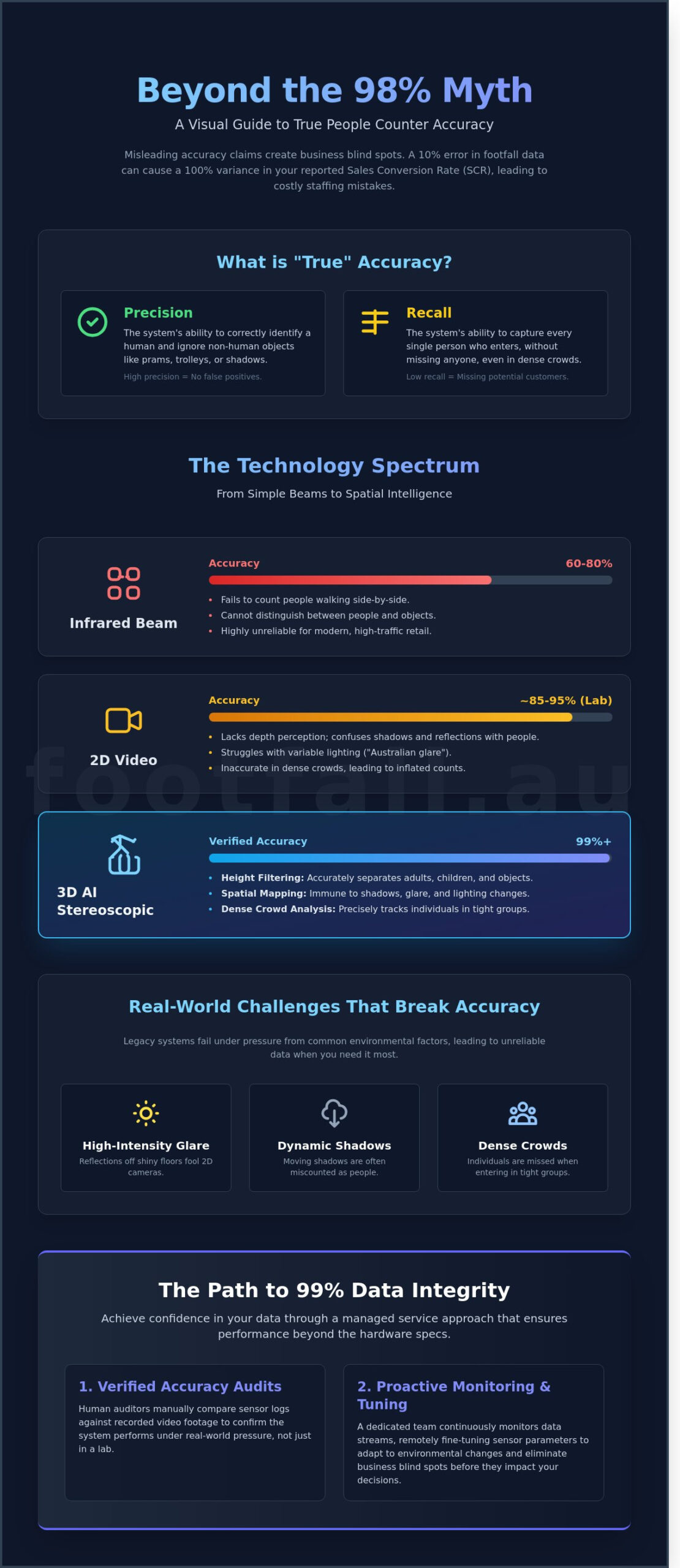
We define people counter accuracy through two distinct lenses: precision and recall. Precision measures the system’s ability to distinguish a human from a non-human object, such as a shopping trolley, a pram, or a swinging glass door. Recall measures the system’s ability to capture every individual who crosses the threshold without omission. If your system has high precision but low recall, you’re essentially missing 15% of your potential customers. This gap creates a “data debt” that compounds over time, leading to skewed performance reports.
Many entry-level sensors claim 90% accuracy, which sounds impressive until you apply it to retail math. In an Australian retail environment with a 10% Sales Conversion Rate (SCR), a 10% error in footfall data can result in a 100% variance in your reported conversion. You can’t manage what you don’t measure correctly; a 90% accurate system is often worse than no system at all because it provides a false sense of certainty.
Why ‘98% Accuracy’ is a Loaded Term
Marketing brochures often cite 98% accuracy based on controlled lab tests with perfect lighting and single-file traffic. Real-world Australian retail involves complex variables like group shopping, children, and the harsh afternoon glare reflecting off storefronts in Sydney or Brisbane. True accuracy requires “Verified Accuracy.” This involves manual video validation where a human auditor compares recorded footage against sensor logs to ensure the device performs under pressure. Without this verification, a 98% claim is merely a theoretical maximum rather than a daily reality.
The Impact on Business Intelligence
Inaccurate data directly skews your Sales Conversion Rate (SCR) metrics. This makes high-performing teams look mediocre or hides systemic issues in your sales funnel. If a sensor misses a peak period at 11:00 AM on a Saturday in a busy shopping centre, you risk understaffing by 2 or 3 employees. This leads to lost sales and frustrated customers. Reliable business decisions require a foundation of 95% or higher verified precision. This ensures your labour spend, which often exceeds A$30 per hour per staff member, aligns perfectly with actual visitor demand.
The Technology Spectrum: From Infrared to 3D AI Stereoscopic
Precision in retail analytics has evolved from simple hardware triggers to sophisticated spatial intelligence. Early adopters in the Australian retail sector originally relied on infrared beam counters. These devices increment a count whenever a light beam is broken. While cost-effective, they fail in high-traffic environments. If two people enter a store side-by-side, the beam registers only one visitor. Thermal sensors faced similar hurdles; they often struggle to distinguish human heat signatures from ambient temperature spikes during 40-degree Australian summer days. These legacy systems typically offer a people counter accuracy rate of just 60% to 80%, leaving significant gaps in your data.
2D video counters introduced visual verification but lacked depth perception. These systems analyze flat pixels, meaning they frequently mistake shadows or floor reflections for actual customers. This lack of spatial awareness leads to inflated figures. Recent advances in crowd counting technology have shifted the industry toward 3D solutions that treat the entrance as a three-dimensional volume rather than a flat image.
How 3D Stereoscopic Vision Works
3D stereoscopic sensors utilize a dual-lens configuration to mimic human binocular vision. By capturing two simultaneous images from slightly different angles, the device calculates the precise distance of every object in its field of view. This depth data allows for sophisticated filtering that 2D cameras cannot match:
- Height Filtering: Accurately separates children from adults and ignores shopping trolleys or prams.
- Spatial Mapping: Eliminates false counts triggered by shadows, reflections, or changes in floor lighting.
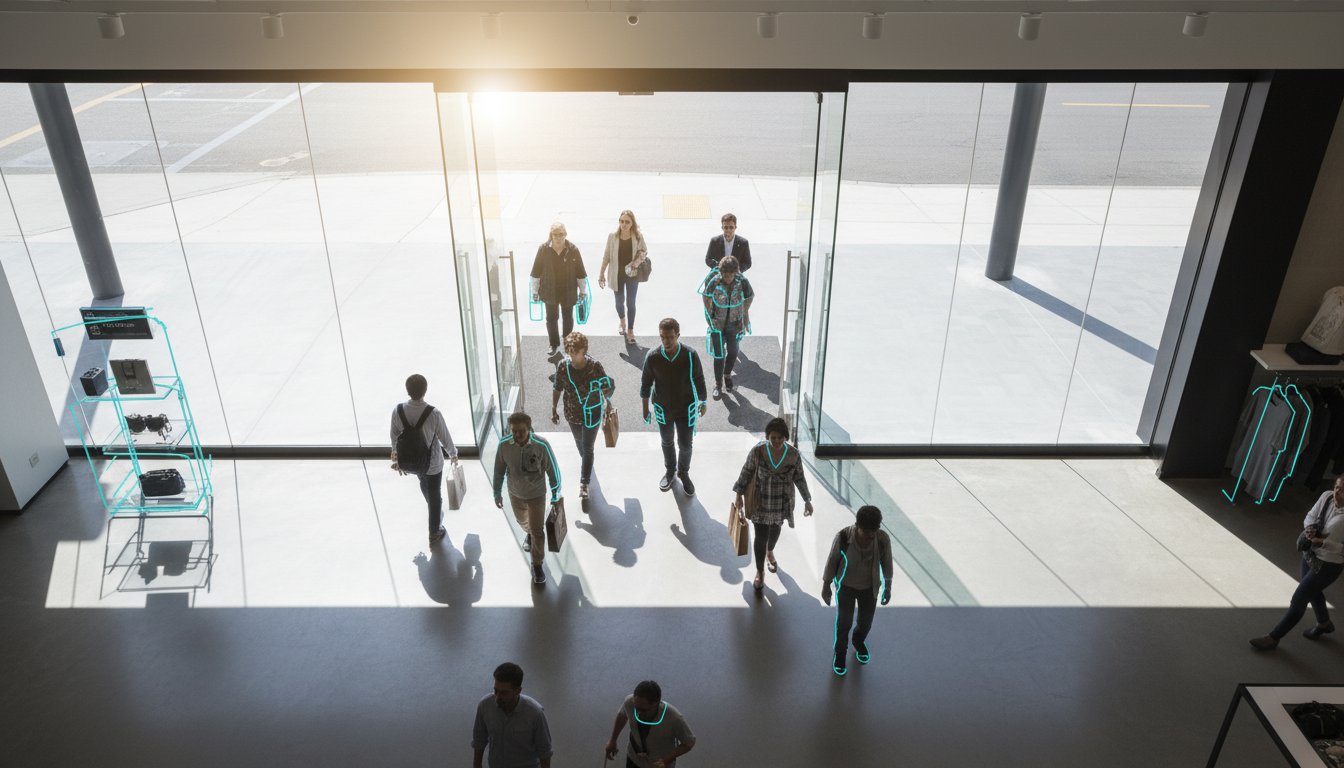
- Dense Crowd Analysis: Distinguishes individual “head and shoulder” profiles even when visitors walk in tight groups.
This technology ensures your people counter accuracy remains above 98% even during peak holiday sales periods. It provides the hard evidence needed to calculate true conversion rates without the noise of non-prospect traffic.
The AI Revolution in Human Detection
Modern sensors don’t just see; they interpret. Advanced AI models now filter out non-human movements such as swinging doors or cleaning robots. By using edge computing, devices like the FootfallCam Pro2 process this complex data locally on the hardware itself. This reduces latency and ensures privacy, as no raw video leaves the device. If you’re looking to upgrade your store’s intelligence, you can explore precision counting solutions tailored for the Australian market. This integration of AI and 3D vision transforms raw foot traffic into a reliable stream of actionable evidence for your business strategy.
Environmental Factors That ‘Break’ People Counter Accuracy
Precision in data collection depends heavily on the physical environment of the retail space. Even high-end 3D LiDAR or Time-of-Flight sensors face challenges that can degrade people counter accuracy if not properly calibrated. High-intensity sunlight, often referred to as “Australian Glare,” presents a specific hurdle for legacy 2D optical sensors. At store entrances in coastal cities like Perth or Gold Coast, light levels can spike from 500 lux to over 100,000 lux in seconds as clouds move. This blinding effect causes traditional video sensors to lose track of targets, leading to undercounting during peak daylight hours.
Lighting and Physical Obstacles
Ceiling height and mounting angles dictate the effective field of view. A sensor mounted at 3.5 metres provides a different coverage area than one at 2.2 metres. Blind spots occur when physical obstructions, such as hanging seasonal signage or security pillars, block the sensor’s line of sight. Academic research into detecting pedestrian flow shows that occlusion is a primary cause of data loss in crowded environments. Entrance width also plays a role. A standard 2-metre doorway might need one sensor, but a wide 8-metre mall frontage requires multiple units to ensure 100% coverage without overlap errors. Without synchronisation between these units, a single customer walking through the middle could be counted twice.
Filtering the Noise: Staff and Recurring Movement
Raw data often includes “noise” that skews conversion rates and leads to poor inventory decisions. Staff members entering and exiting for breaks or stock runs can inflate footfall by 12% to 18% in a typical 8-hour shift. Modern systems use Staff Exclusion Tags, which are small IR-reflective or Bluetooth wearables, to automatically remove employees from the final count. This ensures people counter accuracy remains focused on revenue-generating visitors.
- U-Turn Detection: AI algorithms identify people who cross the threshold and immediately pivot back out, usually within 3 seconds, to keep data clean.
- Dwell Time Filtering: By setting a minimum dwell time threshold, such as 20 seconds, businesses separate genuine shoppers from passersby who briefly step inside to check a price or escape the weather.
- Group Counting: Sophisticated sensors distinguish between a family of four and four individual shoppers. This is vital for calculating “buying units,” as a family usually represents a single transaction opportunity.
By addressing these environmental variables, retailers move from guessing to knowing. It’s the difference between a raw number and an actionable insight that drives store performance.
How to Audit and Verify Your System’s Precision
Validating your data transforms raw numbers into actionable intelligence. Australian retailers often lose 5% to 8% of their data integrity when they fail to audit hardware after an initial installation. Use this four-step framework to ensure your insights remain reliable and your investment continues to deliver value.
- Step 1: Perform a live manual count. Spend 30 minutes at your entrance with a handheld clicker. Compare your physical tally against the system dashboard in real time to identify immediate discrepancies between human observation and digital logs.
- Step 2: Review video validation clips. Examine what the sensor actually sees. High-quality systems record short bursts of video that allow you to verify if the AI correctly identifies a human versus an inanimate object like a pram or a security bollard.
- Step 3: Check for double counting. Wide entrances at major hubs like Westfield Bondi Junction often require multiple sensors. Ensure your software stitches these views together correctly so a single visitor isn’t logged twice as they walk between overlapping sensor zones.
- Step 4: Schedule accuracy health checks. Aim for a bi-annual review. Store layout changes or new hanging marketing banners can accidentally obstruct a sensor’s field of view, degrading performance over time without triggering an obvious system error.
The Importance of Video Validation
You can’t audit what you can’t see. A people counter without a video overlay makes it impossible to verify the data’s origin. Remote technicians use recorded validation samples to tune the AI, teaching it to ignore shadows or floor reflections. We define Ground Truth as the manual verification of sensor data against actual human movement. This process is the only way to guarantee your people counter accuracy stays above the 98% threshold required for serious financial forecasting and labour modelling.
Calibrating for Seasonal Changes
Traffic density shifts dramatically during peak events like the Boxing Day sales. When crowds move in tight clusters, your sensor’s sensitivity may need adjustment to prevent undercounting. Software updates are vital for maintaining this precision as they introduce improved algorithms for handling high-volume spatial analytics. If you’ve recently moved a heavy floor display or added a large Christmas tree near the entrance, your system needs a new exclusion zone. This prevents the sensor from wasting processing power on static objects, keeping your people counter accuracy high and your conversion rate data clean.
The Footfall Australia Approach to 99% Data Integrity
Footfall Australia doesn’t just ship hardware. We provide a verified stream of intelligence. Our Managed Service model ensures your hardware maintains a 99% accuracy benchmark through remote auditing and proactive tuning. While standard devices often drift over time, our technical teams in Brisbane, Sydney, and Melbourne monitor performance to account for site-specific variables. We adjust for floor reflections, shifting shadows, and local lighting changes that typically degrade people counter accuracy in busy retail environments. This hands-on oversight means you aren’t just buying a sensor; you’re securing a permanent data partner.
Central to this precision is the integration of FootfallCam V9 Software. This platform translates complex spatial movements into clear, high-definition reporting. It provides a single source of truth that management teams use for critical staffing and CAPEX decisions. By removing the technical burden from your internal IT teams, we ensure the data remains clean, consistent, and ready for immediate analysis.
Beyond the Sensor: Strategic Data Management
We focus on actionable insights because raw numbers lack value without context. By decoding the visitor journey, we help you understand why a specific percentage of your traffic might bypass a high-margin department. If you’re currently using outdated infrared beams or 2015-era thermal counters, our Legacy Swap Out Plan provides a structured pathway to upgrade. We’ve helped Australian retailers identify and fix floor-plan bottlenecks that previously cost them up to 12% in potential conversion volume. We track the narrative of human movement, not just the crossing of a line.
Your Path to Data Confidence
It’s time to stop relying on gut feel. Guesswork is an expensive liability in the modern Australian market where every square metre must perform. We invite you to a free consultation to evaluate your current entrance challenges and pinpoint where your data might be failing you. Moving from observation to optimization requires a foundation of evidence. Contact Footfall Australia for an accuracy-first site assessment and discover how 99% precision changes your bottom line.
Transforming Raw Movement Into Actionable Intelligence
Data-driven leadership requires a foundation of absolute certainty. Relying on outdated infrared sensors or unverified tallies often creates a 15% margin of error that directly compromises your conversion rate analysis and labour scheduling. High-performance retail environments demand people counter accuracy that remains resilient against environmental shifts, shadows, and dense group movement. By deploying AI-driven 3D Stereoscopic technology, you capture the granular details of the visitor journey with scientific precision.
Footfall Australia provides a 99.5% accuracy guarantee through our proprietary remote tuning process. We back this advanced technology with local Australian support teams stationed across all major cities, ensuring your hardware performs at peak efficiency regardless of your location. Our systems turn human movement into a strategic narrative, allowing you to optimize operations based on evidence rather than intuition. It’s time to replace the fog of guesswork with the clarity of spatial analytics.
Get a Precision-First People Counting Quote
Your path to optimized growth starts with data you can finally trust.
Frequently Asked Questions
Is 100% accuracy possible with a people counter?
No, achieving 100% absolute accuracy isn’t technically possible due to unpredictable environmental variables, but modern 3D sensors reach 98% precision. This 2% margin typically accounts for extreme edge cases, such as visitors carrying oversized objects that obscure their silhouette. For an Australian retailer, a 98% accuracy rate provides a reliable foundation for calculating conversion rates and optimizing staff rosters without the risk of significant data skew.
How do people counters handle children and groups?
Advanced sensors use height thresholds, typically set at 1.3 metres, to distinguish children from adults automatically. This ensures your data reflects potential buyers rather than entire family units. Sophisticated spatial analytics also identify group behaviour, counting three people entering together as individual units while flagging them as a single buying group to refine your conversion metrics and sales performance analysis.
Can people counters distinguish between staff and customers?
Yes, modern systems use AI-based skeletal tracking or BLE tags to exclude staff from the total count. By filtering out employees who enter and exit the floor 20 times a day, you prevent data inflation. This level of people counter accuracy ensures that your marketing ROI reflects genuine visitor interest rather than internal operational movements or security patrols.
Do environmental factors like lighting affect AI people counters?
Lighting conditions don’t affect 3D Time-of-Flight sensors because they generate their own infrared light to map the environment. These units maintain 98% accuracy in total darkness or harsh Australian afternoon glare that would blind a standard 2D camera. AI-driven 3D sensors remain stable across 24 hour cycles, providing consistent data regardless of your store’s internal lighting design or large glass shopfronts.
How often should I audit the accuracy of my counting system?
You should perform a manual verification audit every 3 months to ensure the system maintains its calibrated baseline. If you move your entrance furniture or change the physical layout by more than 1 metre, an immediate re-calibration is necessary. Consistent quarterly checks guarantee that your A$50,000 monthly marketing spend is being measured against precise, verified footfall figures rather than outdated assumptions.
What is the difference between 2D and 3D people counting accuracy?
The primary difference lies in depth perception; 2D sensors offer roughly 80% accuracy because they can’t distinguish between shadows and real people. In contrast, 3D sensors provide 98% people counter accuracy by measuring the physical height and volume of objects in the field of view. This prevents double-counting when two people walk side-by-side, a common error that inflates 2D data by up to 15%.
Can I use my existing CCTV cameras as accurate people counters?
You can integrate existing CCTV, but these systems typically only achieve 60% to 75% accuracy compared to dedicated hardware. Standard security cameras are often mounted at wide angles, which creates perspective distortion and overlapping silhouettes. For a professional Australian retail environment, relying on CCTV often results in a 20% undercount during peak Saturday trade periods when precision matters most.
How does high traffic density affect the precision of the sensor?
High traffic density significantly degrades the precision of older 2D systems, but 3D sensors maintain 98% accuracy even with 5 people passing per second. The onboard processor tracks individual paths simultaneously, preventing the “blobbing” effect where multiple visitors are counted as a single mass. This ensures your peak hour data remains actionable, even during high-volume events like Black Friday or Boxing Day sales.