People Counter ROI Calculator: Quantifying the Value of Footfall Data in 2026
What if every uncaptured visitor walking past your retail location cost your business exactly A$42.50 in unrealised revenue? Most Australian retailers understand that foot traffic is the lifeblood of physical commerce, yet a 2024 industry survey found that 68% of operations managers struggle to justify technology spend without a direct link to the bottom line. You’ve likely felt the frustration of seeing a busy floor while facing high labour costs, knowing that a people counter ROI calculator is the only way to prove those missed opportunities to your board.
It’s time to replace intuition with precision. We’ll show you how to transform raw sensor data into a sophisticated financial roadmap using our strategic ROI framework. You’ll learn to quantify the “missed opportunity” cost and align staffing levels with 2026 retail award rates to drive immediate payback. This guide provides the framework you need to present a bulletproof, data-backed business case to your stakeholders that turns footfall into a measurable asset.
Key Takeaways
- Replace intuition with evidence by using a people counter ROI calculator to measure total cost of ownership against recovered revenue and operational savings.
- Master the labour optimisation pillar to align staffing levels with actual visitor waves, significantly reducing wage wastage across your Australian locations.
- Quantify the financial impact of missed conversions to understand exactly what it costs your business when visitors leave without making a purchase.
- Benchmark your investment against Australian retail standards, where a 6-12 month payback period is the hallmark of a successful implementation.
- Discover why 98%+ sensor accuracy and AI-driven data filtering are non-negotiable requirements for protecting the integrity of your financial insights.
Why Every Business Needs a People Counter ROI Calculator in 2026
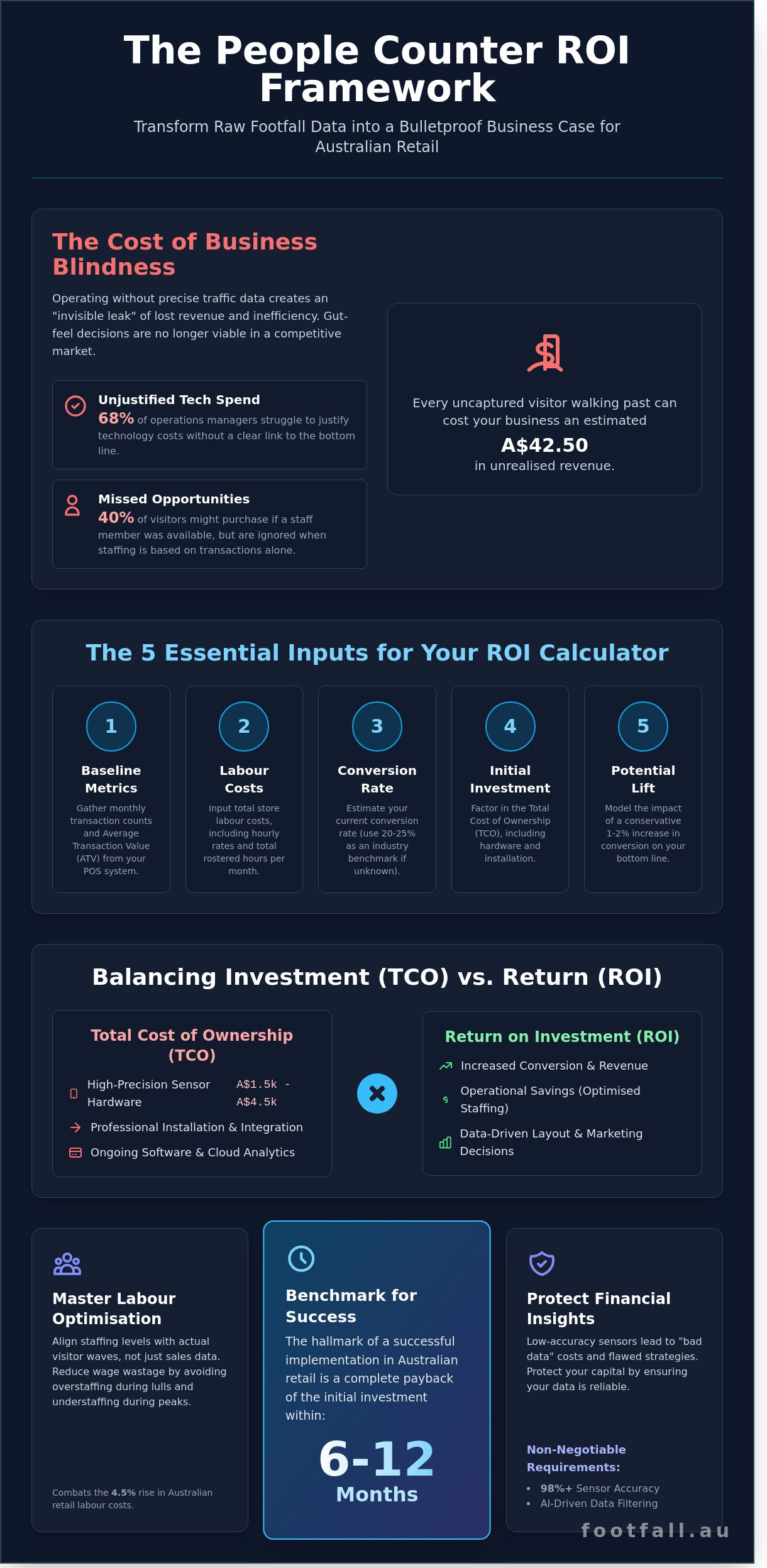
Precision is the new currency in Australian retail. A people counter ROI calculator serves as a financial compass, allowing executives to weigh the Total Cost of Ownership (TCO) against recovered revenue and operational savings. In a 2026 economic climate where Australian retail margins face pressure from a 4.5% rise in labor costs and shifting consumer habits, relying on “gut feel” is no longer a viable strategy. Modern management requires hard evidence to justify every dollar spent on physical infrastructure.
Many businesses suffer from an “invisible leak” where unmeasured foot traffic represents a massive loss in potential turnover. Without a strategic ROI framework, a simple headcount is just a vanity metric. You need to identify why 18% of your peak-hour visitors leave without making a purchase. This data gap often results in thousands of dollars in lost opportunities every week. A calculator transforms these abstract losses into concrete figures, proving that data-driven adjustments can recoup the initial technology investment within months.
The Cost of Business Blindness
Operating without precise traffic data creates a ripple effect of inefficiency. When you make staffing decisions based on transaction counts alone, you ignore the 40% of visitors who might have bought something if a staff member was available. This blindness leads to misallocated marketing budgets and poor store layouts. Integrating people counting technology removes this guesswork, providing a clear view of how many people actually entered your space versus how many converted into customers.
ROI vs. TCO: Understanding the Full Picture
To see the true value of your investment, you must look beyond the initial price tag. A comprehensive people counter ROI calculator breaks down the TCO, which typically includes:
- High-precision sensor hardware (ranging from A$1,500 to A$4,500 per unit).
- Professional installation and network integration.
- Ongoing software licensing and cloud analytics fees.
Cheap, low-accuracy sensors often result in “bad data” costs, leading to incorrect strategic moves. Investing in high-accuracy AI sensors protects your capital by ensuring the insights you act upon are 99% accurate. This reliability is what ultimately drives the long-term profitability of the system.
The Essential Inputs: How to Use a Footfall ROI Calculator
Precision is the foundation of any successful business strategy. When you use a people counter ROI calculator, the quality of your output depends entirely on the accuracy of your data. You shouldn’t rely on guesswork when thousands of dollars in potential revenue are on the line. Follow these five steps to build a reliable financial model:
- Step 1: Gather your baseline metrics. Identify your current monthly transaction counts and your Average Transaction Value (ATV) from your POS system.
- Step 2: Input total store labour costs. Include the hourly rates for your team and the total number of hours rostered across a standard month.
- Step 3: Estimate your current conversion rate. If you haven’t tracked footfall before, use an industry benchmark of 20% to 25% for specialty retail in Australia.
- Step 4: Factor in the initial investment. Include the total cost of the people counting systems Australia setup, encompassing hardware and professional installation.
- Step 5: Calculate the Potential Revenue Lift. Model the impact of a conservative 1% to 2% increase in conversion to see the immediate effect on your bottom line.
Defining Your Baseline Metrics
Your ATV acts as the primary multiplier in this equation. If your average sale is A$120, every single customer gained through better staffing or layout carries that exact weight. You’ll need to pull clean data from your POS system to integrate with your new footfall statistics. This process helps you identify “Power Hours,” those specific windows, like Saturday lunchtimes or Thursday late-night trade, where visitor volume is high but conversion might be lagging. You can review our integration guides to understand how to sync these data sets seamlessly.
Calculating Potential Conversion Lift
Small shifts in behavior lead to significant financial results. A 1% increase in conversion often pays for the entire people counter ROI calculator investment within the first 90 days of operation. This shift is frequently linked to dwell time; data suggests that keeping a visitor in-store for an extra 10 minutes can increase purchase probability by up to 30%. Use the calculator to run “what-if” scenarios. Test how a different floor plan or a more aggressive roster during peak times changes your projected annual profit. This evidence-based approach removes the anxiety from operational changes and replaces it with a clear, logical path to growth.
Beyond Simple Counting: Quantifying Conversion and Staffing ROI
Raw visitor numbers provide a baseline, but the real power of a people counter ROI calculator lies in its ability to quantify operational efficiency. Sophisticated retailers move beyond counting heads to analyze three core pillars: labour, conversion, and marketing. This shift from observation to optimization reveals exactly where capital leaks occur and where growth remains untapped.
The Labour Optimisation Pillar addresses the disconnect between staff schedules and actual visitor waves. Many Australian retailers lose over A$20,000 per store annually by overstaffing “dead zones” while simultaneously losing sales during peak periods because the staff-to-customer ratio is too low. Precision data allows you to reallocate these hours, ensuring your best sellers are on the floor when the crowd is thickest.
The Marketing Pillar changes how you view advertising spend. Instead of looking solely at total sales, you can measure the true cost-per-visitor (CPV) for national campaigns. If a A$40,000 localized campaign triggers a 15% lift in traffic across Queensland stores, you can calculate the exact cost to get a single person through the door. This level of intelligence ensures marketing budgets are spent on strategies that actually drive physical movement.
Quantifying “Dwell Time” is equally vital for high-ticket item sales. Spatial analytics show that increasing dwell time in a premium electronics or furniture zone by just 4 minutes can correlate with a 14% increase in basket size. By using a people counter ROI calculator, you can estimate the revenue lift generated by layout changes that encourage longer browsing sessions.
The Financial Impact of Staffing Alignment
Eliminating just two redundant staff hours per day in a typical Australian retail environment saves approximately A$21,900 per year, based on current casual award rates. Data-driven scheduling prevents the hidden cost of “Lost Sales” during peaks where queues exceed five minutes. Labour Efficiency Ratio is the total staff hours worked divided by the total number of visitors recorded during a specific period.
Conversion Rate: The Ultimate Retail Lever
Sales conversion only tracks who bought something, while traffic conversion tracks the total opportunity. Implementing retail footfall analysis Australia helps identify if visitors are leaving because of poor service timing or stock issues. Recovering a single high-value customer with a Lifetime Value (LTV) of A$3,500 through better service availability provides an immediate, massive return on your sensor investment.
Benchmarking Success: What a ‘Good’ Return on Investment Looks Like
Measuring success requires a clear baseline. In the Australian retail landscape, a 6 to 12 month payback period is the industry standard for sensor deployment. High-performing retailers often see a full return on their hardware and software investment within a single peak trading cycle, such as the period between Black Friday and the January sales. When you input your specific traffic numbers into a people counter ROI calculator, you should look for this 12 month break-even point as your primary KPI.
ROI benchmarks shift significantly across different sectors. Retailers typically focus on a 2% to 5% lift in conversion rates as their success metric. For Australian museums and galleries, ROI is often measured by a 15% increase in successful grant applications, backed by audited visitation data. In commercial offices, the return manifests as a 20% reduction in HVAC and cleaning costs through occupancy-based scheduling. Accuracy is the foundation of these figures.
We refer to the “Precision Penalty” as the hidden cost of cheap sensors. A 10% margin of error in visitor counts doesn’t just mean slightly messy data; it often translates to a 50% error in ROI projections. If your sensors undercount traffic during a busy Saturday, your conversion rates appear artificially high. This leads to understaffing, lost sales, and a fundamental misunderstanding of your store’s capacity. Precision isn’t a luxury; it’s the difference between a strategic asset and a data liability.
Payback Period Analysis
Determining the break-even point involves weighing your initial A$ investment against the incremental revenue generated by optimized staffing. High-volume seasons accelerate this process. A single well-timed roster adjustment during the EOFY sales can often cover the annual subscription cost of the software. To achieve these results, sophisticated footfall data analysis is required to identify exactly where the gaps in your service delivery exist. Without this analysis, the hardware remains a cost rather than a tool for growth.
Qualitative ROI: The Intangible Benefits
Not every benefit appears on a balance sheet immediately. Qualitative ROI includes the reduction in “strategic friction” between floor managers and head office. When decisions are backed by evidence, executive stress decreases. You can treat your physical space as a laboratory, using data to provide a Proof of Concept for new store layouts or product placements before committing to a national rollout. This evidence-based approach ensures that customer experience is improved by reducing wait times at checkout, which protects your long-term brand equity.
Maximising Precision: Why FootfallCam Pro2 is the ROI Engine
Precision isn’t just a technical metric; it’s a financial safeguard. When you use a people counter ROI calculator, the output is only as reliable as the raw data you provide. A system with 85% accuracy introduces a 15% margin of error into your labour planning and conversion metrics. For an Australian retailer managing 25 locations, this discrepancy can lead to overstaffing costs exceeding A$80,000 annually. The FootfallCam Pro2 delivers 98% accuracy or higher, ensuring your financial projections translate into actual bottom-line growth.
The FootfallCam Pro2 Advantage
The FootfallCam Pro2 utilises 3D stereoscopic vision and edge-based AI processing to map spatial depth. This technology allows the device to distinguish between a genuine customer and a staff member, or even filter out non-human objects like shopping trolleys. The V9 software suite automates ROI reporting by integrating POS data directly, which eliminates the manual labour of cross-referencing spreadsheets. The Legacy Swap Out Plan preserves ROI for existing users by providing a discounted pathway to replace outdated hardware with AI-driven sensors while maintaining historical data continuity.
- AI Staff Exclusion: Prevents staff movements from inflating footfall and deflating conversion rates.
- Shadow Suppression: Advanced optics ensure accurate counts even in high-glare Australian storefronts.
- V9 Analytics: Provides management with instant visibility into peak hours and dwell times.
Securing Your Investment with Footfall Australia
Scaling a system across a national footprint requires more than just hardware. Footfall Australia provides the local expertise necessary for complex deployments from Brisbane to Perth. Choosing a partner with dedicated people counter support ensures that your sensors remain calibrated and your data stays clean. This ongoing maintenance prevents data drift, keeping the inputs for your people counter ROI calculator accurate for the entire lifecycle of the equipment. Reliable data integrity is the difference between a one-off insight and a long-term strategic advantage.
Ready to see the numbers for your business? Contact Footfall Australia today for a custom ROI projection and discover how precision data can transform your retail operations.
Turn Footfall Into Financial Certainty
Success in the Australian retail landscape no longer relies on intuition. It depends on the precision of your data. By integrating a people counter ROI calculator into your planning, you transform raw footfall numbers into actionable financial outcomes. You’ve seen how tracking conversion rates and optimizing staff schedules can directly impact your bottom line; it often reveals hidden revenue gaps in your daily operations. Precision isn’t just a metric. It’s a competitive advantage.
Footfall Australia brings over 20 years of local expertise to your business. We provide proprietary AI hardware that delivers 98% verified accuracy, ensuring every decision is backed by reliable evidence. Our national support network manages seamless multi-site deployment across every state, so your data remains consistent from Perth to Sydney. It’s time to stop guessing and start measuring the true value of every visitor who walks through your doors. Your business deserves the clarity that only high-tech spatial analytics can provide.
Request Your Custom ROI Calculation from Footfall Australia and discover how to maximize your A$ returns. We look forward to helping you master your visitor journey.
Frequently Asked Questions
How do I calculate ROI for a people counter?
You calculate ROI by subtracting the total cost of the system from the net profit gain, then dividing that figure by the initial investment. It’s a straightforward formula that yields a percentage. Use a people counter ROI calculator to input variables like current conversion rates and average transaction values. A 1.2% increase in conversion typically covers the hardware cost within 90 days for most Australian retailers.
What is a typical payback period for footfall technology in Australia?
Most Australian businesses achieve a full return on investment within 6 to 12 months of installation. High-traffic sites in Sydney and Melbourne often reach this milestone in under 180 days due to the volume of actionable data. We’ve seen local boutiques recover costs faster by identifying and fixing “dead hours” where staff costs exceeded visitor revenue. It’s about turning data into immediate operational changes.
Can a people counter really help me reduce my staffing costs?
Labor costs decrease by 12% to 15% when managers align rosters with actual peak foot traffic rather than historical guesses. You’ll stop overstaffing during quiet Tuesday mornings and ensure enough floor coverage for the Saturday rush. This precision prevents wage leakage and ensures your highest-performing staff are present when the visitor count is highest. It’s a data-driven approach to workforce management.
How does data accuracy affect my ROI calculation?
Accuracy is the primary driver of ROI precision because a 5% margin of error can lead to thousands of dollars in misallocated resources. An accurate people counter ROI calculator relies on high-fidelity data to provide reliable insights. While older thermal sensors offer 70% accuracy, modern 3D LiDAR sensors provide 99.5% precision. This gap represents the difference between making a guess and making a strategic investment.
Do I need to integrate my POS system to see a return on investment?
POS integration isn’t strictly necessary, but it provides the conversion data needed for the fastest possible return. Linking sales to traffic allows you to see exactly how many visitors actually made a purchase. Retailers using integrated data see a 20% higher revenue growth than those who only track entry counts. It transforms a simple tally into a sophisticated tool for measuring store performance and sales effectiveness.
What is the difference between ROI for retail vs. public spaces like libraries?
Retail ROI targets sales growth and conversion, while public space ROI focuses on operational funding and resource allocation. Libraries and galleries use this data to secure 10% to 15% more annual funding by proving facility utilization to local councils. For these sectors, the return isn’t found in a cash register. It’s found in the ability to justify budgets and optimize building maintenance based on human movement.
Is there a qualitative ROI to people counting that isn’t just about sales?
Qualitative ROI manifests as better visitor experiences and evidence-based facility management that protects your brand reputation. Cleaning schedules based on usage rather than fixed times can reduce facility management costs by 20% while improving hygiene scores. You’ll also identify bottlenecks in your floor plan that frustrate customers. Happy visitors stay longer, and longer dwell times correlate with a 30% increase in potential spend per visit.
How much does a professional people counting system cost to implement?
A professional-grade 3D sensor installation in Australia typically costs between A$800 and A$1,500 per entrance. This price includes the hardware, professional calibration, and the first year of cloud-based reporting software. While entry-level DIY kits exist for less, they lack the precision required for a serious business strategy. Investing in high-end sensors ensures the data you’re acting on is actually correct, which protects your long-term profit margins.