
Building a Business Case for People Counters: A 2026 Strategic Guide
Could your retail strategy be leaving a 20% conversion boost on the table simply because the boardroom lacks empirical evidence? In the competitive Australian retail market, many operations leaders find themselves trapped between the need for precision and a budget that prioritises immediate overheads. You likely feel the frustration of knowing exactly where your store performance gaps are, only to have your proposals for hardware stalled by a lack of cross-departmental alignment. Successfully building a business case for people counters requires shifting the conversation from what the technology costs to how much reliance on intuition is actually costing the business.
We’ve designed this 2026 strategic guide to help you bridge that gap and secure executive approval for data-driven innovation. You’ll learn how to present a clear ROI framework that resonates with Finance, addresses IT’s integration concerns, and proves that high-accuracy systems like the FootfallCam Pro2 can pay for themselves within three to six months. This article provides the logic needed to align stakeholders across Operations and Finance, giving you the roadmap to move from a single pilot to a national rollout backed by total organisational buy-in.
Key Takeaways
- Replace gut feelings with empirical evidence to identify hidden operational costs and unlock revenue growth through precise footfall data analysis.
- Master the financial logic of building a business case for people counters by calculating how a 1% conversion lift directly impacts your EBITDA.
- Align the interests of Finance, IT, and Operations by proactively addressing privacy compliance and technical integration requirements.
- De-risk your investment by implementing a high-impact store pilot that generates undeniable success signals for a national rollout.
- Secure long-term executive trust by prioritising hardware accuracy, ensuring your strategic decisions are always based on reliable, verifiable metrics.
Why Intuition-Based Management Fails in 2026
Reliance on professional instinct has long been a badge of honour for retail veterans. However, in 2026, intuition bias is a silent drain on profitability. This bias occurs when decisions regarding staffing, stock, and marketing are based on anecdotal evidence rather than empirical truth. When building a business case for people counters, it’s essential to highlight that gut feelings often mask systemic inefficiencies. A manager might feel the store is busy on Saturday mornings, but without precise measurement, they cannot distinguish between high-intent shoppers and casual browsers. This lack of clarity results in misaligned operational costs that erode the bottom line.
The retail landscape has moved beyond basic sales tracking. While Point-of-Sale (POS) systems record what was sold, they fail to capture the “Invisible Customer”, which is the visitor who walked out empty-handed. Transitioning to comprehensive footfall data analysis allows businesses to quantify this missed opportunity. Every unmeasured entry represents a financial leak. By understanding the total volume of opportunities, retailers can move from reactive management to a proactive strategy where every operational shift is backed by real-time evidence.
The Cost of Unmeasured Foot Traffic
Unmeasured traffic is the critical gap between total store entries and completed transactions. Without visibility into this metric, retailers often fall victim to the vanity of high foot traffic that doesn’t convert. In the Australian market, this frequently leads to overstaffing during traditional peak windows, such as Thursday late-night shopping, when actual visitor patterns may have shifted. Actionable insights from people counter technologies allow you to align labour costs with actual demand. This ensures staff are present when they can most effectively drive revenue rather than just standing by during quiet periods.
Meeting Modern Consumer Expectations
Today’s shoppers demand efficiency and a frictionless physical environment. If a store feels overcrowded or wait times are excessive, consumers simply leave. Positioning people counting technology as a customer service tool is a vital part of building a business case for people counters. It isn’t just about tracking; it’s about using data to ensure the environment remains responsive. By monitoring dwell times and queue lengths, businesses can create a more inviting space that respects the customer’s time and encourages conversion through better service availability.
Constructing the ROI Framework: Converting Traffic into Revenue
Securing budget for new hardware often hinges on your ability to translate technical metrics into financial outcomes. When building a business case for people counters, your strongest argument is the direct link between traffic visibility and EBITDA growth. Most retailers focus solely on total sales, but this ignores the conversion potential of every person who enters the building. By implementing a rigorous retail footfall analysis Australia framework, you can demonstrate exactly how small operational tweaks lead to significant revenue lifts.
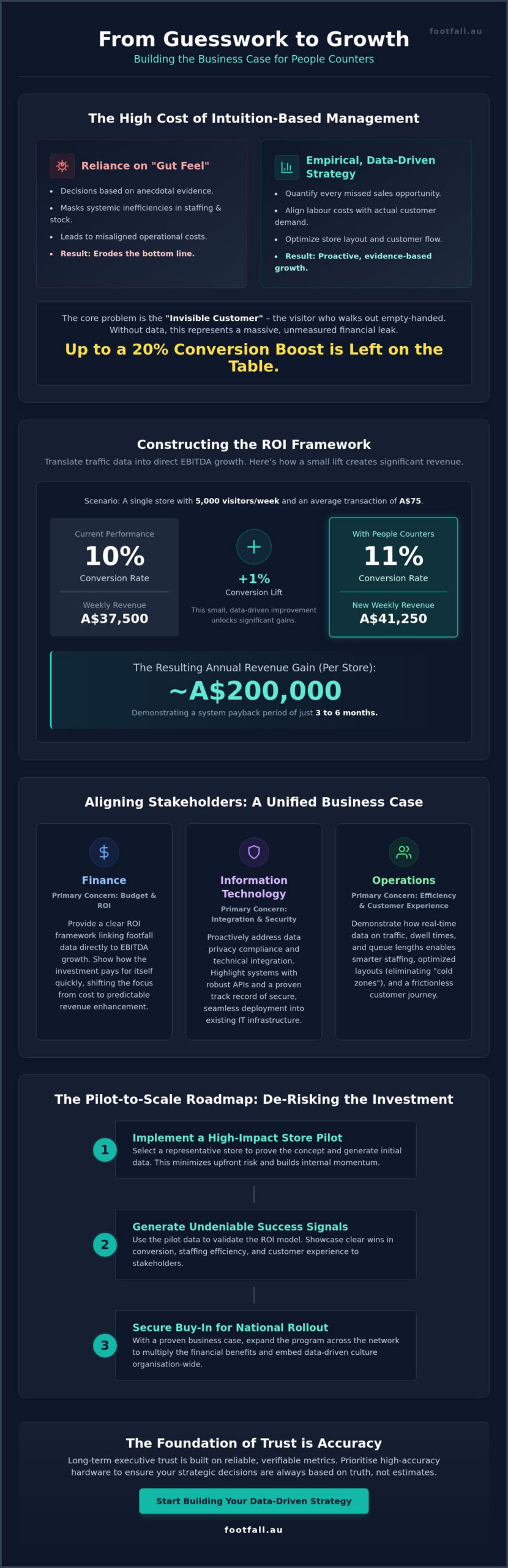
Consider the impact of a 1% increase in conversion. If a store receives 5,000 visitors per week with an average transaction value of A$75, a 10% conversion rate generates A$37,500 in revenue. Moving that conversion rate to 11% increases weekly revenue to A$41,250. This single, modest improvement results in an annual revenue gain of nearly A$200,000 per store. Modern systems provide more than just entry counts; they offer valuable data to merchandisers through heatmap patterns and dwell time analysis. This allows you to identify “cold zones” in your layout and adjust product placement to capture interest that was previously lost.
The Conversion Rate Formula for Executives
To win over the CFO, you must bridge the gap between your Point-of-Sale (POS) data and physical traffic. True conversion is impossible to calculate without knowing the total number of opportunities. Presenting the “lost opportunity cost” reveals the hidden financial leak in the business. The FootfallCam Pro2 is designed to integrate seamlessly with existing retail ecosystems, providing a unified dashboard where traffic and sales data converge. This transparency makes the investment feel inevitable because it replaces guesswork with a clear, auditable trail of performance. Reviewing your current traffic reporting capabilities is the first step toward this financial clarity.
Labour Optimisation and Operational Efficiency
Labour is typically a retailer’s largest controllable expense. Using data from people counting systems Australia, you can align staff rotas with actual visitor peaks rather than traditional shifts. This reduces labour wastage during quiet periods and ensures you’re fully staffed when conversion opportunities are highest. Effective queue management also plays a vital role; when customers see a long, unmanaged line, they often abandon their purchase. Real-time data allows managers to open additional registers exactly when needed, protecting the sale and improving long-term customer retention.
Stakeholder Alignment: Addressing IT, Finance, and Operations
Building a business case for people counters requires more than just a projected ROI; it demands a unified front among the “Power Trio” of IT, Finance, and Operations. Each department views technical innovation through a different lens of risk and utility. If you don’t address these specific concerns early, your proposal will likely stall at the board level. You must pivot from a purely operational narrative to one that encompasses security, fiscal structure, and employee empowerment. Successful internal persuasion starts by speaking three different professional languages simultaneously.
IT departments in Australia are increasingly sensitive to the Australian Privacy Act and evolving global standards. Their primary fear is the introduction of new hardware that could pose a data breach risk or complicate network security. You can mitigate this by highlighting the “Privacy by Design” architecture of modern sensors. Unlike traditional CCTV, AI-driven counters use edge processing to convert movement into anonymised data points directly on the device. No raw video ever leaves the sensor. This approach is so effective that even government agencies use similar camera-based systems to validate passenger trip reporting in high-traffic public transit environments without compromising individual privacy.
Finance stakeholders typically focus on the distinction between CAPEX and OPEX. While the initial hardware investment is a capital expenditure, the long-term value lies in operational savings. If your business is already struggling with inaccurate infrared sensors, the Legacy Swap Out Plan offers a structured path to upgrade to high-precision hardware without the friction of a full-scale replacement budget. This allows Finance to see a clear path toward a lower total cost of ownership through improved data accuracy and reduced maintenance of obsolete systems.
Privacy and Security: Winning Over the IT Department
Edge processing is your strongest technical argument. By processing data at the “edge,” the FootfallCam Pro2 ensures that sensitive imagery is never stored or transmitted. You aren’t collecting faces; you’re collecting vectors of movement. This distinction is vital for compliance with 2026 privacy regulations. AI-driven sensors provide a level of anonymisation that traditional security cameras cannot match, making them the preferred choice for ethical data collection in public spaces.
Usability and Adoption: Winning Over Store Teams
Operations teams often fear that new technology is a tool for surveillance. You must reframe this. Use the FootfallCam V9 Software to show store managers how intuitive dashboards actually make their lives easier. When a manager can prove they need an extra team member for a specific peak, the data becomes their ally. Creating data champions within your pilot stores helps drive bottom-up buy-in. These leaders can demonstrate to their peers how footfall metrics lead to better-managed shifts and less burnout during unexpected surges.
The Pilot-to-Scale Roadmap: De-risking the Investment
Executives often hesitate at the thought of a national rollout due to the perceived risk of a failed technology integration. Building a business case for people counters is significantly easier when you move from abstract projections to a tangible Proof of Concept (PoC). A phased roadmap allows you to isolate variables, refine your data collection processes, and generate internal success stories. This evidence makes the eventual expansion feel like a logical next step rather than a financial gamble. By starting small, you prove the system’s utility before committing to a larger capital expenditure.
Success in the pilot phase depends on clear, non-negotiable objectives. You aren’t just testing if the hardware works; you’re testing if your organisation can act on the insights provided. By the end of a 90-day review, you should present a direct correlation between data-driven staffing changes and a measurable lift in store revenue. This evidence transforms the conversation from a request for budget into a strategic necessity. Managing the physical installation with minimal disruption is also key. In the Australian retail environment, this often means coordinating after-hours work to ensure trading remains unaffected while sensors are calibrated for 98% accuracy.
Selecting Your Pilot Location
Avoid the temptation to use your flagship store as the primary test site. These locations often have high-performing teams and stable traffic that can mask the very problems you’re trying to solve. Instead, identify stores with high footfall but fluctuating conversion rates. These locations provide the most fertile ground for proving that building a business case for people counters is a sound financial decision based on real-world performance gains. Ensure local store management is fully briefed and supportive, as their willingness to adjust rotas based on the data is what ultimately proves the ROI.
From Proof of Concept to National Rollout
Scaling across Australia presents unique logistical challenges, from remote site access to maintaining consistent installation standards. Working with a partner that offers people counter support ensures your national rollout remains on schedule and data integrity is preserved. Once the PoC proves the revenue lift, you can confidently secure the larger CAPEX budget for a national expansion. A local partner network simplifies this process by providing the technical backbone needed for a seamless transition from one store to one hundred. To begin your pilot store selection, consult with our strategic team for a site-specific audit.
Partnering for Success: Why Reliable Technology Matters
The final pillar in building a business case for people counters is the selection of a technology partner that guarantees data integrity. Accuracy is the bedrock of executive trust. If a system provides only 80% accuracy, the resulting data is functionally useless for strategic planning, as it introduces a margin of error that can hide significant performance trends. Executives will quickly identify inconsistencies between poor traffic data and verified sales figures, which can permanently undermine future requests for innovation budget. Choosing the FootfallCam Pro2 ensures you are presenting 98% accurate metrics that stand up to the most rigorous financial scrutiny.
Reliability extends beyond the hardware itself. For Australian businesses, the value of a partnership lies in local support and a sustainable cost model. Many international providers lock retailers into restrictive, escalating subscription fees that erode ROI over time. We prioritise a perpetual licensing model and offer structured support plans that provide long-term fiscal certainty. This approach ensures that your people counting infrastructure remains an asset rather than a recurring liability on the balance sheet. By securing a partner with a deep understanding of the local retail environment, you gain a strategic backbone for your entire digital transformation.
The Footfall Australia Advantage
With over 20 years of local expertise, we understand the specific challenges of the Australian market, from high-density urban centres to regional retail hubs. Our Legacy Swap Out Plan is a low-friction strategy for businesses currently hampered by outdated or inaccurate hardware. It allows you to modernise your infrastructure without the complexity of a total system overhaul. By integrating high-precision hardware with the FootfallCam V9 Software, we provide a single source of truth for the Board, ensuring every department works from the same verified dataset.
Next Steps: Starting Your Tech Transformation
Before your next internal stakeholder meeting, ensure you have a clear path forward. Preparation is the difference between a rejected proposal and a funded pilot. Use this checklist to solidify your position:
- Summarise the pilot objectives: Define exactly which stores will be tested and why.
- Address the IT security profile: Prepare the documentation on edge processing and privacy compliance.
- Present the EBITDA lift: Show the projected revenue gains from a 1% conversion improvement.
- Request a tailored ROI projection: Use verified market data to show the payback period.
Moving from intuition to evidence-based management is a journey that requires the right technical foundation. Our team is ready to help you quantify the potential in your physical spaces and build a narrative of growth that your leadership team cannot ignore. Contact Footfall Australia for a strategic consultation today to begin your data-driven evolution.
Empowering Your Retail Strategy with Empirical Truth
Transitioning from intuition to evidence-based management is no longer a luxury but a competitive necessity in the 2026 Australian retail landscape. By following a structured ROI framework and aligning stakeholders through transparent, privacy-first technology, you can eliminate the financial leaks caused by unmeasured traffic. Mastering the process of building a business case for people counters transforms your role from a reactive manager to a strategic architect of store performance. You aren’t just buying hardware; you’re investing in a single source of truth that empowers every department to optimise operations with absolute confidence.
We’ve been serving the Australian retail sector since 2004, providing the technical expertise and local support needed for seamless digital transformations. With our national partner network and the AI-driven 99.5% accuracy of the FootfallCam Pro2, your data will always be reliable and actionable. Take the final step in your internal persuasion process and secure your business case with a Footfall Australia expert consultation. It’s time to turn your physical spaces into measurable engines of growth.
Frequently Asked Questions
What is the most common reason retail technology projects fail to get buy-in?
Projects often fail because they are presented as a technical expense rather than a strategic revenue driver. Without a unified front between IT, Finance, and Operations, proposals lack the broad support needed for board approval. Addressing departmental silos early ensures the technology is viewed as an essential tool for organizational growth rather than a burden on the budget.
How do I calculate the ROI of a people counting system for my CFO?
Focus on the revenue impact of conversion rate improvements and labor cost reductions. For example, a 10% to 20% improvement in conversion rates is common through optimized staffing. You should also highlight the potential for a 5% to 15% reduction in labor costs through data-driven scheduling, which is a key part of building a business case for people counters.
Is new retail hardware compliant with the Australian Privacy Act?
Modern hardware is designed for compliance by processing data at the edge. The FootfallCam Pro2 converts movement into anonymised vectors without storing or transmitting raw video footage. This “Privacy by Design” approach ensures your data collection remains ethical and adheres to the Australian Privacy Act standards, protecting both the consumer and the business.
Can we integrate new footfall data with our existing POS system?
Yes, footfall data is most valuable when combined with sales figures to reveal true conversion rates. FootfallCam V9 software allows for seamless integration with most POS systems via API or automated data imports. This creates a unified dashboard that provides the Board with a single source of truth for store performance across the entire network.
What is the difference between a pilot programme and a full national rollout?
A pilot programme is a controlled test in a few high-impact stores to validate the Proof of Concept and de-risk the investment. A national rollout is the full-scale implementation across your entire network once success signals are confirmed. The pilot provides the empirical evidence needed to secure the larger CAPEX budget for the national expansion.
How long does it typically take to see a return on investment after installation?
Most Australian retailers see a full return on their investment within 3 to 6 months. This rapid payback is driven by immediate gains in conversion and more efficient labor allocation. By identifying and fixing performance gaps quickly, the system effectively pays for itself through recovered revenue and reduced operational wastage.
How do I handle staff resistance to new monitoring technology?
Reframe the technology as a support tool designed to ensure stores are never understaffed during peak periods. When store teams understand that the data protects them from being overwhelmed by unmanaged surges, resistance typically fades. Use the dashboards to empower managers to prove their staffing needs to upper management based on actual visitor volume.
What should I look for in a retail technology partner in Australia?
Look for a partner with extensive local experience and a national installation network. High accuracy is non-negotiable; building a business case for people counters depends on data you can trust. Ensure they offer local Australian support plans and hardware that provides at least 98% accuracy to maintain long-term executive confidence.