
How to Stop Guessing in Retail Management: A Data-Driven Framework
With the National Minimum Wage in Australia rising to $26.44 per hour as of July 2026, every hour of overstaffing is an expensive leak in your bottom line. Most managers still rely on a gut feeling to decide when to open extra registers or launch a promotion. You have likely felt the frustration of a crowded floor that fails to produce matching sales figures, leaving you to wonder where the disconnect lies. Learning how to stop guessing in retail management isn’t about ignoring your experience; it’s about validating your professional instincts with objective, empirical evidence.
We understand that managing a physical environment requires a balance between technical innovation and practical application. This guide will show you how to shift from intuition-based decisions to a position of strategic certainty through sophisticated footfall analytics. We’ll explore a framework designed to give you a clear understanding of customer behavior and optimized staffing schedules. By the end, you’ll have the tools to provide objective proof of ROI for store changes, ensuring that every operational shift is backed by a narrative of movement and measurable human action.
Key Takeaways
- Identify how anecdotal evidence and incomplete POS data create invisible leaks in your store’s profitability.
- Discover how to stop guessing in retail management by replacing intuition with empirical certainty using high-accuracy people counting technology.
- Learn to utilize Sales Conversion and Capture Rates as objective truth-tellers to measure store efficiency and display appeal.
- Audit your national store network for blind spots and deploy a robust data-led framework for operational excellence.
- Future-proof your strategy by leveraging existing assets, such as turning CCTV into smart sensors with the FootfallCam Centroid.
The Cost of Intuition: Why Guessing Fails Modern Retail
Retail guessing occurs when managers rely on anecdotal staff feedback or incomplete POS data to guide store operations. It’s a common trap. While intuition has its place in creative merchandising, it’s a poor foundation for operational efficiency. Decisions based on what it felt like on a Saturday afternoon often lead to inconsistent results. Understanding how to stop guessing in retail management requires a fundamental shift in how we define store health. Instead of looking only at the end of the transaction chain, we must look at the behavior that precedes it.
Total sales figures are lagging indicators. They tell you about the success of yesterday, but they offer no insight into the opportunities you missed. A store might hit its daily target while actually underperforming relative to the number of people who walked through the door. This disconnect is where profitability drains away. By adopting a systematic approach to managing products and people, you move from a transactional focus to a behavioral insights focus. You begin to treat physical presence as a sequence of human actions that can be interpreted and optimized.
The Problem with POS-Only Data
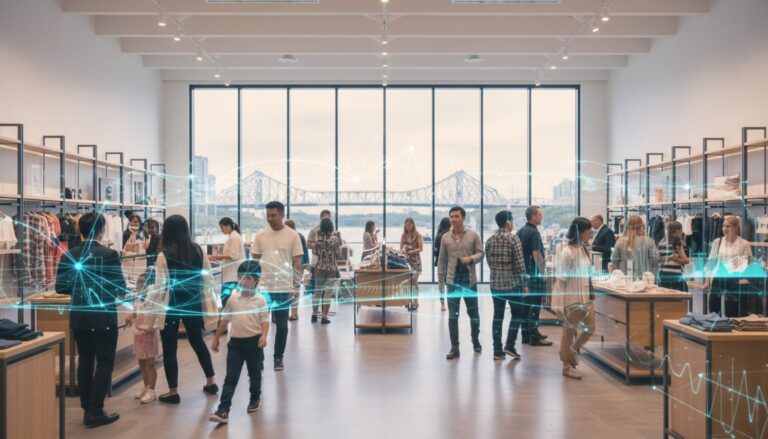
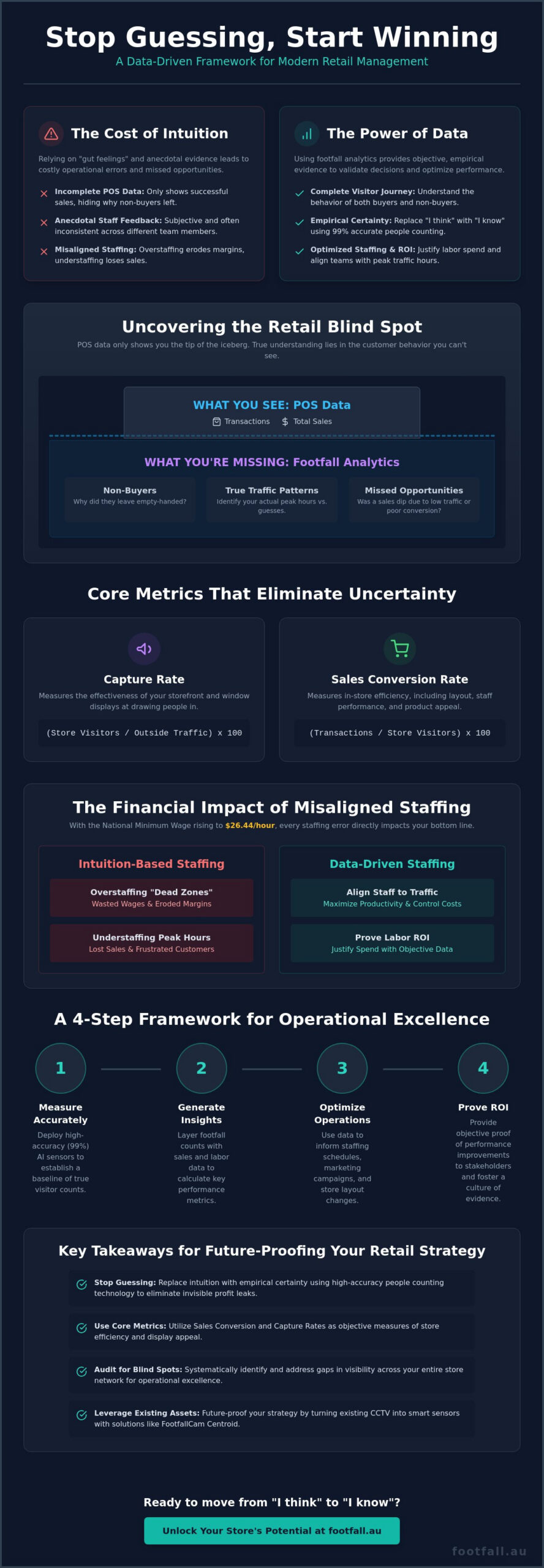
POS systems are excellent at recording what happened at the till, but they’re silent about what happened in the aisles. They don’t account for the “Non-Buyer.” Understanding why a visitor left without making a purchase is just as vital as knowing what a customer bought. The “Retail Blind Spot” is the gap between foot traffic and transactions. Without high-accuracy people counting data, you’re only seeing half of the picture. This lack of visibility makes it impossible to know if a sales dip was caused by low traffic or poor in-store conversion.
The Financial Impact of Misaligned Staffing
Labor is often the highest controllable expense in retail. With the National Minimum Wage in Australia rising to $26.44 per hour as of July 2026, the cost of inefficiency has never been higher. Overstaffing during quiet “dead zones” erodes your margins, while understaffing during unrecognized peaks leads to abandoned baskets and frustrated customers. Data provides the objective proof needed to justify labor spend to stakeholders. It ensures your team is positioned exactly where and when they’re needed most, transforming staffing from a guess into a calculated strategic advantage.
Transitioning from Gut Feeling to Data-Driven Certainty
Moving from “I think” to “I know” is the most significant leap a retail leader can make. While experience is valuable, it often lacks the precision required for modern optimization. Establishing a baseline of true visitor counts across your national retail landscape allows you to see the store as it actually is, not as it’s perceived. This is the fundamental step in learning how to stop guessing in retail management. By grounding your strategy in empirical reality, you replace doubt with a quiet, data-backed confidence.
The hierarchy of retail intelligence begins with raw footfall counts. These numbers are the foundation, but their true utility appears when they’re transformed into actionable analytics. Sophisticated Data-Driven Decision Making involves layering these counts against sales data, labor costs, and marketing spend. This methodology is central to how to stop guessing in retail management. Many executives worry that such systems are too complex to manage. In reality, modern AI solutions are designed to be highly accessible, stripping away technical jargon to provide simple, intuitive reporting that empowers every level of the organization.
The Role of People Counting Technology
AI-powered sensors, such as the FootfallCam Pro2, provide the 99% accuracy required for high-stakes decision making. These systems use edge computing to process movement locally, ensuring privacy-first data collection that meets Australian standards. You don’t have to choose between customer trust and operational visibility. By utilizing real-time data for floor management and historical data for seasonal planning, you create a dual-layered approach to store oversight.
Creating a Culture of Evidence
Technology alone won’t change an organization; you must foster a culture that values evidence over anecdote. This starts with training staff to interpret footfall reports rather than relying on the “feel” of the floor. Setting data-backed KPIs for regional managers ensures everyone is working toward the same objective goals. Linking performance reviews to conversion rates, rather than just total revenue, highlights the importance of efficiency. If you’re ready to modernize your oversight, you can review our technology options to find the right fit for your network.
Core Metrics That Eliminate Uncertainty in Store Management
To truly understand how to stop guessing in retail management, you must focus on the metrics that define the narrative of customer movement. Raw numbers are only the beginning. The real strategic advantage comes from interpreting these figures to uncover operational friction. By measuring specific behavioral markers, you move away from subjective opinions and toward empirical certainty. This shift enables leaders to make data-driven decisions in retail that directly impact the bottom line.
Capture rate is one of the most underutilized metrics in the sector. It measures the percentage of passersby who choose to enter your store, providing a direct assessment of your street-front appeal. If your capture rate is low, your window displays or signage aren’t resonating with the local demographic. Similarly, maintaining the right staff-to-customer ratio is vital for service excellence. Too few staff leads to abandoned baskets; too many creates unnecessary overhead. Finding the “sweet spot” ensures your team is productive without being overwhelmed.
Mastering the Conversion Rate
The Sales Conversion Rate is the ultimate truth-teller in retail efficiency. It’s calculated with a simple formula: (Transactions ÷ Total Footfall) × 100. A high footfall count with a low conversion rate is a clear signal of failure in service quality or stock availability. It means you’re successfully attracting visitors, but failing to meet their needs once they’re inside. Managers can refine this by leveraging Retail Footfall Analysis in Australia to benchmark performance against regional standards and identify specific hours where conversion dips.
Optimising Store Layout and Dwell Time
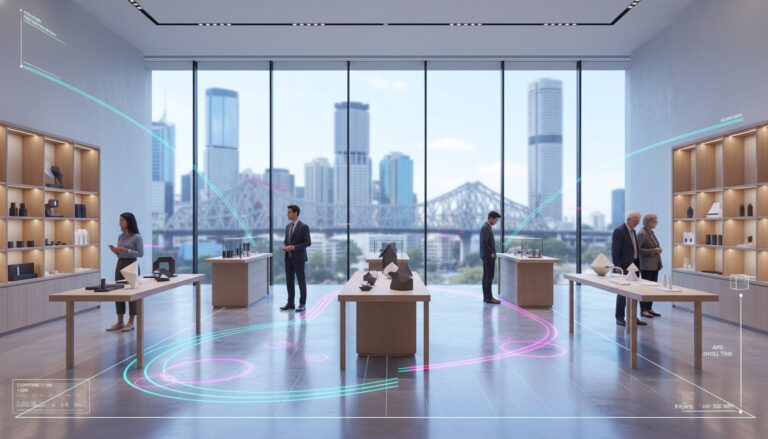
Dwell time measures the duration a visitor spends in your environment. Generally, there’s a strong correlation between dwell time and average transaction value (ATV). Using heatmaps allows you to identify “dead zones” where customers rarely venture, often due to poor lighting or restrictive layouts. Once these zones are identified, you can use A/B testing in the physical environment to measure the impact of changes. Move a high-demand category to a quiet corner and monitor the data to see if dwell time and sales increase. This iterative process turns store management into a continuous cycle of evidence-based optimization.
Implementing a Data-Led Framework for Operational Excellence
Building an operational framework requires more than just installing sensors; it demands a structured approach to visibility across your entire organization. You must first audit your national store network to identify blind spots where customer behavior remains unobserved. This systematic review is the cornerstone of how to stop guessing in retail management. Once these gaps are identified, deploying high-accuracy hardware ensures the foundation of your data is sound. Integrating this information with your POS system creates a unified view of the customer journey, allowing you to see exactly where potential sales are lost between the entrance and the till.
Operational excellence is an iterative process. Use weekly reports to adjust staffing and marketing strategies on the fly, responding to shifting behavioral trends in real-time. This level of agility allows you to scale success by applying insights from high-performing stores to underperforming ones. If a specific layout or staffing model works in one flagship location, the data will show you exactly how to replicate that result across other regions. This ensures that your growth is consistent, predictable, and backed by empirical proof.
Step-by-Step Integration
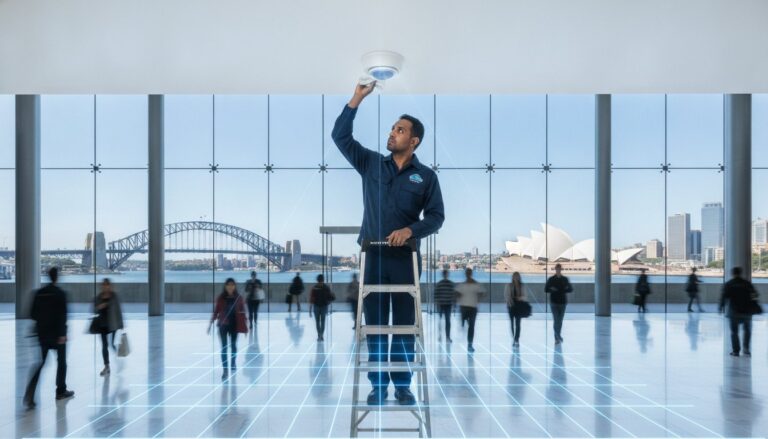
Success begins with selecting hardware tailored to your specific environment. Different ceiling heights and lighting conditions require specialized sensors to maintain the 99% accuracy levels expected in professional retail environments. Setting up the FootfallCam V9 Software allows for automated reporting, delivering insights directly to decision-makers without manual intervention. Regular system maintenance is essential to ensure long-term data integrity, providing a reliable stream of information for years to come.
Strategic Staffing Adjustments
The most immediate benefit of a data-led framework is the transition from fixed rosters to demand-based scheduling. Instead of guessing when your stores will be busy, you can use predictive analytics to anticipate peak hours before they happen. Identifying “Power Hours” allows managers to pinpoint the specific windows of time where foot traffic is highest, ensuring that staffing levels are optimized to capture every possible sales opportunity during these critical periods. This proactive approach turns labor from a static cost into a dynamic driver of growth. To begin your implementation, explore our retail analytics hardware and software options to find the right fit for your network.
Future-Proofing Your Retail Strategy with Footfall Australia
Selecting a national partner with local expertise is the final step in securing your operational future. The Australian retail landscape presents unique geographical and economic challenges that require more than just a software subscription. By partnering with a specialist who understands the nuances of the local market, you gain access to a support network that ensures your data remains accurate and actionable. This partnership is the most effective way to learn how to stop guessing in retail management, as it provides the technical stability needed to make high-stakes decisions with confidence.
One of the most significant advantages of modern retail intelligence is the ability to leverage existing infrastructure. You don’t always need a complete hardware overhaul to gain sophisticated insights. The FootfallCam Centroid can turn your existing CCTV network into a suite of smart sensors, extracting behavioral data without the need for additional cabling or intrusive installations. This capability addresses a common barrier to entry, allowing you to modernize your oversight while maximizing the utility of your current assets. It transforms a standard security tool into a strategic engine for growth.
The value of this data compounds over time. While immediate staffing adjustments provide a quick return, historical footfall trends offer immense leverage during property negotiations. If a shopping center’s traffic declines or shifts away from your storefront, having empirical proof allows you to negotiate lease terms from a position of strength. You’re no longer relying on the landlord’s estimates; you’re using your own verified records to protect your margins. In the competitive environment of 2026, a “wait and see” approach is the biggest risk a manager can take. Every day without visibility is a day of lost opportunity.
The Footfall Australia Advantage
Our proprietary AI hardware is engineered for 99.5% accuracy, even in complex environments with challenging lighting or high ceilings. We maintain a local network of partners to provide Comprehensive People Counter Support, ensuring that your systems are always calibrated for peak performance. Whether you manage a single boutique or a national retail chain, these solutions scale to meet your specific organizational needs without sacrificing precision or data integrity.
Next Steps for Decision Makers
Transitioning to a data-driven model starts with an honest assessment of your current visibility. We recommend requesting a site audit to identify specific data gaps within your network. If you’re currently struggling with outdated or inaccurate hardware, you can explore our Legacy Swap Out Plan to modernize your infrastructure efficiently. This is the most direct path to understanding how to stop guessing in retail management and reclaiming your operational margins. Contact our strategic consultants today to eliminate retail guesswork.
Securing Your Competitive Advantage Through Empirical Visibility
Shifting from anecdotal evidence to empirical certainty is no longer a luxury; it’s a requirement for operational survival. You have seen how identifying the “Retail Blind Spot” and mastering conversion rate metrics can transform your store’s efficiency. By implementing a structured framework, you ensure that every staffing decision and layout change is backed by a narrative of movement rather than a mere gut feeling. This is exactly how to stop guessing in retail management and start leading with objective proof of ROI.
Footfall Australia has been trusted by Australian businesses since 2004 to provide high-quality technical solutions that empower managers. With a 99.5% accuracy guarantee through our AI-powered FootfallCam Pro2, you can achieve proven ROI by optimizing staff schedules and improving sales performance. It’s time to replace uncertainty with a foundation of expertise. Eliminate Guesswork: Get a Custom People Counting Solution for Your Business. Your data is ready to tell the story of your store’s future success.
Frequently Asked Questions
How is people counting data different from my POS sales reports?
People counting data measures the total volume of opportunities, whereas POS reports only record successful transactions. POS systems are silent about the visitors who leave empty-handed. By comparing footfall to sales, you calculate the conversion rate. This is the most effective way to understand how to stop guessing in retail management. It reveals whether a sales dip is due to low traffic or a failure to serve the people already in your store.
Can I use my existing CCTV cameras to stop guessing about traffic?
You can leverage your existing infrastructure by using the FootfallCam Centroid to convert CCTV feeds into smart sensors. This device processes video streams using AI to extract behavioral data without requiring new camera installations. It’s a cost-effective method for modernizing your oversight while maintaining your current hardware assets. This integration allows you to gain sophisticated analytics across your entire floor plan without intrusive cabling or significant capital expenditure.
Is people counting technology compliant with Australian privacy laws?
Modern people counting technology is fully compliant with Australian privacy standards. AI sensors like the FootfallCam Pro2 use edge computing to process movement locally, meaning no video or personally identifiable information is ever uploaded to the cloud. The system records anonymous counts and behavioral patterns rather than individual identities. This privacy-first approach ensures you maintain customer trust while gaining the empirical certainty needed for strategic store management.
How long does it take to see a return on investment from footfall analytics?
Most retailers observe a return on investment within the first three months of implementation. The most immediate impact comes from labor optimization, as data-backed staffing schedules reduce the costs of overstaffing during quiet periods. Over time, the compounding value of conversion rate improvements and more effective marketing campaigns further increases profitability. By identifying and fixing invisible leaks in your operations, the system pays for itself through reclaimed margins and increased sales.
What is the most important retail metric to track besides total sales?
The sales conversion rate is the most critical metric for assessing store efficiency. It provides a direct measurement of how effectively your team and inventory are meeting the needs of every visitor. While total sales tell you what happened, the conversion rate tells you how well you’re performing relative to your actual potential. Tracking this figure is fundamental for anyone learning how to stop guessing in retail management and seeking objective proof of operational health.
Does people counting work for small boutique stores as well as large chains?
People counting is highly effective for both single boutique stores and national retail chains. For smaller stores, every visitor represents a higher percentage of potential revenue, making conversion accuracy vital for survival. For large chains, the technology allows for benchmarking across multiple locations to identify high-performing models that can be replicated. The scalability of the FootfallCam V9 Software ensures that businesses of any size can access sophisticated behavioral insights.
How accurate are modern AI people counters in crowded environments?
Modern AI people counters achieve up to 99.5% accuracy even in high-density environments. The FootfallCam Pro2 uses advanced 3D stereoscopic vision and AI algorithms to distinguish between adults, children, and groups. It remains reliable under varying lighting conditions and handles overlapping paths or “shadowing” where one person might block another from a standard camera’s view. This high level of precision is essential for maintaining data integrity in busy flagship locations.
Can I integrate footfall data with my existing workforce management software?
Integration is a core feature of professional footfall analytics. You can seamlessly link your footfall data with workforce management software or POS systems through the FootfallCam V9 Software or custom APIs. This unified view allows you to automate demand-based scheduling, ensuring that your staff rosters are always aligned with predicted visitor peaks. Creating a centralized data ecosystem empowers your management team to make informed decisions without manually cross-referencing multiple reporting platforms.