Analytics for Physical Places: Optimise Your AU Space
With the Australian retail analytics market projected to reach USD 285.13 million by 2030, the era of managing spaces by gut feeling is officially over. Implementing robust Analytics for Physical Places is no longer a luxury for those who want to understand why customers behave the way they do. You likely know the frustration of watching visitors move through your space while lacking the hard data to explain their choices. Relying on intuition often leads to inefficient staffing and missed conversion opportunities, leaving you to wonder if your store layout actually works or if your marketing spend is truly delivering a return.
This guide will show you how to bridge that gap by transforming raw movement into actionable business intelligence. You’ll discover how to make evidence-based decisions that improve operational efficiency and boost ROI. We’ll explore how high-accuracy people counting technology provides the foundation for smarter staffing and optimised layouts. You’ll also learn how to stay ahead of the 2024 updates to the Privacy Act, ensuring your data collection remains transparent and compliant while you scale your spatial intelligence capabilities.
Key Takeaways
- Move from basic observation to strategic insight by applying the four pillars of spatial analytics to identify and resolve performance bottlenecks.
- Evaluate the technical advantages of AI-powered video sensors over legacy tracking methods to ensure your Analytics for Physical Places reach the 99.5% accuracy threshold.
- Leverage spatial heatmaps to audit current floor utilisation and implement evidence-based changes that directly improve customer conversion rates.
- Utilise the FootfallCam V9 software platform to transform complex human movement patterns into simple, intuitive reporting for your management team.
- Future-proof your investment by choosing a strategic partner that offers scalable national support and a clear path for hardware upgrades through the Legacy Swap Out Plan.
What are Analytics for Physical Places and Why Do They Matter?
Analytics for Physical Places represents the systematic measurement and interpretation of human movement within a defined environment. It’s the science of understanding how people occupy and navigate a built space. This discipline draws heavily from the foundational principles of Spatial Analysis, applying mathematical logic to the way individuals interact with physical boundaries. For Australian businesses, this data provides the empirical evidence required to replace “gut feeling” with strategic certainty.
The transition toward data-driven management is accelerating across the country. With the Australian retail analytics market projected to reach USD 285.13 million by 2030, 2026 has emerged as the year of “Hyper-local Intelligence.” This approach moves away from broad, regional trends to focus on the specific micro-movements within your four walls. By capturing precise metrics, facility managers can finally link physical presence to business growth. Understanding these patterns allows for a proactive approach to management, ensuring that every operational decision is backed by verified movement data.
The utility of this information extends beyond simple counting. When you understand the relationship between footfall, dwell time, and conversion, you gain a holistic view of your business health. This evidence-based approach offers several strategic advantages:
- It eliminates the risks associated with relying on anecdotal staff reports.
- It provides a measurable baseline for evaluating the success of marketing campaigns.
- It allows for precise staffing levels that match actual visitor demand.
The Evolution of Location Intelligence
Tracking technology has progressed significantly from the manual clickers and infrared beams of the past. Modern systems now utilise AI-driven 3D stereoscopic vision to achieve a level of precision that was previously impossible. High-performance hardware like the FootfallCam Pro2 delivers 99.5% accuracy by leveraging edge computing. This means data is processed directly on the sensor, providing real-time insights without compromising network security or speed. In a competitive landscape, simple visitor counts are no longer enough. The real advantage comes from the depth of data provided by integrated IoT systems that can distinguish between adults, children, and staff members.
Key Metrics Every Facility Manager Should Track
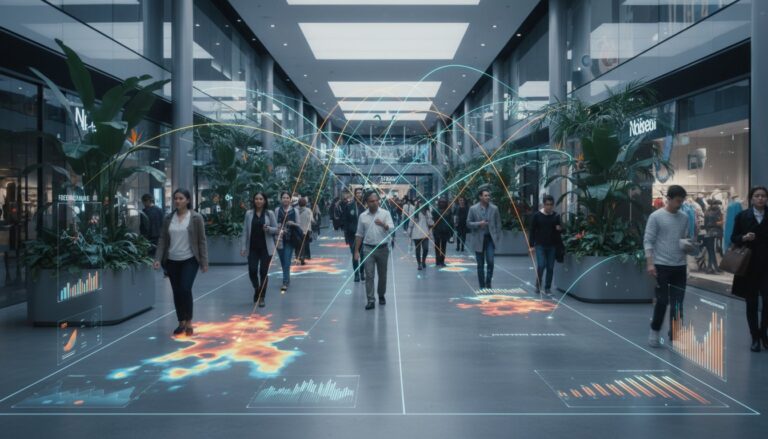
Effective Analytics for Physical Places requires a focus on utility rather than just volume. While footfall volume provides a necessary baseline, the conversion rate remains the most critical KPI for retail environments. It reveals the efficiency of your space by showing the percentage of visitors who actually complete a transaction. Dwell time is equally important; it measures engagement within specific zones or aisles, indicating which areas hold interest and which are merely transit points. Finally, flow patterns help identify “golden zones” and bottlenecks. By visualising these paths, you can implement evidence-based layout changes that improve traffic flow and maximise exposure to high-value products.
The Four Pillars of Physical Space Analytics
To master Analytics for Physical Places, you must move beyond simple visitor counting. A mature data strategy relies on four distinct pillars that categorise information based on its utility and complexity. These pillars transform raw numbers into a narrative of human behaviour, allowing you to manage your space with surgical precision. By understanding these categories, you can transition from reactive troubleshooting to proactive strategy.
Descriptive analytics serves as your entry point. It quantifies what is happening in your space right now. This includes real-time occupancy monitoring, which is essential for both customer service and safety compliance. Diagnostic analytics takes this a step further by asking why certain events occurred. By comparing performance across different weeks or national holidays, you can identify if a dip in traffic was a seasonal trend or a specific operational failure. This level of scrutiny allows you to validate the success of marketing campaigns with empirical evidence rather than subjective staff feedback.
The most advanced organisations look toward the future. Predictive analytics uses historical data to forecast visitor trends, helping you prepare for peak periods before they happen. This shift is a key component in the Future Of Physical Retail, where staying ahead of consumer shifts is vital for survival. Finally, prescriptive analytics provides specific recommendations for operational changes. It doesn’t just show you a problem; it suggests a solution based on simulated outcomes.
Understanding Descriptive and Diagnostic Data
Visualising occupancy levels in real-time ensures that your facility never exceeds safe limits while maintaining high service standards. You can use diagnostic data to isolate variables, such as weather or local events, to see their true impact on your footfall. This clarity is essential for any facility manager who needs to justify budget allocations or layout adjustments to stakeholders. When you compare your data across different timeframes, you’ll see patterns that intuition alone could never detect.
Moving Toward Predictive and Prescriptive Insights
Moving toward predictive insights allows for precise staffing schedules. By forecasting needs, you can reduce labour costs during quiet hours and ensure enough coverage during surges. Advanced systems allow you to simulate layout changes before moving a single shelf. This process becomes even more powerful when you integrate your footfall data analysis with your existing business systems. This combination reveals the true conversion rate of specific zones, showing you exactly where engagement turns into revenue. If you’re ready to refine your strategy, consider how our V9 analytics software can unify these pillars into a single dashboard.
Sensor-Based vs. App-Based Analytics: Choosing the Right Accuracy
Selecting the correct methodology for Analytics for Physical Places determines the ultimate utility of your data. While some providers suggest that app-based location tracking is a cost-effective alternative to hardware, these systems face significant hurdles in 2026. MAC address randomisation and strict mobile operating system permissions have made Wi-Fi and Bluetooth tracking increasingly unreliable. These methods often require a user to opt-in or have a specific app active, which creates massive “blind spots” in your data. You can’t build a strategy on a sample size that only represents a fraction of your actual visitors.
Sensor-based technology remains the “Gold Standard” for precision. As highlighted in Physical Analytics research, the granular study of human movement requires a high level of fidelity that signal-based tracking simply cannot replicate. By using dedicated hardware, you capture 100% of the movement within a space without relying on consumer device settings. This leads to a higher initial investment, but the long-term reliability ensures your operational decisions are based on fact rather than skewed percentages.
The Hardware Advantage: FootfallCam Pro2
The FootfallCam Pro2 sets the benchmark for accuracy by using stereoscopic 3D vision. This technology mimics human sight, providing the depth perception necessary to achieve 99.5% accuracy. Unlike basic 2D cameras, these sensors can distinguish between humans and non-human objects such as shopping trolleys, shadows, or even children. This level of detail is vital when you’re calculating conversion rates; you don’t want your data inflated by a delivery person or a moving display. Furthermore, the device uses edge processing to analyse movement locally. By processing data on the sensor itself, it ensures that only numerical metadata is transmitted to the cloud, providing a secure foundation for Analytics for Physical Places.
Privacy and Compliance in Physical Analytics
Maintaining trust is paramount as Australian regulations tighten. Following the Privacy and Other Legislation Amendment Act 2024, businesses must be more transparent about how they track movement. Anonymised AI counting is inherently superior to facial recognition because it identifies human shapes rather than individual identities. This approach allows you to meet your obligations under the Australian Privacy Principles (APPs) while still gaining deep insights into flow patterns. With the OAIC now empowered to issue fines of up to $330,000 for administrative breaches, choosing a privacy-first system isn’t just ethical; it’s a critical risk management strategy. Communicating this commitment to your visitors builds a narrative of respect and transparency, ensuring your data collection supports your brand reputation.
Transforming Raw Movement Data into Operational Strategy
Collecting information is only the first stage of a successful data strategy. The true value of Analytics for Physical Places emerges when you translate those raw numbers into specific operational tactics. This process requires a structured approach to ensure that every insight leads to a measurable improvement in your facility’s performance. You don’t just need more data; you need a framework to act on it.
Success begins by identifying a core business question. Instead of looking at a dashboard and hoping for inspiration, start with a specific problem, such as “Why is the conversion rate dropping on weekends?” Once you’ve defined the question, you can audit your space using heatmaps to see where people actually spend their time. This often reveals a disconnect between where you think people go and where they actually linger. By correlating this traffic data with external factors like local weather patterns or nearby events, you can isolate the variables that truly drive your footfall. Finally, implement iterative changes and measure the delta to confirm if your adjustments produced the desired outcome.
Optimising Store and Venue Layouts
Analytics for Physical Places allows you to treat your floor plan as a living laboratory. By identifying “dead zones,” you can repurpose underutilised areas for higher engagement or high-margin products. Testing the impact of end-cap displays or new promotional signage becomes a simple matter of comparing dwell times before and after the change. Flow analysis helps you understand the natural path to purchase, ensuring that your most popular items don’t causing bottlenecks that frustrate visitors. Small adjustments to shelving or entry points can lead to significant shifts in how a space is navigated, directly influencing total sales volume.
Staffing for Success: The Power of Power Hours
Aligning your staff rosters with peak visitor times is the most direct way to capture every potential sale. Most businesses have “Power Hours” where traffic surges, but staffing levels often remain static due to outdated scheduling habits. By linking advanced people counting technology to your labour management software, you can automate this alignment. This reduces overhead during quiet periods without sacrificing maintenance or service quality. It ensures your best sales staff are on the floor when they can make the most impact. If you’re ready to start optimising your operations, contact Footfall Australia today to discuss a tailored deployment for your space.
Implementing Analytics for Physical Places with Footfall Australia
Successful deployment of Analytics for Physical Places requires more than just high-performance hardware. It demands a strategic partner with the infrastructure to support national operations. Footfall Australia has maintained a dedicated presence across the country since 2004, providing the local expertise necessary for complex, multi-site rollouts. Choosing a partner with this level of longevity ensures that your data strategy remains consistent and reliable across every location in your network. We move beyond the role of a hardware vendor to act as a specialized consultant, guiding you from the initial site survey to the delivery of actionable dashboard insights.
Data integrity is the foundation of our service. We offer both Basic and Premium Support Plans to ensure your systems remain calibrated and your reporting stays accurate. Our integrated approach combines the 99.5% accuracy of FootfallCam Pro2 hardware with the sophisticated analytical power of the V9 software platform. This combination allows you to monitor your physical environment with the same precision you expect from your digital channels. By maintaining a steady focus on the utility of information, we ensure that every metric captured serves a specific operational purpose.
The FootfallCam V9 Software Ecosystem
The V9 software platform transforms complex movement narratives into intuitive, role-based reporting. CEOs can access high-level executive summaries to track national performance trends, while Store Managers utilize granular data to optimize daily rosters and floor activities. The system includes automated reporting features and real-time alerts for occupancy limits, which are essential for maintaining safety standards and service quality. For organizations with existing data stacks, V9 offers seamless integration with broader business intelligence tools, allowing you to view your spatial analytics alongside other critical performance metrics.
Future-Proofing with the Legacy Swap Out Plan
Many Australian facilities still rely on outdated infrared or thermal counting systems that lack the precision required for modern decision-making. These legacy technologies often fail to distinguish between staff and visitors or struggle with high-traffic surges. Our Legacy Swap Out Plan provides a structured path to modernize these systems with AI-driven 3D vision. This transition improves data reliability while offering significant cost benefits by leveraging existing infrastructure where possible. Upgrading to a modern system is an essential step for any business looking to stay prepared for shifting behavioral trends. Contact Footfall Australia for a comprehensive people counting systems Australia consultation to evaluate your current setup and discover the advantages of an evidence-based upgrade strategy.
Mastering Your Spatial Intelligence
Managing a physical environment requires more than just observation; it demands a commitment to empirical evidence. By adopting comprehensive Analytics for Physical Places, you move from reactive management to a proactive strategy that anticipates visitor needs. You’ve seen how the four pillars of analytics provide a framework for growth and why high-accuracy hardware is the only way to avoid the blind spots of app-based tracking. Success lies in the utility of your information and your ability to turn movement into operational change.
Footfall Australia has been serving Australian businesses since 2004, providing the expertise needed for successful national deployments. Our proprietary FootfallCam V9 Analytics Software offers the intuitive reporting you need to empower every stakeholder in your organisation. Supported by a national installation and support network, we ensure your data integrity remains high long after the initial setup. It’s time to stop guessing and start measuring. Request a Data Strategy Consultation from Footfall Australia to begin transforming your space into a high-performance environment. You’ll gain the clarity needed to make confident, evidence-based decisions for your future.
Frequently Asked Questions
What is the difference between spatial analytics and physical place analytics?
Spatial analytics is a broad discipline that encompasses geographic data, GPS tracking, and large-scale mapping. In contrast, physical place analytics is a specialized subset that focuses exclusively on how humans interact with built environments. It measures micro-movements within specific boundaries, such as retail stores or transport hubs, to provide the granular data needed for interior layout optimization and operational efficiency.
How accurate are modern people counting systems in 2026?
Modern 3D stereoscopic sensors, such as the FootfallCam Pro2, deliver 99.5% accuracy under optimal conditions. This high level of precision is achieved through AI-driven edge processing that distinguishes human shapes from non-human objects like shopping trolleys or shadows. This ensures your Analytics for Physical Places provide a reliable foundation for calculating conversion rates and making staffing decisions without the “noise” of inaccurate data.
Do analytics for physical places record personal information or faces?
No, professional systems focus on anonymised movement patterns rather than individual identities. AI-powered sensors identify human vectors and shapes to count entries and exits without capturing facial features or sensitive personal data. This privacy-first approach ensures that your data collection remains fully compliant with the Australian Privacy Principles (APPs) while still providing the deep spatial insights required for business growth.
Can I use existing CCTV cameras for physical place analytics?
You can leverage existing IP cameras by integrating them with the FootfallCam Centroid. This device connects to your current CCTV network and applies advanced AI processing to standard video feeds, transforming them into analytical data. While dedicated 3D sensors offer the highest accuracy for entry points, this integrated approach allows businesses to extract additional value from their previous hardware investments across larger areas.
What is the ROI of implementing a footfall analytics system?
ROI is typically achieved through reduced labor costs and improved customer conversion rates. By aligning staff rosters with actual visitor demand, businesses can minimize wasted wages during quiet periods and maximize sales opportunities during peak “Power Hours.” Many organizations also see a measurable return by using data to validate marketing spend and implementing evidence-based layout changes that increase average transaction values.
How does weather or external events affect footfall data analysis?
Weather and local events serve as critical diagnostic variables that explain fluctuations in visitor volume. Advanced software like FootfallCam V9 allows you to overlay external data, such as rainfall or local festival calendars, directly onto your traffic reports. This correlation helps you determine if a performance dip was caused by environmental factors or internal operational issues, leading to more accurate future forecasting.
Is it possible to track dwell time in specific areas of a building?
Yes, you can define virtual zones within your analytics software to measure exactly how long visitors spend in specific aisles or promotional areas. This data reveals the “stickiness” of your displays and identifies “dead zones” that may require a layout adjustment. Tracking dwell time allows you to move beyond simple entrance counts and understand the depth of engagement within your Analytics for Physical Places.