Measuring Marketing Effectiveness with Footfall Data: The 2026 Strategy
While retail foot traffic grew by 2.0% in mid-2026, the persistent challenge for most managers remains identifying which specific marketing dollars actually triggered those visits. You’ve likely felt the frustration of high digital engagement that fails to show a clear correlation with physical store entry. Relying on intuition in a data-rich environment often leads to wasted budgets and missed opportunities. It’s a common pain point that undermines the confidence of even the most experienced strategic planners.
Measuring marketing effectiveness with footfall data provides the empirical evidence required to stop guessing and start growing. We’ll show you how to bridge the gap between online impressions and in-store actions using the FootfallCam Pro2 and V9 Software. This guide outlines a clear framework for attributing visits to specific campaigns, helping you optimise future marketing windows and improve your Return on Ad Spend (ROAS) through precise, actionable analytics.
Key Takeaways
- Identify why relying solely on Point-of-Sale data fails to capture the full impact of your marketing efforts on unconverted store visitors.
- Discover how establishing a four-week traffic baseline allows for the precise measurement of campaign-driven surges and street-to-store capture rates.
- Learn a structured framework for measuring marketing effectiveness with footfall data to bridge the gap between digital impressions and physical visits.
- Gain actionable insights on reallocating your marketing budget from low-performing channels toward high-conversion windows using empirical evidence.
Beyond the Click: Bridging the Retail Attribution Gap
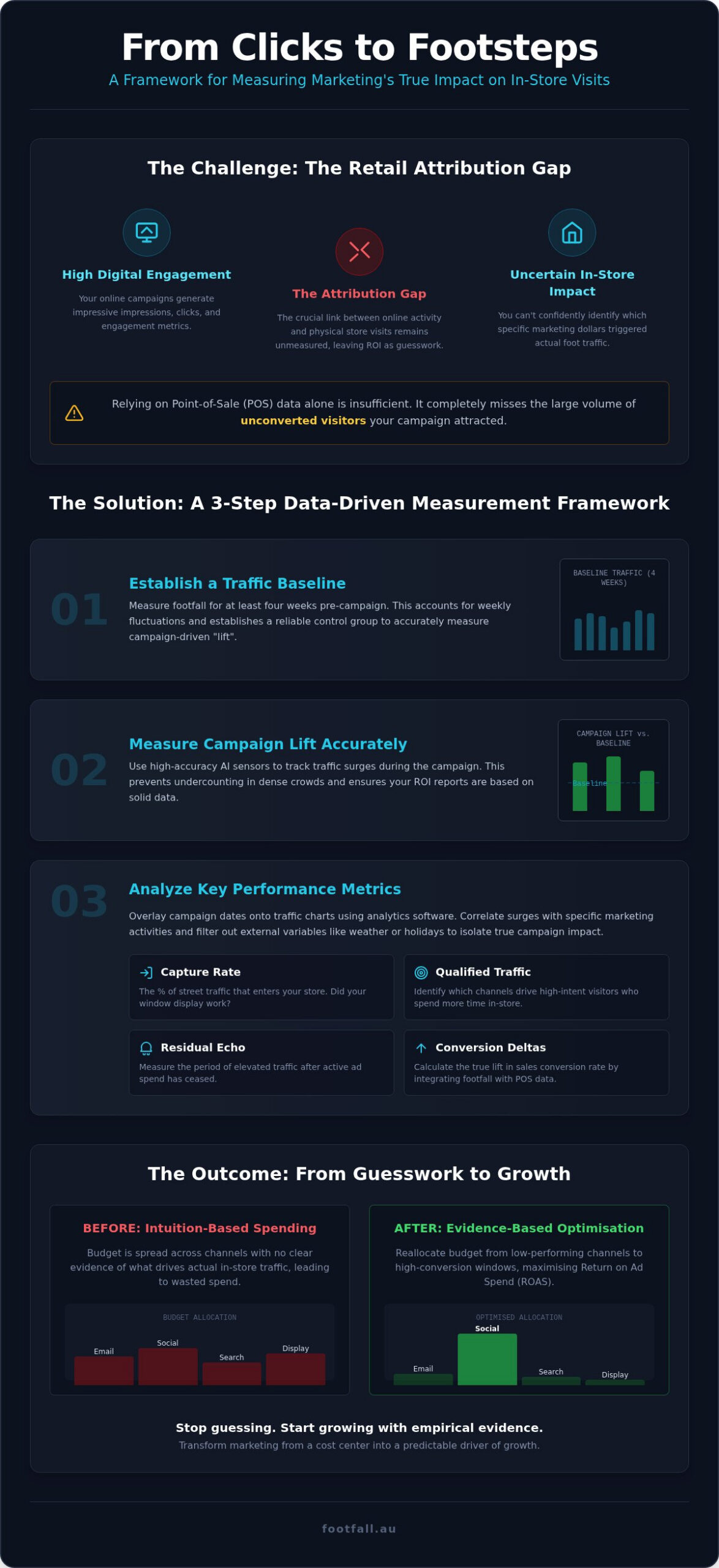
Digital marketing often terminates at the click, yet for physical retailers, the customer journey is only halfway complete. This disconnect is known as the Retail Attribution Gap. While digital dashboards provide impressions and click-through rates, they fail to track the subsequent human movement into your physical space. Retail Attribution is the process of identifying which marketing touchpoints lead to a physical store visit. Without this critical link, your evaluation of marketing effectiveness remains fragmented and speculative.
Relying on Point-of-Sale (POS) data alone is insufficient for modern strategy. Transaction records only account for the final purchase, completely missing the unconverted visitor who entered your store because of an ad but left without buying. By measuring marketing effectiveness with footfall data, you capture the total traffic your campaign generated. This allows you to observe Physical Retargeting opportunities, where you compare baseline traffic against campaign lift to see exactly how digital spend translates into physical presence.
The Capture Rate: The Missing Link in Campaign ROI
The Capture Rate is the percentage of people passing your store who actually step inside. It’s a vital metric for determining if window displays or local signage are performing. Using street-level sensors like the FootfallCam Pro2, you can differentiate between organic street traffic and campaign-driven surges. If street traffic remains constant but your Capture Rate increases during a specific promotion, your marketing creative is successfully pulling people in. The FootfallCam V9 Software visualises these trends, ensuring you distinguish between general foot traffic and the specific results of your latest ad spend.
Implementing a Data-Driven Measurement Framework
Establishing a reliable baseline is the first step in any robust framework for measuring marketing effectiveness. Measuring marketing effectiveness with footfall data requires at least four weeks of pre-campaign traffic data to account for weekly fluctuations. This baseline provides the essential control group against which you measure the “lift” generated by your specific marketing spend.
Precision is non-negotiable when measuring marketing effectiveness with footfall data. To ensure data integrity during peak surges, utilise high-accuracy AI sensors like the FootfallCam Pro2. These devices maintain high precision even in dense crowds, preventing the undercounting that often compromises ROI reports. By integrating sales figures with comprehensive footfall data analysis, you can calculate true conversion deltas and determine if your campaign attracted high-intent shoppers or merely increased general browsing.
Correlating Campaign Windows with Traffic Surges
Within the FootfallCam V9 Software, you can tag specific start and end dates to overlay marketing spend directly onto traffic charts. This visual correlation makes it easy to identify the “Residual Echo,” which is the period where traffic remains elevated after active spend has ceased. To isolate the true impact of your marketing, use the software’s filtering tools to exclude external variables like extreme weather or public holidays. This rigorous approach ensures your ROI calculations reflect human behaviour influenced by your brand, not environmental factors.
For businesses looking to implement these systems, professional installation services across Australia ensure your sensors are perfectly calibrated for your specific retail layout.
Optimising Future Spend with Empirical Evidence
Transitioning from volume metrics to quality indicators marks the evolution of a mature marketing strategy. While total traffic counts provide a surface-level view, shifting your focus to “Qualified Traffic” allows you to evaluate if your campaigns are reaching the intended audience. By measuring marketing effectiveness with footfall data, you can identify which specific channels drive high-intent visitors who spend more time in-store. This level of granularity enables you to reallocate budget from low-performing digital placements toward the high-conversion windows that yield tangible results.
Adopting sophisticated people counting systems in Australia provides a distinct competitive edge for national brands. It transforms marketing from a cost centre into a predictable driver of growth. When presenting to board-level stakeholders, having empirical evidence replaces intuition with quiet confidence. You no longer need to speculate on the success of a campaign; you can demonstrate it with verified traffic deltas and street-to-store capture rates.
Calculating the True Return on Ad Spend (ROAS)
Offline ROAS is calculated by dividing your Campaign Sales Lift by the Campaign Cost. However, measuring marketing effectiveness with footfall data reveals value that sales figures alone miss. An increased Capture Rate indicates that your marketing creative successfully engaged the public, even if immediate conversion remained flat due to in-store factors. Building a long-term people counting technology roadmap ensures your organisation remains agile, continuously refining marketing spend based on the narrative of human movement within your physical environments.
Turning Movement into Marketing Intelligence
Transitioning from speculative marketing to empirical strategy requires a fundamental shift in how you define success. By bridging the retail attribution gap, you stop guessing which ads drive door swings and start seeing the narrative of human movement. Measuring marketing effectiveness with footfall data allows your organisation to validate digital spend through precise street-to-store capture rates and long-term traffic baselines. This logical approach ensures every dollar spent is backed by high-accuracy evidence rather than intuition.
Footfall Australia has been trusted by national Australian brands since 2004 to deliver these insights. With the AI-driven accuracy of the FootfallCam Pro2 and the comprehensive FootfallCam V9 analytics suite, you can transform your reporting with quiet confidence. Request a consultation with Footfall Australia to optimise your marketing measurement today. Embracing these tools positions your business as a forward-thinking leader in an increasingly data-reliant retail landscape.
Frequently Asked Questions
How do I attribute a specific sale to an offline marketing campaign?
You attribute sales by correlating POS transaction times with campaign-driven traffic spikes within the FootfallCam V9 Software. By comparing your established baseline against the campaign window, you can identify the lift in both visitors and revenue. This method is critical for measuring marketing effectiveness with footfall data, as it distinguishes between organic sales and those specifically triggered by your recent marketing investments.
What is a good capture rate for a retail store in Australia?
A standard capture rate for Australian retail stores generally falls between 5% and 15%, though this fluctuates based on store type and street density. High-end boutiques may target the upper end of this range, while larger format retailers typically see lower percentages. Monitoring this metric with the FootfallCam Pro2 helps you objectively assess the performance of window displays and local storefront marketing.
Can people counting data be integrated with my existing digital marketing tools?
Integration is a core feature of the FootfallCam V9 Software, which provides API access for connecting with digital marketing dashboards and business intelligence tools. This allows you to view physical store visits alongside your digital impressions and click-through rates. Such a unified data set is vital for measuring marketing effectiveness with footfall data, enabling a holistic view of the entire customer acquisition funnel.
How long should I track footfall to see the true impact of a marketing campaign?
Establish a traffic baseline by tracking footfall for at least four weeks before launching your campaign. This period accounts for natural weekly cycles and provides a clean control group. Continue monitoring for two weeks after the campaign ends to capture the Residual Echo of delayed visits, ensuring your final ROI report reflects the full influence of your marketing spend on human behaviour.