
Data-Driven Staff Scheduling in Retail: A Comprehensive Guide for 2026
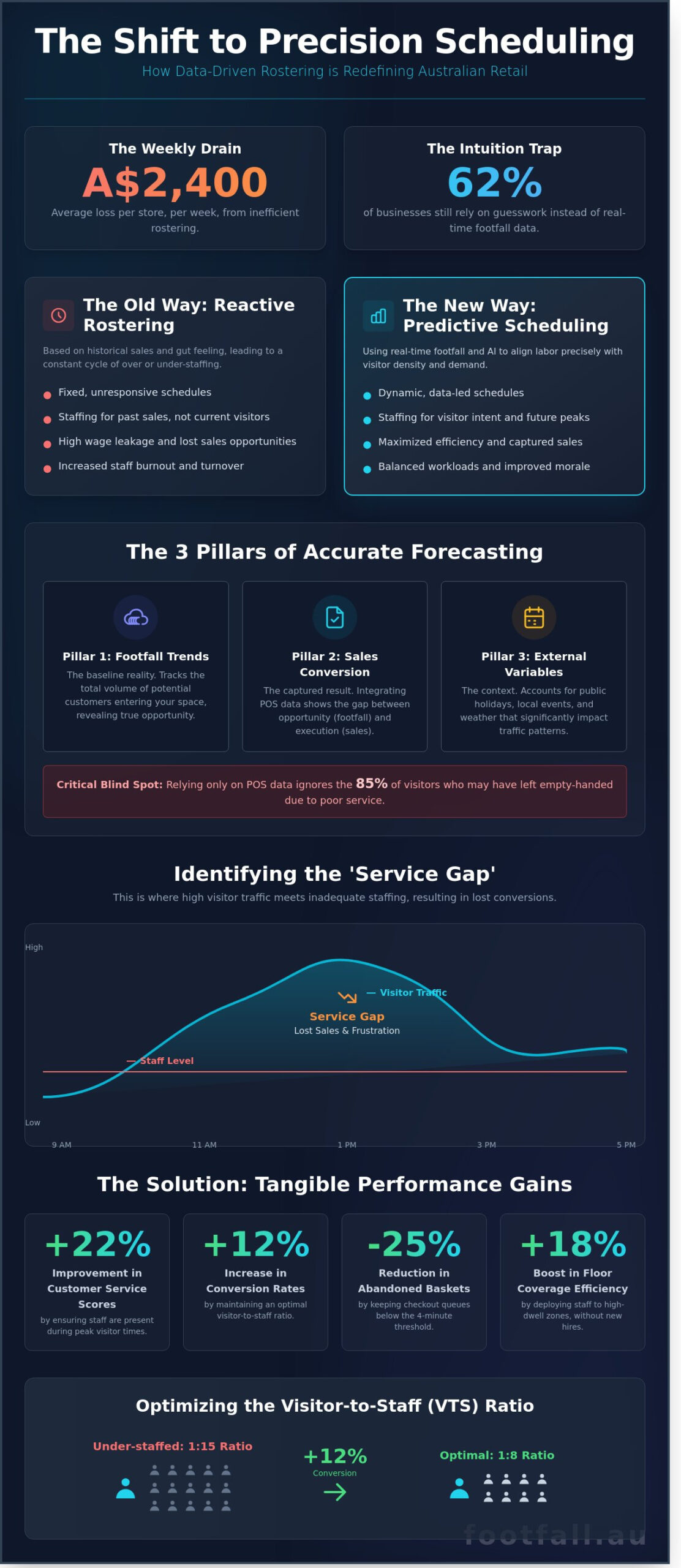
In a 2024 analysis of Australian brick-and-mortar stores, retailers lost an average of A$2,400 per week simply because staff were rostered for the wrong hours. What if you could reclaim that lost margin by treating your roster as a precision tool rather than a weekly chore? Most managers understand that data-driven staff scheduling retail is the key to efficiency, yet 62 percent of Australian businesses still rely on historical intuition rather than real-time footfall intelligence.
You’ve likely felt the frustration of paying for three staff members to stand in an empty store at 10:00 AM, only to watch a single employee struggle during a surprise 2:00 PM surge. Eliminate that friction and capture every sales opportunity by syncing your team’s presence with actual visitor intent. This guide provides a clear roadmap to implementing predictive analytics, ensuring your evidence-based changes can improve customer service scores by 22 percent before the 2026 peak season arrives.
Key Takeaways
- Transition from intuition-based rostering to an evidence-based strategy that aligns your labor hours with predicted visitor density for maximum efficiency.
- Master data-driven staff scheduling retail by integrating historical footfall trends with POS data to eliminate labor waste and capture every sales opportunity.
- Identify and resolve the “Friction Zone” where high visitor traffic results in lower conversion rates due to inadequate staffing levels.
- Establish a precise Visitor-to-Staff (VTS) target ratio to ensure your Australian retail operations remain responsive to real-time consumer demand.
- Leverage advanced spatial analytics and AI-powered reporting to transform raw foot traffic data into a strategic roadmap for long-term growth.
Beyond the Roster: Why Data-Driven Staff Scheduling is Critical in 2026
Precision defines the modern Australian retail environment. Data-driven staff scheduling retail transforms labor from a static overhead into a dynamic asset by aligning rostered hours with predicted visitor density. Management teams are moving away from gut-feeling decisions. They now use evidence-based operational strategies to dictate every shift. Traditional fixed rosters fail to meet the needs of 2026 consumers, whose shopping habits fluctuate based on hybrid work patterns and digital integration. Data shows that maintaining a 1:8 staff-to-customer ratio can increase conversion rates by 12% compared to a 1:15 ratio. Aligning people with presence is no longer optional; it’s a requirement for survival.
The True Cost of Inefficient Scheduling
Wage leakage drains retail profits silently. For a national chain operating 50 outlets, over-staffing by just two hours per day results in A$730,000 of lost capital annually across the network. The cost of under-staffing is equally high due to abandoned baskets. When checkout queues exceed four minutes, 25% of Australian shoppers leave the store without purchasing. Beyond the immediate financial loss, poor scheduling damages employee morale. High-stress peaks followed by long periods of inactivity contributed to a 32% increase in retail staff turnover in 2025, proving that inefficient rosters alienate talent.
From Reactive to Predictive Management
Stop fixing last week’s mistakes and start predicting next Saturday’s peak. Modern systems move beyond retrospective analysis to anticipate future needs. AI now identifies non-obvious traffic patterns, such as the 18% surge in foot traffic seen in Melbourne CBD stores when local temperatures drop below 15 degrees. Predictive scheduling is the use of historical footfall trends to forecast future labor requirements. This transition allows store managers to act with quiet confidence. They use actionable insights to ensure the right team members are on the floor exactly when the data confirms they are needed, creating a seamless journey for every visitor.
- Eliminate guesswork: Use spatial analytics to determine exact staffing needs.
- Boost conversions: Ensure high-value zones are always attended during peak dwell times.
- Reduce churn: Create balanced workloads that respect employee time and energy.
The Three Pillars of Accurate Retail Labor Forecasting
Effective labor management rests on a tripod of intelligence. Without all three legs, your scheduling strategy collapses into guesswork. To build a robust model for 2026, retailers must synthesize three specific data streams.
- Pillar 1: Historical Footfall Trends. This establishes your baseline. It tracks the physical volume of potential customers entering your space, regardless of whether they buy.
- Pillar 2: Sales Conversion Data. By integrating Point of Sale (POS) results, you see what you actually captured. This reveals the gap between opportunity and execution.
- Pillar 3: External Variables. You must account for Australian public holidays, local events like the AFL Grand Final, and seasonal weather shifts. A 35-degree day in Sydney impacts mall traffic differently than a rainy afternoon in Melbourne.
Relying solely on POS data creates a dangerous blind spot. It ignores the 85% of visitors who might have walked out empty-handed because no one was available to assist them. Without footfall context, you’re only scheduling for the customers you kept, not the ones you lost.
Footfall vs. POS: The Leading vs. Lagging Indicator
Sales figures are a lagging indicator. They only tell you about the success you’ve already had. Footfall is a leading indicator; it shows you the potential currently inside your four walls. High sales volume often masks “exhausted staff syndrome.” This occurs when a team of three handles a crowd meant for six. While the daily take might look healthy, the 12% drop in average transaction value suggests your team was too busy to upsell. FootfallCam sensors provide the ground truth by counting every person, not just every receipt. This allows for data-driven staff scheduling retail that matches human presence to human potential rather than just reacting to past transactions.
Dwell Time and Zone Analytics
Spatial data reveals exactly where staff are needed most. If dwell time in fitting rooms exceeds 8 minutes without staff interaction, conversion rates typically plummet by 22%. Use zone analytics to move employees dynamically. Instead of tethering everyone to the point of sale, deploy them to high-traffic zones during “Power Hours.” These are the specific windows where visitor density is at its peak. By identifying these zones, a Brisbane-based fashion retailer recently increased their floor coverage efficiency by 18% without hiring additional headcount. It’s about moving the staff you have to the places where they’ll generate the highest A$ return per minute.
Identifying the ‘Service Gap’: Analyzing Traffic vs. Conversion
Visualising the divergence between your visitor curve and your labour curve reveals the hidden costs of your current roster. Most Australian retailers experience a “Friction Zone” during Saturday afternoon peaks between 1:00 PM and 3:00 PM. This occurs when high traffic meets stagnant staffing levels. Conversion rates typically drop by 12% in these windows because customers cannot locate assistance. Effective data-driven staff scheduling retail relies on closing this gap to ensure every visitor has a path to purchase.
The Service Gap Framework
Retailers must categorise their floor performance into three distinct zones to maintain profitability. The Understaffed Peak features high traffic and high dwell times, yet conversion dips. This is the “lost revenue” scenario where customers abandon baskets due to long queues or lack of service. The Overstaffed Trough creates a profit bleed, with high labour costs and minimal footfall. The Optimal Zone represents the seamless alignment of staff expertise with visitor intent. Achieving this balance requires precise spatial analytics to predict when intent is highest.
Benchmarking Performance Nationally
Comparing a Sydney CBD flagship against a regional store in Bendigo requires standardised footfall metrics. Champion stores often convert 22% of traffic with lean teams by focusing exclusively on high-intent windows. National benchmarks from 2025 show that top-tier performers use data to set realistic KPIs for store managers based on actual opportunity rather than historical sales alone. This shift empowers managers to defend their labour spend with evidence, ensuring regional variations don’t skew performance reviews.
The financial impact of closing the service gap is measurable and immediate. Adding a single staff member at an A$34 hourly rate during a specifically identified peak can generate a significant return on investment. Internal case studies from late 2024 demonstrate that a 5% increase in staff during peak traffic periods leads to a 15% growth in total revenue. Precision in data-driven staff scheduling retail ensures that your most expensive resource, your people, are positioned exactly where the profit is. This strategy moves the business away from guesswork and toward a model of evidence-based success.
Eliminating the friction zone isn’t about spending more on labour; it’s about spending more intelligently. When you align your team with the actual movement of human beings through your space, you reduce the stress on your employees and the frustration of your customers. It’s a calculated approach that treats every visitor as a narrative of movement that can be decoded and served.
Step-by-Step: Implementing a Data-Led Scheduling Strategy
Transitioning to a data-driven staff scheduling retail model requires a systematic overhaul of how labor hours are allocated. Start by auditing your existing data infrastructure. You must ensure your Point of Sale (POS) systems, people counters, and workforce management software communicate seamlessly. In 2024, retailers who integrated these three streams reduced overstaffing costs by 14% on average. Once your data is unified, establish your baseline metrics.
Generate a 6-week traffic forecast using AI-driven analysis of your historical footfall. This window allows managers to meet Australian Fair Work requirements regarding roster notice periods while remaining agile. Precision is the goal. Use this forecast to identify the specific hours where a 5% increase in staff could lead to a 10% lift in conversion. Finally, implement a weekly feedback loop. Review conversion reports every Monday to adjust the following fortnight’s roster based on real-world performance.
Defining Your Ideal VTS Ratio
Calculating your Visitor-to-Staff (VTS) ratio is the most critical step in balancing payroll with customer experience. To find this number, divide your peak hourly traffic by the number of floor staff present. The VTS ratio represents the maximum number of customers a staff member can manage before service quality declines. High-end boutiques in Sydney or Melbourne often target a 4:1 ratio to maintain premium service levels. Conversely, high-volume discount retailers may push this to 20:1 during peak periods. Identifying your “breaking point” ensures you don’t pay for idle hands or lose sales to long queues.
Building the ‘Flexi-Roster’
Static rosters are a relic of the past. Modern data-driven staff scheduling retail strategies rely on “sprint shifts.” These are typically 4-hour blocks designed to cover intense lunch peaks or the 3:00 PM school-run surge. This approach maximizes coverage without committing to expensive 8-hour shifts during low-traffic mornings.
- Deploy 4-hour sprint shifts for known peak windows to keep labor costs under 18% of revenue.
- Utilize automated mobile alerts to move staff from stockroom tasks to the floor when footfall exceeds your VTS threshold.
- Maintain compliance with the General Retail Industry Award by ensuring all shifts meet the 3-hour minimum engagement rule.
This hybrid model combines a core team of full-time experts with a flexible pool of casuals who thrive on shorter, high-energy shifts. It creates a resilient floor presence that scales instantly with demand.
Ready to eliminate the guesswork from your roster? Discover how Footfall’s spatial analytics can pinpoint your exact staffing needs.
Future-Proofing Retail Operations with FootfallCam Intelligence
Transitioning to a data-driven staff scheduling retail model requires more than just intent; it demands a foundation of verifiable truth. Retailers in 2026 cannot afford to base labor budgets on anecdotal evidence or outdated spreadsheets. FootfallCam provides the end-to-end infrastructure needed to turn physical movement into strategic assets, ensuring your workforce is always aligned with actual customer demand.
FootfallCam Pro2: Precision Meets Reliability
The FootfallCam Pro2 serves as the hardware foundation for any sophisticated labor model. It delivers 99.5% counting accuracy, a critical threshold because staff won’t trust rosters generated from perceived “glitchy” data. High precision ensures that when a manager sees a spike in the dashboard, it represents real people, not shadows or carts. Using 3D Stereoscopic vision, the Pro2 maintains this accuracy even in high-density environments during peak Australian holiday periods. It functions as a privacy-first AI device, processing all counting locally to ensure individual identities remain protected. This approach satisfies modern compliance standards while providing the granular detail required for data-driven staff scheduling retail. Footfall Australia supports these deployments through a national partner network, providing local expertise and technical maintenance from Sydney to Perth.
V9 Analytics: The Manager’s Command Centre
Raw foot traffic numbers only gain value when they dictate operational change. The V9 software platform acts as a command centre, automatically highlighting staffing gaps where visitor peaks aren’t met by scheduled labor hours. Managers gain access to customisable dashboards that visualise the visitor journey and conversion trends in real-time. This intelligence allows for the seamless export of high-resolution data into leading Australian workforce management (WFM) tools such as Tanda or Deputy. By syncing footfall insights with these platforms, retailers can automate their rostering based on predictive modeling rather than reactive guessing.
and eliminate the inefficiencies of manual planning.
Building a data-first culture creates a sustained competitive advantage. Labor costs typically represent 15% to 25% of a retailer’s gross turnover in the Australian market. Optimising this spend through FootfallCam intelligence ensures every A$ invested in payroll directly supports customer service and conversion. This strategic shift transforms the store from a static environment into a responsive space that breathes with the rhythm of its visitors. By 2026, the gap between retailers using evidence-based scheduling and those relying on intuition will define who thrives in the competitive physical landscape.
Turn Operational Insights into Retail Growth
Success in 2026 requires moving beyond traditional rosters. By identifying the service gap between foot traffic and conversion rates, you transform labour from a fixed cost into a strategic asset. Implementing a data-driven staff scheduling retail strategy ensures your floor is never understaffed during peak A$ sales opportunities. This precision eliminates guesswork; it allows managers to focus on enhancing the visitor journey through every touchpoint. Precision in staffing directly correlates with improved customer satisfaction and higher average transaction values across your fleet.
Footfall Australia has supported local retailers since 2004, providing the technical eyes needed to see these patterns clearly. Our Pro2 AI hardware delivers 99.5% counting accuracy, ensuring your scheduling decisions rest on a foundation of hard evidence rather than intuition. With national support and maintenance plans across the country, we provide the stability your business needs to scale effectively. Optimise your retail workforce with Footfall Australia’s data solutions and lead the market with confidence. Your store’s peak performance is within reach when you let the numbers lead the way.
Frequently Asked Questions
What is data-driven staff scheduling in a retail context?
Data-driven staff scheduling retail involves using empirical footfall metrics and conversion data to align your labor hours with actual customer demand. Managers don’t rely on gut feelings; they use high-precision sensors to identify peak occupancy times. This methodology ensures you have enough team members during a 2:00 PM Saturday rush while reducing overstaffing during quiet Tuesday mornings. It’s a strategy that transforms labor from a fixed cost into a variable that directly improves the customer experience.
How much can a retail store save by using footfall data for scheduling?
Retailers typically reduce total labor costs by 12% within the first six months of implementation. By eliminating unnecessary shifts during low-traffic periods, a medium-sized Australian store spending A$500,000 annually on wages can save approximately A$60,000. These savings occur without sacrificing service quality. The data ensures staff are redistributed to high-traffic windows where they can maximize conversion rates and increase average transaction values. It’s about working smarter, not just leaner.
Can people counters distinguish between staff and customers?
Advanced AI sensors use staff exclusion technology to distinguish between employees and visitors with 98% accuracy. These systems often utilize wearable tags or sophisticated skeletal tracking to identify staff members by their movement patterns. This precision prevents your data from being skewed by staff movements near the entrance. Accurate filtering’s essential for calculating true conversion rates and ensuring your scheduling decisions reflect genuine customer demand rather than internal operational movements.
Is it difficult to integrate footfall data with my existing scheduling software?
Integrating footfall data with existing workforce management platforms is a seamless process via modern API connections. Most enterprise-grade sensors provide automated data feeds that sync directly with software like Tanda or Deputy in real-time. This connectivity lets managers see traffic forecasts alongside their roster builders. By automating this data flow, you’ll eliminate manual entry errors and ensure your scheduling decisions are always based on the most recent spatial analytics.
What is the best staff-to-customer ratio for an Australian retail store?
The optimal staff-to-customer ratio for Australian specialty retail typically sits at 1:10, though high-end boutiques often aim for 1:3 to maintain service standards. In 2024, research showed that exceeding a 1:15 ratio leads to a 20% drop in conversion rates due to long wait times. You should use your specific dwell time data to determine your unique “sweet spot.” Tracking this ratio ensures your team’s ready for peak periods without inflating your overheads.
How far in advance can I accurately forecast retail foot traffic?
You can accurately forecast retail foot traffic up to four weeks in advance with a 90% confidence interval using historical trends. Sophisticated algorithms analyze three years of past visitor data, local Australian public holidays, and weather patterns to predict future peaks. While short-term forecasts for the next 48 hours are the most precise, the one-month outlook provides a reliable foundation for creating compliant rosters. This foresight lets you manage labor budgets with scientific precision.
Does data-driven scheduling work for small boutique shops as well as large chains?
Data-driven staff scheduling retail is highly effective for small boutiques because their profit margins are often more sensitive to labor fluctuations. A single unnecessary shift in a small shop can represent a 5% increase in daily operating costs. For these businesses, precision’s vital. By identifying exactly when the “power hours” occur, boutique owners can ensure their best salespeople are on the floor when high-value customers are most likely to visit.
Is people counting technology compliant with Australian privacy laws?
Modern people counting technology is fully compliant with the Australian Privacy Act 1988 because it processes data anonymously. The sensors track movement patterns and shapes rather than capturing identifiable facial features or personal information. This “privacy by design” approach ensures your business gains deep spatial insights without ever compromising the anonymity of your visitors. You’ll get the actionable intelligence you need while remaining completely within the legal frameworks of the Australian retail landscape.