
Building a Winning Business Case for a People Counting System in 2026
What if your most significant operational expense is being allocated based on a 15 percent margin of error? In the Australian retail and facility management sectors, businesses relying on manual observations often miss up to A$3,200 in weekly revenue simply because staff rosters don’t align with actual visitor peaks. Developing a robust business case for a people counting system is no longer about buying sensors; it’s about reclaiming that lost margin through precision. You likely feel the frustration of seeing empty aisles during fully staffed shifts or, conversely, watching potential customers walk out during an afternoon rush because of long queues.
It’s clear that intuition isn’t enough to satisfy a board focused on the bottom line. This guide will show you how to quantify the ROI of footfall analytics and secure stakeholder approval for a modern implementation. We’ll provide a clear roadmap to translate raw movement into evidence-based arguments, ensuring your strategy integrates seamlessly into existing KPIs for 2026 and beyond.
Key Takeaways
- Eliminate the hidden costs of “gut feeling” management by replacing operational blind spots with evidence-based spatial analytics.
- Optimise A$ labour expenditure and lift conversion rates by aligning your staff rosters with verified visitor traffic peaks.
- Develop a robust business case for people counting system adoption by calculating the Total Cost of Ownership and the projected payback period for high-precision hardware.
- Address stakeholder concerns regarding data security by ensuring your implementation meets both GDPR and Australian privacy standards without compromising on 98%+ accuracy.
- Execute a strategic implementation through a tailored site audit and KPI definition to transform raw footfall data into actionable business intelligence.
Identifying the Operational Blind Spots in Modern Business
A people counting system serves as the foundational architecture for spatial analytics, moving beyond simple entry tallies to decode the narrative of human movement. Developing a robust business case for people counting system implementation is no longer a luxury for Australian retailers; it’s a strategic necessity for 2026. Relying on “gut feeling” or anecdotal observations creates invisible leaks in your profit margins. These “operational blind spots” represent the disconnect between what managers assume is happening on the floor and the objective reality of visitor behavior.
Transitioning from raw visitor counts to actionable spatial intelligence requires a shift in mindset. You aren’t just counting heads. You’re measuring the efficiency of your physical environment. In the Australian market, where labor costs and commercial rents remain high, the ability to align resources with actual demand determines survival. Real-time data provides the quiet confidence needed to make bold operational changes, backed by hard evidence rather than intuition.
The Cost of Inaccurate Data
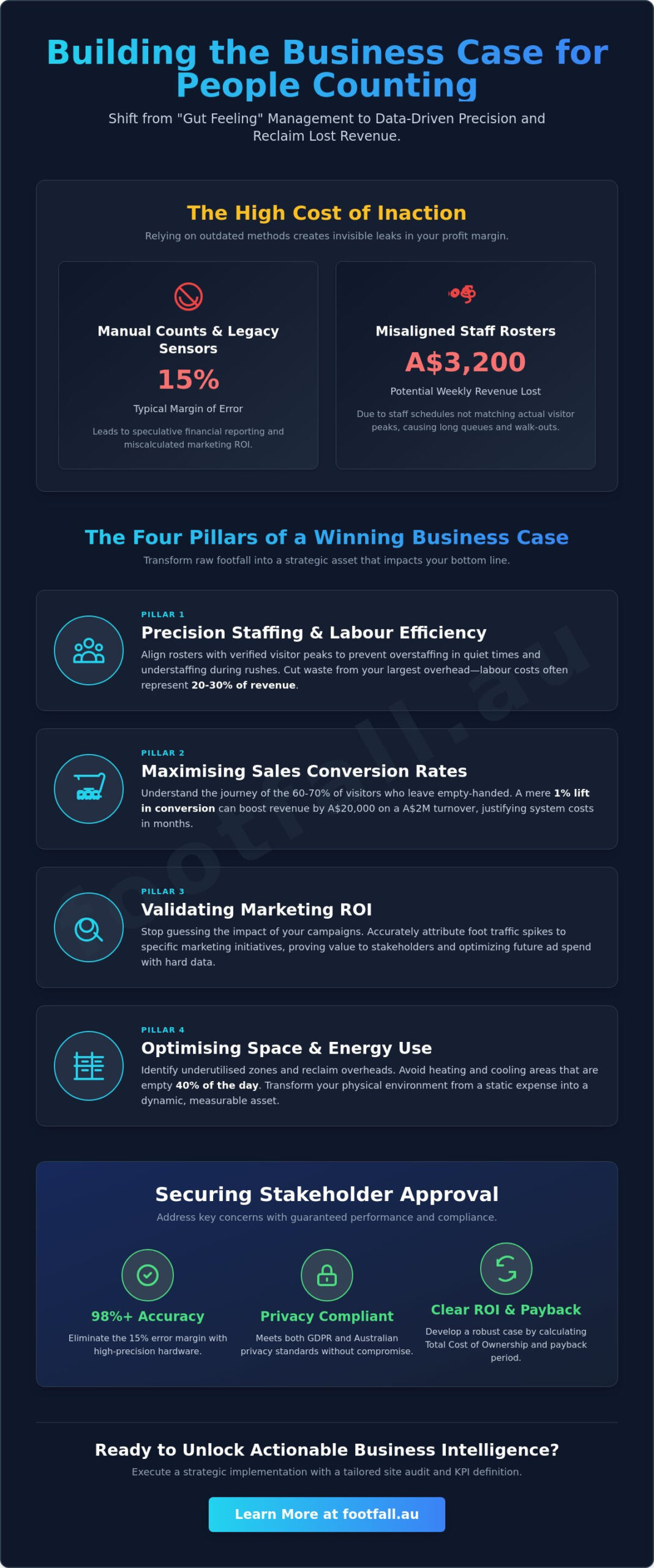
Inaccurate data ripples through every department. When a business relies on manual clickers or legacy infrared sensors with a 15% error margin, financial reporting becomes speculative. Marketing teams struggle to calculate true ROI because they can’t accurately attribute foot traffic spikes to specific campaigns. In a retail context, operational blind spots are the critical gaps in visibility where high-intent customers are lost due to unmonitored queue lengths or poor layout flow. Precision matters because a 5% discrepancy in visitor data can lead to thousands of dollars in misallocated payroll every quarter.
Opportunity Cost: What Doing Nothing Costs You
Doing nothing has a measurable price tag. If your staff-to-visitor ratio is misaligned during a Saturday peak in Sydney or Melbourne, you’re likely losing 12% of potential sales to walk-outs. Underutilised office spaces in CBD areas cost Australian firms significant overheads that could be reclaimed through better occupancy management. By 2026, data-driven competitors will use real-time spatial intelligence to optimise every square metre. Consider these costs of inaction:
- Lost Conversion: Customers leaving because assistance wasn’t available during unpredicted peaks.
- Wasted Energy: Heating and cooling zones that remain empty 40% of the working day.
- Stagnant Growth: An inability to benchmark performance across multiple sites using a unified business case for people counting system deployment.
Success in the coming years depends on your ability to see what others miss. Building this business case is the first step toward total spatial awareness. It transforms the physical environment from a static expense into a dynamic, measurable asset.
The Four Pillars of a People Counting Business Case
A robust business case for people counting system implementation moves beyond simple entry tallies. It transforms raw footfall into a strategic asset that addresses specific operational pain points. To secure stakeholder buy-in, you must demonstrate how data-driven intelligence impacts the bottom line through four distinct pillars of value.
Pillar 1: Precision Staffing and Labour Efficiency
Labour costs represent one of the largest overheads for Australian businesses, often accounting for 20% to 30% of total revenue. People counting data allows you to align staff rosters with actual visitor peaks rather than relying on gut feel. By identifying precise high-traffic windows, managers can ensure adequate service levels to prevent walkaways during busy periods. Conversely, the system identifies quiet zones where you can reduce hours without affecting the customer experience. For a deeper look at how this works in local markets, see our guide on Retail Footfall Analysis in Australia.
Pillar 2: Maximising Sales Conversion Rates
The true health of a retail business is found in its conversion rate: the number of transactions divided by total footfall. Without a business case for people counting system, you only see the people who bought something, ignoring the 60% or 70% of visitors who left empty-handed. Data shows that even a 1% lift in conversion can justify the system cost within the first six months. For instance, a store with A$2,000,000 in annual turnover that achieves a 1% conversion increase gains A$20,000 in pure revenue. Using dwell time data, you can also identify if customers are spending time in the right aisles or if poor store layout is hindering sales.
Pillar 3: Space Utilisation and Overhead Reduction
Optimising your facility footprint is essential as commercial rents in Sydney and Melbourne continue to climb. People counting sensors provide heatmaps that reveal underutilised areas of your building. While some stakeholders may raise concerns about technical risks related to privacy or data accuracy, modern AI-driven sensors process information locally to ensure anonymity while maintaining 98% accuracy. This intelligence allows you to repurpose dead zones or reduce leased square meterage to save thousands in annual rent.
Pillar 4: Quantifying Marketing Effectiveness
Marketing shouldn’t be a black hole for capital. By correlating digital campaign launches with physical entry spikes, you can measure the direct impact of your advertising spend. This allows you to stop wasting budget on channels that don’t drive traffic and double down on those that do. If you’re ready to see how these metrics apply to your specific site, explore our footfall solutions for a tailored assessment.
Calculating the Strategic ROI of Footfall Analytics
Building a robust business case for people counting system implementation requires moving beyond the initial hardware price tag. You must evaluate the Total Cost of Ownership (TCO), which includes installation, software licensing, and ongoing cloud management. A FootfallCam Pro2 implementation offers a strategic advantage by using AI-driven accuracy to protect your investment. Lower-tier sensors often suffer from 15% error rates in complex lighting, leading to flawed business decisions that cost more in the long run. High-precision AI ensures your data remains a reliable asset for years, preventing the “garbage in, garbage out” cycle that plagues cheaper alternatives.
Strategic planning relies on the longevity of your data. A scoping study of footfall sensors demonstrates how these systems support long-term visitor archives and provide the evidence needed for successful grant applications or capital expenditure requests. By treating footfall data as a permanent business asset rather than a temporary metric, you ensure the system pays for itself through sustained operational intelligence.
Quantitative vs. Qualitative Returns
Hard numbers provide the most immediate justification for your budget. In the Australian retail landscape, aligning staff rosters with actual peak traffic can reduce unnecessary wage expenses by up to 12%. You also gain significant leverage during lease negotiations; presenting verifiable foot traffic data allows you to challenge landlord assumptions and secure fairer rental rates based on actual exposure. These direct savings create a compelling business case for people counting system adoption across multiple sites.
Soft numbers are harder to track but equally vital for brand health. Improved visitor experiences lead to higher customer satisfaction scores, while data-backed scheduling prevents the staff burnout associated with unexpected rushes. Implementing people counting technology builds long-term value by transforming raw movement into a narrative of consumer intent, allowing you to refine your brand’s physical presence based on human behaviour.
The Payback Period Framework
Most Australian enterprises achieve a full return on investment within 6 to 14 months. This break-even point is reached by combining hardware costs with annual software licensing and maintenance plans. You should factor in regular calibration to ensure data integrity remains high as your physical environment changes. Consistent uptime is the only way to capture the impact of seasonal trends or marketing activations accurately. For a detailed breakdown of local costs and logistics, refer to The Definitive Guide to People Counting Systems in Australia. This framework ensures your financial projections are grounded in the specific realities of the A$ market and local compliance standards.
Addressing Stakeholder Objections and Technical Risks
A robust business case for people counting system implementation must anticipate and neutralize technical skepticism from the outset. Stakeholders often worry about data privacy, system accuracy, and the friction of integrating new hardware into existing tech stacks. By 2026, these concerns aren’t just operational hurdles; they’re legal and financial imperatives. Reliability starts with a 98% accuracy threshold. Anything less renders your conversion rate data untrustworthy, leading to flawed staffing decisions and wasted marketing spend. Precision is the foundation of every strategic decision you’ll make.
Privacy-First Analytics
Modern footfall sensors prioritize anonymity by design to meet the rigorous demands of the Australian Privacy Principles (APP) and international GDPR standards. Unlike invasive facial recognition, which captures personally identifiable information, advanced person detection technology uses silhouette and heat mapping to track movement. This approach ensures you gather deep behavioral insights without ever recording a face or storing private data. By 2026, 85% of Australian consumers expect transparent data practices. Utilizing anonymous tracking de-risks your investment from future regulatory shifts while maintaining public trust.
Seamless BI Integration
Data silos stifle growth. To maximize ROI, your footfall sensors must communicate directly with your Point of Sale (POS) and Business Intelligence (BI) tools. API access is essential for comprehensive footfall data analysis, allowing you to overlay visitor counts against transaction volumes in real-time. This visibility uncovers exactly where sales are lost on the floor. Solutions like the FootfallCam Centroid reduce IT friction by acting as a plug-and-play AI hub. It converts existing CCTV feeds into intelligent data streams, eliminating the need for a complete hardware overhaul across your network.
Scalability remains a critical factor for organizations with a national footprint. A centralized management dashboard ensures that a 50-store rollout is as manageable as a single-site pilot. By choosing a system that supports remote firmware updates and automated health checks, you protect the long-term viability of your business case for people counting system deployment. Secure your competitive edge by moving from guesswork to evidence-based management that scales with your ambition.
Ready to validate your strategy with precision data? Explore our integration-ready sensors today.
Implementing Your Strategy with Footfall Australia
Moving from a theoretical framework to a live deployment requires a disciplined, phased approach. To build a successful business case for people counting system integration, you must bridge the gap between high-level strategy and technical execution. Footfall Australia provides the roadmap to ensure your investment translates into measurable operational gains across your entire portfolio.
- Step 1: Conduct a site audit. Precision begins with placement. We identify every entry and exit point, including staff-only doors and delivery bays, to ensure your data remains untainted by non-customer movement.
- Step 2: Define your core KPIs. Focus on specific metrics that drive your bottom line. Whether you’re targeting a 3% increase in conversion rates or a 10% reduction in overstaffing during quiet periods, your KPIs dictate your reporting structure.
- Step 3: Select the appropriate hardware. We recommend the FootfallCam Pro2. Its 3D stereoscopic vision handles complex lighting and high-density traffic with over 99.5% accuracy, providing the reliable foundation your analytics require.
- Step 4: Pilot the system. Deploy the technology in a high-impact, representative location for 60 to 90 days. This generates the real-world evidence needed to prove ROI before a wider commitment.
- Step 5: Roll out nationally. Scale your solution with a structured deployment plan that includes local Australian support and ongoing maintenance to guarantee long-term data integrity.
Why a National Partner Matters
Managing a fragmented network of sensors across different states often leads to data silos and maintenance headaches. Footfall Australia provides a unified service model that ensures consistent data quality from Hobart to Darwin. Our local support teams understand the Australian retail environment and provide rapid on-site maintenance that overseas providers can’t match. If you’re currently struggling with aging 2G or 3G era sensors, our Legacy Swap Out Plan offers a cost-effective path to modernise your infrastructure without starting from scratch.
Next Steps for Your Business Case
The final stage of your business case for people counting system adoption is the presentation of facts to your stakeholders. Start by drafting a concise executive summary that links footfall data directly to your 2026 financial targets. Avoid technical jargon and focus on how spatial intelligence solves existing business blind spots. To make your case bulletproof, we recommend requesting a tailored ROI projection from our team. We’ll help you calculate the exact payback period based on your specific traffic volumes and average transaction values.
Ready to transform your data into a strategic asset? Contact Footfall Australia to start your business case today and secure the insights your business needs to thrive.
Turning Human Movement into Strategic Certainty
Moving into 2026, guesswork isn’t a viable strategy for Australian retail and public spaces. You’ve seen how identifying operational blind spots and mapping the visitor journey transforms raw traffic into actionable intelligence. Building a robust business case for people counting system technology requires more than just a list of features; it demands a clear link between spatial analytics and bottom-line growth. By focusing on conversion rates and dwell time, you create a narrative of evidence-based success that stakeholders can’t ignore.
Footfall Australia brings over 20 years of experience to your project, ensuring your data is both reliable and relevant to local market conditions. Our AI-powered FootfallCam Pro2 hardware delivers a 98% accuracy guarantee, giving your leadership team the precision they need to back major capital decisions. We provide comprehensive local support and maintenance plans to ensure your investment remains a high-performing asset for years to come. It’s time to replace assumptions with the clarity of hard evidence.
Build your data-driven business case with Footfall Australia
The transition from intuition to intelligence is a journey we’re ready to take with you. Let’s start measuring what matters today.
Frequently Asked Questions
How much does a people counting system typically cost in Australia?
A professional people counting system in Australia typically costs between A$1,200 and A$3,500 per entrance for hardware and professional installation. These figures vary based on sensor sophistication and spatial requirements. You should also budget for ongoing software fees, which generally range from A$40 to A$100 per month for data hosting and advanced spatial analytics.
Is a business case necessary for a small retail chain?
A formal business case for a people counting system is essential for small retail chains to justify the initial capital expenditure. It transforms gut feelings into measurable metrics like conversion rates and peak traffic hours. Small retailers often see a 15% increase in profitability by aligning staff rosters with actual visitor flow, making the investment evidence-based rather than speculative.
How accurate are modern AI people counters compared to older technology?
Modern AI sensors achieve accuracy rates exceeding 98% in complex environments. Older infrared or thermal technology often struggled with shadows and group counting, frequently dropping below 80% accuracy in high-traffic scenarios. 2026 AI models use deep learning to distinguish between adults, children, and shopping units, providing a level of precision that older systems simply can’t match.
Can people counting data be integrated with our existing POS system?
Most advanced people counters integrate seamlessly with existing POS systems via API or direct software plugins. This connection is vital because it allows you to calculate your true conversion rate by comparing transaction volumes against total footfall. Without this integration, you’re only seeing half the picture of your store’s performance and missing critical opportunities for optimization.
What is the average ROI period for a footfall analytics system?
Most businesses achieve a full return on investment within 6 to 12 months of implementation. This rapid ROI results from immediate improvements in staff scheduling and marketing effectiveness. By identifying that a 5% increase in conversion rate covers the system’s cost, the business case for a people counting system becomes a logical financial decision for growth-oriented managers.
Does the system require constant manual monitoring or is it automated?
These systems operate fully autonomously, requiring zero manual monitoring from your team. Sensors capture data 24/7 and upload it to a cloud-based dashboard for instant viewing. You can set up automated weekly reports or real-time alerts that notify floor managers when occupancy reaches specific thresholds, ensuring your operations remain agile without adding to the administrative burden.
Are there privacy laws in Australia that restrict people counting?
People counting systems in Australia comply with the Privacy Act 1988 because they don’t record personally identifiable information. Modern AI sensors use anonymous vector tracking, which converts human shapes into digital coordinates without capturing facial features. This ensures your data collection meets Australian Privacy Principles while providing deep insights into visitor behavior and dwell times.
What happens if our building has irregular layouts or high ceilings?
High ceilings and irregular layouts are managed through specialized wide-angle lenses and stitching multiple sensors together. Sensors mounted at heights of up to 10 meters still maintain 95% accuracy by using advanced 3D stereoscopic vision. We map your specific floor plan to eliminate blind spots, ensuring the visitor journey is tracked accurately regardless of architectural challenges.