
Footfall Data Privacy Concerns in Australia: A Guide to Ethical Analytics
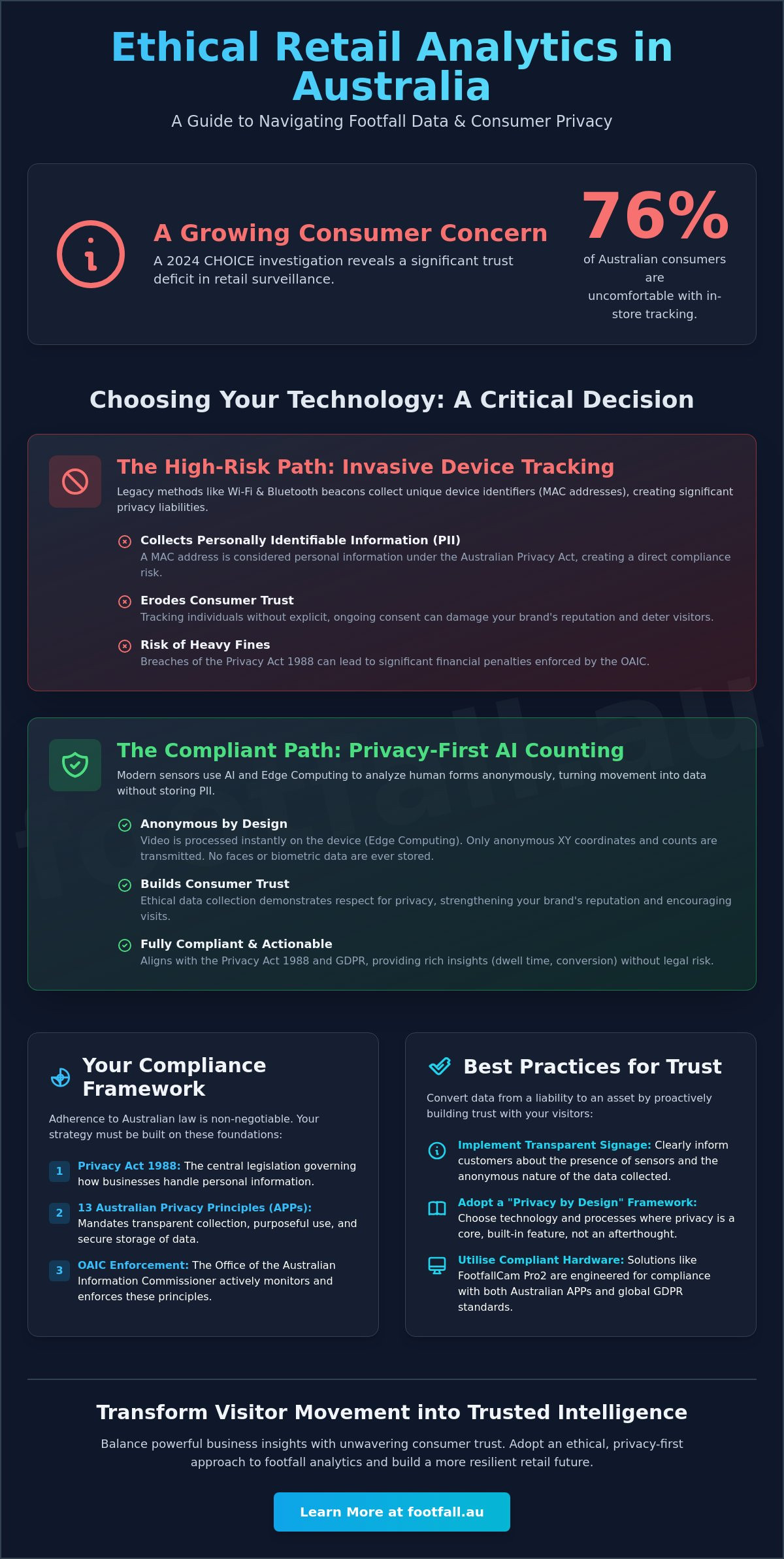
In 2024, a CHOICE investigation into retail surveillance revealed that 76% of Australian consumers are deeply uncomfortable with how their physical movements are tracked in-store. This statistic underscores the growing weight of footfall data privacy concerns Australia faces as businesses attempt to modernize their spatial analytics. You understand that capturing visitor flow is vital for optimizing staff rosters and conversion rates. However, the threat of heavy fines under the Privacy Act 1988 often makes data collection feel like a liability rather than an asset. It’s a tension between the need for evidence-based decisions and the fundamental right to anonymity.
This guide provides a clear path forward. You’ll learn how to leverage powerful foot traffic insights through ethical, anonymous collection methods that protect your brand’s reputation. We’ll detail the specific Australian regulatory landscape, introduce hardware solutions that are private by design, and outline a framework for transparent communication. By the end, you’ll have the tools to transform raw movement into actionable intelligence without compromising consumer trust.
Key Takeaways
- Align your retail operations with the Australian Privacy Act 1988 by understanding how the 13 Australian Privacy Principles (APPs) apply to modern foot traffic sensors.
- Differentiate between invasive MAC address tracking and privacy-first AI counting that monitors human forms without capturing or storing sensitive facial recognition data.
- Implement transparent communication strategies and clear signage to proactively address footfall data privacy concerns Australia consumers and advocacy groups may have.
- Utilise high-precision technology like FootfallCam Pro2 to maintain full compliance with both local Australian regulations and global GDPR standards.
- Convert visitor movement into actionable intelligence using ethical data collection methods that balance business growth with consumer trust.
Understanding the Footfall Data Privacy Landscape in Australia (2026)
Ethical retail management requires a clear grasp of legal boundaries. Under the Privacy Act 1988, footfall data privacy concerns Australia by intersecting with how businesses collect and store spatial information. The core challenge lies in distinguishing between identifiable personal information, which directly names an individual, and anonymous aggregate data, which tracks patterns without compromising identity. Modern Australian privacy law mandates that data collection must be transparent and purposeful. Businesses must ensure that sensor technology captures movement patterns rather than individual identities to remain compliant.
Consumer advocacy groups like CHOICE have intensified their scrutiny of retail tracking technologies. Their recent reports highlight a growing demand for visibility into how sensors monitor movement in shopping centres. The Australian Competition and Consumer Commission (ACCC) now emphasizes that transparency isn’t optional. Retailers must provide clear signage and accessible information to ensure consumers understand the scope of digital monitoring. This shift ensures that data collection serves the visitor journey rather than intruding upon it.
The Shift in Australian Consumer Sentiment
Data collected between 2023 and 2025 reveals that 74% of Australians feel uncomfortable with their data being shared without explicit consent. High-profile data breaches at major national firms have eroded retail trust, making shoppers more protective of their digital footprint. Brands that adopt a “quiet confidence” in data handling gain a distinct competitive advantage. By prioritizing privacy-first analytics, you reassure customers that their presence is valued but their identity is protected. This evidence-based approach transforms data from a liability into a strategic asset.
Key Regulatory Bodies and Standards
The Office of the Australian Information Commissioner (OAIC) leads the enforcement of privacy principles across the country. Following the Digital Platform Services Inquiry, the scope of retail analytics has expanded to include stricter oversight of physical space monitoring. The 2026 Privacy Act updates specifically target real-time spatial analytics, requiring businesses to prove that their data collection is necessary for operational efficiency. To address footfall data privacy concerns Australia, firms must implement “privacy by design” frameworks. These standards ensure that every data point, from dwell time to conversion rates, is captured through a lens of security and ethical precision.
- OAIC Enforcement: Active monitoring of how businesses apply Australian Privacy Principles (APPs) to sensor data.
- Digital Platform Inquiry: Increased focus on the intersection of physical movement and digital profiles.
- 2026 Updates: New requirements for “right to be forgotten” protocols even within anonymous datasets.
AI-Based Counting vs. Invasive Device Tracking
Distinguishing between anonymous counting and personal tracking is the first step in addressing footfall data privacy concerns Australia. Traditional methods often relied on capturing unique identifiers from smartphones, creating a digital trail that follows a visitor across various locations. Modern AI sensors shift this focus from who the person is to how the space is used. This distinction isn’t just technical; it’s the foundation of ethical retail operations in a climate of increasing scrutiny.
How AI Sensors Preserve Anonymity
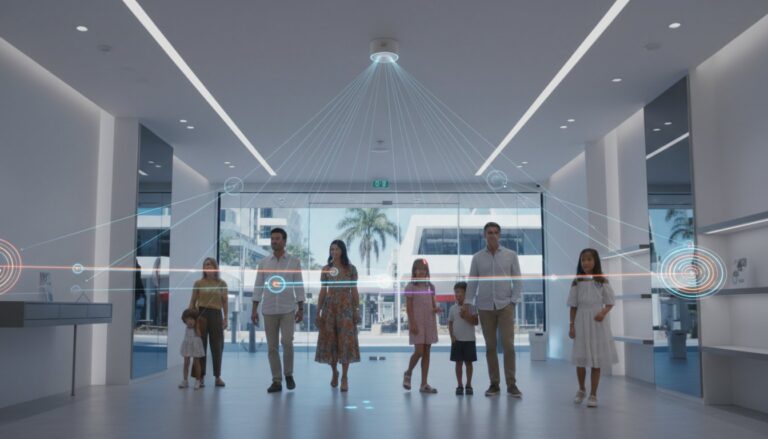
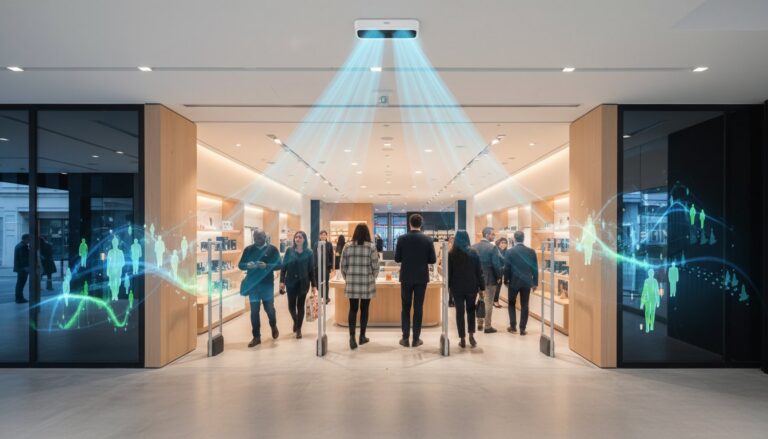
AI-powered hardware uses advanced algorithms to identify human shapes without ever capturing biometric data. These sensors don’t store video or recognize individual faces. Instead, they convert live video feeds into anonymous X-Y coordinates instantly. This process relies on Edge Computing, where all data processing occurs on the device hardware itself rather than being sent to a central cloud server. By the time information leaves the sensor, it’s already been stripped of any identifying features, leaving only the essential count. This method ensures that no personal information is ever at risk of a breach because the data simply doesn’t exist in a personal format.
The Problem with Bluetooth and Wi-Fi Beacons
Legacy systems often use Wi-Fi or Bluetooth “pings” to track the Media Access Control (MAC) addresses of nearby smartphones. This practice creates significant privacy risks because it allows a business to recognize the same device across different times and locations. Many Australians find this level of persistence intrusive. This sentiment aligns with broader regulatory scrutiny, such as the 2021 ACCC finding on location data, which highlighted how consumers can be misled about how their movements are monitored.
Beyond the ethical issues, device-based tracking has become technically unreliable. Major mobile operating systems have introduced aggressive privacy features to combat these footfall data privacy concerns Australia. These include:
- MAC Randomization: Apple’s iOS 14 and later versions generate a unique, random MAC address for each Wi-Fi network, preventing sensors from identifying a returning device.
- Android Protocols: Android 11+ employs similar “private MAC” protocols by default, which renders legacy beacon tracking obsolete.
- Inaccuracy: These updates can lead to accuracy errors exceeding 30% compared to dedicated people counting technology.
Relying on permanent identifiers is a high-risk strategy that yields diminishing returns. Businesses should prioritize real-time processing that delivers actionable insights without archiving personal history. Choosing to implement privacy-first analytics allows you to understand visitor journeys while respecting the boundaries of every individual who enters your premises.
Compliance Framework: The Australian Privacy Principles (APPs)
The Australian Privacy Principles (APPs) provide the legal architecture for every retail sensor and spatial intelligence tool deployed across the country. These 13 principles ensure that data collection remains ethical, secure, and respectful of the individual. Compliance isn’t a static checkbox; it’s an ongoing commitment to transparency. According to the 2023 Australian Community Attitudes to Privacy Survey, 70% of Australians view privacy as a major concern in their daily lives. This sentiment directly influences how businesses must address footfall data privacy concerns Australia to maintain public trust.
APP 1 requires businesses to manage personal information in an open and transparent way. This means your privacy policy must clearly state what data you collect and how you use it. APP 3 is even more critical for analytics. It mandates that you only collect personal information that’s reasonably necessary for your functions. Ethical footfall counters bypass this requirement by using “Privacy by Design” to ensure no personal information is ever solicited or stored.
There’s a significant legal distinction between a security camera (CCTV) and a dedicated people counter. CCTV systems typically record and store identifiable video footage. This constitutes personal information under the Privacy Act. In contrast, modern people counters process images locally on the “edge,” converting visual data into anonymous numerical strings instantly. This technical separation means the device never stores an individual’s likeness; it removes the data from the scope of “personal information” and reduces your compliance burden significantly.
Data Minimisation and Purpose Limitation
Efficiency depends on precision, not intrusion. Data minimisation requires you to collect only the specific metrics needed for operational goals. You don’t need to know who a visitor is to understand when your peak hours occur. Effective strategies include:
- Operational Focus: Use data strictly for staffing optimisation and layout improvements.
- Metadata Deletion: Establish clear deletion schedules for any temporary metadata used during initial processing.
- Spatial Boundaries: Ensure sensors are configured to ignore areas where privacy expectations are higher, such as external footpaths or staff-only zones.
Privacy Impact Assessments (PIA)
Australian businesses should conduct a formal PIA before installing any new tracking hardware. This process identifies potential privacy risks and builds a roadmap for mitigation before the first sensor is mounted. A thorough PIA evaluates the “Privacy by Design” credentials of your technology partner. It ensures their sensors don’t inadvertently capture sensitive data. This proactive strategy addresses footfall data privacy concerns Australia by transforming privacy from a legal hurdle into a competitive advantage. It proves to your customers that their movement is measured with respect and strategic intent.
Best Practices for Transparent Data Implementation
Addressing footfall data privacy concerns Australia requires more than just legal compliance; it demands a strategy of radical transparency. Retailers must bridge the gap between technical data collection and consumer trust by making the invisible visible. Start by crafting a privacy policy specifically for your physical location rather than simply repurposing your website’s terms and conditions. This document should explicitly state what sensors are in use, whether it’s 3D LiDAR or Wi-Fi analytics, and outline the exact retention periods for anonymized datasets.
Staff training is the most overlooked component of ethical data implementation. Your floor team acts as the primary point of contact for inquisitive shoppers. If a customer asks about a ceiling-mounted sensor, employees shouldn’t offer vague answers or look confused. Equip them with concise scripts that explain how the store counts movement to optimize staffing levels and reduce wait times. This humanizes the technology and reinforces the message that the data serves the visitor experience rather than just the corporate bottom line.
Provide clear opt-out or opt-in mechanisms where technically feasible. While passive counting often makes individual opt-outs difficult, you can offer “data-free zones” or provide clear instructions on how shoppers can reset their mobile advertising IDs. These small gestures demonstrate a commitment to consumer agency that sets a brand apart in a crowded market.
Communicating the Value of Data
Shift the narrative from “monitoring” to “improving.” Explain to your customers how spatial intelligence leads to tangible benefits, such as shorter checkout queues and better product availability. Positioning your analytics as a tool for retail footfall analysis Australia allows you to frame data collection as a method for operational excellence. Use the insights to make more empathetic, human-centric business decisions. For example, if data shows a high dwell time in a specific aisle, use that evidence to add seating or improve lighting, showing customers that their movement patterns directly influence a better shopping environment.
Signage and Disclosure Templates
Effective signage is your first line of defense against footfall data privacy concerns Australia. Place notifications at eye level at every entry point using high-contrast text and clear iconography. Avoid buryng the disclosure in a wall of fine print; instead, use a primary headline that declares “We use anonymous sensors to improve your experience” followed by a QR code. This code should link directly to a mobile-optimized page detailing your data anonymization protocols and contact information for your privacy officer.
In Australian retail, the “Reasonable Expectation” rule dictates that businesses must provide clear and prominent notification at the point of entry if data collection exceeds what a typical consumer would expect for a standard commercial transaction.
Ready to implement ethical analytics in your space? Explore our transparent footfall solutions
FootfallCam: A Privacy-First Solution for Australia
Addressing footfall data privacy concerns Australia requires a shift from passive monitoring to active, ethical data management. FootfallCam Pro2 sensors lead this transition by employing edge computing. This means the sensor processes all visual information locally on the device itself. It never transmits raw video footage to the cloud. Instead, it converts human movement into anonymous mathematical coordinates. This architecture ensures compliance with the Australian Privacy Act 1988 and the strict requirements of GDPR. Business owners get the precision they need without the liability of storing sensitive visual data.
Hardware Features that Protect Privacy
The hardware is engineered to prioritize anonymity from the first frame. Built-in privacy masks allow retailers to black out specific areas, ensuring that staff or sensitive zones are never tracked. The system uses anonymous pixel processing to identify human silhouettes based on height and shape, rather than facial features. All data moving to the FootfallCam V9 software is protected by industrial-grade encryption. Our “Legacy Swap Out” plan specifically helps businesses move away from invasive 2D cameras. These older systems often lack modern encryption and pose higher risks. Swapping to the Pro2 ensures your infrastructure is both high-performing and legally sound.
Partnering with Footfall Australia
Strategic success depends on trust. We provide direct access to people counter support for Australian clients, offering on-the-ground expertise that overseas providers can’t match. This includes performing regular compliance audits to ensure your data collection remains within legal boundaries as regulations evolve. With the 2024 updates to Australian privacy laws, having a local partner is critical for maintaining data integrity. We focus on the visitor journey as a narrative of movement, not a collection of identities. This ethical strategy future-proofs your operations against upcoming legislative changes. You can secure a high-accuracy installation by contacting our consultants for a site assessment today. We help you turn foot traffic into a strategic advantage without compromising the privacy of a single visitor.
Future-Proof Your Strategy with Ethical Intelligence
Navigating footfall data privacy concerns Australia requires a shift from passive observation to proactive ethical management. By 2026, the Australian Privacy Principles (APPs) demand a higher standard of transparency that traditional device tracking can’t meet. Retailers must adopt AI-based counting solutions that prioritize visitor anonymity without sacrificing the precision of spatial analytics. This strategic approach doesn’t just mitigate legal risk; it builds lasting consumer trust. Data is only valuable if it leads to positive changes in your operations while respecting the visitor journey.
FootfallCam provides the technological foundation for this transition. Our Privacy-by-Design hardware is already used by leading global retailers to ensure data collection remains fully compliant with APP and GDPR standards. You don’t have to choose between deep insights and ethical operations. With expert local support and maintenance based in Australia, your business can implement a seamless reporting system that empowers every strategic decision with hard evidence. It’s time to replace guesswork with a framework built for technical reliability.
Take the first step toward transparent analytics today. Request a Privacy-First Consultation with Footfall Australia and ensure your business stays ahead of shifting trends.
Frequently Asked Questions
Is it legal to track customer movements in Australian retail stores?
Yes, it’s legal to track customer movements provided you comply with the Privacy Act 1988 and the 13 Australian Privacy Principles. You must ensure the data collected doesn’t identify individuals. Most retailers use anonymous counting to stay compliant, as this focuses on aggregate patterns rather than personal information. If your system de-identifies data at the source, you’re operating within Australian legal frameworks.
Does a people counter count as a surveillance device under the Privacy Act?
A people counter isn’t typically classified as a surveillance device if it uses infrared, thermal, or 3D depth-sensing technology that doesn’t record identifiable faces. State-specific laws, like the Victoria Surveillance Devices Act 1999, focus on devices that record private conversations or activities. Because professional counters turn movement into mathematical coordinates, they don’t capture the “personal information” that triggers strict surveillance regulations.
Do I need to put up signs if I am using a people counter?
You aren’t legally required to display signage if the device only collects anonymous, non-identifiable data. However, the Office of the Australian Information Commissioner (OAIC) suggests transparency is a best practice for building trust. If your system tracks MAC addresses or uses biometric technology, the Privacy Act 1988 requires you to take reasonable steps to notify visitors through entry signs or a public privacy policy.
What is the difference between anonymous counting and facial recognition?
Anonymous counting tracks physical shapes or heat signatures to generate totals, while facial recognition captures unique biometric templates to identify specific people. These technologies carry different risks regarding footfall data privacy concerns Australia. Facial recognition falls under “sensitive information” categories, requiring explicit consent from every visitor. Anonymous counting avoids this hurdle by never storing images or identifying traits, making it a safer choice for retail compliance.
How does the ACCC view retail data collection in 2026?
The ACCC views retail data collection through the lens of consumer protection and transparency, following the 2022 Privacy Legislation Amendment. By 2026, the regulator expects businesses to practice data minimization, only collecting what’s strictly necessary for operations. They’ve increased focus on “unfair trading practices,” meaning any data used to deceptively influence consumer behavior could lead to penalties. Fines for non-compliance now reach up to A$50 million for serious breaches.
Can I use footfall data if my store is located in a high-privacy zone?
Yes, you can use footfall analytics in high-privacy zones by deploying sensors that utilize edge computing. This technology processes all information locally on the hardware instead of sending raw video to the cloud. By converting human movement into numerical data points instantly, you meet the strict requirements of local councils and sensitive public spaces. It’s a strategic way to gain insights without risking a privacy violation.
What happens if my business is found to be in breach of the Privacy Act?
Your business faces significant financial and reputational risks if it breaches the Privacy Act 1988. Under the 2022 enforcement updates, the OAIC can facilitate civil penalties of up to A$50 million or three times the value of the benefit gained from the breach. Beyond these fines, the Commissioner often mandates public apologies and independent audits. These audits can disrupt your daily operations for several months while you prove your compliance.
How does FootfallCam ensure my data remains anonymous?
FootfallCam ensures anonymity by using 3D LiDAR and Time-of-Flight technology to track silhouettes rather than features. The sensor’s onboard processor converts video frames into anonymous data strings immediately; it doesn’t save or transmit any identifiable imagery. This “privacy by design” approach means the output is purely statistical. You receive accurate conversion rates and dwell times without ever capturing personal data that could identify your Australian customers.