
How to Reduce Anxiety About Store Performance: A Guide to Retail Staff Scheduling Optimisation
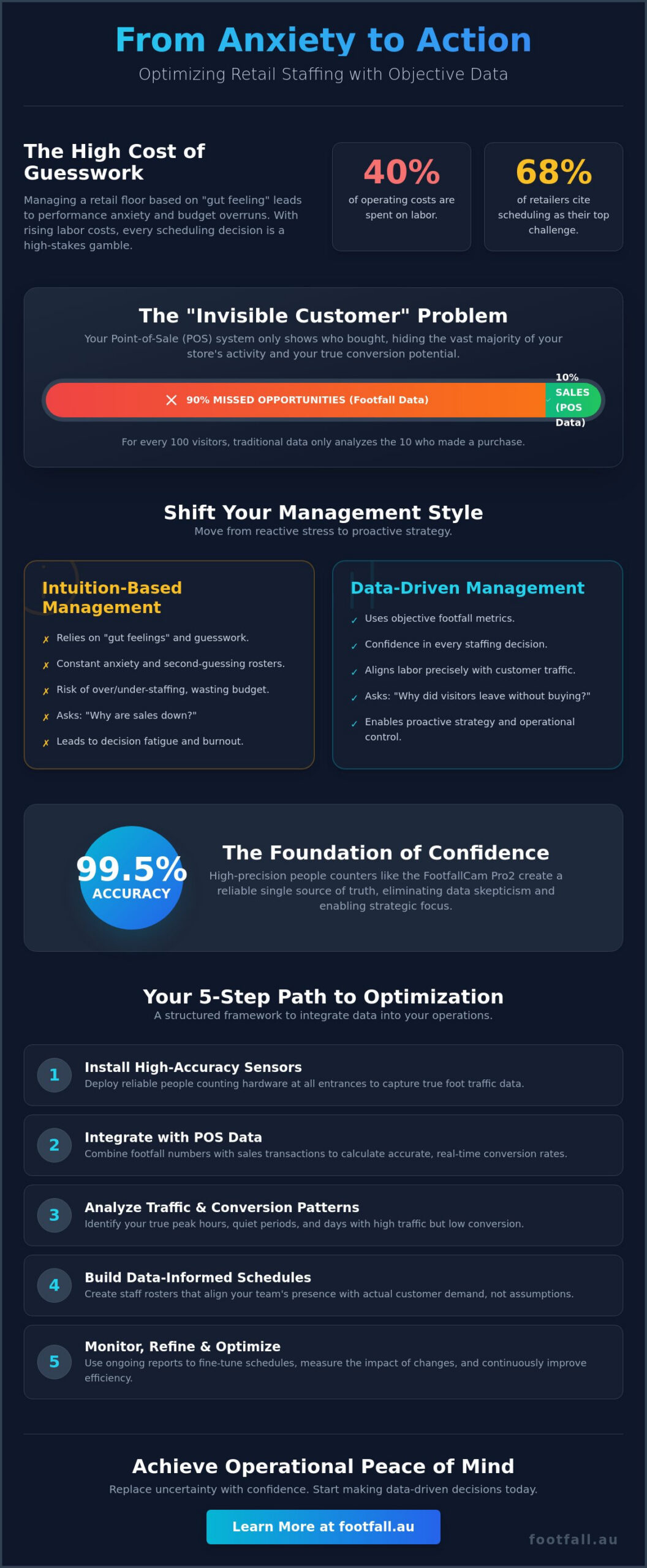
If labor accounts for nearly 40% of your operating costs, why are you still relying on a “gut feeling” to decide who works the floor this Saturday? Many Australian retail managers feel a persistent sense of anxiety when looking at low conversion rates or empty aisles during expensive shift blocks. With the base hourly rate for a level 1 retail worker rising to A$27.81 this July, the financial stakes of a poorly planned roster have never been higher. It’s a common struggle, yet 68% of retailers still cite scheduling as their top workforce management challenge in 2026.
You don’t have to manage in the dark. By integrating objective footfall data into your retail staff scheduling optimisation, you can replace managerial uncertainty with empirical evidence. This guide will show you how to move beyond intuition to build staffing models that align perfectly with actual customer demand. We’ll explore how to use business intelligence to reduce operational stress, protect your labour budget, and drive confidence in every scheduling decision you make.
Key Takeaways
- Identify the “Invisible Customer” problem and why relying solely on sales data leads to inaccurate performance assessments and managerial stress.
- Learn how to implement retail staff scheduling optimisation by replacing subjective intuition with high-accuracy footfall metrics to manage labour costs effectively.
- Explore how the 99.5% accuracy of the FootfallCam Pro2 creates a reliable single source of truth for evaluating store traffic and conversion rates.
- Contrast the anxiety of over-staffing with the confidence gained through data-driven labour allocation during both peak and quiet periods.
- Master a structured five-step framework to integrate people counting hardware with POS systems for real-time reporting and enhanced operational control.
What is Retail Performance Anxiety and Why Does it Happen?
Retail performance anxiety is the persistent psychological stress experienced by store leaders when they lack objective visitor metrics to justify operational decisions. Unlike the clinical definition of performance anxiety, which often focuses on public speaking or social evaluation, this professional variant stems from the weight of accountability in an environment of partial visibility. In the Australian retail sector, where labour accounts for approximately 40% of operating costs, the pressure to get every roster right is immense. When you manage a physical space based on intuition rather than empirical evidence, you’re essentially operating in the dark.
The “Invisible Customer” problem is the primary driver of this uncertainty. Most managers rely heavily on Point-of-Sale (POS) data to judge success, yet this only accounts for a small fraction of the store’s activity. If 100 people enter your store and 10 buy something, your POS system tells you everything about those 10 transactions. It says nothing about the 90 people who walked away. Without knowing your true foot traffic, you can’t distinguish between a “quiet day” and a “poorly converted day.” This information gap forces managers into a cycle of reactive worrying rather than proactive strategy.
Relying on gut feelings leads to significant decision fatigue. Every time a manager makes a choice about early finishes or overtime without data, they’re gambling with the store’s budget. This constant second-guessing increases cortisol levels and leads to burnout. Transitioning to a data-driven strategy for retail staff scheduling optimisation removes this emotional burden. It replaces the “I think we’re busy” narrative with “I know our peak is at 2 PM.”
The Symptoms of Data-Blind Management
Managers suffering from data-blindness often experience specific operational stressors. They might second-guess staffing rosters constantly, unsure if they’ve scheduled enough floor coverage for actual peak traffic times. It’s common to feel “busy” all day yet see disappointing end-of-day sales reports; a phenomenon that usually points to a service bottleneck rather than a lack of customers. There’s also a nagging anxiety regarding the effectiveness of window displays or promotions. Without a way to measure the “draw-in” rate, you’re left guessing if that expensive new campaign actually increased store entries.
Moving Beyond the POS Limit
The psychological relief of data begins when you look past the cash register. POS data only tells you who bought, but footfall data tells you who you missed. Understanding your true capture rate changes the management conversation from “Why are sales down?” to “Why did 85% of visitors leave empty-handed?” This shift in perspective is the first step toward effective Employee scheduling software integration and retail staff scheduling optimisation. When you see the narrative of movement through your store as a sequence of human actions, you gain the confidence to align your team with the actual flow of opportunity.
Replacing Intuition with Objective Footfall Data
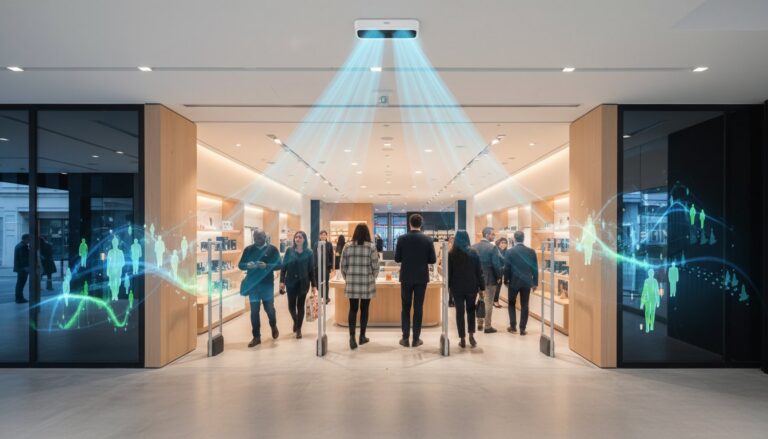
Replacing intuition with objective data requires a fundamental shift from qualitative observation to quantitative measurement. High-accuracy people counters serve as the foundation for this transition, providing a single source of truth that transcends personal opinion or anecdotal evidence. When a manager relies on the FootfallCam Pro2, which offers 99.5% accuracy, data skepticism disappears. You no longer have to wonder if the sensors missed a group or double-counted a staff member. Instead, you can focus entirely on the strategic implications of the numbers provided by your analytics platform.
This precision allows you to view foot traffic as a predictable narrative of human movement rather than random noise. Modern systems use advanced computing to optimize retail staff scheduling, ensuring that your most capable team members are on the floor when opportunity is highest. Automated AI reporting further reduces the burden of constant floor observation. You don’t need to be everywhere at once if your software is already flagging anomalies and identifying trends. This level of automation is essential for retail staff scheduling optimisation, as it frees leaders to focus on coaching and customer engagement.
The Power of the Conversion Rate
Knowing your conversion rate fundamentally changes your perspective on store performance. A “bad day” at the cash register might actually be a high-traffic day where service levels failed to meet demand. Conversely, low sales during a period of low traffic isn’t a failure of the team; it’s a reflection of external market conditions. By using retail footfall analysis Australia, you can benchmark your performance against national trends to see if your traffic dips are unique to your location. This distinction is vital for identifying if a sales dip is a traffic problem or a service problem.
Visualising the Customer Journey
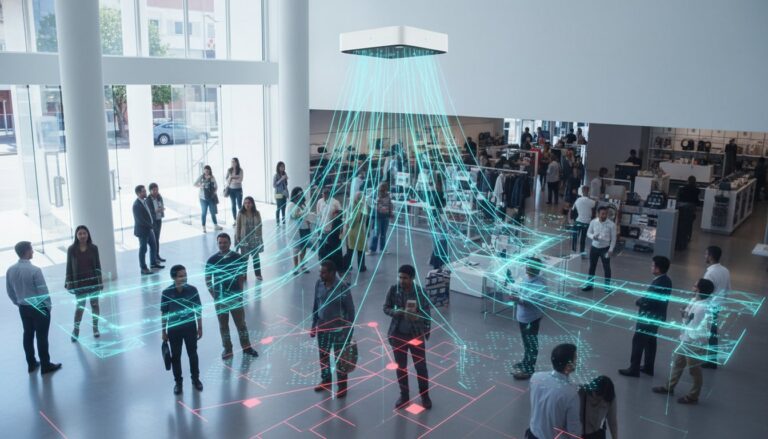
Heatmaps provide a psychological benefit by making the invisible visible. They reveal how customers actually navigate your space, highlighting popular zones and identifying “dead zones” that might be causing layout anxiety. Understanding these friction points allows you to refine your floor plan with confidence. Modern people counting technology translates physical steps into digital insights, giving you a clear map of the customer journey. When you understand the flow of your environment, you can better position staff to assist customers at critical decision points. To see how these insights can transform your operations, explore our range of data-driven retail solutions.
Comparing Intuition-Based vs. Data-Driven Management
Consider two store managers during a quiet Tuesday afternoon in a Sydney CBD boutique. Manager A, relying on intuition, sees an empty floor and feels an immediate pressure to cut costs. They send a casual staff member home early to save on the A$34.76 hourly rate, only to be overwhelmed when a sudden wave of commuters arrives at 4:15 PM. Manager B, however, remains calm. Their retail staff scheduling optimisation platform shows that while 2 PM is historically quiet, traffic consistently spikes 300% in the late afternoon. They keep their team intact, ready to capture every conversion opportunity. This contrast highlights the difference between reactive stress and proactive confidence.
Objective data serves as a neutral language that reduces friction between head office and store-level staff. During performance reviews, arguments about “feeling busy” or “it was just a slow week” are replaced by clear metrics. When both parties look at the same dashboard, the conversation shifts from blame to problem-solving. This transparency allows leaders to justify operational changes to stakeholders or investors with absolute certainty. You aren’t just asking for more budget; you’re presenting an evidence-based case for why specific labour allocations will drive higher returns.
Staffing for Success, Not Stress
Predicting the “lunch rush” or the “after-school surge” shouldn’t be a guessing game. By analysing historical traffic patterns, you can ensure adequate coverage exactly when it’s needed. This precision allows you to align staff breaks with low-traffic periods, maintaining high service levels without over-extending your team. Matching work intensity to actual visitor volume is also a key factor in reducing employee burnout. Staff feel supported when they aren’t under-resourced during peaks, and they feel productive when their tasks align with store traffic. Effective retail staff scheduling optimisation creates a balanced environment where performance is sustainable.
Marketing Accountability
Budgetary anxiety often stems from the mystery of marketing ROI. It’s stressful to wonder “is this ad working?” while watching sales fluctuate. Data-driven management provides an immediate answer by tracking real-time lifts in foot traffic following a campaign launch. You can validate the effectiveness of a new window display by measuring “turn-in” rates through sophisticated footfall data analysis. If traffic increases but sales don’t, you know the marketing worked, but the floor execution or stock levels didn’t. This level of insight allows you to prove ROI on marketing spend, replacing fear with strategic clarity.
5 Steps to Retail Staff Scheduling Optimisation
Moving from intuition to evidence requires a structured implementation of technology. To achieve effective retail staff scheduling optimisation, you must first establish a baseline of high-accuracy data. Start by installing FootfallCam Pro2 People Counters at every entrance to capture a total visitor count. This hardware ensures that your foundational data is 99.5% accurate, removing any doubt about the numbers you’re reviewing. Once your baseline is set, the following five steps will transform your store operations.
- Step 1: Baseline Hardware: Deploy consistent people counting sensors across all access points to ensure no visitor is missed.
- Step 2: POS Integration: Connect your footfall data with your existing Point-of-Sale system to calculate real-time conversion rates and identify service gaps.
- Step 3: Real-Time Alerts: Configure automated notifications for occupancy levels and queue lengths to manage floor-level stress during unexpected surges.
- Step 4: Heatmap Analysis: Review weekly heatmaps to pinpoint friction points in the customer journey and adjust your floor layout accordingly.
- Step 5: Predictive Planning: Use historical analytics to forecast traffic for seasonal peaks, such as the EOFY sales or Boxing Day, ensuring your roster is ready for the volume.
Automating the Check-In
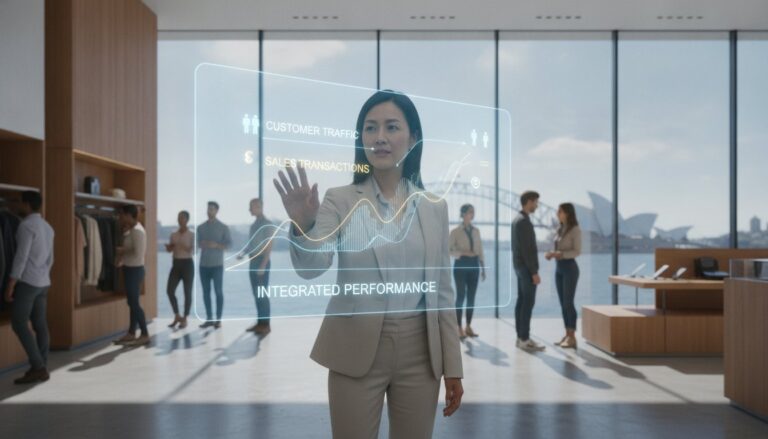
Success in retail staff scheduling optimisation depends on the consistent review of information. Using FootfallCam V9 Software, you can receive automated performance reports via email every morning. These reports allow you to set KPIs that focus on factors within your control, such as conversion rates and average dwell time, rather than worrying about national traffic trends you cannot change. Automated reporting acts as a digital manager that never sleeps, ensuring you’re always informed of store performance before you even step onto the floor.
Leveraging Existing Infrastructure
You don’t always need a complete hardware overhaul to gain sophisticated insights. The FootfallCam Centroid can turn your existing CCTV network into a data powerhouse, processing video feeds to provide advanced analytics without the need for additional sensors. This approach minimises your initial investment while maximising the business intelligence available for people counting systems Australia. By ensuring your hardware is future-proofed for 2026 standards, you protect your budget while gaining the tools needed to refine your operations. To start building your data-driven roster, explore our retail analytics solutions today.
Achieving Operational Peace of Mind with Footfall Australia
Operational peace of mind isn’t a luxury; it’s the natural byproduct of replacing guesswork with precision. By partnering with a specialist that understands the unique pressures of the Australian retail environment, you move beyond the daily struggle of manual roster adjustments. Footfall Australia provides the empirical foundation required for successful retail staff scheduling optimisation, ensuring that every decision is backed by high-fidelity data. When your staffing levels mirror your actual customer traffic, the anxiety of underperformance disappears, replaced by a clear strategy for growth.
Reliable hardware creates reliable sleep. For business owners and operations managers, knowing that your data is being captured with 99.5% accuracy removes the burden of constant verification. Long-term data integrity is maintained through dedicated people counter support, which ensures your systems remain calibrated and functional year-round. This continuous monitoring allows you to shift your focus from surviving the retail landscape to actively optimising it. You stop reacting to the market and start leading it.
The Footfall Australia Advantage
Footfall Australia has provided national coverage and local expertise across the Australian market since 2004. We understand that a store in a busy Melbourne shopping centre faces different challenges than a flagship boutique in Perth. Our comprehensive suite of hardware, including FootfallCam Pro2 sensors and Centroid AI boxes, is designed to scale with your business. We offer tailored support plans, such as our Premium and Basic Support options, to ensure your business intelligence remains actionable. This local presence means you have a partner who is physically available to support your national retail chain or independent store whenever needed.
Your Next Steps to Clarity
The path to operational clarity begins with a comprehensive site audit. This process identifies current data gaps in your stores and evaluates how your existing infrastructure can be enhanced. If you’re currently using outdated technology, our Legacy Swap Out Plan facilitates a smooth transition to modern, AI-driven counters. You can also request a demonstration of the FootfallCam V9 analytics dashboard to see how your team can benefit from real-time reporting. This transition is the final stage in mastering retail staff scheduling optimisation, giving your team the tools they need to perform with confidence and precision. Empower your managers with the single source of truth they deserve.
Mastering the Future of Your Retail Environment
Transitioning from intuition to empirical evidence is the only sustainable way to eliminate store performance anxiety. By leveraging the 99.5% accuracy of the FootfallCam Pro2, you gain a definitive single source of truth that POS data alone cannot provide. Identifying the “Invisible Customer” and aligning labour with actual traffic flows transforms the operational landscape. This shift doesn’t just protect your budget; it empowers your team to perform with confidence during every shift.
Implementing retail staff scheduling optimisation is a strategic move toward long-term stability and growth. Footfall Australia has been a trusted partner for Australian retailers since 2004, providing the national support and maintenance plans necessary to keep your business intelligence actionable. It’s time to stop second-guessing your rosters and start leading with data-driven clarity. When you have visibility over every visitor’s journey, you can manage your physical space with the same precision as a digital storefront.
Eliminate uncertainty and optimise your store with Footfall Australia today.
Take the first step toward a more predictable and profitable retail future. Your store’s potential is waiting to be measured, and we’re ready to help you capture it.
Frequently Asked Questions
How can people counting data actually reduce my daily stress?
People counting data reduces stress by replacing subjective “gut feelings” with empirical evidence. Instead of worrying whether a sales dip was your team’s fault, you can see if store traffic was down across the entire precinct. This visibility allows you to make calm, evidence-based decisions rather than reacting emotionally to daily fluctuations. It provides the quiet confidence that your operational choices are rooted in reality.
Is it difficult to integrate footfall counters with my current POS system?
Integrating footfall counters with your existing POS system is a straightforward process designed for high technical compatibility. Our software connects these data streams to provide an automated conversion rate. This integration eliminates the need for manual spreadsheets and ensures you have a real-time view of how many visitors are actually becoming customers. It’s a seamless way to combine sales and traffic metrics.
What is the difference between a standard security camera and a people counter?
Standard security cameras are designed for visual monitoring, while people counters are precision instruments for spatial analytics. The FootfallCam Pro2 uses 3D stereoscopic vision to achieve 99.5% accuracy, even in challenging lighting. Security cameras often lack the depth perception needed to distinguish between individuals in a group or to filter out non-human shadows, making them unreliable for accurate data collection.
Can footfall data help me manage staff more effectively during peak hours?
Footfall data is essential for retail staff scheduling optimisation during peak hours. By reviewing historical traffic patterns, you can predict exactly when surges will occur and roster your strongest sellers accordingly. This prevents your team from being overwhelmed and ensures you don’t miss high-value opportunities due to under-staffing. It aligns your labour costs directly with the actual flow of customers.
How accurate are modern people counters in a busy retail environment?
Modern sensors like the FootfallCam Pro2 maintain 99.5% accuracy in high-traffic retail environments. They use advanced AI to distinguish between adults, children, and staff members, ensuring your data remains clean and relevant. This level of precision is vital for Australian retailers who need reliable metrics to justify their labour spend and operational changes during busy trading periods.
Will I need a dedicated IT team to manage the FootfallCam V9 software?
You don’t need a dedicated IT team to manage FootfallCam V9 software. The platform is built for retail managers, featuring intuitive dashboards and automated email reports. It does the analytical heavy lifting for you, delivering actionable insights directly to your inbox. This allows you to focus on store leadership and team coaching rather than technical troubleshooting or data entry.
How does knowing my conversion rate help me improve store performance?
Knowing your conversion rate allows you to pinpoint exactly where your store is losing revenue. If your foot traffic is high but sales are low, the problem likely lies in service levels or stock availability. This insight helps you refine your retail staff scheduling optimisation by placing more staff on the floor during high-traffic, low-conversion windows to capture missed sales.
Is there a way to upgrade my old counting system without starting from scratch?
Upgrading an outdated system is simplified through our Legacy Swap Out Plan. This programme allows you to replace inaccurate or end-of-life hardware with modern AI-driven sensors without a complete infrastructure overhaul. It’s a cost-effective way to bring your business intelligence up to 2026 standards while maintaining continuity in your historical data. You gain modern precision without the stress of a total rebuild.