Customer Dwell Time Analysis: The 2026 Guide to Optimising Physical Spaces
What if your busiest store zones are actually your least profitable areas? It’s a common frustration to see high foot traffic that doesn’t translate into sales, leaving you to wonder why engagement isn’t converting. You’ve likely felt the pressure of inefficient staffing during peak times or struggled to justify layout changes without hard evidence. Implementing a sophisticated customer dwell time analysis using the FootfallCam Pro2 hardware removes this guesswork by treating physical presence as a sequence of interpretable human actions.
We understand that in 2026, data is only valuable if it leads to specific, positive changes in your operations. This guide promises to show you how measuring and analysing dwell time can transform your efficiency and drive measurable revenue growth. We’ll examine how to identify high-engagement zones, create data-backed staffing schedules, and integrate these insights into your business intelligence systems. You’ll also learn how to maintain compliance with the latest Australian Privacy Principle disclosure requirements while leveraging the enhanced AI capabilities of the FootfallCam V9 Software to optimise every square metre of your floor space. By moving from intuition to empirical evidence, you can ensure your physical environment stays prepared for shifting behavioural trends.
Key Takeaways
- Transition from simple traffic counting to deep engagement metrics by implementing a robust customer dwell time analysis strategy.
- Discover how stereoscopic AI sensors like the FootfallCam Pro2 provide the high-accuracy data needed to justify major layout and staffing changes.
- Learn to identify and eliminate “Cold Zones” where visitors fail to engage, turning underutilised floor space into high-value revenue drivers.
- Align your human resources with actual engagement peaks to improve operational efficiency and customer service quality.
- Integrate complex movement data into a single, intuitive reporting dashboard using the latest FootfallCam V9 Software.
What is Customer Dwell Time Analysis in Physical Spaces?
Customer dwell time analysis is the systematic measurement of how long a visitor remains within a specific zone or across your entire premises. While traditional metrics focus on the entry point, dwell time focuses on the internal journey. It’s a critical component of modern customer analytics, shifting the focus from simple presence to active engagement. In 2026, physical environments are no longer just transaction points; they’ve become experience hubs where movement tells a story of intent.
Forward-thinking businesses are moving away from the basic practice of “counting heads” to a more nuanced model of measuring engagement. This transition allows managers to distinguish between “passer-by” traffic and “engaged” dwell time. A visitor who traverses a corridor in five seconds represents volume, but a visitor who lingers at a display for five minutes represents potential revenue. Identifying these differences is the first step toward creating a high-performance floor plan.
By defining “Power Zones”—areas where visitors consistently spend high amounts of time—you can pinpoint exactly where your layout succeeds. These zones represent the high-performance sectors of your space where visual merchandising or service offerings successfully hold attention. Conversely, identifying zones with unexpectedly low dwell time helps you diagnose layout friction or ineffective displays before they impact your quarterly bottom line.
The Difference Between Footfall and Dwell Time
While people counting provides the baseline volume of your traffic, dwell time adds necessary context. Footfall is the “who and when,” but dwell time is the “how long and why.” A store with high footfall but low dwell time often suffers from a “window shopping” problem. People enter, glance around, and leave without meaningful interaction. This suggests that while your location or marketing successfully drives traffic, your internal environment fails to convert that interest into engagement.
Key Dwell Time Metrics to Track in 2026
- Average Dwell Time: This serves as your macro-level health check. It helps you understand the overall stickiness of your environment and provides a baseline for site-wide performance.
- Dwell Time by Zone: This metric allows for micro-optimisation. It identifies high-value areas and provides the empirical data needed to justify moving high-margin products to more engaging locations.
- Repeat Visitor Dwell: Stickiness matters for long-term growth. Measuring how long returning customers stay versus new visitors provides insight into brand loyalty and the effectiveness of your experience-based offerings.
The Technology Behind Accurate Dwell Time Measurement
Precise customer dwell time analysis requires more than just a standard security camera. It demands hardware capable of depth perception. Modern AI-powered 3D sensors, such as the FootfallCam Pro2, utilise stereoscopic vision to create a three-dimensional map of the environment. This technology mimics human sight, allowing the system to distinguish between a customer and inanimate objects like shopping trolleys, pushchairs, or shifting shadows. By accurately identifying human forms, the system ensures that your data reflects actual engagement rather than environmental noise.
Processing this information efficiently is where edge computing becomes essential. Instead of sending raw video feeds to a central server, the sensors process data locally on the device. This approach minimises bandwidth usage and ensures that sensitive visual data never leaves the premises, aligning with the strict privacy expectations of 2026. For businesses with existing IP camera infrastructure, the FootfallCam Centroid offers a strategic bridge. It applies AI analytics to your current hardware, providing a cost-effective route to sophisticated dwell metrics without a total system overhaul.
FootfallCam Pro2: The Gold Standard for 2026
Achieving a 99.5% accuracy rate is the baseline for making reliable capital expenditure decisions. The FootfallCam Pro2 achieves this by using advanced AI to track individual paths in real-time. This capability is fundamental for calculating dwell time because it allows the system to follow a visitor from the moment they enter a specific zone until they depart. When you can rely on this level of precision, you can begin Personalizing the customer experience based on actual dwell patterns rather than guesswork.
Privacy-First Data Collection
Australian businesses must navigate increasingly complex privacy regulations. Traditional Wi-Fi tracking has become unreliable due to MAC address randomisation on modern smartphones, often leading to skewed dwell data. In contrast, video-based AI sensors provide superior accuracy while maintaining total anonymity. These systems don’t record faces or personal identifiers; they simply track movement patterns. This non-intrusive approach ensures your customer dwell time analysis remains compliant with Australian Privacy Principles and international GDPR standards. If you’re looking to upgrade your current setup, you might consider exploring the latest AI-driven sensors to ensure your data is both accurate and ethical.
Correlating Dwell Time with Sales Conversion and Engagement
Effective customer dwell time analysis moves beyond simple observation to reveal the “Dwell-to-Dollar” ratio. This metric tracks how increases in visit duration impact average basket size. Data consistently shows that customers who remain in a store longer are more likely to encounter additional products, leading to higher conversion rates. It’s an empirical way to measure the depth of engagement rather than just the breadth of traffic. When you understand this correlation, you can stop guessing about floor plan effectiveness and start making decisions based on revenue potential.
Identifying “Cold Zones” is equally vital for operational health. These are areas where visitors pass through quickly without stopping. By pinpointing these dead spots, managers can re-evaluate signage, lighting, or product placement. This isn’t just for retailers; museums and libraries use these insights to measure the success of specific exhibits or collections. If a curated display has a low average dwell time, it signals a need for better storytelling or interactive elements to capture visitor interest. It’s about ensuring every square metre of your space serves a purpose.
Staffing levels play a significant role in these engagement metrics. Analysing the correlation between staff-to-customer ratios and dwell time often reveals that an available team member can extend a visitor’s stay. When customers feel supported and engaged by staff, they tend to linger. If they can’t find help during a moment of interest, they often leave. Balancing your roster based on these engagement patterns ensures you’re providing the right level of service to maximise the value of every visit.
Identifying Your ‘Sticky’ Zones
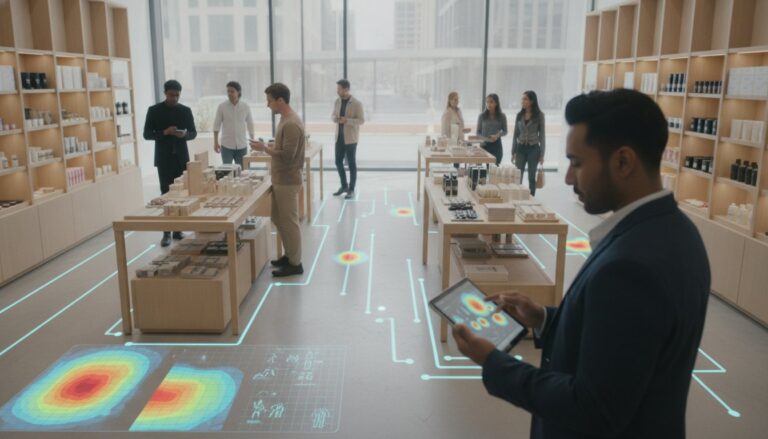
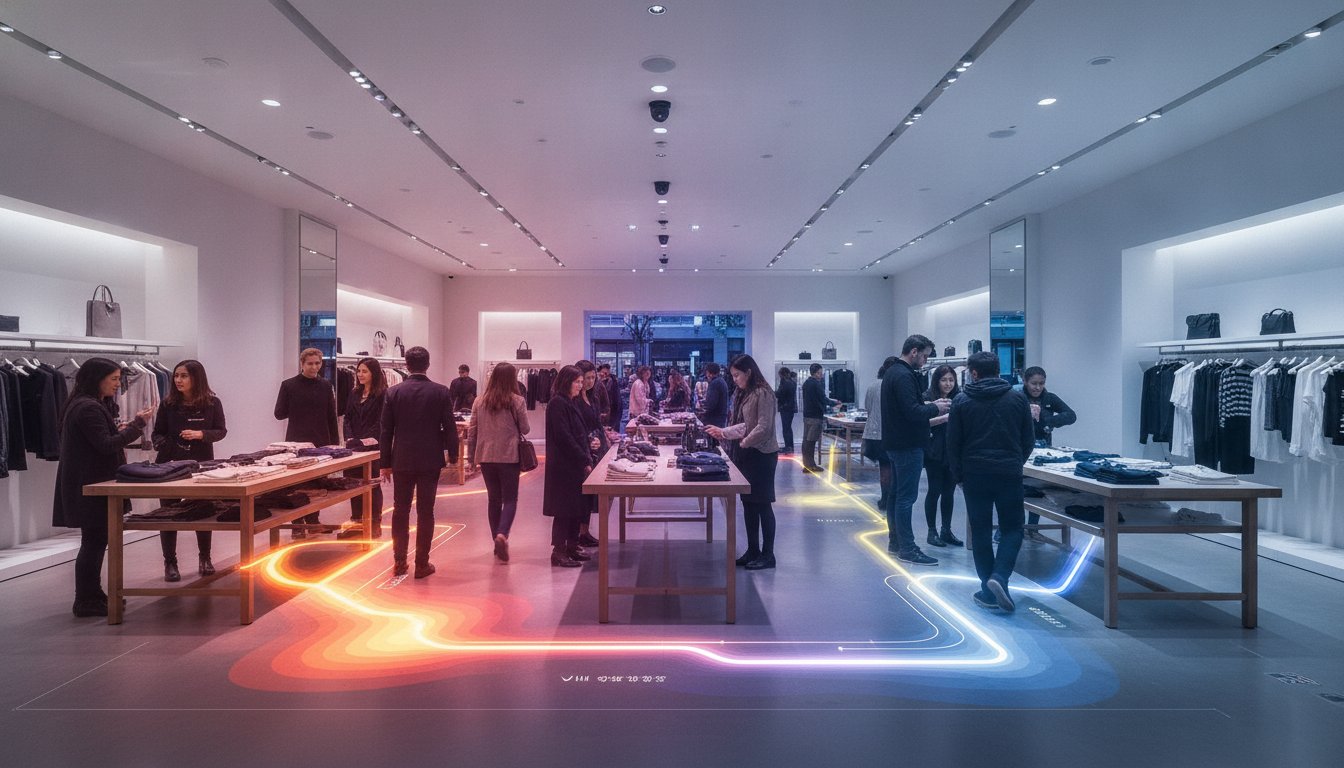
Heatmaps within the FootfallCam V9 Software provide a visual narrative of movement. They show exactly where customers congregate and for how long. You can use these visuals to test the impact of promotional displays in real-time. By comparing dwell time before and after a layout change, you gain a clear ROI on that specific floor space. Sticky zones are defined as areas where dwell time exceeds the store average by 50%.
Dwell Time as a KPI for Marketing ROI
Marketing success is often measured by the “attraction rate” of a window display. This is the percentage of passers-by who stop and enter. Once they’re inside, customer dwell time analysis becomes the primary metric for assessing campaign effectiveness. Integrating this with footfall data analysis allows you to justify marketing spend with hard numbers. Comparing these metrics across national locations helps identify which layouts work best, enabling a standardised approach to success across your entire network.
Strategic Applications: Optimising Layout and Staffing
Strategic implementation of customer dwell time analysis follows a logical sequence from observation to action. First, establish a baseline by measuring the current average dwell time across all zones over a 30 day period. This data provides the necessary context for identifying anomalies and measuring future success. Second, distinguish between productive engagement and operational bottlenecks. A high dwell time at a product display is a success; a high dwell time at the checkout indicates a queueing problem that needs immediate resolution. Accurate data helps you tell the difference.
Third, use these insights to reconfigure your floor plan. Moving “Power Zones”—those areas with naturally high engagement—deeper into the space encourages visitors to traverse underutilised areas. Fourth, align your staff rosters with these peak engagement periods. Fifth, maintain a cycle of continuous improvement by monitoring the FootfallCam V9 Software dashboard for behavioural shifts following each change. This structured approach ensures that every adjustment to your physical space is backed by empirical evidence rather than intuition.
Optimising Retail Layouts for Engagement
Effective layouts account for the “Decompression Zone,” the initial three metres of a store where visitors are adjusting to the environment. Dwell time typically starts after this threshold, so placing high-value items too close to the entrance often leads to missed opportunities. To maximise circulation, place high-dwell categories in the back-right of the premises, a strategy that aligns with natural human movement patterns. Integrating these tactics with broader retail footfall analysis Australia ensures your layout drives both traffic and depth of engagement.
Dynamic Staffing Based on Dwell Trends
Engagement-based staffing is the next evolution in workforce management. Instead of scheduling based solely on transaction volume, look at when dwell time peaks. You might find that footfall is moderate, but the customers present are highly engaged and require more assistance. Ensuring staff are on the floor during these high-intent periods reduces service gaps that lead to abandoned purchases. This proactive approach ensures your team is positioned where they can have the greatest impact on conversion. If you’re ready to transform your operational efficiency, you can optimise your store layout with data through our national support network.
Implementing Dwell Time Solutions with Footfall Australia
Footfall Australia has operated since 2004, providing a foundation of local expertise for national-scale rollouts across the country. We help organisations transition from fragmented data to a cohesive strategy through comprehensive customer dwell time analysis. For businesses currently burdened by outdated hardware, our Legacy Swap Out Plan provides a structured pathway to upgrade to modern AI-driven sensors without disrupting existing operations. This ensures your infrastructure remains capable of meeting the sophisticated analytical demands of the 2026 retail and public space environment. We specialise in turning raw traffic data into actionable business intelligence that empowers decision-makers at every level of the organisation.
Our national partner network ensures that support is always available, regardless of your location. We understand that data is only valuable if it is accurate and accessible, which is why we focus on high-quality technical solutions that integrate seamlessly with your existing workflow. By providing the technological means to observe human action and the strategic framework to interpret it, we help you move away from intuition and toward empirical evidence. This measured approach suggests stability and long-term thinking, positioning your business to stay prepared for shifting behavioural trends.
Seamless Software Integration
The FootfallCam V9 Software serves as a unified intelligence hub, aggregating data from FootfallCam Pro2 sensors into intuitive reporting dashboards. It integrates with existing Point-of-Sale systems to calculate true conversion rates by correlating dwell time with actual transaction data. National managers can access high-level overviews of total store performance, while local site leads receive granular insights into specific zone engagement. The system also supports real-time alerts for occupancy thresholds and queue management, allowing for immediate operational responses to shifting customer density and service needs.
Expert Support and National Coverage
Long-term success with customer dwell time analysis depends on consistent data integrity and system reliability. Our Premium Support Plan provides the technical oversight needed to ensure your sensors remain calibrated and your reporting stays accurate. We maintain a national network of certified installers, providing reliable people counter support across all Australian states and territories. We highlight the reliability of FootfallCam Pro2 in high-density environments, ensuring that even during peak traffic periods, your engagement metrics remain precise. Whether you are managing a government facility, a corporate office, or a national retail chain, our team provides tailored solutions that reflect the specific movement patterns of your sector.
Transforming Movement into Measurable Growth
Physical spaces in 2026 require a shift from passive observation to active optimisation. By moving beyond basic traffic counts and embracing customer dwell time analysis, you gain the empirical evidence needed to refine store layouts and align staffing with actual engagement peaks. This transition ensures that every square metre of your floor space contributes directly to your bottom line. You’ve seen how stereoscopic AI technology and sophisticated reporting tools like the V9 Software can turn human movement into a strategic narrative for your organisation.
Success relies on high-quality data and a partner that understands the Australian landscape. Footfall Australia provides an industry-leading 99.5% accuracy rate and a national support network that has made us a trusted choice for over 9,000 global brands. We empower you to make decisions based on logic rather than intuition, ensuring your physical environment remains resilient and efficient. Optimise your space with Footfall Australia’s advanced dwell time analysis today. We’re ready to help you navigate the future of physical retail and public spaces with confidence.
Frequently Asked Questions
What is a good average dwell time for a retail store?
A “good” dwell time is relative to your specific retail category and business objectives. For instance, a convenience store aims for high efficiency and lower dwell times, while a high-end showroom benefits from longer engagement. The primary goal of customer dwell time analysis isn’t to reach a universal number, but to establish a baseline for your specific environment and measure how layout changes impact that duration over time.
Can dwell time analysis distinguish between staff and customers?
Yes, advanced systems filter out staff movement to ensure data remains focused on genuine visitor behaviour. This is typically achieved through the FootfallCam V9 Software by setting specific exclusion zones or using AI to recognise repetitive staff paths. By isolating employee movement from visitor data, you gain a much clearer understanding of true customer engagement and can make more accurate decisions regarding floor plan optimisation.
Is customer dwell time analysis legal under Australian privacy laws?
It is legal as long as the data collection remains anonymous and complies with the Australian Privacy Principles. As of 2026, businesses using automated systems for significant decisions must disclose details about these processes. Since FootfallCam Pro2 sensors process data at the edge and don’t record identifiable facial features, they provide a privacy-first solution that meets these regulatory requirements while delivering high-quality business intelligence.
How many sensors do I need to accurately measure dwell time?
The number of sensors required depends on the complexity of your floor plan and the number of zones you wish to monitor. A single FootfallCam Pro2 can typically cover a standard entrance or a specific high-value zone. For larger premises with multiple Power Zones, you’ll need a network of sensors to track the continuous journey of a visitor. A professional site survey helps determine the exact configuration for your space.
Does dwell time analysis work in low-light environments?
Yes, the technology remains effective in low-light conditions. Unlike traditional 2D cameras that rely heavily on visual contrast, the FootfallCam Pro2 uses stereoscopic 3D vision to measure depth. This allows the sensor to accurately track human forms even when lighting is suboptimal. This reliability ensures that your customer dwell time analysis remains consistent across different times of day and varying environmental conditions.
What is the difference between dwell time and occupancy?
Dwell time measures the duration of a visit, while occupancy measures the total number of people in a space at any one time. Occupancy is a real-time metric often used for safety and capacity management. Dwell time is a longitudinal metric used to understand engagement levels. Both are essential for operational efficiency, but dwell time provides the deeper insight into how customers are actually interacting with your physical environment.
Can I track dwell time using my existing CCTV cameras?
You can leverage your existing IP cameras by integrating them with the FootfallCam Centroid. This device acts as an AI gateway, applying sophisticated tracking algorithms to your current CCTV infrastructure. While the FootfallCam Pro2 offers the highest native accuracy, the Centroid provides a cost-effective way to gain dwell time insights without replacing all your hardware, making it an excellent option for large-scale national rollouts.
How does the FootfallCam Pro2 calculate dwell time so accurately?
The FootfallCam Pro2 achieves its 99.5% accuracy rate through a combination of 3D stereoscopic lenses and edge computing. By creating a depth map of the environment, the sensor tracks the unique path of a human form in real-time. It calculates the exact moment a person enters and exits a predefined zone. This path-tracking capability ensures that dwell time is recorded as a continuous sequence of action rather than a series of disconnected snapshots.