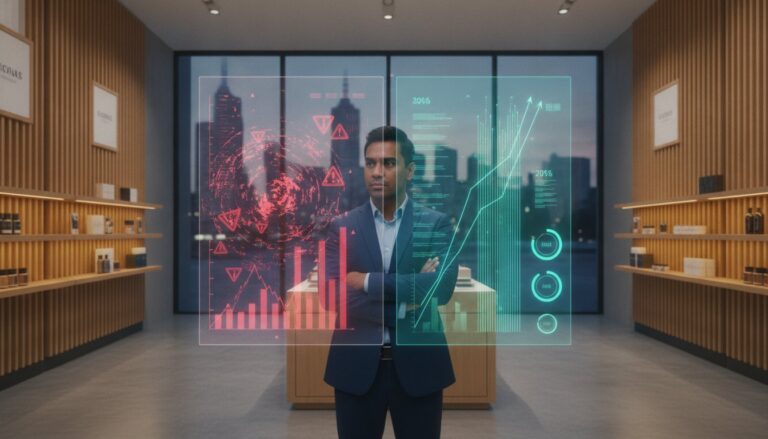

Essential Skills for the Modern Retail Operations Manager in 2026
What if the most critical asset in your toolkit isn’t your years of floor experience, but your ability to translate a sequence of human movements into a justified line item on a balance sheet? You likely feel the pressure of managing vast streams of retail data while struggling to prove the ROI of your staffing decisions to upper management. It’s a common challenge to bridge the performance gap between your online presence and physical Australian storefronts. This article identifies the essential skills for the modern retail operations manager, providing a roadmap to master the analytical and leadership capabilities needed for the 2026 market. You’ll learn to move beyond intuition and use empirical evidence to drive operational excellence. We’ll examine how integrating AI-driven tools like the FootfallCam Pro2 and V9 Software allows you to transform raw metrics into actionable strategies that future-proof your career and drive A$ profitability.
Key Takeaways
- Shift from intuition-based management to a data-orchestration model that interprets physical presence as a sequence of actionable human actions.
- Cultivate the specific skills for the modern retail operations manager required to merge footfall analytics with sales data, ensuring every staffing decision is backed by empirical ROI.
- Learn to apply spatial literacy to store environments, using dwell time and movement patterns to optimise layouts for maximum engagement and profitability.
- Navigate the transition to advanced retail tech stacks by leveraging the FootfallCam Legacy Swap Out Plan to implement AI-driven accuracy across all Australian locations.
The Evolution of Retail Operations: From Intuition to Data Orchestration
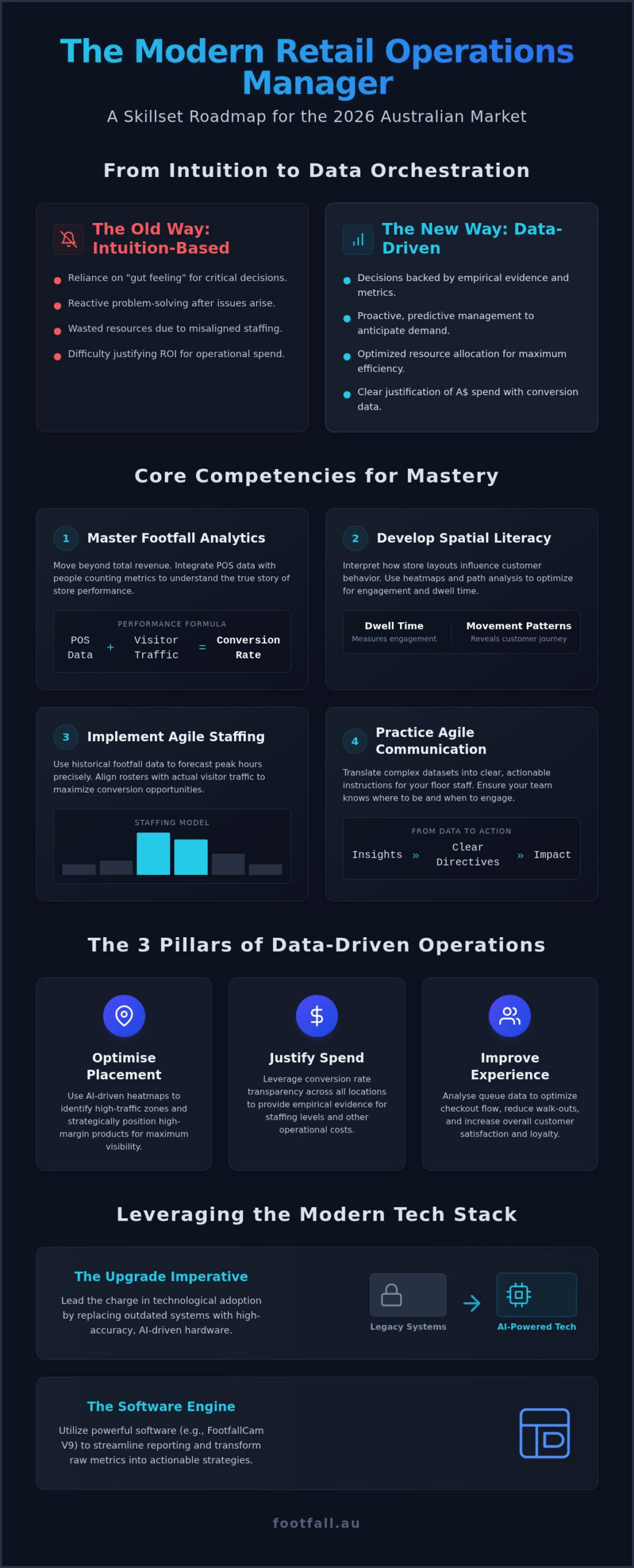
The role of the retail operations manager has undergone a fundamental transformation. By 2026, successful managers act as a vital bridge between physical store behaviour and digital insights. They don’t just watch the floor; they interpret it. Historically, many Australian managers relied on “gut feeling” to determine staffing levels or layout changes. Today, this intuition is insufficient for high-stakes environments where every square metre must perform. Relying on guesswork in a market with high A$ labour costs leads to wasted resources and missed conversion opportunities.
The modern approach shifts from reactive problem-solving to proactive, predictive management. Instead of wondering why sales were low yesterday, managers use real-time data to anticipate demand. This evolution requires specific skills for the modern retail operations manager, focusing on the ability to treat physical presence as a quantifiable sequence of actions rather than just a crowd.
Navigating the 2026 Australian Retail Landscape
Rising labour costs and evolving consumer expectations demand extreme precision in store operations. Implementing retail footfall analysis Australia wide allows managers to maintain a competitive edge by aligning staff schedules with actual visitor peaks. This strategic expertise ensures that every A$ spent on payroll generates a measurable return.
Effective managers now prioritise three key pillars:
- Identifying high-traffic zones using AI-driven heatmaps to optimise product placement.
- Justifying operational spend through conversion rate transparency across all locations.
- Optimising queue management to reduce walk-outs and improve customer satisfaction.
Data Orchestration is the ability to synchronise technology, staff, and customer flow into a single, efficient operational rhythm. By mastering these competencies, managers transition from floor supervisors to strategic experts who drive long-term growth.
Core Competencies: Mastering Footfall Analytics and Agile Staffing
Mastering the specific skills for the modern retail operations manager requires a shift from viewing sales in isolation to understanding the complete visitor journey. True performance isn’t measured by total revenue alone; it’s defined by your conversion rate. By integrating POS data with people counting metrics, you can identify whether a dip in sales stems from low traffic or a failure to close deals on the floor. This clarity allows you to address the root cause of underperformance immediately.
Managers must also develop ‘Spatial Literacy’. This involves interpreting how store layouts influence customer dwell time and movement patterns. If a high-margin display sees high traffic but zero dwell time, the physical arrangement is likely failing to capture interest. Agile communication is the final piece of this competency. You must translate these complex datasets into clear, actionable instructions for your floor staff, ensuring they know exactly where to be and when to engage for maximum impact. Furthermore, supporting the physical health of staff who are constantly on their feet is essential for productivity; to see how specialized wellness services like reflexology from Feet & Life can help, find out more.
Optimising Labor Allocation with Predictive Traffic Patterns
Effective staffing relies on forecasting rather than reaction. Use historical footfall data analysis to map out peak hours and adjust rosters with precision. This data-driven approach allows you to justify staffing costs to stakeholders by highlighting ‘missed opportunities’, those critical windows where high visitor volume didn’t result in sales due to inadequate floor coverage.
Implementing these insights becomes significantly easier with intuitive tools like FootfallCam V9 Software, which streamlines reporting for immediate action. By aligning your team with predicted human movement, you eliminate the guesswork that often leads to overstaffing during quiet periods or being under-resourced during surges. This ensures every A$ spent on labour is an investment in conversion rather than a sunk cost.
Technology Integration: Leveraging the Modern Retail Tech Stack
Accuracy is the foundation of any data-driven strategy. Managers must take responsibility for data integrity by scheduling regular people counter support and maintenance. Without consistent verification, even the most sophisticated analytics become unreliable. Developing these skills for the modern retail operations manager ensures that data remains a tool for growth rather than a source of confusion. Reliable data ensures that every A$ invested in store improvements is backed by empirical evidence.
Deploying the FootfallCam Ecosystem for Operational Excellence
The FootfallCam V9 Software acts as the central hub for these operations. It generates automated reports that highlight critical operational gaps, such as underutilised floor space or bottlenecked entry points. For managers looking to maximise existing assets, the FootfallCam Centroid is a powerful tool. It repurposes existing CCTV into an analytical asset, demonstrating resourcefulness and commitment to cost-efficiency. To stay ahead of the curve, managers should explore the definitive guide to people counting systems in Australia to refine their technological strategy.
Future-Proofing Your Retail Strategy
The transition from floor supervisor to data orchestrator is the defining shift for the coming years. Mastering the skills for the modern retail operations manager requires a commitment to empirical evidence over intuition. By combining spatial literacy with predictive traffic patterns, you can optimize A$ labor costs and drive measurable conversion growth. Don’t let your operations rely on guesswork when empirical clarity is within reach. Success in the 2026 landscape depends on your ability to integrate AI-driven hardware with intuitive software to interpret human actions with precision.
Footfall Australia brings over 20 years of expertise in the Australian market to help you achieve this standard. Our solutions provide AI-driven accuracy for operational decision-making and seamless integration with FootfallCam V9 analytics software. Equip your management team with the FootfallCam Pro2 today. Build a resilient, future-proof career by letting data lead every strategic move.
Frequently Asked Questions
What is the most important hard skill for a retail operations manager in 2026?
Data orchestration is the most critical hard skill. It involves synchronising physical traffic data with sales performance to drive decisions. Managers shouldn’t rely on basic reporting; they must interpret human movement as a sequence of actions. This technical proficiency ensures every operational change is backed by empirical evidence, making it one of the essential skills for the modern retail operations manager.
How does footfall data help in reducing retail operational costs?
Footfall data reduces costs by aligning staff rosters with actual visitor demand. Instead of overstaffing during quiet periods, managers use traffic patterns to allocate resources precisely. This prevents wasted A$ labour costs and ensures peak periods are properly supported. Accurate metrics from devices like the FootfallCam Pro2 allow for lean, efficient operations that maintain high service standards without unnecessary expenditure.
Can an operations manager improve sales without increasing the marketing budget?
Sales can be improved by focusing on the conversion rate of existing traffic. By analysing dwell times and heatmap data, managers can optimise store layouts to increase engagement. Improving the customer journey and ensuring staff are positioned in high-traffic zones captures missed opportunities. This strategy turns current visitors into buyers without spending a single extra A$ on external marketing campaigns.
What software tools should a modern retail operations manager be proficient in?
Proficiency in advanced analytical platforms like FootfallCam V9 Software is essential. These tools provide the intuitive reporting needed to bridge the gap between raw data and strategic action. It isn’t enough to just collect data; managers must integrate these insights with POS systems. Mastering these digital tools is a core part of the skills for the modern retail operations manager, enabling automated excellence.