
Calculating Tenant Revenue from Footfall: 2026 Guide
What if your most reliable revenue forecast isn’t found in a tenant’s self-reported ledger, but in the sequence of footsteps crossing their threshold? You likely already know that relying on manual sales reporting creates a visibility gap that makes setting fair turnover rent thresholds nearly impossible. It’s a common frustration for Australian property managers who need objective data to justify lease renewals or rental increases. This 2026 guide delivers a rigorous methodology for calculating tenant revenue based on footfall by leveraging precision hardware and retail conversion benchmarks. You’ll learn how to transform raw visitor counts into a reliable turnover estimate that stands up during tough negotiations. We will break down the exact formula for predicting revenue, explain how to validate tenant health using the FootfallCam Pro2, and show you how to use these insights to optimise the long-term value of your retail assets.
Key Takeaways
- Master the three-pillar formula to convert raw visitor numbers into accurate turnover estimates using conversion rates and average transaction values.
- Learn the precise methodology for calculating tenant revenue based on footfall to validate sales reporting and set fair turnover rent thresholds.
- Utilise FootfallCam Pro2 hardware to establish a high-accuracy traffic baseline, eliminating the guesswork from tenant health assessments.
- Discover how FootfallCam V9 software integrates with POS systems to provide real-time visibility into store performance across your retail portfolio.
The Core Relationship Between Footfall and Retail Revenue
Physical retail performance is often judged by the finality of a transaction. However, viewing success through the narrow lens of Point-of-Sale (POS) data ignores the vast majority of human behaviour within a store. Footfall represents the total “opportunity volume” available to a tenant. It’s the raw potential of a physical environment before operational variables like staffing or inventory come into play. Relying solely on sales figures provides an incomplete picture of tenant health because it fails to account for missed opportunities or the intrinsic value of the location itself. By calculating tenant revenue based on footfall, landlords can differentiate between a low-performing site and a low-performing operator. This distinction is vital for maintaining a high-quality tenant mix across an Australian retail portfolio.
The Fundamental Revenue Estimation Formula
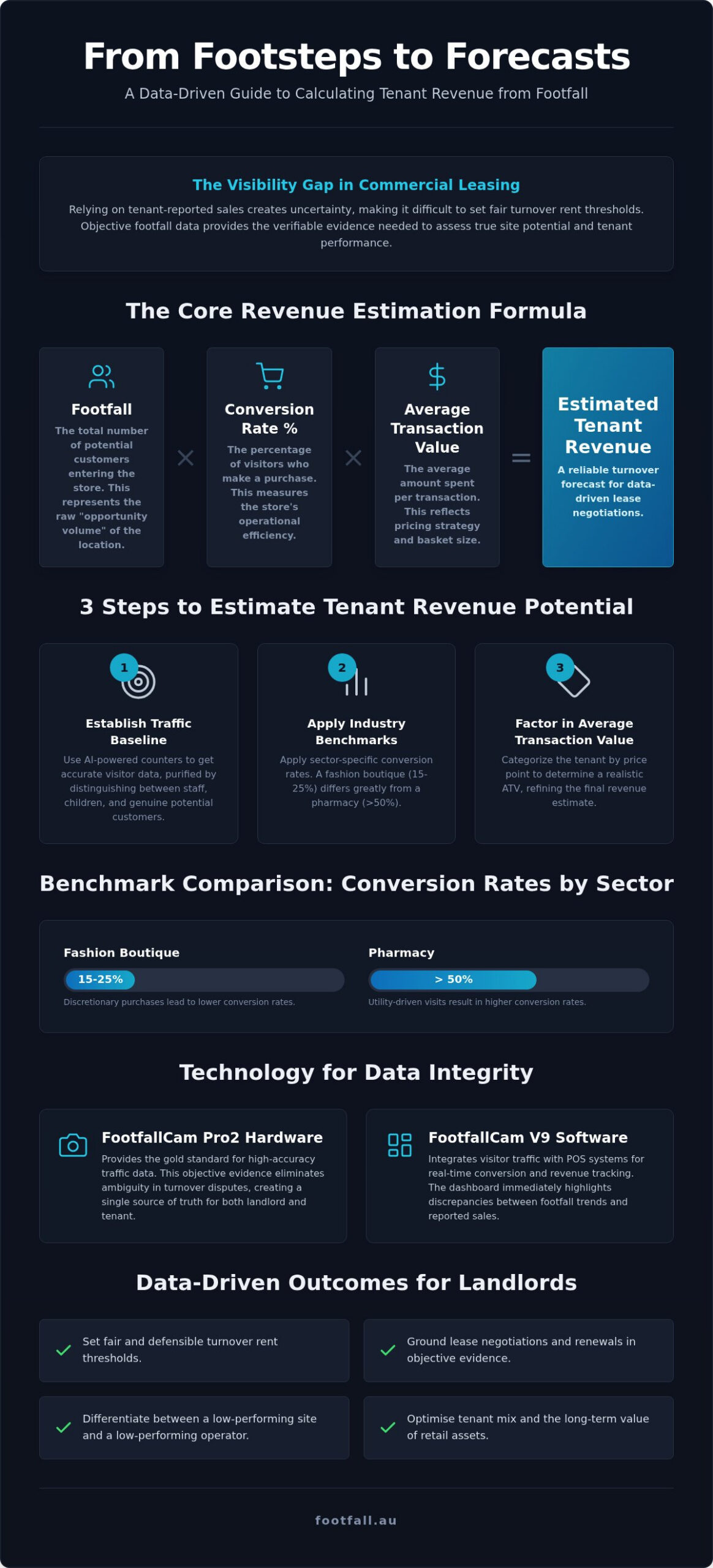
Predicting economic outcomes requires a structured approach rooted in empirical logic. The three-pillar formula used by strategic consultants is: Revenue = Footfall x Conversion Rate x Average Transaction Value (ATV). Each component serves a distinct purpose. Footfall measures site reach, while ATV reflects pricing strategy and basket size. Conversion Rate is the percentage of visitors who complete a purchase. Without precise traffic counts, you lack the denominator required for footfall data analysis, which is essential for measuring true store efficiency. Integrating these metrics facilitates calculating tenant revenue based on footfall with high precision, ensuring that lease negotiations are grounded in evidence. It’s about moving beyond intuition to understand the narrative of movement within the space. This data-driven clarity helps property managers set turnover rent thresholds that accurately reflect the commercial opportunity provided by the shopping centre.
How to Estimate Tenant Revenue Potential: A Step-by-Step Guide
Transitioning from theoretical models to practical application involves a methodical three-step process. First, establish an accurate baseline of visitor traffic using AI-powered counters. These devices distinguish between staff, children, and groups, ensuring your “opportunity” data is a purified representation of potential customers. Second, apply industry-specific conversion rate benchmarks. For example, an Australian fashion boutique might see conversion rates between 15% and 25%, whereas a pharmacy often exceeds 50% due to the utility-driven nature of the visit. Finally, factor in the Average Transaction Value (ATV) by categorising the tenant’s price point and category. This structured approach is the most reliable way of calculating tenant revenue based on footfall when direct sales data is withheld or delayed.
Benchmarking Conversion and Basket Size
Refining your estimates requires granular data beyond simple entrance counts. Australian retail benchmarks vary significantly by sector, making it essential to use category-specific data when calculating tenant revenue based on footfall. Advanced sensors also capture “dwell time” metrics, allowing you to adjust revenue forecasts; longer dwell times in high-end apparel often signal a higher ATV. These insights empower landlords to set “artificial breakpoints” in commercial lease agreements. Rather than waiting for a tenant to report sales, you can use traffic-derived potential as a benchmark for performance reviews. If you’re looking to implement this level of precision across your centre, exploring professional counting hardware is the first step toward empirical lease management. This shift ensures rent reviews are based on the actual commercial value provided by the site’s traffic flow and the tenant’s ability to capture that volume effectively.
Validating Turnover Rent with FootfallCam Pro2 Technology
Establishing a foundation of trust between landlords and tenants requires more than just goodwill; it demands data integrity. The FootfallCam Pro2 serves as the gold standard for high-accuracy data collection in Australian shopping centres. By capturing precise entry and exit counts, this hardware provides the objective evidence needed when calculating tenant revenue based on footfall. When disputes arise regarding percentage rent or turnover reporting, having a verifiable record of visitor volume eliminates ambiguity. It ensures that both parties work from a single source of truth, protecting the landlord’s yield while respecting the tenant’s operational reality.
Automating Insights with FootfallCam V9 Software
Efficiency in modern property management stems from the seamless integration of disparate data sets. FootfallCam V9 Software bridges the gap by connecting visitor traffic with POS systems to provide real-time conversion and revenue tracking. The intuitive dashboard allows property managers to compare footfall trends against reported sales, highlighting discrepancies immediately. For centres burdened by outdated hardware, the Legacy Swap Out Plan offers a streamlined path to modernising people counting systems Australia wide. This transition to automated reporting reduces administrative friction and fosters a culture of transparency. Calculating tenant revenue based on footfall becomes a proactive strategy rather than a reactive audit. It empowers you to identify underperforming assets and make informed decisions that enhance the overall health of your retail environment.
Securing the Future of Data-Driven Property Management
Transitioning to an empirical lease management model ensures that your decisions are backed by the narrative of human movement rather than incomplete sales reports. By mastering the relationship between opportunity volume and conversion, calculating tenant revenue based on footfall becomes a precise science that protects your asset’s yield. We’ve explored how the FootfallCam Pro2 sensors and the V9 analytics platform provide the data integrity needed to validate turnover rent and resolve disputes with confidence. These tools don’t just report numbers; they empower you to understand the true health of your retail environment. With local Australian support and specialised maintenance plans, you can maintain a high-accuracy network that scales with your portfolio. Take the next step in optimising your retail strategy and request a consultation for your national retail network today. Accurate data is the foundation of long-term commercial success.
Frequently Asked Questions
Can I accurately predict revenue for a new tenant before they open?
You can estimate revenue potential by analysing the historic footfall of the specific retail unit and applying industry-specific conversion benchmarks. By using FootfallCam Pro2 sensors, you establish a baseline of the opportunity volume the location provides. Combining this traffic data with the Average Transaction Value of similar tenants allows for a data-driven revenue forecast before a new lease is even signed.
What is a typical retail conversion rate for Australian shopping centres?
Conversion rates vary significantly across different retail categories. In the Australian market, high-end fashion boutiques typically see rates between 15% and 25%. Conversely, utility-based retailers like pharmacies or newsagents often achieve rates exceeding 50%. These benchmarks are essential when calculating tenant revenue based on footfall, as they allow property managers to set realistic performance expectations for each unique store type.
How does footfall data help in setting percentage rent thresholds?
Footfall data provides an objective measure of the commercial opportunity a landlord provides to a tenant. By establishing a clear visitor baseline, you can set artificial breakpoints in lease agreements. This ensures that percentage rent thresholds are grounded in the actual traffic volume entering the store. It protects your yield if a tenant’s reported sales seem disproportionately low compared to their verified visitor traffic.
Is footfall data alone enough to calculate tenant turnover?
Footfall data is the essential denominator, but it must be combined with conversion rates and Average Transaction Value (ATV) for a complete turnover estimate. While traffic counts show the total opportunity, calculating tenant revenue based on footfall requires these additional variables to reflect operational execution. FootfallCam V9 software simplifies this process by integrating traffic patterns with sales data for high-precision validation.