
Privacy-Compliant People Counting in Australia: A Practical Guide
What matters for privacy is not what a people counter is called, but what it collects and how the data is used.
It’s reasonable to want clear answers before introducing in-store analytics. A people counter may serve a different purpose from CCTV, but the device label alone doesn’t establish what information is processed or whether it could identify someone. For Australian businesses, privacy compliant people counting Australia starts with documenting the system’s actual data flows, not relying on assumptions.
This guide explains how to identify the privacy questions to assess, distinguish counting analytics from surveillance, and create a practical customer-facing policy backed by clear governance. It also shows how to assess hardware and software together, including collection, use, access and retention. The result is a stronger basis for responsible measurement and operational decisions.
Key Takeaways
- For privacy compliant people counting Australia, assess what the system collects, processes and retains rather than relying on its product label.
- Build your policy through a practical workflow: define the purpose, map data flows, check applicable obligations, draft notices, set controls and schedule reviews.
- Turn policy commitments into deployment requirements for data access, retention and security, then assess the hardware and software against them.
- Verify technical details and current OAIC guidance before making privacy claims. Clear documentation helps keep decisions proportionate and accountable.
Privacy-compliant people counting in Australia starts with understanding the data
People-counting analytics measures patterns such as entries, exits, visits or movement through a store. These metrics can help retailers understand customer flow and make operational decisions, but systems differ in what they collect and how they process it. A report showing only a total count doesn’t, by itself, tell you what information the system handled along the way.
For privacy compliant people counting Australia, assess the actual data lifecycle rather than relying on terms such as “analytics” or “anonymous”. Ask what the hardware captures, what the software derives, whether individuals could be identified, how the results are used, and how long any source data is kept. These details help distinguish aggregate measurement from a system that captures or uses identifiable images.
When can in-store analytics involve personal information?
Images that reveal a person’s identity may affect the privacy assessment. Device identifiers or datasets that become identifiable when combined with other information may also be relevant. A report containing totals or movement trends may be less identifying, but its aggregate format doesn’t establish whether identifiable information was collected or processed earlier.
Privacy assessment means examining the full data lifecycle, from collection and processing through use, access and retention, to determine whether information can identify an individual.
Map each stage across the counter, software and any connected systems. Record what is captured, where it is processed, who can access it, what is retained, and whether information is shared. This gives your team a factual basis for distinguishing people counting from CCTV surveillance, which may capture images for a different purpose. The distinction depends on the system’s actual capabilities and use, not its label.
The Privacy Act 1988 is a key part of Australia’s privacy framework, but whether particular obligations apply depends on the organisation and circumstances. Check current OAIC guidance when assessing your setup. This overview isn’t legal advice.
How to create an Australian in-store analytics privacy policy
A useful policy turns your intended use of in-store analytics into clear, reviewable decisions. For privacy compliant people counting Australia, document the system’s actual data practices and explain them in language customers can understand. The Privacy Act and Australian Privacy Principles apply to organisations covered by them, subject to relevant exceptions. Check current OAIC guidance and exemptions, and use the Australian Attorney-General’s Department privacy overview as a starting point.
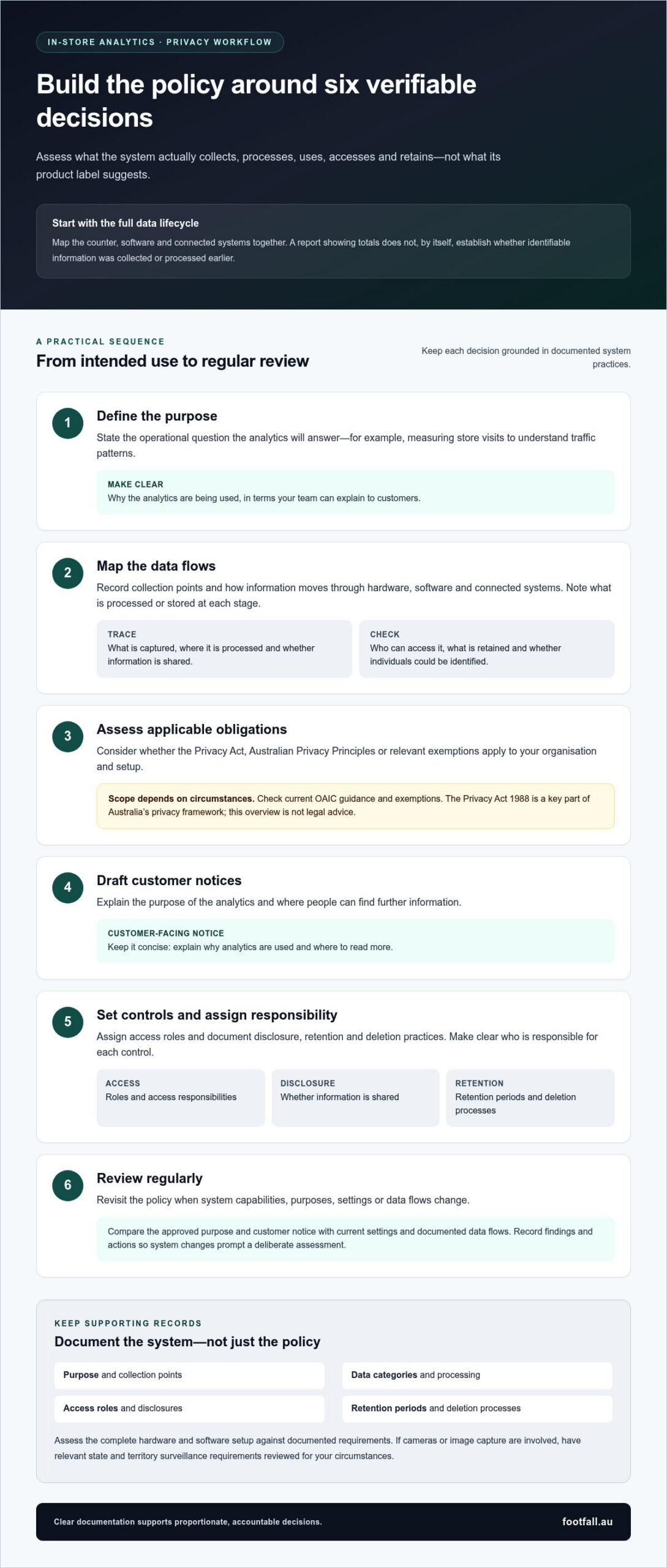
Use this workflow to build the policy and its supporting records:
- 1. Define the purpose. State the operational question the analytics will answer, such as measuring store visits to understand traffic patterns.
- 2. Map data flows. Record collection points and how information moves through hardware, software and connected systems. Note what is processed or stored at each stage.
- 3. Assess obligations. Consider whether the Privacy Act, APPs or relevant exemptions apply to your organisation and setup.
- 4. Draft customer notices. Explain the purpose of the analytics and where people can find further information.
- 5. Set controls. Assign access roles and document disclosure, retention and deletion practices. Make clear who is responsible for each control.
- 6. Review regularly. Revisit the policy when system capabilities, purposes, settings or data flows change.
What should the policy and supporting records document?
Keep an internal record of purposes, collection points, data categories, access roles, disclosures, retention periods and deletion processes. Make the customer-facing notice concise: explain why analytics are used and where to read more. If cameras or image capture are involved, have relevant state and territory surveillance requirements reviewed for your circumstances.
Use these requirements to assess the complete hardware and software setup rather than relying on a product label. Footfall Australia supplies people-counting hardware and analytics software, including FootfallCam Pro2 People Counters and FootfallCam V9 Software. Compare the system’s documented data practices with your requirements for collection, access and retention. This information is general and isn’t legal advice.
Put privacy commitments into practice with people-counting technology
A policy becomes useful when its commitments shape system selection, configuration and ongoing operation. For privacy compliant people counting Australia, translate each requirement into something your team can verify. Specify permitted collection, who can access information, how retention and deletion are managed, and what security measures are expected. Then document how the deployment meets those requirements.
Assess FootfallCam Pro2 People Counters and FootfallCam V9 Software against the same documented criteria. Review the product and configuration details for what is collected, processed, stored, accessed and disclosed. Record verified technical details in your privacy assessment and customer notice, rather than inferring capabilities from a product label. Evaluate the full hardware and software data flow as one system.
How should a business review a people-counting deployment?
Compare the approved purpose and customer-facing notice with the system’s current settings and documented data flows. Assign named owners for access reviews, incident escalation, policy updates and system changes. Record findings and actions so a change, such as connecting another system, prompts a deliberate assessment rather than an undocumented expansion of use.
Ongoing review keeps documented privacy practices aligned with how the people-counting system actually operates. Set a review schedule that suits your organisation, and revisit the assessment after material changes. The Office of the Australian Information Commissioner (OAIC) provides privacy guidance to inform that work. For background on selection and implementation, explore our FootfallCam Pro2 buying guide and people-counting technology guide as you define requirements and deployment decisions.
Make privacy governance part of every measurement decision
People-counting data is most valuable when its purpose is clear and its handling remains accountable. Treat your documented requirements as a working standard, revisiting them as business needs, system settings or data flows change. That discipline helps your team make informed decisions and explain them clearly to customers.
For privacy compliant people counting Australia, compare your requirements with the technology that will support them. Footfall Australia supplies people-counting hardware and analytics software nationally, including FootfallCam Pro2 People Counters and FootfallCam V9 Software. Use your documented governance requirements to guide system selection and deployment.
Explore Footfall Australia’s people-counting solutions and take a practical next step towards analytics that supports better decisions and responsible data practices.
Frequently Asked Questions
Does the Australian Privacy Act apply to every business using in-store people counting?
No. The Privacy Act 1988 doesn’t automatically cover every business or every counting system. Whether it applies depends on factors such as the organisation’s type and circumstances, including relevant small-business exceptions. The device itself doesn’t determine coverage. For privacy compliant people counting Australia, assess your organisation’s position and check current Office of the Australian Information Commissioner (OAIC) guidance before deciding which obligations apply.
Is people counting the same as CCTV surveillance?
No. People counting aims to measure traffic patterns, while CCTV is commonly used to monitor or record visual activity. The distinction depends on system capabilities and use: some counters may process images, and a camera may serve both analytics and security purposes. If one installation performs both functions, document each purpose separately and assess image handling and access arrangements for each.
Do Australian retailers need signs for in-store people counting?
There isn’t one blanket answer for every installation. Notice expectations can depend on what the system captures, how it’s used and applicable state or territory requirements, particularly where cameras or images are involved. A clear entrance notice can help customers understand the purpose of analytics and where to find more information. Treat signage as part of transparent communication, not a substitute for checking applicable requirements.
How often should a business review its people-counting privacy policy?
Set a planned review schedule, then update the policy whenever a meaningful change could make it inaccurate. Triggers include a new analytics purpose, altered camera settings, a system integration, changed access roles or a data incident. For example, adding a security use to a counter originally deployed for traffic measurement should prompt a review before that new use begins.