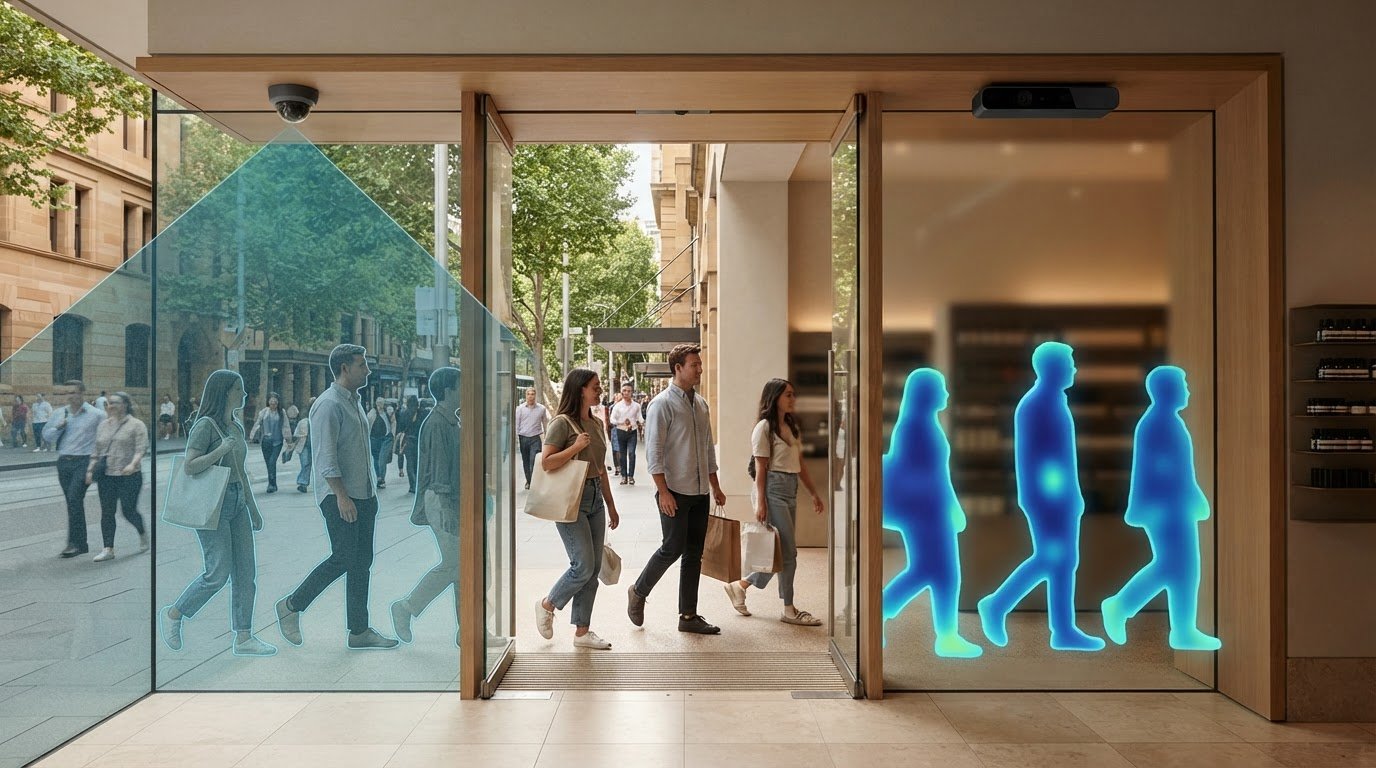
3D People Counting or CCTV for Footfall Accuracy
CCTV isn’t automatically the less accurate option. Moving from CCTV counting to dedicated 3D sensors makes sense when depth-based detection at a defined entrance is more useful than analysing video across a wider area. CCTV systems use AI to count people from video, while 3D counters use depth information to distinguish people by shape and movement.
Both approaches can turn foot traffic into useful operational data, but the right fit depends on the space and what you need to measure. This comparison explains how 3D people counting works, where CCTV counting can be effective, and how camera-based accuracy can be affected by installation angle, obstructions and crowd density. You’ll also find a practical decision guide to help match the counting method to your entrance, store zones or queue areas.
Key Takeaways
- Assess counting accuracy at busy periods and in the actual conditions of your site, not just from a general specification.
- Match the sensor to the space: a focused entrance and a broad, multi-zone area can call for different approaches.
- Consider how each method handles privacy, lighting, obstructions and people moving together.
- Use a manual count as a practical benchmark when evaluating whether your current setup captures footfall reliably.
How accurate is camera-based footfall?
Camera accuracy depends on angle, mounting height and crowd density. At a defined entrance, a dedicated 3D sensor can focus measurement on people crossing that point.
Image and Depth Sensors
Image sensors capture visual frames, while stereo vision estimates depth by comparing images from two lenses. Time-of-Flight sensors record depth geometry rather than conventional pictures, reducing the visual detail collected. Both approaches can detect movement, but the data differs: one includes images, while the other can provide occupancy metadata without identifying individuals. When assessing privacy, consider what the system captures, processes and retains.
CCTV Counting Limitations
CCTV counting applies AI to video, so accuracy can shift with camera angle, height and crowd density. Shadows, obstructions and moving objects such as baby carriages can complicate detection. Video also creates privacy considerations because footage may show identifiable visitors; metadata-based processing reduces the visual information involved. For an Australian site, assess the footage collected and how it is handled alongside counting performance.
Published accuracy figures depend on the system and conditions: modern 3D stereo counters are described at 95-98%, while 3D camera-based counters are also described as close to 99% or higher. Treat these as distinct reported claims, not a universal guarantee. A sensor’s limited field of view can also make it inefficient across large, open areas.
| Option | Accuracy considerations | Privacy and coverage |
|---|---|---|
| CCTV video counting | Angle, height, density, shadows | Video; can cover multiple zones |
| 3D depth sensor | High accuracy at a defined entrance | Depth data; narrower field of view |
Compare peak-period counts with a manual count at your site to assess performance.
How does this differ from a 3D counter or dedicated sensor?
A 3D counter measures depth, helping distinguish people by height, shape and movement. Its sensing method affects performance in retail entrances, groups and changing lighting.
Time-of-Flight Depth Sensing
Time-of-Flight (ToF) sensors emit infrared light and measure how long it takes to return, creating a depth map rather than a conventional image. Their own infrared illumination allows them to operate in darkness. Stereo vision estimates distance by comparing images from two lenses, and adequate lighting can matter. The choice affects how a device reads footfall, not what the resulting traffic count means.
Depth Counting in Crowded Scenes
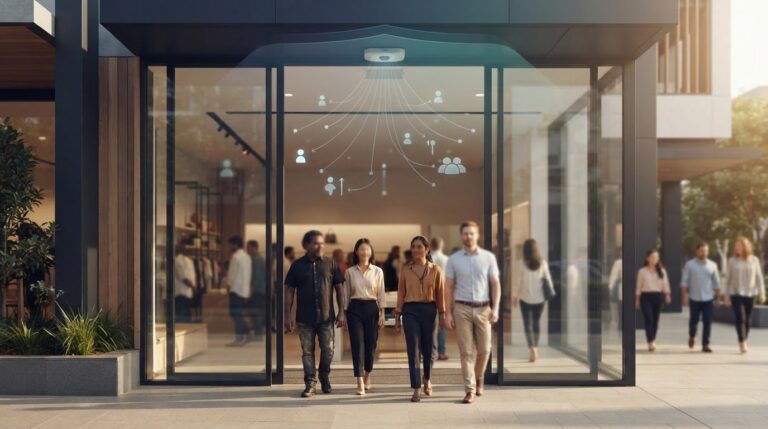
Mounted above an entrance, a top-down depth sensor reads people’s height and shape as they cross its field of view. Stereo systems can separate people travelling in groups and identify direction more reliably than a beam counter. During calibration, height thresholds can filter objects that do not meet the set criteria, helping distinguish a person from a pushchair. Depth information is useful when retail traffic moves quickly through a defined counting point.
For a practical assessment, first identify whether you need entry counts, movement direction or broader zone analysis. Then consider the sensor’s position, lighting and the mix of people and objects passing beneath it. A doorway counter can support footfall measurement, while operational teams can use trends to consider staffing and conversion alongside other business data. Compare dedicated people-counting sensors with the movement you need to measure, rather than choosing by camera type alone.
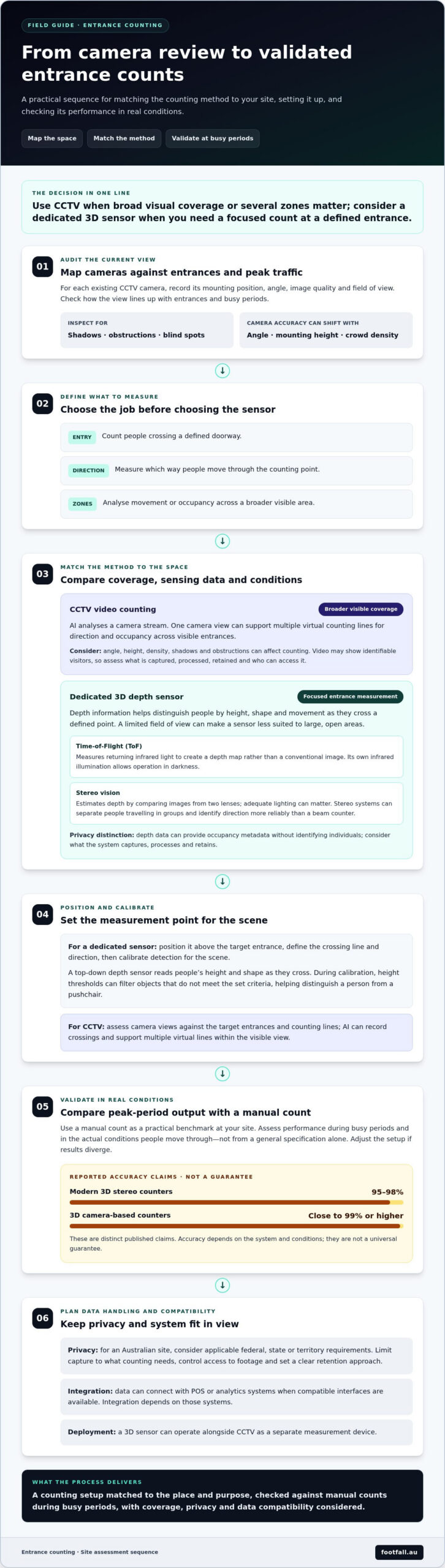
CCTV video-based people counting
CCTV counting uses AI to analyse a camera stream, detect people and record crossings. A single camera view can support multiple virtual counting lines, showing direction and occupancy across visible entrances.
In Australia, privacy obligations depend on whether footage or count data identifies individuals and which federal, state or territory requirements apply. Limit capture to what counting needs, control access to footage and set a clear retention approach.
Before switching, map each existing camera’s mounting position, angle, image quality and field of view. Compare those views with entrances and peak traffic, then identify shadows, obstructions and blind spots affecting precise counts.
For installation, position a dedicated sensor above the target entrance, define the crossing line and direction, then calibrate detection for the scene. Compare its output with a manual count during busy periods and adjust the setup if results diverge.
A 3D sensor can operate alongside CCTV as a separate measurement device. Data can connect with POS or analytics systems when compatible interfaces are available; integration depends on those systems.
CCTV remains useful when teams need broader visual coverage or several zones from one camera. A dedicated 3D counter focuses on movement at its installed location, measuring height and direction without relying on a conventional video image. That distinction matters when a visitor crosses among groups, or when occupancy needs a focused count rather than a display of video.
To assess a transition, document the current camera views, counting needs and data destinations before selecting sensor positions. This makes gaps in coverage and system compatibility visible early. Plan a dedicated people-counting assessment around the entrances and data your operations need.
Footfall Australia: FootfallCam Pro2 People Counters
Footfall Australia offers FootfallCam Pro2 People Counters for organisations assessing a dedicated approach to footfall measurement. They’re relevant when existing CCTV views don’t provide the entrance-level counts or movement data needed for operational decisions.
Use your site layout, current camera coverage and reporting needs to define what you want to measure. Footfall Australia also offers FootfallCam Pro1 IP Cameras, FootfallCam Centroid and FootfallCam V9 Software. These offerings give you options to discuss when considering how people-counting devices and software fit your measurement requirements.
To discuss your people-counting requirements, contact Footfall Australia.
Make your next footfall decision evidence-led
Moving from CCTV counting to dedicated 3D sensors is most useful when the measurement method supports a clear operational decision. Start by defining what your team needs to understand, then align the technology with the space and the movement you want to measure. That turns counting data into a practical input for planning, not just another display of activity.
Footfall Australia offers FootfallCam Pro2 People Counters, FootfallCam Pro1 IP Cameras and FootfallCam Centroid. These options can help frame a discussion around your existing setup and measurement priorities.
Contact Footfall Australia to discuss your people-counting needs and take a considered next step with your footfall measurement.
Frequently Asked Questions
What is 3D people counting?
3D people counting uses depth information to detect people crossing a defined area. A sensor can distinguish movement by shape and direction, rather than relying only on flat image features. For example, a venue can measure entries and exits separately at a shared doorway, helping staff compare arrival patterns with occupancy changes during operating hours.
When is computer vision footfall the right call?
Computer vision footfall suits sites that need to understand activity across broader areas, not just doorway crossings. For example, a shopping centre may want to analyse paths between zones, while a retailer may need to review queue activity. If you’re moving from CCTV counting to dedicated 3D sensors, first decide whether your priority is a focused entrance count or wider visual analysis.
How do CCTV people-counting systems compare with dedicated 3D sensors for accuracy and reliability?
CCTV can serve several measurement points within its field of view, while a dedicated sensor focuses on its installed counting area. Reliability depends on whether the camera view remains clear as traffic, lighting and layouts change. For a useful comparison, record manual counts during representative busy and quiet periods, then compare each system’s direction and entry totals.
What accuracy can 3D people-counting sensors achieve in retail and public spaces?
Modern 3D stereo counters are described as achieving 95-98% accuracy in most conditions; other 3D camera-based counters are described as close to 99% or higher. These are different reported ranges, not a single guaranteed result. In a retail entrance or public venue, compare sensor counts with a manual tally during peak traffic to assess site performance.
How much do dedicated 3D people-counting sensors cost in Australia, including installation?
There’s no single Australian price for a dedicated 3D people-counting system, including installation. The cost depends on the site and is provided after a quote request. Factors include the number and position of sensors, mounting requirements, existing network compatibility and the reporting scope. Share your entrance layout and measurement needs when requesting a quote to support an accurate project assessment.