
Presenting Footfall Data to Management: A Strategic Framework for Actionable Insights
73% of your customers will abandon a purchase if they have to wait for more than five minutes. While retail wait times have surged by 61% since 2022, many executives still dismiss visitor counts as a vanity metric rather than a diagnostic tool for business health. You likely recognize that these numbers represent the silent narrative of your store’s success, yet you struggle to bridge the gap between technical data and executive buy-in. Effectively presenting footfall data to management requires moving past the charts to focus on the financial mandates that drive high-level decisions.
We understand the frustration of seeing actionable insights ignored because they aren’t tied to the bottom line. This article promises to help you transform raw movement patterns into a compelling business case that secures strategic shifts. We’ll explore how a 1% increase in dwell time can lead to a 1.3% increase in sales and how to align your reporting with the EU AI Act requirements taking effect on August 2, 2026. You’ll gain a clear reporting framework that uses FootfallCam V9 software to turn spatial analytics into a roadmap for operational excellence and long-term growth.
Key Takeaways
- Shift from vanity metrics to actionable intelligence by identifying specific operational changes driven by visitor movement patterns.
- Master the process of presenting footfall data to management by aligning traffic statistics with core financial KPIs like sales conversion and capture rates.
- Utilize a structured narrative arc in your reports to lead with financial results and provide clear resolutions to identified performance gaps.
- Build executive confidence by defending data integrity and addressing common objections with objective, evidence-based spatial analytics.
- Leverage FootfallCam V9 software to automate the delivery of professional PDF reports and real-time dashboards to decision-makers.
Why Traditional Footfall Reporting Fails to Move Management
Management often views total visitor counts as a vanity metric. It’s a number that looks good on a slide but fails to explain how to increase revenue or optimize resources. In Australia, a significant disconnect exists between data collection and strategic execution. While many businesses invest in people counting systems, the resulting reports often lack the practical depth required for high-level decision-making. Executives don’t just want to know how many people entered a space; they want to know what those numbers mean for the bottom line. Strategic footfall reporting is the alignment of visitor behavior with financial outcomes.
The Difference Between Data and Insights
Raw data tells you what happened, while insights tell you why it matters. For instance, knowing that 5,000 people entered your store last Saturday is a data point. An insight reveals that despite this high traffic, your conversion rate dropped by 4% because retail wait times have surged by 61% since 2022. Decision-makers prioritize metrics like Capture Rate and Sales Conversion because these figures directly influence ROI. When presenting footfall data to management, every chart must answer a specific business question. If the data doesn’t lead to a clear “what now?” moment, it’s just noise that obscures the path to growth. Identifying the “So What?” factor in every report ensures that your analysis remains relevant to those holding the budget.
Common Reporting Mistakes That Lose Executive Attention
Decision-makers have limited bandwidth and value precision over volume. Over-complicating visualizations with too many variables is a quick way to lose their interest. Reports often fail because they don’t link trends to department-specific KPIs. Marketing needs to know the Capture Rate from a window display, while Operations needs to know how dwell time affects staffing levels. Another frequent error is ignoring external context. A 10% traffic spike might seem like a win, but if it occurred during a national holiday or a major local event, it’s an expected trend rather than a result of internal strategy. Failing to address people counter accuracy can also undermine your credibility if management relies on anecdotal observations from the shop floor. You must provide a narrative that accounts for these variables to maintain authority during the presentation.
Translating Raw Traffic into Executive KPIs
Raw visitor counts are a starting point, but they don’t drive decisions. KPIs do. Effective reporting means presenting footfall data to management as a financial narrative. You must shift the focus from volume to value by utilizing metrics that reflect the health of the entire business ecosystem. When you’re presenting footfall data to management, focusing on these ratios provides the clarity needed for budget approvals.
Sales Conversion Rate remains the gold standard for retail reporting. Since retail conversion rates typically hover between 20% and 40%, even a marginal 1% increase in conversion can lead to a 1.3% boost in total sales. This metric allows you to isolate store performance from external traffic trends, providing an objective view of how well your team converts opportunities into revenue. It moves the conversation from “how many people came in” to “how much money did we make from those who did.”
Capture Rate measures your street-to-store effectiveness. It reveals how many passersby were actually enticed to enter. High external traffic with a low capture rate suggests a failure in window marketing or brand appeal. Monitoring this helps justify marketing spend by proving which campaigns successfully pulled people through the door. If you’re looking for ways to optimize these metrics, exploring the solutions at footfall.au can provide the technological foundation you need.
Staffing Efficiency Ratio aligns labor costs with peak traffic periods. Data shows that 73% of customers will abandon a purchase if they wait more than five minutes. By overlaying footfall peaks with staff rosters, you can eliminate bottlenecks and ensure high service levels during the busiest windows without overspending on quiet hours. This precision reduces churn and protects your brand reputation.
Dwell Time vs. Transaction Value helps you understand the visitor journey’s quality. Longer dwell times often correlate with higher transaction values, provided the environment is optimized. If visitors spend more time in-store but sales don’t rise, it indicates a disconnect in product placement or service engagement that requires immediate attention.
Linking Footfall to the Bottom Line
Calculating the ‘Lost Opportunity Cost’ is essential for securing executive buy-in. If 1,000 people enter but only 200 buy something, you have 800 missed opportunities. Using advanced footfall data analysis helps you quantify the potential revenue lost to poor store layout or inadequate staffing. This financial framing turns a technical report into a compelling business case that management cannot ignore.
Operational KPIs for Public Spaces and Offices
For libraries, museums, or corporate offices, KPIs shift toward occupancy and utilization. Understanding space utilization rates is vital for corporate real estate optimization. When presenting data to your board or local government, use occupancy levels to justify maintenance schedules or infrastructure funding. This evidence-based approach replaces guesswork with precision, ensuring resources are allocated where they are actually used.

Structuring Your Presentation for Maximum Impact
A successful executive presentation doesn’t bury the lead. When presenting footfall data to management, start with an Executive Summary that highlights the primary financial impact immediately. If your data indicates that a 5% drop in capture rate resulted in a specific revenue loss last month, lead with that figure. Board members value efficiency; they want to see the bottom-line implications before diving into the methodology. Adhering to the “One Slide, One Message” rule ensures that your core insights aren’t lost in a sea of secondary metrics. Each slide should serve as a single, undeniable proof point for the strategic shift you’re proposing.
The most effective presentations follow a clear narrative arc: Context, Conflict, and Resolution. You provide the context by showing current traffic trends. You identify the conflict by highlighting a gap, such as high traffic volumes coupled with stagnant sales. Finally, you offer the resolution through specific, data-backed actions. This structure transforms a dry report into a compelling business case that demands a response. Presenting footfall data to management in this way positions you as a strategist rather than just a data collector.
The Three-Part Presentation Framework
Start with “The Hook” by using a surprising trend or anomaly to grab attention, such as a sudden 15% spike in weekend dwell time that didn’t translate to sales. Follow this with “The Evidence,” where you support your observations with validated people counting technology to ensure the numbers are beyond reproach. Conclude with “The Call to Action,” outlining the operational changes required to capitalize on the data, such as adjusting staff rosters or redesigning a specific store zone to improve flow.
Choosing the Right Visualizations
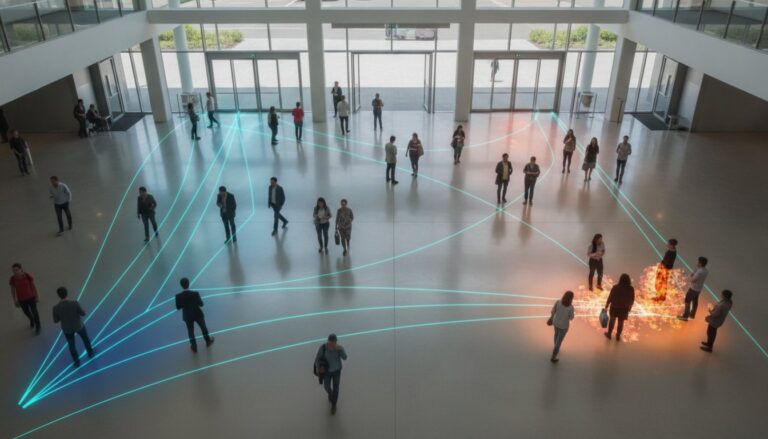
Visual hierarchy is essential for simplifying complex movement patterns. Use Year-on-Year (YoY) comparisons to show long-term growth and Week-on-Week (WoW) trends to highlight the immediate impact of recent marketing campaigns. Heatmaps are particularly powerful for explaining store layout bottlenecks to non-technical stakeholders, as they provide an intuitive look at where visitors cluster. While complex scatter plots might appeal to analysts, simple bar charts often outperform them in the boardroom because they communicate performance gaps with total clarity. Stick to clean, functional visuals that emphasize results over technical complexity.
Overcoming Common Management Objections
Anticipating executive pushback is a prerequisite for any successful strategy. When you’re presenting footfall data to management, you’ll likely face the argument that sales figures are the only metric that truly matters. You must challenge this reactive mindset by demonstrating that sales data only records your successes; it ignores the vast majority of visitors who left without making a purchase. Footfall data serves as a diagnostic tool that identifies where the sales process failed. It provides the “why” behind the revenue, transforming a simple tally into a powerful lever for operational change.
Defending people counter accuracy is often the next hurdle. Executives might favor anecdotal observations from a five-minute floor walk over long-term sensor data. You can overcome this skepticism by highlighting the precision of 3D stereoscopic sensors. Unlike legacy infrared counters that fail in crowded entrances, modern systems provide a level of evidence that gut feeling cannot match. Framing the system as a revenue generator rather than a cost center is vital. You aren’t just buying hardware; you’re investing in the ability to stop making expensive, guess-based decisions about staffing and inventory.
Privacy and compliance are non-negotiable topics in the modern boardroom. With the EU AI Act’s high-risk provisions taking effect on August 2, 2026, management needs reassurance that data collection won’t lead to legal liability. Explain that your system prioritizes privacy-by-design by using anonymized, aggregated data. It’s about counting silhouettes and movement patterns, not identifying individuals. Aligning your reporting with both GDPR and Australian privacy standards ensures that your strategic shifts are built on a foundation of total compliance.
Handling Data Skepticism
Differentiate clearly between ‘counting’ and ‘tracking’ to alleviate privacy fears. Use ‘Staff Exclusion’ features to prove data integrity, showing management that your numbers represent genuine customers rather than employee movements. When comparing people counting systems Australia standards to legacy technology, emphasize the reliability of AI-driven platforms like FootfallCam V9. This technical transparency builds the trust necessary for long-term budget approvals.
The ROI Conversation
Shift the conversation from the price of the camera to the cost of bad decisions. A single poorly timed staff roster can cost thousands in lost sales opportunities. Suggest a ‘Pilot Store’ approach to prove value before a national rollout. This allows you to demonstrate the impact of staff optimization and energy savings in a controlled environment. Highlighting these tangible wins makes it much easier to justify the investment for the wider estate.
To ensure your next presentation is backed by the highest standards of data precision, explore our range of AI-powered people counters today.
Automating Executive Insights with FootfallCam V9
Efficiency is the hallmark of a sophisticated operation. Manually compiling reports is time-consuming and introduces the risk of human error. By utilizing FootfallCam V9, the process of presenting footfall data to management becomes an automated, seamless workflow. Automated PDF reporting ensures that key stakeholders receive high-level insights directly in their inboxes on a weekly or monthly basis. This consistent delivery builds a culture of data-driven accountability. It ensures that visitor analytics remain at the forefront of every strategic discussion without requiring hours of manual preparation.
Customizable dashboards allow you to tailor the data view for specific executive roles. While a marketing manager focuses on capture rates from a recent campaign, an operations executive can monitor real-time occupancy levels across the entire national estate. This personalization ensures that no one is overwhelmed by irrelevant charts. Cross-store benchmarking further enhances this by identifying top-performing locations. By comparing a flagship store in Melbourne with a regional branch, management can pinpoint exactly where operational best practices are being met and where intervention is required to improve performance.
Integration capabilities represent the final step in closing the loop between traffic and revenue. While Footfall Australia doesn’t sell POS systems, our V9 software integrates with existing transaction data to provide instant conversion metrics. This allows you to see the immediate financial impact of visitor movement without manual data merging. Since retail conversion rates typically sit between 20% and 40%, having this data updated in real-time allows for rapid tactical adjustments that protect your margins.
The Power of the V9 Analytics Suite
The V9 software translates complex AI data into simple executive summaries. Instead of wading through raw numbers, the ‘Report Centre’ allows you to generate board-ready presentations in minutes. You can also set up automated ‘Alerts’ for occupancy limits or unusual traffic spikes. These proactive notifications allow management to respond to floor-level issues before they impact the customer experience. This proactive approach is essential when 73% of customers will abandon a purchase if they have to wait more than five minutes.
Future-Proofing with AI Hardware
Data reliability starts at the sensor level. The FootfallCam Pro2 is the industry standard for data reliability because it utilizes advanced AI to distinguish between adults, children, and staff members. This precision is essential for maintaining the integrity of your conversion rates. As businesses prepare for the high-risk AI provisions of the EU AI Act on August 2, 2026, investing in privacy-compliant hardware is a strategic necessity. Ready to transform your data? Contact Footfall Australia for a strategic consultation to see how our V9 suite can empower your leadership team.
Transforming Spatial Analytics into Decisive Strategy
Success in the boardroom depends on your ability to link physical movement to financial outcomes. Move beyond vanity metrics. By focusing on high-impact KPIs like capture rates and sales conversion, you provide management with the diagnostic tools they need to thrive. Mastering the art of presenting footfall data to management requires a structured narrative that highlights the gap between current performance and potential revenue. You’ve seen how automation and precise AI hardware eliminate the manual burden of reporting. Now, use these insights to drive operational change.
Footfall Australia has supported local businesses since 2004. We provide the technological eyes to see what’s happening on the ground. By combining proprietary AI-driven FootfallCam technology with a national network of expert installation partners, we ensure your data is accurate and actionable. We’re here to help you turn raw visitor numbers into a compelling business narrative that secures buy-in. Book a Strategy Session with Footfall Australia today to start optimizing your space with quiet confidence. Your data is ready to tell a story; make sure it’s one that leads to success.
Frequently Asked Questions
What are the most important footfall KPIs for senior management?
Turn-in rate and visitor frequency are critical for assessing brand health and marketing longevity. While conversion measures internal efficiency, the turn-in rate evaluates the appeal of your physical storefront to passersby. High-frequency visits indicate a loyal customer base, which management values for long-term revenue stability and predictable growth patterns.
How do I link footfall data to actual revenue in my report?
Calculate Sales Per Visitor (SPV) by dividing total revenue by total footfall to provide a clear dollar value for every person who enters the space. Industry evidence shows that a 1% increase in dwell time correlates with a 1.3% increase in sales. This formula allows you to project potential revenue gains based on improved visitor engagement and longer stay durations.
Can footfall data help me reduce operational costs?
Footfall data optimizes utility costs by aligning HVAC and lighting schedules with actual occupancy levels. In smart buildings, sensors monitor real-time usage to trigger cleaning and maintenance services only when necessary. This shift from fixed schedules to demand-based maintenance reduces labor and energy expenses across large estates by targeting resources where they are actually needed.
How do I explain data discrepancies to a skeptical manager?
Address discrepancies by verifying sensor health and accounting for external variables like weather or major local events. Use the video validation features in FootfallCam V9 to prove that the system accurately distinguishes between genuine customers and staff or security. This transparent verification process builds the trust required when presenting footfall data to management during high-stakes reviews.
What is the best way to visualize foot traffic for a non-technical audience?
Use directional flow maps and zone engagement charts to illustrate how people move through a space. These visuals are more intuitive than raw spreadsheets because they highlight bottlenecks and dead zones immediately. Clean, color-coded heatmaps allow non-technical executives to grasp complex spatial behavior in seconds, making the data feel accessible and actionable.
Is it necessary to integrate POS data with footfall reports?
Integration is essential for calculating the true conversion rate of your physical locations. Without transaction data, footfall only measures volume; with it, you measure performance. Linking these datasets allows management to see exactly how store layout changes or staffing shifts impact the final purchase, providing a complete picture of the visitor journey.
How often should I present footfall reports to the executive team?
Present high-level strategic reports monthly to align with standard financial review cycles. Weekly summaries are better suited for store managers and operations teams who need to make rapid adjustments to rosters or inventory. This cadence ensures that presenting footfall data to management remains relevant and impactful without causing information fatigue or data over-saturation.
How do I justify the cost of a high-accuracy people counting system?
Justify the investment by quantifying the cost of missed opportunities and customer churn. Since 73% of customers will abandon a purchase after a five-minute wait, inaccurate data leads to poor staffing that directly bleeds revenue. A high-accuracy system provides the precision needed to recover these lost sales, typically paying for itself through improved conversion within the first few months.