Australian Retail People Counter Buyer’s Guide 2026: Choosing the Best System
By 2026, 61% of Australian consumers expect AI to enhance their shopping experience, yet many retailers still rely on legacy infrared sensors that can’t distinguish a delivery driver from a high-value customer. If your traffic data feels inconsistent, it’s likely because your hardware isn’t keeping pace with the complexity of modern footfall. This Australian retail people counter buyer’s guide provides the technical framework to move beyond intuition and toward empirical, data-driven store management.
You understand that with rising national labor costs, every rostered hour must be optimized against actual traffic peaks to protect your margins. We’ll show you how to achieve 98% counting accuracy and seamless POS integration to automate your conversion rate reporting. This evaluation covers the critical shift toward AI-powered 3D sensors, such as the FootfallCam Pro2, and explains how to ensure your operations remain fully compliant with the Australian Privacy Principles. You’ll learn how to justify marketing spend across multiple locations by transforming physical movement into a clear, strategic narrative of human behavior.
Key Takeaways
- Understand why 98% counting accuracy is the essential benchmark for 2026 to ensure staff rosters align perfectly with actual customer traffic.
- Use this australian retail people counter buyer’s guide to distinguish between high-performance 3D Stereo Vision and legacy sensors that struggle with wide Australian storefronts.
- Learn how to maintain 100% compliance with Australian Privacy Principles (APP) by utilizing anonymous feature detection instead of prohibited facial recognition.
- Discover how to automate your retail conversion rate reporting by integrating advanced traffic data with your existing point-of-sale systems.
- Leverage Footfall Australia’s 20 years of local expertise to implement reliable hardware like the FootfallCam Pro2 through a proven national installation network.
Why Australian Retailers are Upgrading People Counters in 2026
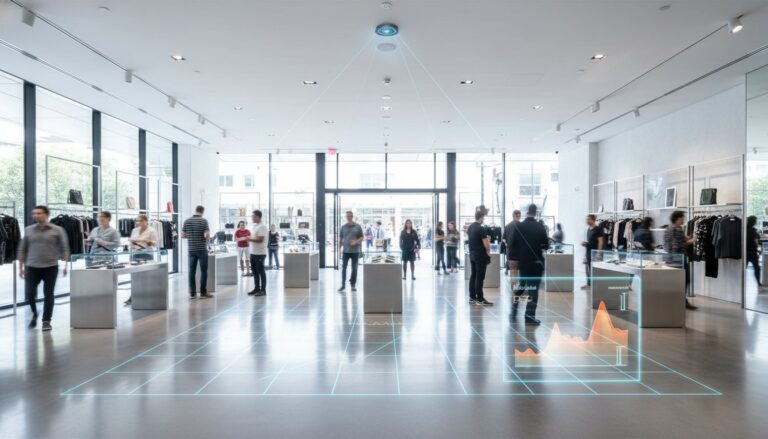
The retail sector in Australia is undergoing a fundamental shift in how physical space is measured. By 2026, the reliance on simple door counts has vanished, replaced by a need for granular insights into customer behavior. This australian retail people counter buyer’s guide addresses the growing gap between retailers using legacy hardware and those leveraging high-accuracy AI systems. Rising national labor costs have made precision-based staff scheduling a survival tactic rather than an optional optimization. You can’t afford to base rosters on intuition when data provides a definitive roadmap for workforce allocation.
Legacy infrared and thermal counters frequently fail to meet the 98% accuracy standard required for modern operations. These older systems struggle with wide Australian storefronts and varying light conditions, often double-counting groups or missing individuals entirely. As hybrid retail models continue to evolve, with 50% of consumers purchasing smaller items online while visiting stores for larger goods, the role of the physical store has changed. It’s now a touchpoint for brand experience and high-value conversions. This requires a deeper understanding of how people move through the space.
Defining Modern People Counting Systems
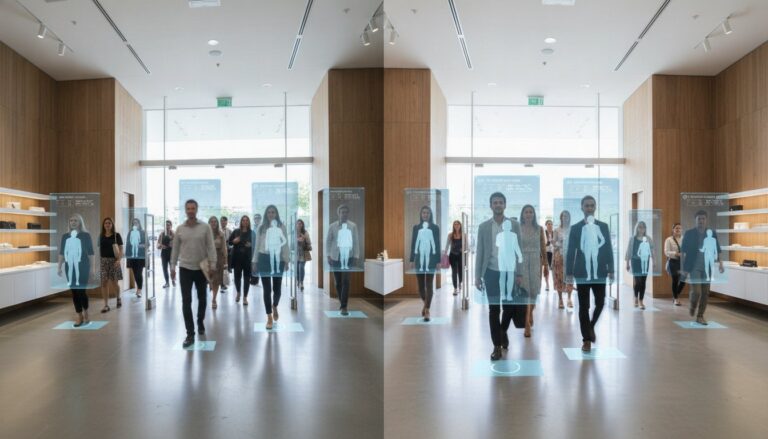
Modern people counting technology has transitioned from isolated sensors into integrated business intelligence hubs. These systems use AI to distinguish between staff members, children, and shopping groups, ensuring that your data reflects actual buying intent. Footfall Intelligence is the intersection of traffic and transaction data. By utilizing hardware like the FootfallCam Pro2, retailers can filter out non-customer traffic, providing a clean dataset for the FootfallCam V9 Software to analyze.
The Strategic Value of Traffic Data
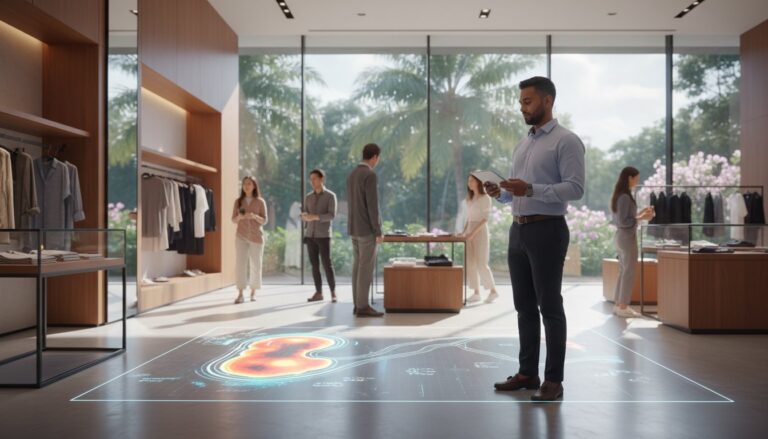
Moving from gut feel to empirical evidence allows national store managers to make confident decisions about their property portfolios. Traffic data serves as the primary validator for marketing spend, showing exactly how national campaigns translate into physical visits. Accurate data reveals the narrative of movement within your store.
- Identify peak traffic hours to optimize staff rosters and reduce labor waste.
- Measure the direct link between dwell time and sales conversion rates.
- Evaluate store layout effectiveness by tracking customer flow and engagement zones.
- Validate the ROI of window displays and local marketing activations.
For those still using outdated hardware, a Legacy Swap Out Plan offers a structured path to upgrade. This ensures that every store in a national network operates on the same high-accuracy foundation. It makes cross-location comparisons valid and actionable. Decisions become backed by logic rather than guesswork.
Key Benchmarks: How to Evaluate the Best People Counters
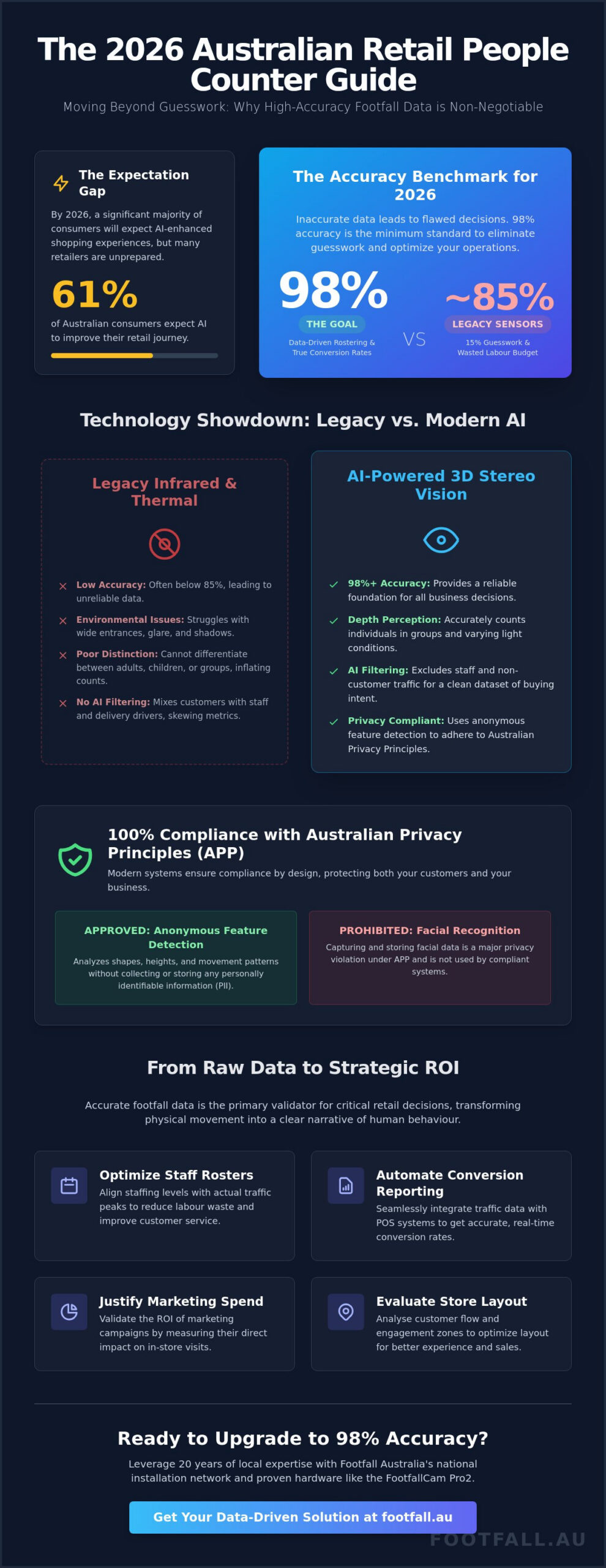
Accuracy is not a vanity metric. It is the technical foundation of your return on investment. If a system provides 85% accuracy, a retailer managing a million-dollar labor budget is essentially making decisions based on fifteen percent guesswork. This australian retail people counter buyer’s guide defines 98% counting accuracy as the minimum acceptable standard for 2026. Data below this threshold leads to skewed conversion rates and inefficient rostering, which directly impacts your bottom line.
Environmental adaptability is another critical benchmark. Australian retail environments often feature wide, open storefronts and high levels of natural glare from large windows. Legacy sensors often struggle with these conditions, leading to undercounts during peak daylight hours. High-performance systems must demonstrate the ability to maintain precision regardless of shadows or intense lighting. Integration with your existing national POS and ERP systems ensures that traffic data doesn’t sit in a silo. True operational efficiency occurs when you can view footfall alongside real-time sales performance. For retailers managing multiple sites, the ability to centralise traffic analytics across a national network is a non-negotiable requirement.
Hardware Precision and AI Filtering
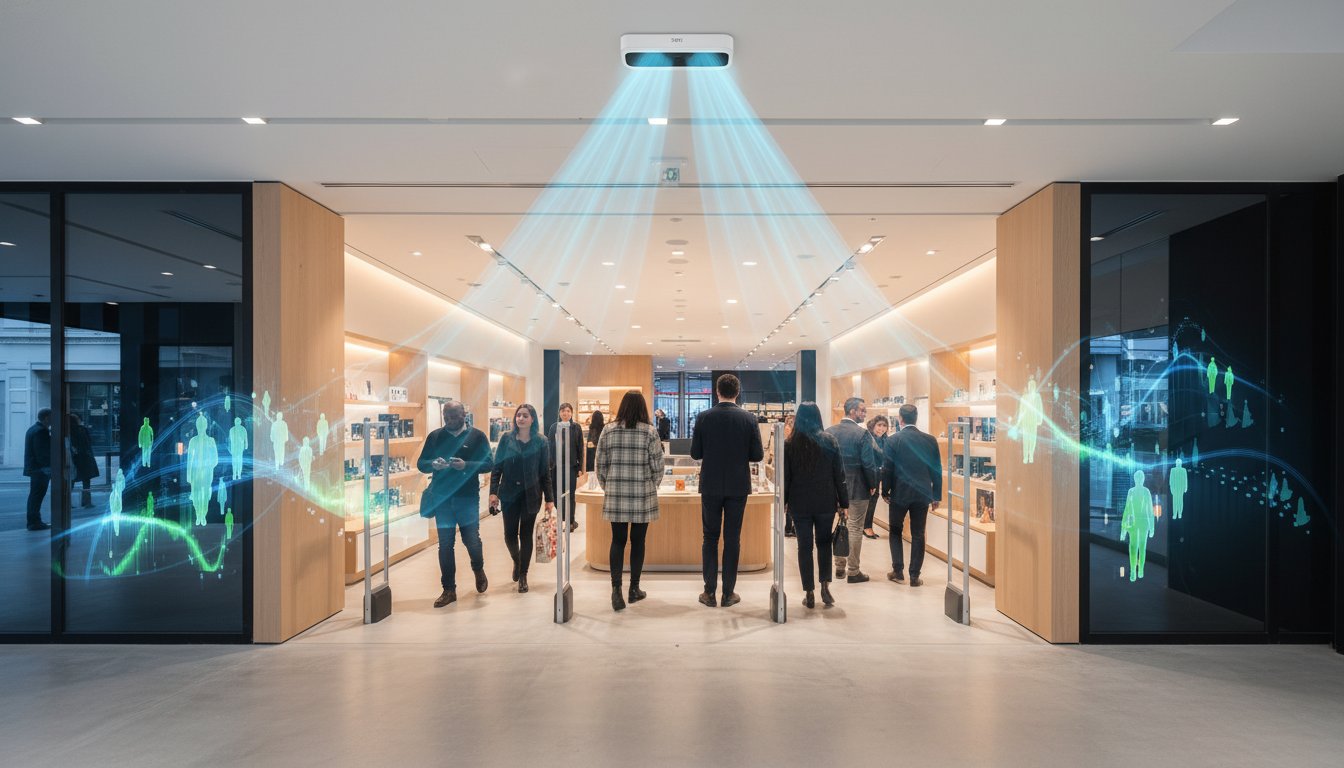
The transition to 3D Stereo Vision hardware, such as the FootfallCam Pro2, is essential for modern depth perception. This technology allows the system to distinguish between a single customer and a shopping group, preventing the artificial inflation of visitor numbers. Advanced AI filtering is equally important for maintaining data integrity. Your system should automatically exclude security personnel, mall walkers, and store staff from the final customer count. By focusing only on genuine buying intent, your conversion metrics remain untainted by non-commercial movement.
Software and Analytics Dashboards
Data is only valuable if it is accessible and actionable. The FootfallCam V9 Software provides a sophisticated yet intuitive interface designed for both store managers and national directors. Automated reporting should deliver daily, weekly, and monthly performance snapshots directly to your inbox, removing the need for manual data extraction. Mobile accessibility ensures that operations managers can maintain oversight of national retail activities from any location. When evaluating hardware, ensure it aligns with the Australian Privacy Principles to protect both your brand and your customers’ data. These benchmarks ensure that the technology you deploy today remains a strategic asset for years to come.
The Top People Counting Technologies for 2026
The technological landscape for retail analytics is rapidly consolidating around high-fidelity visual data. While entry-level solutions like infrared (IR) beams and thermal sensors once dominated the market, they’ve largely been relegated to low-traffic environments where precision isn’t critical. In professional retail settings, these legacy systems struggle with ghosting effects and an inability to distinguish between humans and inanimate objects. This australian retail people counter buyer’s guide identifies AI-powered 3D Stereo Vision as the current industry benchmark, offering a superior balance of cost-efficiency and operational accuracy for national rollouts.
Choosing the right hardware requires a clear understanding of Time-of-Flight (ToF) versus 3D Stereo Vision. ToF sensors measure the time light takes to bounce off objects, which works well in dark environments but often lacks the resolution needed for complex customer behavior analysis. Conversely, 3D Stereo Vision utilizes dual lenses to mimic human depth perception, providing the clarity required to filter out non-customer traffic in real-time. This precision is vital for maintaining compliance with the Australian Privacy Principles, as these systems process movement patterns without storing personally identifiable information. Finding the sweet spot for a national rollout involves prioritizing sensors that offer edge-processing, reducing the load on your store’s network while maintaining 98% accuracy.
AI Video Analytics and 3D Stereo Vision
3D sensors provide a level of spatial awareness that single-lens cameras simply can’t match. By creating a three-dimensional map of the entrance, these units accurately track individuals even in dense crowds. The use of Power over Ethernet (PoE) simplifies national installations by using a single cable for both power and data, reducing the technical overhead for facility managers. AI Video Analytics represents the most future-proof investment in 2026 because it allows for software-based feature updates that extend the hardware’s lifecycle as behavioral trends shift.
Leveraging Existing Infrastructure with AI
For retailers with significant investments in standard CCTV, the FootfallCam Centroid offers a strategic middle ground. This AI box connects to existing IP cameras, converting raw video feeds into high-accuracy counting data through server-side processing. While this hybrid approach saves on initial hardware costs at legacy sites, it may require more robust local network bandwidth compared to dedicated edge-processing units. You can explore a deeper technical breakdown of these systems in our guide to people counting technology. Balancing the immediate savings of hybrid systems against the long-term reliability of dedicated 3D sensors is the key to a successful national deployment.
Australian Privacy Principles (APP) & Data Compliance
Privacy compliance isn’t just a legal obligation; it’s a foundation of customer trust. In the Australian retail market, the 13 Australian Privacy Principles (APP) govern how private sector organizations with an annual turnover exceeding $3 million must handle personal data. This australian retail people counter buyer’s guide prioritizes systems that ensure your operations remain fully compliant by design. The primary objective is to collect actionable traffic insights without ever capturing or storing Personally Identifiable Information (PII).
Distinguishing between facial recognition and anonymous feature detection is vital for regulatory alignment. Facial recognition, which identifies specific individuals, is often prohibited in general retail environments without explicit, informed consent. In contrast, professional people counters utilize anonymous vector tracking. These systems identify a human shape as a mathematical coordinate rather than a visual identity. This approach allows you to understand customer flow and dwell time while respecting the anonymity of every visitor who enters your store.
Data sovereignty is another critical factor for national retailers. You must know exactly where your traffic data is stored and processed. High-quality systems often utilize local cloud instances or on-site servers to ensure data doesn’t cross international borders unnecessarily. Transparency remains a core requirement of the APPs. Best practices involve clear in-store signage at entry points, informing customers that anonymous traffic sensing is in use for operational optimization. If you’re unsure about your current compliance status, you can request a privacy assessment to ensure your hardware meets national standards.
APP Alignment for Video Analytics
Modern sensors like the FootfallCam Pro2 utilize edge processing to maintain total privacy. This means the raw video feed is processed directly on the device; it’s converted into anonymous data strings before it ever hits your network. The actual images never leave the sensor. According to the 2026 OAIC guidelines for retail surveillance, this localized processing is the preferred method for minimizing privacy risks. By using anonymous vector tracking, the system can distinguish between staff and customers based on movement patterns and height without ever needing to see a face.
Cybersecurity for National Retailers
Managing a multi-site retail network requires robust encrypted data transmission protocols. All traffic data sent from your stores to the FootfallCam V9 Software should be protected by industry-standard SSL/TLS encryption. This prevents unauthorized interception of your commercial intelligence. Within the software, role-based access levels allow you to control who can view specific data sets, ensuring that store managers only see their own metrics while national directors maintain a bird’s-eye view. Regular firmware updates are essential for maintaining this security perimeter, protecting your hardware from emerging vulnerabilities and ensuring the long-term integrity of your national retail network.
Implementing the Best Solution with Footfall Australia
Choosing the right hardware is only the first step in a successful digital transformation. Footfall Australia’s 20-year history provides a level of reliability that few can match in the national retail landscape. We understand that a counting system is a long-term infrastructure investment. This australian retail people counter buyer’s guide emphasizes the need for a partner that offers more than just a box of sensors. You require a strategic collaborator that manages everything from the initial site survey to the ongoing refinement of your data streams.
Our national installation coverage ensures that multi-site retailers receive consistent service quality throughout Australia. We leverage an established network of local partners who understand the specific technical requirements of Australian commercial environments. This structural scale allows us to handle complex rollouts across hundreds of locations while maintaining the precision required for high-stakes decision-making. By consolidating your traffic analytics under one provider, you eliminate the data silos that often plague fragmented retail networks.
The Footfall Australia Advantage
Working with us grants you direct access to proprietary FootfallCam Pro2 technology and the sophisticated FootfallCam V9 Software. We don’t just install hardware; we provide the ecosystem necessary for sustained growth. Our Premium and Basic Support Plans ensure your data integrity remains high through regular system health checks and remote calibration. For retailers currently struggling with inaccurate, older sensors, our Legacy Swap Out Plan provides a cost-effective pathway to modernize your fleet without the typical hurdles of a full-scale replacement. We focus on the utility of information, ensuring every metric leads to a positive operational change.
Strategic support is what separates a simple door counter from a business intelligence tool. Once your hardware is active, our team helps you transition from basic monitoring to advanced footfall data analysis. This process transforms raw movement into a narrative of human behavior, allowing you to identify exactly where your conversion opportunities lie. Our people counting systems Australia framework is designed specifically to drive ROI by linking traffic volume to your existing sales performance indicators.
Next Steps for Your Retail Business
The path to 98% counting accuracy begins with a thorough understanding of your store’s physical constraints. You can book a national site audit and infrastructure check to determine the optimal sensor placement for your specific ceiling heights and entrance widths. This technical assessment ensures that your 2026 strategy is built on a foundation of empirical evidence. We’ll help you customize your analytics dashboard to reflect your specific retail KPIs, ensuring that national directors and store managers alike have the insights they need at their fingertips.
Don’t leave your traffic data to chance. Consult with our experts for a tailored counting solution that aligns with your operational goals and ensures total APP compliance across your entire network.
Optimising Your National Retail Strategy for 2026
Success in the modern retail environment depends on the transition from intuitive management to empirical, data-driven logic. This australian retail people counter buyer’s guide has outlined the essential framework for selecting a system that balances high-fidelity 98% accuracy with total Australian Privacy Principles compliance. By moving beyond legacy sensors and adopting 3D Stereo Vision technology, you ensure that every rostered hour and marketing dollar is backed by verifiable movement patterns rather than guesswork.
Footfall Australia has been serving national retailers since 2004, providing the technical expertise required to navigate shifting behavioral trends. We prioritize the utility of information, ensuring that your traffic data integrates seamlessly with your existing infrastructure to drive measurable growth. It’s time to transform your physical storefronts into high-performance, observable environments. Get a Custom Quote for Your National Retail Footprint and take the first step toward a more efficient, evidence-based operation. Your future strategy is only as strong as the data that supports it.
Frequently Asked Questions
What is the most accurate people counter for retail in 2026?
3D Stereo Vision sensors, specifically units like the FootfallCam Pro2, are the industry benchmark for accuracy in 2026. These devices utilize dual-lens technology to create a detailed depth map of the environment, achieving a verified accuracy rate of 98% or higher. This level of precision is a core recommendation in our australian retail people counter buyer’s guide, as it effectively filters out inanimate objects and non-customer traffic that often skew data in older systems.
How do people counters comply with Australian Privacy Principles (APP)?
Compliance is maintained through anonymous vector tracking and edge-based processing. Modern sensors convert human movement into mathematical coordinates directly on the hardware, ensuring that identifiable images or raw video never leave the device. This methodology aligns with the 13 APPs by ensuring no Personally Identifiable Information (PII) is collected or stored, allowing retailers to gather behavioral analytics while respecting total visitor anonymity.
Can people counters distinguish between staff and customers?
Yes, advanced systems use AI filtering and specialized exclusion protocols to separate staff from genuine customer traffic. This is typically achieved through height-based filtering or the use of exclusion tags that the sensor identifies and removes from the final count. By excluding security personnel and floor staff, the resulting data provides a clean representation of buying intent, which is essential for calculating accurate conversion rates across a national store network.
Do people counters work in low-light retail environments?
Professional 3D sensors are designed to maintain high accuracy even in challenging lighting conditions. Unlike standard 2D cameras that rely on visual contrast, 3D Stereo Vision technology utilizes depth perception and infrared light to track movement in dim areas. This ensures that late-night trading hours or stores with atmospheric lighting still receive precise footfall data without requiring additional high-intensity light sources at the entrance.
What is the difference between 2D and 3D people counting sensors?
2D sensors use a single lens to capture flat images, making them susceptible to errors caused by shadows, floor patterns, or people walking closely together. 3D sensors utilize binocular vision to perceive depth, allowing the system to accurately separate individuals within a dense crowd. This australian retail people counter buyer’s guide recommends 3D technology for any professional retail environment where the goal is to achieve the 98% accuracy threshold required for reliable staff scheduling.
How much does a professional people counting system cost in Australia?
The total investment for a professional system depends on the number of entrances, ceiling heights, and the complexity of the required data integration. While there are various hardware options available in the Australian market, national retailers typically prioritize comprehensive packages that include high-accuracy sensors, analytics software, and structured support plans. You should evaluate the long-term ROI generated by labor optimization and improved conversion rates when considering your budget.
Can I integrate my people counter with my POS system?
Integration is a standard feature of modern analytics platforms like the FootfallCam V9 Software. By syncing your traffic data with sales figures from your point-of-sale system, you can automatically generate conversion rate reports for every store location. This allows national directors to identify high-performing sites and those that require additional operational support, turning raw visitor numbers into actionable commercial intelligence.
Is it possible to use existing CCTV cameras for people counting?
You can leverage existing IP camera infrastructure by connecting them to an AI processing unit like the FootfallCam Centroid. This device applies advanced counting algorithms to your current video feeds, providing a strategic way to upgrade legacy sites. While dedicated 3D sensors offer the highest precision, this hybrid approach allows for a faster national rollout while still delivering significantly better data than traditional infrared beam counters.