Improving Customer Experience with Footfall Data: A 2026 Strategic Guide
If you’re still relying on gut instinct to determine your staff rosters or store layout, you’re likely ignoring the most valuable narrative in your business: the physical movement of your customers. It’s a common frustration for Australian retailers to see high labour costs climb while “dead zones” on the floor remain undiagnosed, making it nearly impossible to prove the ROI of a premium window display. You know that your space has more potential, but without a clear map of human behaviour, you’re essentially flying blind.
The path to improving customer experience with footfall data lies in shifting from simple counting to deep flow analysis. By mastering the science of customer movement, you can eliminate friction points and optimise staff-to-customer ratios with quiet confidence. This guide provides a strategic framework for 2026, showing you how to transform raw traffic data into a data-backed floor plan and a superior retail environment. We’ll examine how modern tools like FootfallCam V9 software turn complex technical metrics into intuitive, actionable reports that empower your management decisions through empirical evidence.
Key Takeaways
- Transition from basic entry counting to multidimensional spatial analysis to capture the full narrative of how visitors interact with your physical space.
- Deploy advanced 3D stereoscopic technology to secure high-accuracy metrics and real-time heat mapping, even in high-traffic retail environments.
- Master the art of improving customer experience with footfall data by identifying underperforming “cold zones” and validating layout changes through empirical A/B testing.
- Synchronise staff-to-customer ratios with real-time demand to eliminate service friction and prevent revenue loss from excessive queue lengths.
- Scale your insights across multiple locations using a structured five-step national roadmap designed for data integrity and long-term operational growth.
Defining Retail Traffic Flow Analysis: Beyond Basic Footfall
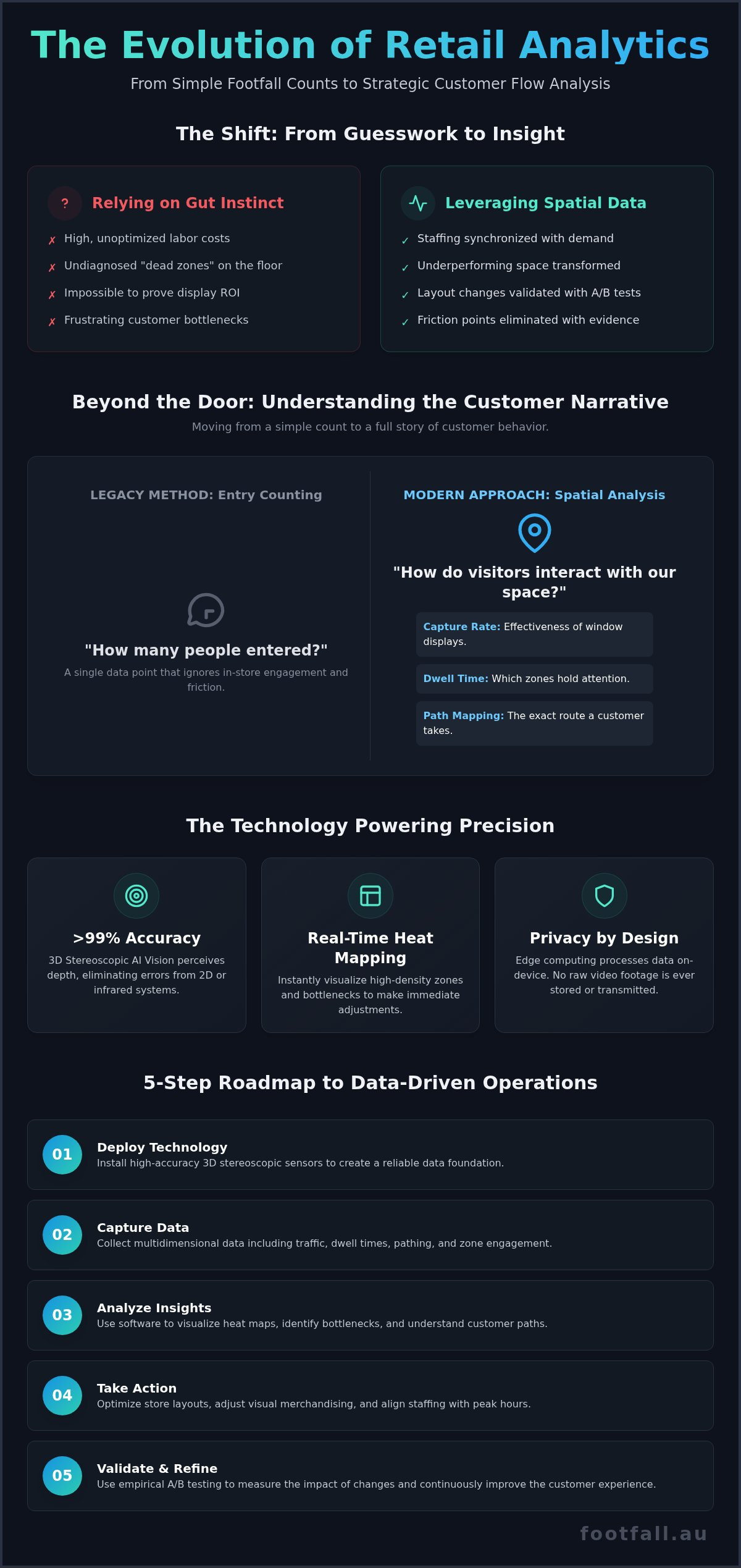
Many retailers confuse occupancy with engagement. A door count tells you how many people entered your store, but it says nothing about the friction they encountered or the displays they ignored. Spatial analysis is the multidimensional study of how visitors navigate your floor plan, turning physical presence into a sequence of interpreted actions. In the competitive Australian retail market of 2026, relying on entry data alone is like reading the first page of a book and claiming to know the ending. Improving customer experience with footfall data requires a transition from binary counting to a nuanced understanding of the human narrative.
This narrative is built on specific metrics that go beyond the front door. Capture rate measures how effectively your window displays draw people in, while dwell time identifies which zones actually hold their attention. Path-to-purchase mapping allows you to see the exact route a customer takes, highlighting whether they followed your intended journey or were diverted by a layout flaw. By treating movement as data, you can replace managerial guesswork with empirical evidence that leads to specific, positive changes in operations.
The Evolution of Spatial Analytics
The industry has moved far beyond the era of simple infrared beams that often double-counted groups or missed children. Modern people counting systems in Australia now utilise 3D stereoscopic AI vision, such as the FootfallCam Pro2, to achieve accuracy levels exceeding 99%. This technological leap is essential for businesses looking to transition from basic monitoring to sophisticated flow analysis. While earlier people counting technology focused primarily on security and occupancy, today’s systems are designed to optimise profitability. Using the FootfallCam V9 software, retailers can now visualise high-density zones in real-time, allowing for immediate adjustments to the customer environment rather than waiting for end-of-month reports.
Why Intuition Fails in High-Stakes Retail
The fallacy of the “gut feeling” is one of the most expensive risks in retail management. A manager might perceive a specific aisle as successful because it always seems crowded, but data often reveals a different story. High density without movement usually indicates an invisible bottleneck, a point of frustration where customers are stuck rather than shopping. These “dead zones” in premium retail real estate represent significant lost revenue. When you use empirical evidence to identify these areas, you can transform underutilised space into high-value touchpoints. Improving customer experience with footfall data ensures that every square metre of your floor plan serves a purpose, backed by the reality of how your customers actually behave.
The Technology Powering Modern Traffic Mapping
Precision in spatial analysis is no longer a luxury reserved for global flagships. It’s a technical requirement for any Australian business serious about improving customer experience with footfall data. While basic sensors might provide a rough estimate of traffic, modern traffic mapping relies on 3D stereoscopic vision to differentiate between adults, children, and even shopping trolleys. The FootfallCam Pro2 achieves accuracy levels above 99% by using two lenses to perceive depth, effectively eliminating the errors common in 2D video analytics or Wi-Fi tracking.
Choosing the right data source is a strategic decision. Wi-Fi tracking offers insights into repeat visits but lacks the spatial precision of video analytics. Conversely, AI-driven heat mapping provides a real-time visualisation of high-density zones, allowing managers to see exactly where customers linger. This level of detail is vital for identifying bottlenecks before they lead to walk-aways. As highlighted in a Harvard Business School case study on Nordstrom, leveraging this deluge of data creates a measurable competitive advantage in workforce management and service quality.
FootfallCam Pro2: The Industry Standard for Flow Data
The hardware behind these insights must be both powerful and discreet. The FootfallCam Pro2 utilises edge computing, meaning all data processing happens on the device itself. This approach ensures high-speed reporting and reinforces a privacy-by-design philosophy, as no raw video footage leaves the unit. It’s fully compliant with both GDPR and Australian privacy regulations, providing peace of mind in an era of increasing data scrutiny. For those evaluating their specific needs, consulting the FootfallCam Pro2 buying guide can help determine the optimal placement for maximum coverage and reliability in high-traffic environments.
Integrating Existing Infrastructure with Centroid
Upgrading your analytical capabilities doesn’t always require a complete hardware overhaul. FootfallCam Centroid allows businesses to repurpose existing CCTV networks for sophisticated flow analysis by applying AI processing to standard video streams. This is often the most efficient route for large-scale environments like shopping centres or multi-level department stores. If you are currently working with older, less accurate hardware, the Legacy Swap Out Plan offers a structured path to modernise your system without redundant costs. All data, whether from new Pro2 units or repurposed cameras, is centralised within the FootfallCam V9 Software, providing a single source of truth for your operational strategy. To see how these systems can work for your specific floor plan, you might consider exploring our range of integrated hardware solutions.
Optimising Store Layout and Visual Merchandising
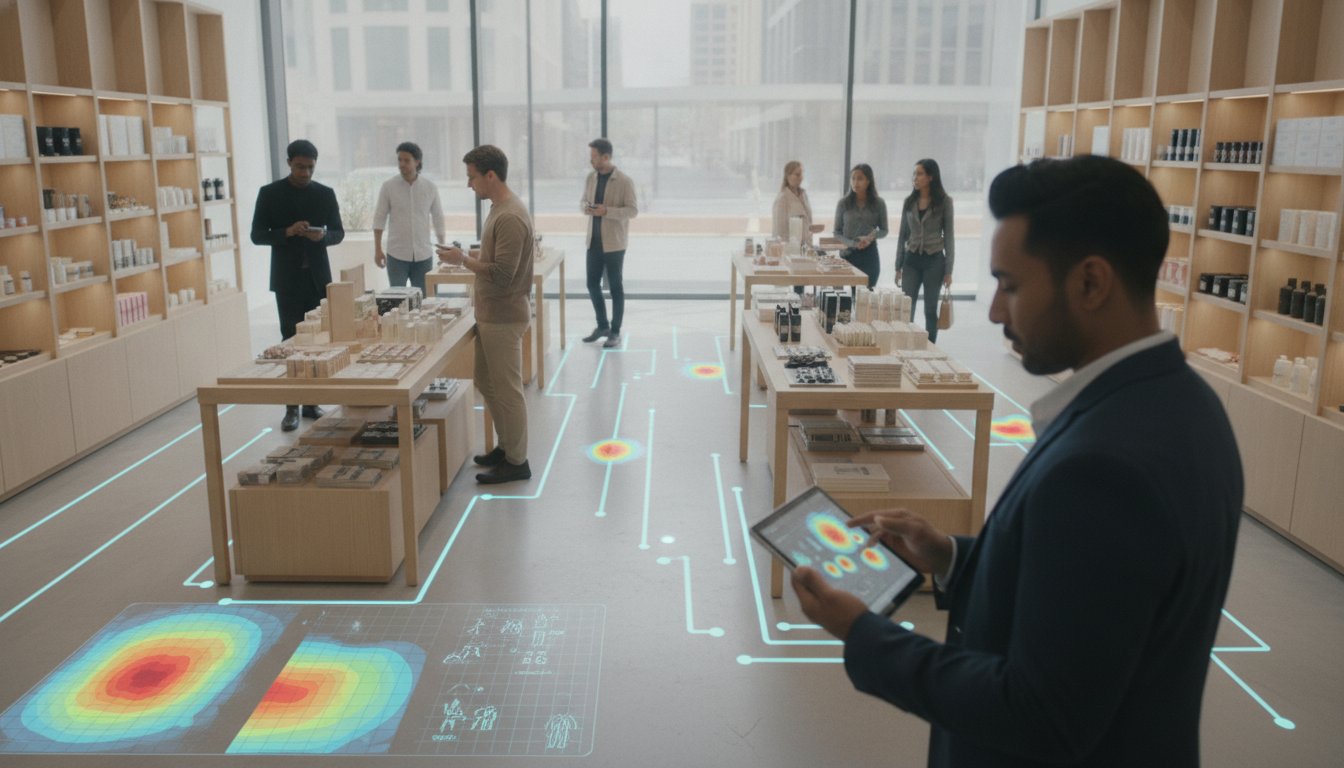
Transforming a floor plan from a static design into a dynamic conversion engine requires a fundamental shift in perspective. In a modern retail environment, layout is no longer just about aesthetics; it’s a data science. By improving customer experience with footfall data, you can identify the “Hot Spots” where engagement is highest and the “Cold Zones” where traffic consistently drops off. These insights allow for the strategic reconfiguration of shelving and displays to ensure that every square metre of your premium floor space contributes to your bottom line.
Retailers often focus on the “Power Aisle”, the primary path most customers naturally follow. Without empirical tracking, it’s easy to misplace high-margin products in areas with low dwell time. Using flow analysis, you can A/B test store layouts with the same precision as a digital storefront. By changing a single variable, such as the orientation of a display or the width of an aisle, and measuring the delta in customer movement, you gain clear evidence of what actually influences shopper behaviour. This iterative process turns your store into a living laboratory where decisions are backed by the reality of human movement.
Visual Merchandising ROI
Quantifying the impact of a window display or an expensive end-cap shouldn’t be a guessing game. By utilising retail footfall analysis Australia, businesses can calculate the specific “Capture Rate”. This metric reveals the percentage of passersby who are successfully drawn into the store by your visual cues. If a display has a high dwell time but low conversion, it suggests the friction might lie in pricing or product accessibility. You can then adjust lighting, signage, or even staff placement based on where customers’ gaze and movement patterns are concentrated, ensuring your merchandising budget is spent on proven winners.
Removing Friction from the Customer Journey
The first few metres of a store, often called the “decompression zone”, are critical for setting the tone of the visit. Flooding this area with complex displays frequently creates a mental bottleneck that overwhelms the customer. Improving customer experience with footfall data helps you identify these invisible points of resistance. When you clear these physical and psychological obstacles, the flow leads naturally toward the point of sale. Monitoring how customers navigate around structural pillars or tight corners allows you to eliminate the “dead zones” that frustrate shoppers, creating a seamless path that encourages longer visits and higher basket values. For those whose mobility or foot comfort might be a barrier to enjoying these spaces, you can check out Active Footcare for professional podiatry support.
Operational Efficiency: Staffing and Queue Management
In Australia, where labour costs are among the highest in the world, inefficient staffing isn’t just a minor oversight; it’s a direct threat to your bottom line. Managing a retail floor requires more than a standard roster that ignores the peaks and troughs of actual visitor flow. Improving customer experience with footfall data allows you to align your most expensive resource-your people-with the moments they’re needed most. By calculating the ideal staff-to-customer ratio based on historical and real-time movement, you ensure that service quality remains high without overspending on underutilised hours.
Predictive analytics play a vital role here, especially when preparing for national seasonal peaks like the Boxing Day sales or Black Friday. Instead of guessing how many casual staff to hire, you can use multi-year data trends to forecast exactly when the surges will hit. This foresight allows for a leaner, more responsive operational model that scales with demand, ensuring you’re never caught understaffed during a high-conversion window. Similar seasonal pressures are felt in the horticulture sector, where growers and labour hire providers utilize Fair Farms to access specialized HR support and ensure their workforce remains compliant during high-demand periods.
The ROI of Staff Optimisation
Wage wastage occurs during “dead hours” when staff numbers exceed the actual visitor count. Conversely, revenue is lost during surges when high-value customers can’t find assistance and leave empty-handed. Reliable data is the foundation of this balance. Investing in professional people counter support ensures that your sensors stay calibrated and your staffing decisions remain grounded in accurate figures. This empirical approach replaces intuition with quiet confidence, allowing you to prove the direct link between staff presence and conversion rates.
Queue Management Strategies
The final stage of the customer journey is often where the most friction occurs. Long queues are the primary driver of “walk-aways,” where a customer has already selected a product but abandons the purchase due to perceived wait times. Real-time monitoring enables automated alerts that notify managers to open a new checkout before the queue becomes a deterrent. Analysing these abandonment rates provides a clear picture of lost opportunities. Improving the “Last Impression” of the experience ensures that the effort spent drawing a customer into the store isn’t wasted at the point of sale. To start optimising your rosters with precision, explore our integrated staffing and queue management solutions.
Implementing a National Traffic Flow Strategy
Scaling spatial analytics from a single flagship to a national network requires a structured, repeatable framework. For multi-state retailers in Australia, the challenge isn’t just collecting numbers; it’s ensuring that every store, regardless of its specific location, follows the same data-driven logic. Improving customer experience with footfall data at this scale demands a unified approach to hardware deployment and reporting. A successful national rollout follows a rigorous five-step roadmap: site auditing, hardware standardisation with FootfallCam Pro2 units, professional calibration, software integration, and finally, regional manager training to turn insights into action.
Partnering with an established expert like Footfall Australia, which has been operational since 2004, provides the local infrastructure necessary for such a large-scale undertaking. National support ensures that technical issues don’t lead to data gaps that could skew your quarterly performance reviews. Choosing between a Basic or Premium Support Plan is a strategic decision based on your need for data integrity. The Premium plan offers proactive remote health checks, ensuring your sensors remain accurate without requiring constant manual oversight from store managers.
Data Integration and Business Intelligence
The true power of spatial analytics is realised when you move beyond isolated metrics. By syncing your flow data with Point-of-Sale (POS) systems, you can perform a true conversion analysis that accounts for every stage of the customer journey. The FootfallCam V9 dashboard facilitates this by providing a centralised view of national performance. This allows head office to identify why certain regions might be outperforming others despite similar foot traffic. Shifting from raw numbers to sophisticated footfall data analysis enables you to spot macro-trends in consumer behaviour, allowing for more agile inventory and marketing shifts across the country.
Long-term Maintenance and System Health
A national strategy is only as strong as its weakest sensor. Maintaining system health through regular remote audits is essential to prevent “data drift,” where environmental changes like new lighting or signage might affect sensor accuracy. As you look toward the future, the transition to predictive flow and AI-driven automation will become the standard for improving customer experience with footfall data. Upgrading from older technology through a Legacy Swap Out Plan ensures your business remains competitive as these advanced capabilities become operational. To ensure your network is prepared for the next generation of retail analytics, contact Footfall Australia for a comprehensive site assessment and start building your data-backed future today.
Future-Proofing Your Physical Environment with Precision
Transitioning to a data-backed operational model is no longer optional for competitive Australian retailers. By moving beyond binary entry counts to multidimensional spatial analysis, you gain the ability to eliminate physical bottlenecks and justify every merchandising decision through empirical evidence. This shift turns raw movement statistics into a strategic asset that directly influences your bottom line and operational efficiency. Improving customer experience with footfall data is fundamentally about removing the friction that exists between a visitor’s intent and their final purchase, ensuring your space works as hard as your team does.
Footfall Australia has been the nation’s trusted partner since 2004, providing proprietary AI-driven hardware and a comprehensive national support network to ensure your data remains accurate. Our expertise ensures technical issues don’t lead to data gaps, allowing you to navigate the complexities of 2026 retail with quiet confidence and technical superiority. Maximise your store’s potential with a Footfall Australia site assessment and transform your floor plan into a high-performance conversion engine. With the right analytical foundation, you can lead your organisation toward a future where every customer interaction is understood and perfectly optimised.
Frequently Asked Questions
How is retail traffic flow analysis different from just counting people?
Traffic flow analysis provides a multidimensional view of how visitors interact with your space, whereas basic counting only records entry and exit totals. By improving customer experience with footfall data, you can identify specific paths taken and zones ignored. This allows you to understand the “why” behind store performance rather than just the “how many,” turning movement into actionable strategy.
Can traffic flow analysis track individual customers throughout the store?
Modern systems track the sequence of movement as anonymous path data rather than identifying specific individuals. The technology focuses on human behavior patterns, such as dwell times and aisle navigation, to provide strategic insights. This approach ensures you gain a granular understanding of the customer journey without compromising the anonymity of your visitors.
Is the technology compliant with Australian privacy laws?
Yes, FootfallCam technology is designed to comply with Australian privacy regulations and global standards like GDPR. By using edge computing, all data processing occurs on the device itself, and no raw video footage is ever stored or transmitted. This privacy-by-design approach ensures that your operational insights are gathered in a fully compliant and ethical manner.
How does heat mapping help with visual merchandising?
Heat mapping provides a real-time visual representation of customer density across your floor plan, highlighting “hot spots” where engagement is highest. You can use these insights to validate the effectiveness of specific displays or lighting changes. If a high-margin product is located in a “cold zone,” heat mapping gives you the empirical evidence needed to justify a more strategic relocation.
Can I use my existing CCTV cameras for traffic flow analysis?
You can repurpose existing CCTV infrastructure by integrating it with the FootfallCam Centroid AI processor. This system applies advanced analytics to your standard video streams, turning traditional security cameras into sophisticated spatial sensors. It’s a highly efficient way to implement improving customer experience with footfall data across large environments without the need for a total hardware overhaul.
What is a ‘capture rate’ and why does it matter for my windows?
Capture rate is the ratio of people who enter your store compared to the total number of passersby detected outside. It’s a critical metric for measuring the ROI of your window displays and exterior marketing efforts. A low capture rate suggests that while your location has high traffic, your visual cues aren’t effectively converting that interest into physical store visits.
How much does it cost to implement a traffic flow system in Australia?
Implementation costs in Australia vary significantly based on the number of sites, the complexity of your floor plan, and whether you’re using new hardware or existing CCTV. Factors such as installation requirements and your choice between basic or premium support plans also influence the total investment. For an accurate quote tailored to your specific operational needs, a professional site assessment is the standard starting point.
What kind of ROI can I expect from staffing optimisation?
Staffing optimisation typically leads to a measurable reduction in wage wastage during low-traffic periods and an increase in conversion rates during surges. By aligning your rosters with empirical traffic patterns, you ensure that high-value customers receive immediate assistance. This balanced approach directly impacts profitability by preventing lost sales and reducing unnecessary operational overhead.